
BuddhistCatholicContemplativeEvangelicalGeneral ChristianHinduJewishLatter-day SaintMuslimNew VisionsProgressive Christian
Beliefs
- Buddhist
- Catholic
- Contemplative
- Evangelical
- General Christian
- Hindu
- Jewish
- Latter-day Saint
- More Voices
- Muslim
- New Visions
- Pagan
- Progressive Christian
Topics
- Religion News
- Food and Religion
- Sports and Religion
- Religious Art
- Religious Music and Entertainment
- Religious Events
- History and Religion
- Style and Religion
- Politics and Religion
- Women in Religion
- Recreation Outdoors and Religion
- Business Finance and Religion
- Careers Workplace and Religion
- Education and Religion
- Family Parenting and Religion
- Health Fitness and Religion
- Home and Religion
- Relationships and Religion
- Technology and Religion
- Travel and Religion
Columnists
- Buddhist Columnists
- Business Finance and Religion Columnists
- Careers Workplace and Religion Columnists
- Catholic Columnists
- Contemplative Columnists
- Education and Religion Columnists
- Evangelists Columnists
- Family Parenting and Religion Columnists
- General Christian Columnists
- Health Fitness and Religion Columnists
- Hindu Columnists
- History and Religion Columnists
- Home and Religion Columnists
- Jewish Columnists
- More Voices Columnists
- Latter Day Columnists
- Muslim Columnists
- New Visions Columnists
- Nonreligious Columnists
- Pagan Columnists
- Politics and Religion Columnists
- Progressive Columnists
- Recreation Outdoors and Religion Columnists
- Relationships and Religion Columnists
- Religion News Columnists
- Religious Art Columnists
- Religious Events Columnists
- Religious Music and Entertainment Columnists
- Sports and Religion Columnists
- Style and Religion Columnists
- Technology and Religion Columnists
- Travel and Religion Columnists
- Women in Religion Columnists
Resource Library
- 2026 Calendar
- Library of World Religions
- The 100 Most Holy Places on Earth
- Patheos Answers
- Podcasts
- Videos
- Faith Leaders Database
- Anglican Episcopalian
- Bahai
- Baptist
- Buddhism
- Christianity
- Confucianism
- Eastern Orthodoxy
- Hinduism
- Holiness and Pentecostal
- ISKCON
- Islam
- Judaism
- Lutheran
- Methodist
- The Church of Jesus Christ of Latter-day Saints
- New Age
- Paganism
- Presbytarian and Reformed
- Protestantism
- Religion Behind the Scenes
- Roman Catholic
- Scientology
- Shia Islam
- Sikhism
- Sufism
- Sunni Islam
- Taoism
- Zen
- See all religions
Research Tools
 Ad-Free & Subscriber Log-In Subscription Support
Ad-Free & Subscriber Log-In Subscription Support
Follow Patheos 

- Trending:
- Forgiveness
- |
- Marriage
- |
- Consciousness
- |
- Death Penalty
- |
- Election
- |
- Halloween

- Home
- Catholic
- Real Presence, or When is Jesus’ Presence Ever Not Real?
Real Presence, or When is Jesus’ Presence Ever Not Real?
Last updated on: April 15, 2023 at 6:32 am by Jack Hartjes
Real Presence, or When is Jesus’ Presence Ever Not Real? 2023-04-15T06:32:33-06:00 Jack Hartjes
Patheos Explore the world's faith through different perspectives on religion and spirituality! Patheos has the views of the prevalent religions and spiritualities of the world.
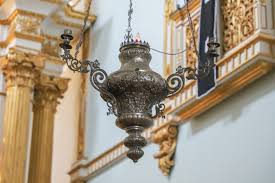
Can the sanctuary lamp honor Jesus’ real presence in the world as well as in the tabernacle?
Celebrations of Grace: The Sacraments of the Catholic Church, Part 10
I was walking through the vestibule of a local Lutheran church and peering into the sanctuary. (The word “sanctuary” means interestingly different things for Lutherans and Catholics; but see below for that.) As I was saying, I was walking, along with the church’s pastor, and peering, and I noticed a lighted sanctuary lamp. In Catholic churches that lamp signals the real presence of Christ in the tabernacle. I wondered what it meant in this Lutheran church. Lutherans don’t reserve Eucharistic elements, consecrated hosts, in a special place between liturgies.
I asked the pastor why that lamp was lit. He informed me—like I should have known—that it means God is present there. But I persisted, noting the difference in Catholic and Lutheran practice and belief. Those beliefs are not as different as I was taught ages ago. Lutherans have assured me that Jesus is really, not just symbolically, present in the Eucharistic celebration. We differ in that Catholics believe – and Lutherans do not – that Jesus’ presence continues in any Eucharistic elements that remain after the communion rite. The Lutheran pastor answered simply, “God is present everywhere.”
The sanctuary
That answer wasn’t immediately helpful, but it got me thinking about real presence. If God really is present everywhere, shouldn’t we have sanctuary lamps all over the place? Of course, that’s impossible. I suppose having one lamp perpetually lit in this one special place may be the Lutheran way of holding in mind and honoring God’s real presence everywhere else.
I went back to that Lutheran church to get another view of the sanctuary lamp. Without a tabernacle nearby, it seemed to be shining for the space where people gather. The Lutheran term for that whole space is “sanctuary.” Catholics call “sanctuary” the smaller space where the altar and tabernacle sit and the liturgical ministers perform their tasks. We call the space for the assembly of the people the “nave.” Such a plain term for such an important space! If my argument below has merit, we could adopt the Lutheran usage and be clearer about what real presence is.
Real presence
With the practice of reserving hosts in a tabernacle, Catholics have a concrete way of relating to different kinds of presence. But it’s a bit puzzling. We believe in a real presence of Jesus in that one special place and also in a presence that we don’t usually call real everywhere else.
The opposite of real is imaginary, but Jesus’ presence in the stranger and in the sunset surely isn’t imaginary or even merely symbolic. (Ironically, there seem to be a lot of Catholics who think Jesus’ presence in the Eucharist is merely symbolic.) We need some different vocabulary as an alternative to “real,” “imaginary,” and “symbolic.”
The Body of Christ
Or some older vocabulary. William T. Cavanaugh (see this post) explains a switch in the way Catholics have spoken of the Body of Christ in the Church and in the Eucharist. Following Paul, the Church has always thought of her members as parts of the Body of Christ. On the same theme Pope Pius XII wrote the encyclical “The Mystical Body of Christ” my early favorite image of the Church. But Paul didn’t use the term “mystical.” “Mystical Body,” in Church history, originally referred to the Body of Christ in the Eucharist! How did we get from Eucharistic “Mystical Body” to Eucharistic “Real Presence”?
According to Henri de Lubac’s research, which Cavanaugh follows, in the 12th century the Eucharist became “Corpus Verum,” the True Body of Christ. Then Catholics needed a new term for the Church, and “mystical” was newly available. The Church became the “Mystical Body of Christ.”
The Church has a visible, institutional body, of course. At least as my young self imagined it, there had to be something else there—hidden, invisible, interior—the mystical body of Christ. And I loved that image from Pius XII’s encyclical.
Cavanaugh advocates going back to the original usage. The Church, with its people and their visible structure, practices, doctrines, is Christ’s True Body in the world. Jesus is not there like a reality over, under, or inside the visible forms that we see. True bodies are those visible things. But in the Eucharist we do describe Jesus’ presence as in or under the forms of bread and wine and in the sharing of a meal. That’s the kind of presence that a mystical body would have. We just might want to begin saying, once again, the Eucharist is the Mystical Body of Christ.
Levels of realness
The presence of Christ in the Eucharist is real, as real as God’s mysterious activity. But Catholic piety sometimes pays more attention to the physical elements of the Eucharist, especially the consecrated host, than to the Eucharist as an action of the Church with Christ. (The Blessed Sacrament and its cult, or worship, will be the subject of a later post.) So when we think of real presence, we imagine Jesus being present in the same way as a physical thing is present. Before it was bread standing before us. Now it’s Jesus, hidden, but standing before us just as the bread was doing before. That’s a real presence, alright, but is it real enough for the Eucharist?
One of the things I love about the Catholic Church is the positive attention she pays to the world of matter. This world is not a place to get through on our way to somewhere else. It’s a creation that God loves for its own sake. It praises God in its own unique way, and it enters into the Church’s praises, especially in the sacraments. But it’s a created world, not a self-standing one. It owes its reality to Another. That, in fact, is its glory, but it’s a glory that it must attribute to God. God is the “really real,” who has reality naturally, not by gift.
Catholic theology speaks of uncreated grace, grace that is identical with the uncreated God. The grace of the Eucharist, as of all the sacraments, is like that. So when we celebrate a sacrament, we are in the presence of the One who is more real than we can imagine, the source of all reality.
Mystical presence
I don’t think we can immediately dispense with the phrase “real presence” of Christ in the Eucharist. But we should be clear that “real presence” also applies to Jesus in the poor, in the People of God, in nature. We should begin to imagine the sanctuary lamp shining to honor that presence in the world, a world to which Jesus in the form of bread wants to go as viaticum and food for the sick.
I suggest two vocabulary changes. We could begin referring to Jesus’ “mystical presence” in the sacraments—a super-real kind of presence. We could also upgrade what we call the nave to the status of sanctuary, holy place. Let the sanctuary lamp’s light shine out from the tabernacle to the entire gathering place of the holy People of God. Let the people imagine the light of the sanctuary going on and on to the farthest reaches of God’s real presence in the world.
Image credit: Wikimedia Commons via Google Images
Previous Post

July 31, 2019
Grace in a World of Grace: The Symbiosis of Sacraments and Life
Next Post
August 5, 2019 The Story of a Journey of Much More than Souls
Browse Our Archives
Select a Category Advent Christmas Amazon Synod Angels Being Consumed Bible Catholic Modern Creed Ecology Economics Elizabeth Johnson Eucharist Fragments and Filaments Gender and Sex Gospel of Mark Herzog Historical Jesus Liturgy Luke Opening Scriptures on Way to Emmaus Ordinary radicals Parables Pro-Life Reincarnation Rosary Sacraments science Social Justice Souls Stories of Jesus The Creed Torture and Eucharist Tracy Uncategorized War and Peace
Select a Month October 2026 June 2025 April 2025 March 2025 February 2025 January 2025 November 2024 July 2024 March 2024 December 2023 October 2023 September 2023 August 2023 May 2023 April 2023 March 2023 February 2023 January 2023 December 2022 November 2022 October 2022 September 2022 August 2022 July 2022 June 2022 April 2022 March 2022 February 2022 January 2022 December 2021 November 2021 October 2021 August 2021 July 2021 June 2021 April 2021 March 2021 February 2021 December 2020 November 2020 October 2020 August 2020 July 2020 June 2020 May 2020 April 2020 March 2020 February 2020 January 2020 December 2019 November 2019 October 2019 September 2019 August 2019 July 2019 June 2019 May 2019 April 2019 March 2019 February 2019 January 2019 December 2018 November 2018 October 2018 September 2018 August 2018 July 2018 June 2018 May 2018
Follow Us!
TAKE THE
Religious Wisdom Quiz
I am a period of seven years times seven, followed by a year of liberty and restoration. What am I?
Select your answer to see how you score.
A year of rest The Year of Jubilee The Sabbath year A holy year
Related posts from Lost in a One-Acre Wood

“Drink the Cup” – Liturgy Teaches Us Eucharistic...

Holy Thursday Theology and the Scientific Quest for...

Kneeling Through the Communion Rite: Now I Get...
Ministries in the Church, Momentum for Change, Again
TRENDING AT PATHEOS Catholic

Creation, Preservation, and Teleology in Catholic Theology
As I write this, it is very early Monday morning. Like millions...

The Parable Of The Sower And The Word...
One of Christ’s most famous parables is that of the sower who...

Rejecting Doom: Christian Hope And Human Action
Christianity is a religion of hope. We are to have hope and...

Why I Choose the Eucharist Over the Sermon
Choose the Eucharist, Not the Sermon What are we supposed to get...

5 Design Elements Found in Spiritually Rooted Homes
Putting Spirituality Into Home Decor Our homes are more than our living...

Credo: A Story of God Told with the...
About 10 years ago, I began to imagine a personal "Credo" that...
view all Catholic blogs
Ad-Free & Subscriber Log-In Subscription Support
- About Us
- 2026 Calendar
- Videos
- Podcasts
- Library of World Religions
- Faith In Media Tracker
- Advertise With Us
- Write for Us
- Privacy Policy
- Terms of Service
- Do Not Sell My Data
- Contact Us
- Radiant Digital
- Manage Newsletter Subscriptions
- Unsubscribe From Notifications
- Sitemap
Copyright 2008-2026, Patheos. All rights reserved.
Subscription Support Ad-Free & Subscriber Log-In
Follow Patheos