
BuddhistCatholicContemplativeEvangelicalGeneral ChristianHinduJewishLatter-day SaintMuslimNew VisionsProgressive Christian
Beliefs
- Buddhist
- Catholic
- Contemplative
- Evangelical
- General Christian
- Hindu
- Jewish
- Latter-day Saint
- More Voices
- Muslim
- New Visions
- Pagan
- Progressive Christian
Topics
- Religion News
- Food and Religion
- Sports and Religion
- Religious Art
- Religious Music and Entertainment
- Religious Events
- History and Religion
- Style and Religion
- Politics and Religion
- Women in Religion
- Recreation Outdoors and Religion
- Business Finance and Religion
- Careers Workplace and Religion
- Education and Religion
- Family Parenting and Religion
- Health Fitness and Religion
- Home and Religion
- Relationships and Religion
- Technology and Religion
- Travel and Religion
Columnists
- Buddhist Columnists
- Business Finance and Religion Columnists
- Careers Workplace and Religion Columnists
- Catholic Columnists
- Contemplative Columnists
- Education and Religion Columnists
- Evangelists Columnists
- Family Parenting and Religion Columnists
- General Christian Columnists
- Health Fitness and Religion Columnists
- Hindu Columnists
- History and Religion Columnists
- Home and Religion Columnists
- Jewish Columnists
- More Voices Columnists
- Latter Day Columnists
- Muslim Columnists
- New Visions Columnists
- Nonreligious Columnists
- Pagan Columnists
- Politics and Religion Columnists
- Progressive Columnists
- Recreation Outdoors and Religion Columnists
- Relationships and Religion Columnists
- Religion News Columnists
- Religious Art Columnists
- Religious Events Columnists
- Religious Music and Entertainment Columnists
- Sports and Religion Columnists
- Style and Religion Columnists
- Technology and Religion Columnists
- Travel and Religion Columnists
- Women in Religion Columnists
Resource Library
- 2026 Calendar
- Library of World Religions
- The 100 Most Holy Places on Earth
- Patheos Answers
- Podcasts
- Videos
- Faith Leaders Database
- Anglican Episcopalian
- Bahai
- Baptist
- Buddhism
- Christianity
- Confucianism
- Eastern Orthodoxy
- Hinduism
- Holiness and Pentecostal
- ISKCON
- Islam
- Judaism
- Lutheran
- Methodist
- The Church of Jesus Christ of Latter-day Saints
- New Age
- Paganism
- Presbytarian and Reformed
- Protestantism
- Religion Behind the Scenes
- Roman Catholic
- Scientology
- Shia Islam
- Sikhism
- Sufism
- Sunni Islam
- Taoism
- Zen
- See all religions
Research Tools
 Ad-Free & Subscriber Log-In Subscription Support
Ad-Free & Subscriber Log-In Subscription Support
Follow Patheos 

- Trending:
- Forgiveness
- |
- Marriage
- |
- Consciousness
- |
- Death Penalty
- |
- Election
- |
- Halloween

- Home
- Catholic
- Christian Democrats. The Center-Right Post-War Years
Christian Democrats. The Center-Right Post-War Years
Last updated on: June 17, 2019 at 10:49 am by Jack Hartjes
Christian Democrats. The Center-Right Post-War Years 2019-06-17T10:49:19-06:00 Jack Hartjes
Patheos Explore the world's faith through different perspectives on religion and spirituality! Patheos has the views of the prevalent religions and spiritualities of the world.
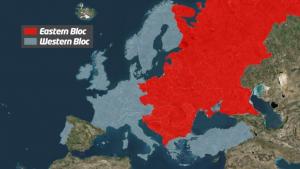
World War II ended with Catholics a powerful political block in Western Europe and a looming Cold War pushing Catholics in a direction some did not want to go.
Individual Catholics came through the Second World War in powerful positions in political parties that were, in name or in spirit, Christian Democrats. They argued opposite sides of major political issues. Some pushed strongly for federalism and world government that would include Communist countries. Others took up the anti-Communist banner and argued for strong nation-states and military preparedness. The shape of the world since then shows which side one out in the end.
Jacques Maritain – his influence and ultimate failure – occupies the center of James Chappel’s fourth chapter in Catholic Modern, “The Birth of Christian Democracy, 1944-1950.” Chappel details his lasting influence and practical failure in three areas—the Jewish question, relations with Communist countries, and the properly limited place of nation-states.
The Jewish Question gets sidelined.
Maritain believed the Church needed to “liberate itself from the sin of racism.” (152) French President Charles de Gaulle insisted, and Pius XII did remove five bishops associated with the collaborators of Vichy France. Their replacements were “icons of the resistance.” (153)
Maritain wanted to go further. Through his friend Biovanni Battista Montini (Later Pope Paul VI), he urged the pope to make a statement about anti-Semitism. That statement wasn’t forthcoming. Catholics preferred to celebrate the courage of a few Christian heroes and, otherwise, let the past be the past. Maritain believed anti-Semitism was still living in the Church.
Several Catholic writers pressed Maritain’s case for atonement and reconciliation with Jews to little effect. Protestant Churches produced the Stuttgart Declaration of Guilt in 1945. Catholic Church leaders and politicians preferred to “interpret Nazism as a pathology of secular materialism with no possible connection to the Church.” (p. 155) Previous posts documented the falsity of this view, for example, this one.
What emerged instead of true contrition was the popular conception of the Church as one of Hitler’s victims. I’ve heard those stories – about Christian heroes and Christians in concentration camps. The stories never explained one crucial difference. While Jews suffered for being Jews, Catholics and Protestants didn’t suffer for being Christian. Heroes of the faith, indeed, Nazis targeted them only because of their political activity.
Anti-Semitism was still living in post-war Europe, with millions of displaced Jews. Maritain wrote:
The bourgeoisie are more sure of themselves than ever, with the competence and awful internal security that comes from refusing self-examination. (p. 159)
Catholics couldn’t re-imagine a Europe that would be culturally and ethnically inclusive. Christian Democrats, Catholic leaders, and American occupiers all could easily see problems with Communism and Nazism. They saw none in Christianity.
Anti-Communism preoccupies the Western world.
In the “cold war” years there wasn’t much room for a middle way between atheist Communists and the “comfortable bourgeoisie.” The former, Maritain claimed were closer to God than the latter.
Catholics were close to or at the centers of power among the ascendant Christian Democrats. Many had worked closely with Communists in the “foxholes” of anti-fascist resistance. Initially, Christian Democrats formed coalitions with socialists and Communists. Germany’s Christian Democratic Union even engaged in the socialist projects of land reform and nationalizing key economic sectors.
Another socialist phenomenon I learned about in the 1960’s is the French “worker-priest” Movement. These priests included Communists sympathizers and even party members. About 90 in all, they “joined the proletariat on the shop floor.” Cardinal Emmanuel Célestin Suhard, one of my favorite liberal in the Vatican II period, was their patron. He believed the hard lot of the proletariat was the result of the capitalist regime. “How could the Church not desire that this regime be structurally transformed?” he wrote. (p. 162)
The door to collaboration closes.
The dream of Cardinal Suhard and others was just that, a dream. Chappel writes,
In the mid-1940’s a space seemed to open up for anti-Capitalist forms of Catholic activism…. By the end of the decade, that space had closed. (164)
The Cold War soon made any pro-Communist or anti-Capitalist sympathies suspect. A figure who achieved some fame in my youth was Cardinal Jozsef Mindszenty. His imprisonment by the Hungarian Communist regime confirmed for many Catholics the evils of Communism. Whether the cardinal’s political views had anything to do with his imprisonment is a factor left out of the stories. He was, according to Chappel, a “hard-line monarchist.” Pope Pius XII had appointed him two years before his imprisonment in an anti-Communist move.
Eventually, the Vatican banned the worker-priest movement. West Germany banned the Communist Party. Abuses like the Soviet version of concentration camps certainly helped solidify anti-Communism in the West. What’s regrettable is the “suffocation effect” it had on Catholic intellectual life.
Many innovations in social and economic thinking had come about through an encounter with Marxism, and after 1949 this avenue was essentially closed. (P. 167)
The powerful nation-state returns.
Traditionally, the Catholic Church has favored local efforts and distrusted dominant, powerful states. That was Maritain’s favorite kind of politics, too. He appreciated figures like Saul Alinsky and Dorothy Day, who were neither pro- nor anti-Communist. They “showed what kinds of results the faith could have when embedded in local cultures of organizing and activism.” (p. 180) Maritain considered anti-Communism a distraction from local problems that Capitalism either caused or was unable to solve. Consequently, Maritain’s bitterest disappointment was the returning dominance of the nation-state.
Part of Maritain’s theorizing that is hard to understand from a 21st century perspective is his advocacy for human rights within the weak state that he preferred. Human rights included political rights and equality before the law, but also the right to a job without racial discrimination. Today one would add other types of discrimination and look for freedom in other areas such as housing. Maritain defended trade unions, the right to work with a just wage, and the right to public assistance. (p. 170) Maritain’s desire for collaboration with Communists and other forms of atheists seemed a good fit for these issues. His preference for unintrusive forms of state government, less so. Perhaps that is why Maritain turned to global government as the way to ensure these human rights.
The Cold War displaces the dream of world government
Already in 1951 Maritain perceived “a rapidly accelerating economic unification of the globe [which] had to be matched with its political unification.” (p. 171) Within this global unity there would be a federalism of state, neither militarized nor all-powerful. The grand scheme was one of layers of authority and responsibility, from families and economic and civic associations all the way up to, perhaps, a United Nations.
Realistic or not, it’s easy to see that the vision does not sit well with a bipolar world of Communists versus Capitalists. Maritain’s dream of collaborative grass-roots working on social issues made some initial headway among Europe’s Christian Democrats. It became implausible as the Cold War heated up.
By the end of the 1940’s the thinking of Catholics and Westerners in general settled down into a more consensus view than had been the case earlier. It was largely center-right, the stance of most Christian Democrats. It included a taste for powerful nation-states and capitalist economics. In some but not all cases, there was effective state support for those left behind. An appreciation of the West’s Christian inheritance went along with a perceived need to stand up to atheistic Communism. The third-way of the more collaborative thinking of figures like Maritain didn’t go away but receded from the foreground … for a while. The result was the world of my first political awareness, the 1950’s and 60’s.
Image credit: CBBC Newsround via Google Images
Previous Post

June 7, 2019
Pluralism, Anti-Fascism, and Fraternal Catholic Modernism, 1929-1944
Next Post
June 14, 2019 Catholic Consensus in the Consumer Society of the ‘Long 1950’s’
Browse Our Archives
Select a Category Advent Christmas Amazon Synod Angels Being Consumed Bible Catholic Modern Creed Ecology Economics Elizabeth Johnson Eucharist Fragments and Filaments Gender and Sex Gospel of Mark Herzog Historical Jesus Liturgy Luke Opening Scriptures on Way to Emmaus Ordinary radicals Parables Pro-Life Reincarnation Rosary Sacraments science Social Justice Souls Stories of Jesus The Creed Torture and Eucharist Tracy Uncategorized War and Peace
Select a Month October 2026 June 2025 April 2025 March 2025 February 2025 January 2025 November 2024 July 2024 March 2024 December 2023 October 2023 September 2023 August 2023 May 2023 April 2023 March 2023 February 2023 January 2023 December 2022 November 2022 October 2022 September 2022 August 2022 July 2022 June 2022 April 2022 March 2022 February 2022 January 2022 December 2021 November 2021 October 2021 August 2021 July 2021 June 2021 April 2021 March 2021 February 2021 December 2020 November 2020 October 2020 August 2020 July 2020 June 2020 May 2020 April 2020 March 2020 February 2020 January 2020 December 2019 November 2019 October 2019 September 2019 August 2019 July 2019 June 2019 May 2019 April 2019 March 2019 February 2019 January 2019 December 2018 November 2018 October 2018 September 2018 August 2018 July 2018 June 2018 May 2018
Follow Us!
TAKE THE
Religious Wisdom Quiz
Which apostle did Jesus say, "Get thee behind me, Satan…"
Select your answer to see how you score.
James Judas Peter John
Related posts from Lost in a One-Acre Wood

The New Catholic Left in the Turbulent 1960’s

Catholic Consensus in the Consumer Society of the ‘Long...
Pluralism, Anti-Fascism, and Fraternal Catholic Modernism, 1929-1944

Anti-Communism, Human Rights, and Paternal Catholic Modernism, 1929-1944
TRENDING AT PATHEOS Catholic

Rejecting Doom: Christian Hope And Human Action
Christianity is a religion of hope. We are to have hope and...

It’s What Comes From Within Which Matters
One of the most difficult things for us to understand is why...

Why I Choose the Eucharist Over the Sermon
Choose the Eucharist, Not the Sermon What are we supposed to get...

5 Design Elements Found in Spiritually Rooted Homes
Putting Spirituality Into Home Decor Our homes are more than our living...

Credo: A Story of God Told with the...
About 10 years ago, I began to imagine a personal "Credo" that...

The Anatomy of Divine Revelation in Catholic Thought
The claim that God has made Himself known to human beings is...
view all Catholic blogs
Ad-Free & Subscriber Log-In Subscription Support
- About Us
- 2026 Calendar
- Videos
- Podcasts
- Library of World Religions
- Faith In Media Tracker
- Advertise With Us
- Write for Us
- Privacy Policy
- Terms of Service
- Do Not Sell My Data
- Contact Us
- Radiant Digital
- Manage Newsletter Subscriptions
- Unsubscribe From Notifications
- Sitemap
Copyright 2008-2026, Patheos. All rights reserved.
Subscription Support Ad-Free & Subscriber Log-In
Follow Patheos