
BuddhistCatholicContemplativeEvangelicalGeneral ChristianHinduJewishLatter-day SaintMuslimNew VisionsProgressive Christian
Beliefs
- Buddhist
- Catholic
- Contemplative
- Evangelical
- General Christian
- Hindu
- Jewish
- Latter-day Saint
- More Voices
- Muslim
- New Visions
- Pagan
- Progressive Christian
Topics
- Religion News
- Food and Religion
- Sports and Religion
- Religious Art
- Religious Music and Entertainment
- Religious Events
- History and Religion
- Style and Religion
- Politics and Religion
- Women in Religion
- Recreation Outdoors and Religion
- Business Finance and Religion
- Careers Workplace and Religion
- Education and Religion
- Family Parenting and Religion
- Health Fitness and Religion
- Home and Religion
- Relationships and Religion
- Technology and Religion
- Travel and Religion
Columnists
- Buddhist Columnists
- Business Finance and Religion Columnists
- Careers Workplace and Religion Columnists
- Catholic Columnists
- Contemplative Columnists
- Education and Religion Columnists
- Evangelists Columnists
- Family Parenting and Religion Columnists
- General Christian Columnists
- Health Fitness and Religion Columnists
- Hindu Columnists
- History and Religion Columnists
- Home and Religion Columnists
- Jewish Columnists
- More Voices Columnists
- Latter Day Columnists
- Muslim Columnists
- New Visions Columnists
- Nonreligious Columnists
- Pagan Columnists
- Politics and Religion Columnists
- Progressive Columnists
- Recreation Outdoors and Religion Columnists
- Relationships and Religion Columnists
- Religion News Columnists
- Religious Art Columnists
- Religious Events Columnists
- Religious Music and Entertainment Columnists
- Sports and Religion Columnists
- Style and Religion Columnists
- Technology and Religion Columnists
- Travel and Religion Columnists
- Women in Religion Columnists
Resource Library
- 2026 Calendar
- Library of World Religions
- The 100 Most Holy Places on Earth
- Patheos Answers
- Podcasts
- Videos
- Faith Leaders Database
- Anglican Episcopalian
- Bahai
- Baptist
- Buddhism
- Christianity
- Confucianism
- Eastern Orthodoxy
- Hinduism
- Holiness and Pentecostal
- ISKCON
- Islam
- Judaism
- Lutheran
- Methodist
- The Church of Jesus Christ of Latter-day Saints
- New Age
- Paganism
- Presbytarian and Reformed
- Protestantism
- Religion Behind the Scenes
- Roman Catholic
- Scientology
- Shia Islam
- Sikhism
- Sufism
- Sunni Islam
- Taoism
- Zen
- See all religions
Research Tools
 Ad-Free & Subscriber Log-In Subscription Support
Ad-Free & Subscriber Log-In Subscription Support
Follow Patheos 

- Trending:
- Forgiveness
- |
- Marriage
- |
- Consciousness
- |
- Death Penalty
- |
- Election
- |
- Halloween

- Home
- Catholic
- On the DOCAT, Social Justice Catechism for Youth, Part Two
On the DOCAT, Social Justice Catechism for Youth, Part Two
Last updated on: July 23, 2019 at 4:11 pm by Jack Hartjes
On the DOCAT, Social Justice Catechism for Youth, Part Two 2019-07-23T16:11:55-06:00 Jack Hartjes
Patheos Explore the world's faith through different perspectives on religion and spirituality! Patheos has the views of the prevalent religions and spiritualities of the world.
A Look at Some Weakness amid Overall Strength
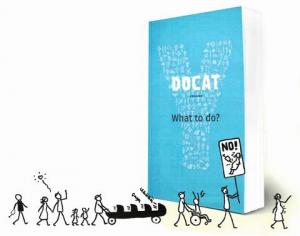
The DOCAT, Pope Francis’ gift to youth and the Church, encourages Catholics to get involved in the struggle for social justice.
I wrote last week in praise of DOCAT, What to Do? – The Social Teaching of the Catholic Church. That gift from Pope Francis to the world as well as to young people does indeed deserve praise. Pope Francis, in a challenge to become actively involved in justice work, sums up its strong message: “A Christian who in these times is not a revolutionary is not a Christian.” (In a forward, “About this Book”) But the book has some weaknesses that made my experience with it, a good one that I hope is shared widely, less than it could have been.
One weakness that I noted already last week is the book’s length. Although it is attractive done, I think a strong editor could have sliced out maybe a third or a half of the verbiage without losing anything that needed saying. As it is, the book is not only a challenge to think about but also a challenge to read, especially for its primary audience, young people.
Before getting into more specific weaknesses, I want to reiterate that I consider DOCAT a major contribution and a fine book. I’d also like to reference another Patheos blog by Keith Michael Estrada that, in different ways from mine, both highly praises and strongly criticizes the DOCAT.
Justice and charity
A great strength of the book is how often it demands that we think about social justice and the lack of justice in many areas of life. All the more disappointing, then, is the fact that nowhere do we get a clear definition of social justice.
The difference between social justice and charity does show up in the famous quote by Dom Helder Camara:
When I give food to the poor, they call me a saint. When I ask why they are poor, they call me a Communist. (p.95)
Charity addresses an immediate need, an emergency situation. Justice tackles long-term or systemic factors, including habitual ways we think and act, that cause suffering. But that crucial distinction is missing where you want to see it spelled out.
The book asks, “What sorts of justice are there?” (#109) There are distributive justice, legal justice, and commutative justice. Then “social justice” either sums them all up or it’s an extension of legal justice. I don’t know how it could be both. What could have been pages gets one confusing paragraph that unaccountably repeats itself, word for word, at the end. This is one case where more words would have been helpful.
Scripture on justice and charity
There are many Scripture references but use of Scripture on social justice could have been more effective. DOCAT notes that Jesus loved and helped disadvantaged people. But he did more: He stood up to the religious-political system that pushed large groups of people to the outskirts of society. The first is charity; the second is social justice.
In the Old Testament kings were “to look out for social justice, make just judgments, perform service for the poor, and so on.” (DOCAT # 200) But the Old Testament gets much more specific. Rights extended to classes of people who are often overlooked. Slavescould rest on Sabbath. Widows and orphans received special consideration. Laws protected debtors: You could take a man’s coat as security for a debt but you had to give it back each night so he could sleep. The poor could glean for grain that harvesters, by law, had to leave behind. Then there was the Sabbath, the Sabbatical Year, and the Jubilee Year. All of these were ways God’s people aspired to a kind of justice, not charity. Together they help us think more expansively and provocatively about justice.
The Church dares to ask, with Archbishop Camara, why people are poor and without the necessities of life. She challenges us to take responsibility for the answer, and so does the DOCAT in many ways throughout. But that question, and how it relates to justice, not charity, is not clear.
A complaint about language
I had hoped that a document aimed at contemporary youth would have avoided the longstanding ecclesial habit of naming both men and women as men. In DOCAT as well as in YOUCAT, the earlier, more general youth catechism, I was disappointed.
There’s a justice issue here that, at least in English, has entered into the ways responsible people use language. At least among editors and publishers, referring to the entire human race as men or man or mankind is no longer proper English. I don’t know if it’s the same for the original German, but translators ought to be sensitive to the language they translate into. Youth especially in the English-speaking world now most often hear and read “people,” or “men and women,” or “humankind.” The church ought to have caught on to that by now.
I can’t resist a poke at the YOUCAT for an especially egregious example of “sexist” language. And the topic is sexism:
#61. In what does the equality of all men (!) consist?
All men are equal inasmuch as they have the same origin in the one creative love of God. All men have their Savior in Jesus Christ. All men are destined to find their happiness and their eternal blessedness in God
Hence all men are brothers and sisters. (!) Christians should practice solidarity not only with other Christians but with everyone and forcefully oppose racist, sexist, and economic divisions in the one human family.
Then there’s DOUCAT’s awful quote from a German bishop that certainly an English translator should have deleted. Instead it gets large-type prominence:
Do as God did: become a man! (p. 280)
It’s ironic when with such language the YOUCAT aims to condemn sexism, or the DOCAT to condemn any kind of social injustice.
Racism, sexism, anti-Semitism
DOCAT gives very little attention is given to discrimination on the basis of race and sex. Anti-Semitism gets no mention at all even though it’s one of the Church’s own great failings throughout much of our history, including in the years before the Second World War.
Several sections mention the rights of minorities but always in a general way without naming specific minorities or specific issyues. We hear nothing of racial discrimination in housing or the job market. There is no condemnation of the way people, by deliberate or unmindful use of language disrespect whole classes of people. We don’t hear about the overt racism of racist jokes or the unconscious (one hopes) but systemic racism whereby law enforcement kills and imprisons people of color in disproportionate numbers. In this country one would want some guidance on determining the obligations of an economy that has benefited from centuries of slave labor and expropriation of indigenous peoples’ lands.
Conclusion
Contributors to DOCAT deserve much credit for undertaking a difficult and important task. It presents the Church’s social teaching in a format suitable for young people or anyone not an expert already. They have brought together a treasure trove of teachings, explanations, and interesting quotations from a wide variety of sources. It has some weaknesses, but it certainly deserves a prominent place in faith formation programs and the general public.
Image credit: Catholic Shoppe USA
Previous Post

May 22, 2019
The Eucharistic Imagination – Too Big for a Private Space
Next Post
May 27, 2019 Memorial Day and the Liturgies of a small town in Rural Minnesota
Browse Our Archives
Select a Category Advent Christmas Amazon Synod Angels Being Consumed Bible Catholic Modern Creed Ecology Economics Elizabeth Johnson Eucharist Fragments and Filaments Gender and Sex Gospel of Mark Herzog Historical Jesus Liturgy Luke Opening Scriptures on Way to Emmaus Ordinary radicals Parables Pro-Life Reincarnation Rosary Sacraments science Social Justice Souls Stories of Jesus The Creed Torture and Eucharist Tracy Uncategorized War and Peace
Select a Month October 2026 June 2025 April 2025 March 2025 February 2025 January 2025 November 2024 July 2024 March 2024 December 2023 October 2023 September 2023 August 2023 May 2023 April 2023 March 2023 February 2023 January 2023 December 2022 November 2022 October 2022 September 2022 August 2022 July 2022 June 2022 April 2022 March 2022 February 2022 January 2022 December 2021 November 2021 October 2021 August 2021 July 2021 June 2021 April 2021 March 2021 February 2021 December 2020 November 2020 October 2020 August 2020 July 2020 June 2020 May 2020 April 2020 March 2020 February 2020 January 2020 December 2019 November 2019 October 2019 September 2019 August 2019 July 2019 June 2019 May 2019 April 2019 March 2019 February 2019 January 2019 December 2018 November 2018 October 2018 September 2018 August 2018 July 2018 June 2018 May 2018
Follow Us!
TAKE THE
Religious Wisdom Quiz
What were the names of Eli's two corrupt sons?
Select your answer to see how you score.
Jonathan and Saul Abinadab and Shammah David and Nathan Hophni and Phinehas
Related posts from Lost in a One-Acre Wood

Axios News, Inflation, Justice, and Young Workers in...
Catholic Church Repudiates the Doctrine of Discovery

Holy Thursday Theology and the Scientific Quest for...
‘Render to Caesar’ – or Not. The Speech...
TRENDING AT PATHEOS Catholic

The Parable Of The Sower And The Word...
One of Christ’s most famous parables is that of the sower who...

Rejecting Doom: Christian Hope And Human Action
Christianity is a religion of hope. We are to have hope and...

Why I Choose the Eucharist Over the Sermon
Choose the Eucharist, Not the Sermon What are we supposed to get...

5 Design Elements Found in Spiritually Rooted Homes
Putting Spirituality Into Home Decor Our homes are more than our living...

Credo: A Story of God Told with the...
About 10 years ago, I began to imagine a personal "Credo" that...

The Anatomy of Divine Revelation in Catholic Thought
The claim that God has made Himself known to human beings is...
view all Catholic blogs
Ad-Free & Subscriber Log-In Subscription Support
- About Us
- 2026 Calendar
- Videos
- Podcasts
- Library of World Religions
- Faith In Media Tracker
- Advertise With Us
- Write for Us
- Privacy Policy
- Terms of Service
- Do Not Sell My Data
- Contact Us
- Radiant Digital
- Manage Newsletter Subscriptions
- Unsubscribe From Notifications
- Sitemap
Copyright 2008-2026, Patheos. All rights reserved.
Subscription Support Ad-Free & Subscriber Log-In
Follow Patheos