
BuddhistCatholicContemplativeEvangelicalGeneral ChristianHinduJewishLatter-day SaintMuslimNew VisionsProgressive Christian
Beliefs
- Buddhist
- Catholic
- Contemplative
- Evangelical
- General Christian
- Hindu
- Jewish
- Latter-day Saint
- More Voices
- Muslim
- New Visions
- Pagan
- Progressive Christian
Topics
- Religion News
- Food and Religion
- Sports and Religion
- Religious Art
- Religious Music and Entertainment
- Religious Events
- History and Religion
- Style and Religion
- Politics and Religion
- Women in Religion
- Recreation Outdoors and Religion
- Business Finance and Religion
- Careers Workplace and Religion
- Education and Religion
- Family Parenting and Religion
- Health Fitness and Religion
- Home and Religion
- Relationships and Religion
- Technology and Religion
- Travel and Religion
Columnists
- Buddhist Columnists
- Business Finance and Religion Columnists
- Careers Workplace and Religion Columnists
- Catholic Columnists
- Contemplative Columnists
- Education and Religion Columnists
- Evangelists Columnists
- Family Parenting and Religion Columnists
- General Christian Columnists
- Health Fitness and Religion Columnists
- Hindu Columnists
- History and Religion Columnists
- Home and Religion Columnists
- Jewish Columnists
- More Voices Columnists
- Latter Day Columnists
- Muslim Columnists
- New Visions Columnists
- Nonreligious Columnists
- Pagan Columnists
- Politics and Religion Columnists
- Progressive Columnists
- Recreation Outdoors and Religion Columnists
- Relationships and Religion Columnists
- Religion News Columnists
- Religious Art Columnists
- Religious Events Columnists
- Religious Music and Entertainment Columnists
- Sports and Religion Columnists
- Style and Religion Columnists
- Technology and Religion Columnists
- Travel and Religion Columnists
- Women in Religion Columnists
Resource Library
- 2026 Calendar
- Library of World Religions
- The 100 Most Holy Places on Earth
- Patheos Answers
- Podcasts
- Videos
- Faith Leaders Database
- Anglican Episcopalian
- Bahai
- Baptist
- Buddhism
- Christianity
- Confucianism
- Eastern Orthodoxy
- Hinduism
- Holiness and Pentecostal
- ISKCON
- Islam
- Judaism
- Lutheran
- Methodist
- The Church of Jesus Christ of Latter-day Saints
- New Age
- Paganism
- Presbytarian and Reformed
- Protestantism
- Religion Behind the Scenes
- Roman Catholic
- Scientology
- Shia Islam
- Sikhism
- Sufism
- Sunni Islam
- Taoism
- Zen
- See all religions
Research Tools
 Ad-Free & Subscriber Log-In Subscription Support
Ad-Free & Subscriber Log-In Subscription Support
Follow Patheos 

- Trending:
- Forgiveness
- |
- Marriage
- |
- Consciousness
- |
- Death Penalty
- |
- Election
- |
- Halloween

- Home
- Catholic
- On the DOCAT, Youth Social Justice Catechism, Part One
On the DOCAT, Youth Social Justice Catechism, Part One
Last updated on: July 23, 2019 at 4:12 pm by Jack Hartjes
On the DOCAT, Youth Social Justice Catechism, Part One 2019-07-23T16:12:26-06:00 Jack Hartjes
Patheos Explore the world's faith through different perspectives on religion and spirituality! Patheos has the views of the prevalent religions and spiritualities of the world.
Strong Challenges in Some Important Areas of Social Life
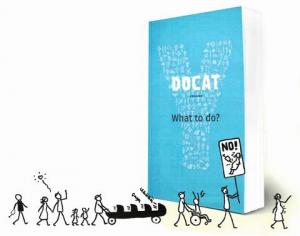
DOCAT, a catechism on the Church’s social teaching for youth, includes simple but interesting illustrations.
Pleased, excited. These name my reaction when the parish religious ed coordinator handed me a copy of DOCAT: What to Do? It’s a Catechism for young people on the social teaching of the Catholic Church. That’s a teaching about which Catholics, especially in Southern Minnesota, hear too little.
A chorus of praise met the release of Pope Francis’ gift to youth at the 2016 World Youth Day. That’s according to this review of the book. An accompanying app gets equal commendation here. A read-through of the text allows me to add my own praise and some criticism, too, which I’ll save for a future post.
I’ll mention one fault, as I see it, right away simply because it struck me on first opening the book. For an important instruction aimed at a young – and busy – audience, it’s very long. The book is small enough and very attractive, but fairly small print in the central text and even smaller in the interesting sidebars make for a lot of words. I wonder which high schoolers or college goers are going to read this book. I hope they do.
On to the strengths of DOCAT
There’s a lot of good, challenging content in this book. I had feared that I would find a lot of safe soundbites and generalities, but, in fact, the book packs a strong punch on some controversial subjects. In true Catholic fashion, it tries to make everyone, whether on the right or the left, uncomfortable.
The range of topics was quite a bit larger than I expected. That accounts partly for the excessive length. Two introductory chapters specify among other things:
- That it’s all about God’s love;
- That salvation is for the body as well as the spirit, for history as well as heaven, for communities as well as individuals;
- That the Church has a social doctrine because human beings are not just individuals; they are also social beings;
- That the Church does not replace the state and politics but encourages members to become involved in both in order to correct society’s unjust structures.
Two things impressed me about these introductory chapters. They were very strong on social sin. Without using that term this part signals what turns out to be the book’s lasting concern with unjust structures. They are society’s ways that pass unnoticed by the comfortable in prosperous countries. Over and over we read how economic structures that we pay so little attention to work against the poor.
Following chapters cover topics related to:
- The person
- The principles of the Church’s social teaching
- The family
- Work
- Economic life
- Political life
- The international community
- The environment
- Peace and violence
Every chapter includes a section of extended quotes from Church documents on social justice from Leo XII’s Rerum Novarum to Pope Francis’ Laudato Si. Docat concludes with a chapter on personal and societal commitment. Sidebars on every page present relevant quotes from religious and secular figures.
Strong messages on economics
On almost any topic the authors find a connection to economics and poverty. They constantly nudge the potentially complacent reader out of any comfort zone of individual self-satisfaction. Even when the chapter’s topic is simply the person, we are reminded of the horrors visited by Europeans on the indigenous American peoples and of the economic, social, political, and, in general, structural causes of poverty today. (Sidebars on pages 62 and 63)
The authors list the four usual principles of Catholic social teaching: the dignity of the human person, the common good, subsidiarity, and solidarity. Before long, though, they have added a fifth — sustainability. This comes in the context of the discussion of private property. Ownership is permitted, but earth’s goods are intended for all, including future generations. Interestingly, this comes even before the discussion on the environment has begun.
The principles of subsidiarity and solidarity specify the venues at which to pursue solutions to problems. Subsidiarity encourages solutions at the smallest, most local levels. Solidarity extends to larger and larger groups, where there must be solutions to problems that local communities can’t handle. Before both of these, as if to keep the various interests involved on the right track, the authors insist on a “preferential option for the poor.” (##94-103)
The chapter on economic life, welfare and justice for all clearly states the Church’s ambivalence toward all economic systems, including capitalism. Markets must serve all people or they are not just. (#161) The market economy, though it has proved to be very efficient, must be subordinate to the constitutional state. Governments must provide clear rules and make provisions for those without jobs or money. (#160)
Challenges to the American way: Work, family, peace
There’s plenty in the DOCAT that American readers especially would do well to heed:
- Workers should be participants in decisions about their work experience. (#145) There is a “moral” right to work. (#148) Wages should ensure a family’s livelihood, and employers, unions, and government should work together to create flexible employment models to benefit families. (#149)
- No one has a right to decide whether another human life is worth living. Abortion and euthanasia are both contrary to God’s and the moral law. The same sensitivity that we owe to our endangered natural world should inspire the protection for the most vulnerable of us. (##71-79)
- Of course, the Church is in favor of peace. The authors of DOCAT are more specific. They challenge the logic of weapons manufacture and trade:
Any excessive accumulation of weapons and universal trade in them are morally unjustifiable. (#295)
- And they challenge the mechanism of fear that nations have relied on to prevent World War III:
The Church expressly rejects the so-called ‘logic of deterrence.’ The indiscriminate destruction of cities, countries, and populations through biological, chemical, or nuclear weapons of mass destruction is a serious crime against God and humanity. (#296)
And on the issue that practically consumes me: ecology
- The Church’s recent concern for the environment shows up well in DOCAT. An example is this quote from Pope Benedict XVI:
[T]echnologically advanced societies must be prepared to encourage more sober life-styles, while reducing their energy consumption and improving its efficiency. At the same time there is a need to encourage research into, and utilization of, forms of energy with lower impact on the environment and a worldwide redistribution of energy resources, so that countries lacking those resources can have access to them. (p. 248, “Message for World Day of Peace” 2010)
- And these from Pope Francis:
We have not yet managed to adopt a circular model of production capable of preserving resources for present and future generations, while limiting as much as possible the use of non-renewable resources, moderating their consumption, maximizing their efficient use, reusing and recycling them. (p. 238, Laudato Si 22)
Both everyday experience and scientific research show that the gravest effects of all attacks on the enbvironment are suffered by the poorest. (p. 241*, Laudato Si* 48)
- The only kind of prosperity that Christians can advocate is one that “uses resources sparingly and thoughtfully—in other words, that does not keep gobbling up the earth’s finite resources….” (#268, italics in original)
The English edition (but I suppose not the original German) has a strong message from the American bishops on climate change. (p. 248-49) And the authors give Jimmy Carter a concluding and sobering word:
We must face the prospect of changing our basic ways of living. This change will either be made on our own initiative in a planned and rational way, or forced on us with chaos and suffering by the inexorable laws of nature. (p. 247, a 1976 speech)
Personal and social commitment
A final chapter addresses some specifics of personal “love in action.” It speaks of involvement as Christians in both Christian and secular movements to address social evils. There are movements, especially political parties, that agree with some but not all of the Church’s positions. Here the position of DOCAT is somewhat confusing, if not overly strong. On political parties that, of course, don’t agree 100 percent with the Church, active participation is approved, but
The prerequisite for responsible involvement is a fundamental recognition by the party of inviolable human dignity, of human rights, personhood, and the defense of innocent human life at all stages of its development and in all conditions of dependence, of marriage as a union of a man and a woman…. (#319)
This seems to forbid membership in the Democratic Party of the United States. But then,
Belonging to Jesus means no professional, financial, economic, or political collaboration with criminal organizations … governmental systems of injustice, or businesses that destroy the environment, violate human dignity (sub-living wages, sickening workplace conditions, child labor), harass and persecute the Church, manufacture weapons of mass destruction, or ruthlessly pursue profits with no care about social consequences. (#321)
I think probably a majority of Americans would find themselves on the wrong side of one or more of those limits. Some of these are areas where the Church lines up closer to Democrats than Republicans.
We live in an imperfect world, where choices are hardly ever all right and often not all wrong either. One message of DOCAT throughout is that social justice is not easy. The document does give important guidance. It has some weaknesses as well, but that is a subject for a future post.
Image credit: Catholic Shoppe USA
Previous Post

May 15, 2019
The Mystical Body and the True Body of Christ
Next Post
May 20, 2019 Performing the Body of Christ against Torture in Chile
Browse Our Archives
Select a Category Advent Christmas Amazon Synod Angels Being Consumed Bible Catholic Modern Creed Ecology Economics Elizabeth Johnson Eucharist Fragments and Filaments Gender and Sex Gospel of Mark Herzog Historical Jesus Liturgy Luke Opening Scriptures on Way to Emmaus Ordinary radicals Parables Pro-Life Reincarnation Rosary Sacraments science Social Justice Souls Stories of Jesus The Creed Torture and Eucharist Tracy Uncategorized War and Peace
Select a Month October 2026 June 2025 April 2025 March 2025 February 2025 January 2025 November 2024 July 2024 March 2024 December 2023 October 2023 September 2023 August 2023 May 2023 April 2023 March 2023 February 2023 January 2023 December 2022 November 2022 October 2022 September 2022 August 2022 July 2022 June 2022 April 2022 March 2022 February 2022 January 2022 December 2021 November 2021 October 2021 August 2021 July 2021 June 2021 April 2021 March 2021 February 2021 December 2020 November 2020 October 2020 August 2020 July 2020 June 2020 May 2020 April 2020 March 2020 February 2020 January 2020 December 2019 November 2019 October 2019 September 2019 August 2019 July 2019 June 2019 May 2019 April 2019 March 2019 February 2019 January 2019 December 2018 November 2018 October 2018 September 2018 August 2018 July 2018 June 2018 May 2018
Follow Us!
TAKE THE
Religious Wisdom Quiz
What is the lesson in the Parable of the Lost Coin?
Select your answer to see how you score.
Money is a blessing Riches must be counted God values each lost person Keep your house clean
Related posts from Lost in a One-Acre Wood

Axios News, Inflation, Justice, and Young Workers in...
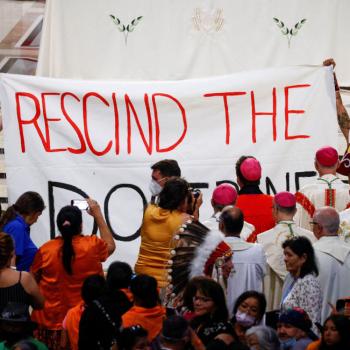
Catholic Church Repudiates the Doctrine of Discovery

Holy Thursday Theology and the Scientific Quest for...
‘Render to Caesar’ – or Not. The Speech...
TRENDING AT PATHEOS Catholic

Creation, Preservation, and Teleology in Catholic Theology
As I write this, it is very early Monday morning. Like millions...

The Parable Of The Sower And The Word...
One of Christ’s most famous parables is that of the sower who...

Rejecting Doom: Christian Hope And Human Action
Christianity is a religion of hope. We are to have hope and...

Why I Choose the Eucharist Over the Sermon
Choose the Eucharist, Not the Sermon What are we supposed to get...

5 Design Elements Found in Spiritually Rooted Homes
Putting Spirituality Into Home Decor Our homes are more than our living...

Credo: A Story of God Told with the...
About 10 years ago, I began to imagine a personal "Credo" that...
view all Catholic blogs
Ad-Free & Subscriber Log-In Subscription Support
- About Us
- 2026 Calendar
- Videos
- Podcasts
- Library of World Religions
- Faith In Media Tracker
- Advertise With Us
- Write for Us
- Privacy Policy
- Terms of Service
- Do Not Sell My Data
- Contact Us
- Radiant Digital
- Manage Newsletter Subscriptions
- Unsubscribe From Notifications
- Sitemap
Copyright 2008-2026, Patheos. All rights reserved.
Subscription Support Ad-Free & Subscriber Log-In
Follow Patheos