
BuddhistCatholicContemplativeEvangelicalGeneral ChristianHinduJewishLatter-day SaintMuslimNew VisionsProgressive Christian
Beliefs
- Buddhist
- Catholic
- Contemplative
- Evangelical
- General Christian
- Hindu
- Jewish
- Latter-day Saint
- More Voices
- Muslim
- New Visions
- Pagan
- Progressive Christian
Topics
- Religion News
- Food and Religion
- Sports and Religion
- Religious Art
- Religious Music and Entertainment
- Religious Events
- History and Religion
- Style and Religion
- Politics and Religion
- Women in Religion
- Recreation Outdoors and Religion
- Business Finance and Religion
- Careers Workplace and Religion
- Education and Religion
- Family Parenting and Religion
- Health Fitness and Religion
- Home and Religion
- Relationships and Religion
- Technology and Religion
- Travel and Religion
Columnists
- Buddhist Columnists
- Business Finance and Religion Columnists
- Careers Workplace and Religion Columnists
- Catholic Columnists
- Contemplative Columnists
- Education and Religion Columnists
- Evangelists Columnists
- Family Parenting and Religion Columnists
- General Christian Columnists
- Health Fitness and Religion Columnists
- Hindu Columnists
- History and Religion Columnists
- Home and Religion Columnists
- Jewish Columnists
- More Voices Columnists
- Latter Day Columnists
- Muslim Columnists
- New Visions Columnists
- Nonreligious Columnists
- Pagan Columnists
- Politics and Religion Columnists
- Progressive Columnists
- Recreation Outdoors and Religion Columnists
- Relationships and Religion Columnists
- Religion News Columnists
- Religious Art Columnists
- Religious Events Columnists
- Religious Music and Entertainment Columnists
- Sports and Religion Columnists
- Style and Religion Columnists
- Technology and Religion Columnists
- Travel and Religion Columnists
- Women in Religion Columnists
Resource Library
- 2026 Calendar
- Library of World Religions
- The 100 Most Holy Places on Earth
- Patheos Answers
- Podcasts
- Videos
- Faith Leaders Database
- Anglican Episcopalian
- Bahai
- Baptist
- Buddhism
- Christianity
- Confucianism
- Eastern Orthodoxy
- Hinduism
- Holiness and Pentecostal
- ISKCON
- Islam
- Judaism
- Lutheran
- Methodist
- The Church of Jesus Christ of Latter-day Saints
- New Age
- Paganism
- Presbytarian and Reformed
- Protestantism
- Religion Behind the Scenes
- Roman Catholic
- Scientology
- Shia Islam
- Sikhism
- Sufism
- Sunni Islam
- Taoism
- Zen
- See all religions
Research Tools
 Ad-Free & Subscriber Log-In Subscription Support
Ad-Free & Subscriber Log-In Subscription Support
Follow Patheos 

- Trending:
- Forgiveness
- |
- Marriage
- |
- Consciousness
- |
- Death Penalty
- |
- Election
- |
- Halloween

- Home
- Catholic
- The Mystical Body and the True Body of Christ
The Mystical Body and the True Body of Christ
Last updated on: April 15, 2023 at 6:42 am by Jack Hartjes
The Mystical Body and the True Body of Christ 2023-04-15T06:42:16-06:00 Jack Hartjes
Patheos Explore the world's faith through different perspectives on religion and spirituality! Patheos has the views of the prevalent religions and spiritualities of the world.
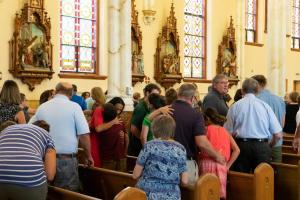
The true Body of Christ gathers around Christ’s Mystical Body in the Eucharist. That W. T. Cavanaugh says is the Church’s earlier theology.
One of my favorite images of the Church, from before the Second Vatican Council, is the Mystical Body of Christ. I was disappointed when the Second Vatican Council put People of God instead of Mystical Body in first place among its many images. But Church as Mystical Body gets some rough treatment in Cavanaugh’s fifth chapter. The Church, Cavanaugh says, is not a mystical presence behind the bodies in the real world. It is a bodily presence in that world, the True Body of Christ.
On Chapter Five of Torture and Eucharist: Theology, Politics, and the Body of Christ, eighth in the series on William T. Cavanaugh. He is a Catholic theologian who writes about the Church and its role in culture, politics, and economics. Introduction to Cavanaugh and links to blogs in the series as they appear are here.
True Body and Mystical Body changing places
It should be obvious from the Incarnation that God means to be an effective, not just a mystical, bodily presence in the world. Henri de Lubac did the historical spadework behind Cavanaugh’s analysis. He found that the term “Mystical Body” originally referred to the Body of Christ in the sacrament of the Eucharist. The Church in its earlier self-concept was “Corpus Verum” — True Body of Christ (p. 212).
The 12th century saw these two terms change places. The Eucharist became “Corpus verum.” A hymn by Pope Innocent VI planted that image of the Sacrament of the Altar firmly in the Church’s liturgy. I used to love that hymn —
Ave Verum corpus natum… Hail true Body, born of the Virgin Mary.
The song and the new theology make a very close connection between the consecrated bread and cup of the Eucharist and the body of Jesus, who lived and died 2000 years in the past. The Church, which Paul said is also the body of Christ, is connected, too, but more distantly, now as a body in a mystical sense.
Cavanaugh references de Lubac again:
[M]ystical body ecclesiologists of the twentieth century had a regrettable tendency to set up a dichotomy between on the one hand, the external, institutional church, and on the other hand, the body of Christ which is ‘interior,’ ‘hidden,’ ‘invisible’ — all aspects which came to be associated with the term ‘mystical.’ (p. 210)
But the Eucharist is not hidden and invisible. It is a very tangible building up of the visible body of the Church in and for the world. Christ isn’t any less present in the Eucharist for being mystical, but that presence has a different orientation. It’s less a re-presentation of the past (though it is that) and more an anticipation and foretaste of the fullness of Christ in the future.
De Lubac held that
... Christ’s gift of his body and blood under the material signs of bread and wine renders impossible any dichotomy between the earthly and the heavenly, the material and the spiritual, or the body and the soul. (p. 225)
Space and time images
That dichotomy is what a state prefers. It gives the state all the territory it needs and cordons off the Church into a separate space. It doesn’t matter to the state if that space is higher, as long as it doesn’t interfere.
The true difference between state and Church, however, is not one of space but of time. The state imagines a featureless time that just keeps going on and on, no matter what happens in it. The Church conceives the same time as qualitative, with a beginning and definite high points and an ending, or goal. For instance, the time that the Church occupies leads from the first to the second coming of Christ. Time is eschatological. This future eschaton, end point or goal, gives meaning to the present.
With that end point in mind, the Church can interact meaningfully with the state and, perhaps, even make a difference. For a long time, including as I was being introduced to theology, the Church’s thinking about the end had little to do with the world in the present. Eschatology was a minor theme, coming at the end of typical theology textbooks. It covered the “Four Last Things” — death, judgment, heaven, hell. It all seemed very remote from earth, to which Scripture says Jesus will return. In the daily prayers of the Mass with which I grew up,“there is not a single allusion to [Jesus’] second coming.” (p. 226)
Pius XII, while championing the Church as Mystical Body, also emphasized the Church as institution in the world, especially the hierarchy with himself at the head. (Of course, Christ would be the head of the Mystical Body.) As an institution the Church was powerless to keep its members from killing each other. This was 1943, the darkest times of the Second World War. Such conflict had no place in the mystical realm of the soul, but then that mystical realm, because it was only mystical, couldn’t stop the killing either. Cavanaugh says the doctrine of the Mystical Body
… masks, rather than witnesses against, the violence of nations. (p. 212)
Conclusion
Cavanaugh summarizes his Chapter 5 this way:
In this chapter I have tried to display how the Eucharist builds a visible social body capable of resisting the state’s strategy of disappearance. The Eucharist anticipates the future Kingdom, re-members Jesus’ conflict with the powers of this world, and brings both future and past dimensions of Christ into the present in the form of a visible body. The result is a “confusion” of the spiritual and the temporal, an invasion of worldly time and space by the heavenly, and thus the possibility of a different kind of social practice. (p. 251)
My thinking about the Eucharist has had to change a little. I’m thinking now about the dismissal at the end of Mass. It has changed recently, and at first I wasn’t sure I liked it. The priest or deacon used to say, “Go in peace to love and serve the Lord.” Now I’ve started hearing simply, “Go in peace.” What happened to loving and serving the Lord? Well, that’s what we’ve been doing for the last hour. It’s not something that starts after Mass is over.
As Cavanaugh says there’s a “confusion” of the spiritual and temporal. It’s as a true body in the world that we break open the Word of God and share bread and cup, binding ourselves together. We’re telling the world, “The Body of Christ is here in plain sight. That already makes a difference.”
Image credit: Holy Angels Catholic Church via Google Images
Previous Post

May 13, 2019
A New Christendom Fails to Challenge the State
Next Post
May 17, 2019 On the DOCAT, Youth Social Justice Catechism, Part One
Browse Our Archives
Select a Category Advent Christmas Amazon Synod Angels Being Consumed Bible Catholic Modern Creed Ecology Economics Elizabeth Johnson Eucharist Fragments and Filaments Gender and Sex Gospel of Mark Herzog Historical Jesus Liturgy Luke Opening Scriptures on Way to Emmaus Ordinary radicals Parables Pro-Life Reincarnation Rosary Sacraments science Social Justice Souls Stories of Jesus The Creed Torture and Eucharist Tracy Uncategorized War and Peace
Select a Month October 2026 June 2025 April 2025 March 2025 February 2025 January 2025 November 2024 July 2024 March 2024 December 2023 October 2023 September 2023 August 2023 May 2023 April 2023 March 2023 February 2023 January 2023 December 2022 November 2022 October 2022 September 2022 August 2022 July 2022 June 2022 April 2022 March 2022 February 2022 January 2022 December 2021 November 2021 October 2021 August 2021 July 2021 June 2021 April 2021 March 2021 February 2021 December 2020 November 2020 October 2020 August 2020 July 2020 June 2020 May 2020 April 2020 March 2020 February 2020 January 2020 December 2019 November 2019 October 2019 September 2019 August 2019 July 2019 June 2019 May 2019 April 2019 March 2019 February 2019 January 2019 December 2018 November 2018 October 2018 September 2018 August 2018 July 2018 June 2018 May 2018
Follow Us!
TAKE THE
Religious Wisdom Quiz
What city did David capture and make the capital of Israel?
Select your answer to see how you score.
Bethlehem Jerusalem Samaria Hebron
Related posts from Lost in a One-Acre Wood

“Drink the Cup” – Liturgy Teaches Us Eucharistic...

Holy Thursday Theology and the Scientific Quest for...

Kneeling Through the Communion Rite: Now I Get...
Economic Scarcity and Eucharistic Abundance: Two Stories about...
TRENDING AT PATHEOS Catholic

Creation, Preservation, and Teleology in Catholic Theology
As I write this, it is very early Monday morning. Like millions...

The Parable Of The Sower And The Word...
One of Christ’s most famous parables is that of the sower who...

Rejecting Doom: Christian Hope And Human Action
Christianity is a religion of hope. We are to have hope and...

Why I Choose the Eucharist Over the Sermon
Choose the Eucharist, Not the Sermon What are we supposed to get...

5 Design Elements Found in Spiritually Rooted Homes
Putting Spirituality Into Home Decor Our homes are more than our living...

Credo: A Story of God Told with the...
About 10 years ago, I began to imagine a personal "Credo" that...
view all Catholic blogs
Ad-Free & Subscriber Log-In Subscription Support
- About Us
- 2026 Calendar
- Videos
- Podcasts
- Library of World Religions
- Faith In Media Tracker
- Advertise With Us
- Write for Us
- Privacy Policy
- Terms of Service
- Do Not Sell My Data
- Contact Us
- Radiant Digital
- Manage Newsletter Subscriptions
- Unsubscribe From Notifications
- Sitemap
Copyright 2008-2026, Patheos. All rights reserved.
Subscription Support Ad-Free & Subscriber Log-In
Follow Patheos