
BuddhistCatholicContemplativeEvangelicalGeneral ChristianHinduJewishLatter-day SaintMuslimNew VisionsProgressive Christian
Beliefs
- Buddhist
- Catholic
- Contemplative
- Evangelical
- General Christian
- Hindu
- Jewish
- Latter-day Saint
- More Voices
- Muslim
- New Visions
- Pagan
- Progressive Christian
Topics
- Religion News
- Food and Religion
- Sports and Religion
- Religious Art
- Religious Music and Entertainment
- Religious Events
- History and Religion
- Style and Religion
- Politics and Religion
- Women in Religion
- Recreation Outdoors and Religion
- Business Finance and Religion
- Careers Workplace and Religion
- Education and Religion
- Family Parenting and Religion
- Health Fitness and Religion
- Home and Religion
- Relationships and Religion
- Technology and Religion
- Travel and Religion
Columnists
- Buddhist Columnists
- Business Finance and Religion Columnists
- Careers Workplace and Religion Columnists
- Catholic Columnists
- Contemplative Columnists
- Education and Religion Columnists
- Evangelists Columnists
- Family Parenting and Religion Columnists
- General Christian Columnists
- Health Fitness and Religion Columnists
- Hindu Columnists
- History and Religion Columnists
- Home and Religion Columnists
- Jewish Columnists
- More Voices Columnists
- Latter Day Columnists
- Muslim Columnists
- New Visions Columnists
- Nonreligious Columnists
- Pagan Columnists
- Politics and Religion Columnists
- Progressive Columnists
- Recreation Outdoors and Religion Columnists
- Relationships and Religion Columnists
- Religion News Columnists
- Religious Art Columnists
- Religious Events Columnists
- Religious Music and Entertainment Columnists
- Sports and Religion Columnists
- Style and Religion Columnists
- Technology and Religion Columnists
- Travel and Religion Columnists
- Women in Religion Columnists
Resource Library
- 2026 Calendar
- Library of World Religions
- The 100 Most Holy Places on Earth
- Patheos Answers
- Podcasts
- Videos
- Faith Leaders Database
- Anglican Episcopalian
- Bahai
- Baptist
- Buddhism
- Christianity
- Confucianism
- Eastern Orthodoxy
- Hinduism
- Holiness and Pentecostal
- ISKCON
- Islam
- Judaism
- Lutheran
- Methodist
- The Church of Jesus Christ of Latter-day Saints
- New Age
- Paganism
- Presbytarian and Reformed
- Protestantism
- Religion Behind the Scenes
- Roman Catholic
- Scientology
- Shia Islam
- Sikhism
- Sufism
- Sunni Islam
- Taoism
- Zen
- See all religions
Research Tools
 Ad-Free & Subscriber Log-In Subscription Support
Ad-Free & Subscriber Log-In Subscription Support
Follow Patheos 

- Trending:
- Forgiveness
- |
- Marriage
- |
- Consciousness
- |
- Death Penalty
- |
- Election
- |
- Halloween

- Home
- Catholic
- Torture, Neo-Liberalism and the Fragmentation of Social Bodies
Torture, Neo-Liberalism and the Fragmentation of Social Bodies
Last updated on: July 23, 2019 at 4:15 pm by Jack Hartjes
Torture, Neo-Liberalism and the Fragmentation of Social Bodies 2019-07-23T16:15:41-06:00 Jack Hartjes
Patheos Explore the world's faith through different perspectives on religion and spirituality! Patheos has the views of the prevalent religions and spiritualities of the world.

The introduction of neo-liberalism into the economy of Chile furthered the fragmentation of society and increased the power of the state.
William T. Cavanaugh writes about the brutal regime under Pinochet in Chile. He documents its effects on individuals and the even more ominous consequences for civil society. The aim and result of Pinochet’s repression was the fragmentation of social bodies. The regime tried to eliminate any intermediary between the individual and the power of the state. Toward this end the state used torture and the neo-liberalism Chilean economists learned at the University of Chicago.
On Chapter One, Sections Two and three of Torture and Eucharist: Theology, Politics, and the Body of Christ, fourth in the series on William T. Cavanaugh, a Catholic theologian who writes about the Church and its role in culture, politics, and economics. Introduction to Cavanaugh and links to blogs in the series as they appear are here.
The regime of torture goes beyond dehumanizing the individual victim. It fragments society. Torture was not only pain but also indefinite confinement, disorientation, and sexual debasement. It reduces the person to the confines of his or her body. The person becomes nothing more than an individual, destroyed as a political actor. Past attachments and future hopes become unreal.
Constant diatribes against “extremism” in the state-controlled media discourage association with a released torture victim. One might come under suspicion oneself. Torture “disciplines” society “into isolated monads easily made to serve the regime’s purposes.” (45)
Torture, though brutal and seemingly a remnant of an uncivilized era, actually follows advanced scientific techniques. Part of the science of torture is knowing how not to kill the victim. The regime needs the tortured person as a tool in the society it is creating, a society of individuals who know no dependence other than on the state. Fear and suspicion are further items in the regime’s toolbox.
Neo-liberalism, the economic theory imposed by ‘Los Chicago Boys’
A person didn’t need to have engaged in any illegal activity to face arrest and torture. It could be perfectly random. The regime could even admit later that “mistakes were made” and only increase the general insecurity thereby. Deliberately vague rules, for example, on the limits to group activities made caution paramount. The net effect of this strategy was the disappearance of social bodies that would rival the state.
It’s significant that the Pinochet coup was against the socialist government, democratically elected, of Salvador Allende. Neo-liberalism was the economic theory the Pinochet regime imposed. Chilean economists, whom the people called “los Chicago Boys,” learned that theory at the University of Chicago (p. 39). Milton Friedman was that school’s economic guru. In his sight,
There are no values, no “social” responsibilities in any sense other than the shared values and responsibilities of individuals. Society is a collection of individuals and of the various groups they voluntarily form. (“The Social Responsibility of Business is to Increase its Profits” Milton Friedman, The New York Times Magazine, September 13, 1970)
Guided by that vision, Pinochet’s neo-liberal economists
privatized state-run enterprises, slashed public employment, reversed land reform, cancelled wage increases, deregulated banking, and dismantled labor unions. (p. 39)
Even without torture neo-liberalism, which passes for conservatism in the United States, tends to weaken the intermediary institutions necessary for a vibrant civil society.
The Church’s loss of the soul
“The Striptease of Power” is Cavanaugh’s title for the next section of Chapter One. It’s eerily appropriate. Striptease reveals, but not all. That is the tease part.
Like striptease, torture in the Pinochet regime is not the straightforward thing it was, say, in the Middle Ages. Then you took your beating in public view. Everyone knew what the story was and where you stood in that story. The Pinochet regime took care to hide torture. The power of the state was felt but not seen. Torture done very scientifically left no marks on the body. Or a “cosmetic” phase, actually part of the torture, gave the body time to heal before the victim walked free.
You could only imagine what was going on; you couldn’t see it. And that imagination was not just an image of the state’s power working somewhere else. It was the state’s power inside you. The state accomplished its control over bodies by invading the inmost regions of the person, the soul. (p. 57)
The Church imagined that it would maintain its authority over souls as it ceded authority over bodies to the state. But the state, grown all-powerful with its torture and neo-liberal economics, wasn’t going to settle for two separate authorities with any kind of power. Cavanaugh says the Church needed to reassert itself in the sphere of bodies or it would lose the soul.
Martyrdom as a discipline the Church needs and the state cannot abide
Cavanaugh says the Chilean Church ceded the territory of the body to the state in exchange for license to operate in the arena of the soul. But bodies and souls don’t separate that easily or without damage. The soul disappears into a private realm, and the body follows. The state remains as the only public entity, the only entity with any public influence.
The Church needs public bodies besides the body of the state. The Church in Chile needed the public witness of martyred bodies to recover its status as a body, a social body to challenge the state. The state imagines it has all power. The imagination of the martyr is that Christ has conquered death, the greatest of the state’s powers. Martyrdom doesn’t consign hope to a distant heaven. In fact, it beats the state at its own game. The state must deny martyrdom to the church. It does so by keeping all traces of torture hidden and “disappearing” the bodies that it murders.
In Chapter Two Cavanaugh will explain how the Church got locked for a time into a private and ineffectual arena. Further chapters will see the Church breaking free of self-imposed restrictions and challenging the Pinochet regime.
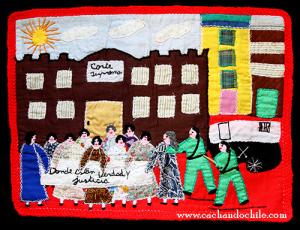
Image credit: Coordinadora Estudiantil Badajoz via Google Images
Previous Post

April 29, 2019
Torture and Society in Pinochet’s Chile
Next Post
May 3, 2019 Greta Thunberg, Pope Francis agree: It’s an Emergency
Browse Our Archives
Select a Category Advent Christmas Amazon Synod Angels Being Consumed Bible Catholic Modern Creed Ecology Economics Elizabeth Johnson Eucharist Fragments and Filaments Gender and Sex Gospel of Mark Herzog Historical Jesus Liturgy Luke Opening Scriptures on Way to Emmaus Ordinary radicals Parables Pro-Life Reincarnation Rosary Sacraments science Social Justice Souls Stories of Jesus The Creed Torture and Eucharist Tracy Uncategorized War and Peace
Select a Month October 2026 June 2025 April 2025 March 2025 February 2025 January 2025 November 2024 July 2024 March 2024 December 2023 October 2023 September 2023 August 2023 May 2023 April 2023 March 2023 February 2023 January 2023 December 2022 November 2022 October 2022 September 2022 August 2022 July 2022 June 2022 April 2022 March 2022 February 2022 January 2022 December 2021 November 2021 October 2021 August 2021 July 2021 June 2021 April 2021 March 2021 February 2021 December 2020 November 2020 October 2020 August 2020 July 2020 June 2020 May 2020 April 2020 March 2020 February 2020 January 2020 December 2019 November 2019 October 2019 September 2019 August 2019 July 2019 June 2019 May 2019 April 2019 March 2019 February 2019 January 2019 December 2018 November 2018 October 2018 September 2018 August 2018 July 2018 June 2018 May 2018
Follow Us!
TAKE THE
Religious Wisdom Quiz
How many books are in the Old Testament?
Select your answer to see how you score.
39 42 66 27
Related posts from Lost in a One-Acre Wood

The Eucharistic Imagination – Too Big for a...
Performing the Body of Christ against Torture in Chile
The Mystical Body and the True Body of Christ
A New Christendom Fails to Challenge the State
TRENDING AT PATHEOS Catholic

Creation, Preservation, and Teleology in Catholic Theology
As I write this, it is very early Monday morning. Like millions...

The Parable Of The Sower And The Word...
One of Christ’s most famous parables is that of the sower who...

Rejecting Doom: Christian Hope And Human Action
Christianity is a religion of hope. We are to have hope and...

Why I Choose the Eucharist Over the Sermon
Choose the Eucharist, Not the Sermon What are we supposed to get...

5 Design Elements Found in Spiritually Rooted Homes
Putting Spirituality Into Home Decor Our homes are more than our living...

Credo: A Story of God Told with the...
About 10 years ago, I began to imagine a personal "Credo" that...
view all Catholic blogs
Ad-Free & Subscriber Log-In Subscription Support
- About Us
- 2026 Calendar
- Videos
- Podcasts
- Library of World Religions
- Faith In Media Tracker
- Advertise With Us
- Write for Us
- Privacy Policy
- Terms of Service
- Do Not Sell My Data
- Contact Us
- Radiant Digital
- Manage Newsletter Subscriptions
- Unsubscribe From Notifications
- Sitemap
Copyright 2008-2026, Patheos. All rights reserved.
Subscription Support Ad-Free & Subscriber Log-In
Follow Patheos