
BuddhistCatholicContemplativeEvangelicalGeneral ChristianHinduJewishLatter-day SaintMuslimNew VisionsProgressive Christian
Beliefs
- Buddhist
- Catholic
- Contemplative
- Evangelical
- General Christian
- Hindu
- Jewish
- Latter-day Saint
- More Voices
- Muslim
- New Visions
- Pagan
- Progressive Christian
Topics
- Religion News
- Food and Religion
- Sports and Religion
- Religious Art
- Religious Music and Entertainment
- Religious Events
- History and Religion
- Style and Religion
- Politics and Religion
- Women in Religion
- Recreation Outdoors and Religion
- Business Finance and Religion
- Careers Workplace and Religion
- Education and Religion
- Family Parenting and Religion
- Health Fitness and Religion
- Home and Religion
- Relationships and Religion
- Technology and Religion
- Travel and Religion
Columnists
- Buddhist Columnists
- Business Finance and Religion Columnists
- Careers Workplace and Religion Columnists
- Catholic Columnists
- Contemplative Columnists
- Education and Religion Columnists
- Evangelists Columnists
- Family Parenting and Religion Columnists
- General Christian Columnists
- Health Fitness and Religion Columnists
- Hindu Columnists
- History and Religion Columnists
- Home and Religion Columnists
- Jewish Columnists
- More Voices Columnists
- Latter Day Columnists
- Muslim Columnists
- New Visions Columnists
- Nonreligious Columnists
- Pagan Columnists
- Politics and Religion Columnists
- Progressive Columnists
- Recreation Outdoors and Religion Columnists
- Relationships and Religion Columnists
- Religion News Columnists
- Religious Art Columnists
- Religious Events Columnists
- Religious Music and Entertainment Columnists
- Sports and Religion Columnists
- Style and Religion Columnists
- Technology and Religion Columnists
- Travel and Religion Columnists
- Women in Religion Columnists
Resource Library
- 2026 Calendar
- Library of World Religions
- The 100 Most Holy Places on Earth
- Patheos Answers
- Podcasts
- Videos
- Faith Leaders Database
- Anglican Episcopalian
- Bahai
- Baptist
- Buddhism
- Christianity
- Confucianism
- Eastern Orthodoxy
- Hinduism
- Holiness and Pentecostal
- ISKCON
- Islam
- Judaism
- Lutheran
- Methodist
- The Church of Jesus Christ of Latter-day Saints
- New Age
- Paganism
- Presbytarian and Reformed
- Protestantism
- Religion Behind the Scenes
- Roman Catholic
- Scientology
- Shia Islam
- Sikhism
- Sufism
- Sunni Islam
- Taoism
- Zen
- See all religions
Research Tools
 Ad-Free & Subscriber Log-In Subscription Support
Ad-Free & Subscriber Log-In Subscription Support
Follow Patheos 

- Trending:
- Forgiveness
- |
- Marriage
- |
- Consciousness
- |
- Death Penalty
- |
- Election
- |
- Halloween

- Home
- Catholic
- Torture and Eucharist: Theology, Politics and the Body of Christ, Introduction
Torture and Eucharist: Theology, Politics and the Body of Christ, Introduction
Last updated on: April 15, 2023 at 6:58 am by Jack Hartjes
Torture and Eucharist: Theology, Politics and the Body of Christ, Introduction 2023-04-15T06:58:50-06:00 Jack Hartjes
Patheos Explore the world's faith through different perspectives on religion and spirituality! Patheos has the views of the prevalent religions and spiritualities of the world.
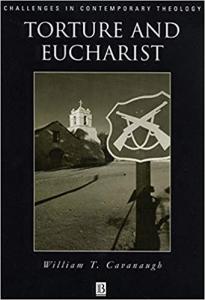
William T. Cavanaugh’s Torture and Eucharist covers the trials and the people and the journey of the Church during the Pinochet dictatorship in Chile.
It has occurred to me to wonder about Jesus’ suffering during his trial and execution. How would it compare to the pains that many others have had forced on them? What would Jesus’ sufferings mean for you if you actually suffered more than Jesus? William T. Cavanaugh begins his Torture and Eucharist, on the Chile of the Augusto Pinochet regime, with that question.
This is the second post on William T. Cavanaugh’s book Torture and Eucharist: Theology, Politics, and the Body of Christ. The book discusses the Church’s role in the world in general and the particular situation of the Church in Chile during the years of the Pinochet regime. Introduction and a developing table of contents for this series are here.
Suffering is a topic for meditation, for example, when we pray the Stations of the Cross. But it isn’t that Jesus’ physical pain was greater than everyone else’s. Jesus hung on the cross for three hours. His total passion, from its beginning at the Garden of Gethsemane to his death, lasted less than a day. History tells us other criminals (in the eyes of the Roman state) suffered for days on their crosses. Modern torture regimens typically go on for weeks or more. Of mental suffering, too, Jesus had plenty, but I wouldn’t say the mental suffering of the mother of a disappeared Chilean child was any less.
Martyrs
We say, in penitential mood, “By his stripes we are healed,” and imagine an infinite price Jesus paid for our salvation. Of course, we wouldn’t have been able to pay that price, but Jesus, because he was both God and man, could and did. That’s the account of atonement that has been taught for the nearly thousand years since St. Anselm. How does that understanding change when we realize Jesus’ “stripes” were not infinite, not even exceptional? What can Jesus’ suffering mean for one who actually has suffered more than Jesus? If it has any meaning, paying a price doesn’t seem to capture it.
The experience of suffering under the brutal Pinochet regime in Chile raises the question, What does Jesus’ suffering mean? Cavanaugh asks it in the very beginning of Torture and Eucharist. I don’t find an answer spelled out anywhere, but the story that he tells, of torture’s effects and the people’s response, gives a kind of answer. It does not depend on quantifying torture but on the voluntariness of joining oneself to others’ suffering. The career of Pinochet nears its end when martyrs appear among torture’s victims.
Torture and the modern state
One of Cavanaugh’s long-term interests is the origin and meaning of the modern state. He pursues this theme in other writings, like Migrations of the Holy: God, State, and the Political Meaning of the Church. In Torture and Eucharist Cavanaugh names the project of the modern state one of “creating individuals.” The state isolates people from each other and weakens traditional groupings within which they formerly found support. I think Cavanaugh would agree that this result comes not from the state as a political entity alone but in conjunction with a closely tied capitalist economy.
That project of making individuals depend on nothing but the state is on view in Pinochet’s Chile, particularly in its use of torture. Torture
… atomizes the citizenry through fear, thereby dismantling other social bodies which would rival the state’s authority over individual bodies. (2)
Chile under Pinochet was an extreme example of what modern states do generally, though more subtly.
Torture was different in ancient and medieval times. In those days regimes used torture for punishment and reform of the individual. In wartime torture was used to extract information. Society with its traditions and support groups carried on, chastened perhaps but not fundamentally changed. In Chile the torture process aimed to remake society. Society would become merely a collection of isolated individuals dependent only on the state.
The modern state presents itself as the guarantor of the rights of the individual against other, more powerful individuals. Families, guilds or unions, professional organizations, churches and other intermediary social bodies also have a role. When these latter institutions atrophy, one of the results of the state’s use of torture, the individual has little recourse. The plot line of Torture and Eucharist involves the re-emergence of the Church as an effective social body, the Body of Christ.
Some themes at play in Torture and Eucharist
The distinction between state and society is important throughout Torture and Eucharist. So also is the separation of politics and religion. In the imagination of the state, both society and religion are areas of conflict, from which the state “saves” us. The state appropriates all legitimate use of violence to itself. It’s a common theme today, but Cavanaugh questions “this imagination of a prior conflict from which the state saves us.” (p. 8)
Liturgy is another theme important for Cavanaugh. He calls torture a perverted liturgy. Torture is a sign and realization of the state’s power. The perverted liturgy of torture organizes bodies
… into a collective performance, not of true community, but of an atomized aggregate of mutually suspicious individuals.” (p. 12)
Cavanaugh criticizes the idea that reduces the Church’s liturgy to signs of grace already active in the world. There is a kind of counter-politics at play in the liturgy, especially the Eucharist. The Eucharist is sign but also reality of God’s grace in the world. It is “true politics,” “the public performance of the true eschatological City of God in the midst of another City which is passing away.” (p. 14)
Concluding the Introduction
Cavanaugh describes two difficulties in writing Torture and Eucharist. The first is the difficult task of the attempt by an outsider to let Chilean voices speak. The second is the difficulty of knowing how and whether to make generalizations from the Chileans’ experience.
The events in this book happened in Chile in the 1970’s and 80’s. The danger is for North Americans to breathe a sigh of relief: “Thank Goodness, that doesn’t happen here.” But when it comes to torture, the leaders of the “free” world are not innocent. More than that, “even where torture is absent the power of modern states is often predicated on the same control of bodies and individualization of the citizenry at which torture aims.” (p. 15)
For me the importance of Torture and Eucharist is in the way it expands the notion of body. There are social as well as individual bodies. The focus on body adds new and counter-cultural meaning to Church and Eucharist. That will become clear in the posts to follow.
Image credit: Amazon.com via Google Images
Next Post

April 29, 2019 Torture and Society in Pinochet’s Chile
Browse Our Archives
Select a Category Advent Christmas Amazon Synod Angels Being Consumed Bible Catholic Modern Creed Ecology Economics Elizabeth Johnson Eucharist Fragments and Filaments Gender and Sex Gospel of Mark Herzog Historical Jesus Liturgy Luke Opening Scriptures on Way to Emmaus Ordinary radicals Parables Pro-Life Reincarnation Rosary Sacraments science Social Justice Souls Stories of Jesus The Creed Torture and Eucharist Tracy Uncategorized War and Peace
Select a Month October 2026 June 2025 April 2025 March 2025 February 2025 January 2025 November 2024 July 2024 March 2024 December 2023 October 2023 September 2023 August 2023 May 2023 April 2023 March 2023 February 2023 January 2023 December 2022 November 2022 October 2022 September 2022 August 2022 July 2022 June 2022 April 2022 March 2022 February 2022 January 2022 December 2021 November 2021 October 2021 August 2021 July 2021 June 2021 April 2021 March 2021 February 2021 December 2020 November 2020 October 2020 August 2020 July 2020 June 2020 May 2020 April 2020 March 2020 February 2020 January 2020 December 2019 November 2019 October 2019 September 2019 August 2019 July 2019 June 2019 May 2019 April 2019 March 2019 February 2019 January 2019 December 2018 November 2018 October 2018 September 2018 August 2018 July 2018 June 2018 May 2018
Follow Us!
TAKE THE
Religious Wisdom Quiz
In the Parable of the Pearl of Great Price, what does the merchant do?
Select your answer to see how you score.
Sells all to buy the pearl Builds a bigger barn Buys many pearls Finds a lost coin
Related posts from Lost in a One-Acre Wood

“Drink the Cup” – Liturgy Teaches Us Eucharistic...

Holy Thursday Theology and the Scientific Quest for...

Kneeling Through the Communion Rite: Now I Get...

Economic Scarcity and Eucharistic Abundance: Two Stories about...
TRENDING AT PATHEOS Catholic

Creation, Preservation, and Teleology in Catholic Theology
As I write this, it is very early Monday morning. Like millions...

The Parable Of The Sower And The Word...
One of Christ’s most famous parables is that of the sower who...

Rejecting Doom: Christian Hope And Human Action
Christianity is a religion of hope. We are to have hope and...

Why I Choose the Eucharist Over the Sermon
Choose the Eucharist, Not the Sermon What are we supposed to get...

5 Design Elements Found in Spiritually Rooted Homes
Putting Spirituality Into Home Decor Our homes are more than our living...

Credo: A Story of God Told with the...
About 10 years ago, I began to imagine a personal "Credo" that...
view all Catholic blogs
Ad-Free & Subscriber Log-In Subscription Support
- About Us
- 2026 Calendar
- Videos
- Podcasts
- Library of World Religions
- Faith In Media Tracker
- Advertise With Us
- Write for Us
- Privacy Policy
- Terms of Service
- Do Not Sell My Data
- Contact Us
- Radiant Digital
- Manage Newsletter Subscriptions
- Unsubscribe From Notifications
- Sitemap
Copyright 2008-2026, Patheos. All rights reserved.
Subscription Support Ad-Free & Subscriber Log-In
Follow Patheos