
BuddhistCatholicContemplativeEvangelicalGeneral ChristianHinduJewishLatter-day SaintMuslimNew VisionsProgressive Christian
Beliefs
- Buddhist
- Catholic
- Contemplative
- Evangelical
- General Christian
- Hindu
- Jewish
- Latter-day Saint
- More Voices
- Muslim
- New Visions
- Pagan
- Progressive Christian
Topics
- Religion News
- Food and Religion
- Sports and Religion
- Religious Art
- Religious Music and Entertainment
- Religious Events
- History and Religion
- Style and Religion
- Politics and Religion
- Women in Religion
- Recreation Outdoors and Religion
- Business Finance and Religion
- Careers Workplace and Religion
- Education and Religion
- Family Parenting and Religion
- Health Fitness and Religion
- Home and Religion
- Relationships and Religion
- Technology and Religion
- Travel and Religion
Columnists
- Buddhist Columnists
- Business Finance and Religion Columnists
- Careers Workplace and Religion Columnists
- Catholic Columnists
- Contemplative Columnists
- Education and Religion Columnists
- Evangelists Columnists
- Family Parenting and Religion Columnists
- General Christian Columnists
- Health Fitness and Religion Columnists
- Hindu Columnists
- History and Religion Columnists
- Home and Religion Columnists
- Jewish Columnists
- More Voices Columnists
- Latter Day Columnists
- Muslim Columnists
- New Visions Columnists
- Nonreligious Columnists
- Pagan Columnists
- Politics and Religion Columnists
- Progressive Columnists
- Recreation Outdoors and Religion Columnists
- Relationships and Religion Columnists
- Religion News Columnists
- Religious Art Columnists
- Religious Events Columnists
- Religious Music and Entertainment Columnists
- Sports and Religion Columnists
- Style and Religion Columnists
- Technology and Religion Columnists
- Travel and Religion Columnists
- Women in Religion Columnists
Resource Library
- 2026 Calendar
- Library of World Religions
- The 100 Most Holy Places on Earth
- Patheos Answers
- Podcasts
- Videos
- Faith Leaders Database
- Anglican Episcopalian
- Bahai
- Baptist
- Buddhism
- Christianity
- Confucianism
- Eastern Orthodoxy
- Hinduism
- Holiness and Pentecostal
- ISKCON
- Islam
- Judaism
- Lutheran
- Methodist
- The Church of Jesus Christ of Latter-day Saints
- New Age
- Paganism
- Presbytarian and Reformed
- Protestantism
- Religion Behind the Scenes
- Roman Catholic
- Scientology
- Shia Islam
- Sikhism
- Sufism
- Sunni Islam
- Taoism
- Zen
- See all religions
Research Tools
 Ad-Free & Subscriber Log-In Subscription Support
Ad-Free & Subscriber Log-In Subscription Support
Follow Patheos 

- Trending:
- Forgiveness
- |
- Marriage
- |
- Consciousness
- |
- Death Penalty
- |
- Election
- |
- Halloween

- Home
- Catholic
- Faith that can Move Mountains … or Not
Faith that can Move Mountains … or Not
Last updated on: April 29, 2019 at 7:49 am by Jack Hartjes
Faith that can Move Mountains … or Not 2019-04-29T07:49:38-06:00 Jack Hartjes
Patheos Explore the world's faith through different perspectives on religion and spirituality! Patheos has the views of the prevalent religions and spiritualities of the world.
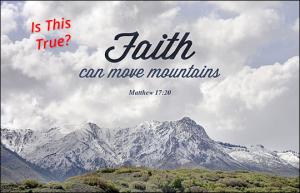
Or, is Jesus talking about something other than the quantity of our faith?
It’s Tuesday after the first “Palm Sunday,” that is, after the day Jesus paraded into Jerusalem on a donkey. Jesus wants to teach something about faith, but what exactly? Yesterday Jesus performed in the temple what we would call an act of civil disobedience. He created a ruckus. (Disagreeing with the first three gospels, the Gospel of John says it happened earlier in Jesus’ ministry. Scholars are not sure whom to believe about the time, but they’re pretty sure, at least, that the demonstration in the temple did happen.)
Monday (according to Matthew, Mark, and Luke) began with a hard-to-figure case of Jesus in a bad mood. He cursed a fig tree for not giving him fruit when it wasn’t even the season for figs. Today, Tuesday, and we see what happened to the fig tree. With the apostles we are astonished to see that the tree is withered to its roots. Then comes a passage in Scripture that has bothered me like few others. This is what Jesus says:
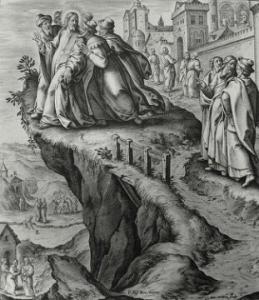
Have faith in God. Amen, I say to you, whoever says to this mountain, ‘Be lifted up and thrown into the sea,’ and does not doubt in his heart but believes that what he says will happen, it shall be done for him. (Mark 11:23)
Well, Jesus might be able to pray a fig tree to death, but I don’t think that I can move a mountain. In fact, I can think of a lot of things, some of them even worthwhile, that I could pray for–and have prayed for–most of which won’t come true. I’m a sucker for hopeless causes.
New appreciation for an obscure saying
Posters and bumper stickers that say, “Faith can move mountains” or “Have faith and your prayers will be answered” really bug me. It’s like saying, when God doesn’t answer my prayers, it’s my fault. I didn’t have enough faith. I didn’t believe hard enough.
So I never liked this passage in Scripture–that is, until I read Binding the Strong Man by Ched Myers. I’ve posted on him before and will probably do so again. Myers says (p. 302-5) “this mountain,” the one to be thrown into the sea isn’t just any mountain. It’s the mountain on which the Temple stands, the Temple Mount. In other words Jesus is clarifying the meaning of the previous day’s demonstration in the Temple. He’s saying the days of the Temple, along with the religious-political-economic structure that it symbolized and anchored, are numbered. That system, with its purity codes, inflexible Sabbath regulations, and complex scribal interpretations of the law–all of which discriminated against the poor and further advantaged the rich–has been the nearly constant target of Jesus’ attacks in Mark’s story.
The curse and the subsequent death of the fig tree, unlike the incident in the Temple, is not high on scholars’ lists of things that probably happened. But Mark puts it in his story like a sandwich around the demonstration in the Temple–first the curse, then the demonstration, then the withered tree. That, too, makes clear for Mark’s readers that Jesus intends an actual destruction of the way of the Temple, not merely a “Cleansing of the Temple” as most Bibles name that story.
Faith and political imagination
Jesus goes on to say,
Therefore I tell you, all that you ask for in prayer, believe that you will receive it and it shall be yours. (Mark 11:24)
Myers thinks this is meant to enlarge one’s “political imagination.” It says, if the bigger-than-life Temple can fall, anything can happen. So it’s about prayer and faith but the context is political. But prayer and faith are important parts of Jesus’ politics. That’s because Jesus’ (and Mark’s) political methods aren’t the normal sort. Mark especially is under a lot of pressure in that respect. There’s a rebellion against the Roman occupation on one side. There are Jewish collaborators with Rome on the other. The Christian community is caught in the middle.
Mark believes, with Jesus, that there’s something bigger than moving a mountain and more important than defeating the Romans. That, by the way, didn’t happen–the Romans destroyed Jerusalem and the Temple around the time that Mark wrote. Seeing an end to the course of domination in human affairs, whether by the military power of Rome or by the religious power of Jewish elites, that’s worth living and dying for. That’s why Jesus rejected the temptation to be a world conqueror and went to the Cross instead.
To support the cause of the oppressed, but to forsake violence, which only leads to another round of domination, puts one in danger from both sides. That’s the “cross” Mark urges on his community and us. Faith and prayer–and maybe only those–can sustain that kind of struggle.
Image credit: Neverthirsty via Google Images
Previous Post

April 12, 2019
Does the Bible Mean what it Says? – Yes, if You Know the Idiom.
Browse Our Archives
Select a Category Advent Christmas Amazon Synod Angels Being Consumed Bible Catholic Modern Creed Ecology Economics Elizabeth Johnson Eucharist Fragments and Filaments Gender and Sex Gospel of Mark Herzog Historical Jesus Liturgy Luke Opening Scriptures on Way to Emmaus Ordinary radicals Parables Pro-Life Reincarnation Rosary Sacraments science Social Justice Souls Stories of Jesus The Creed Torture and Eucharist Tracy Uncategorized War and Peace
Select a Month October 2026 June 2025 April 2025 March 2025 February 2025 January 2025 November 2024 July 2024 March 2024 December 2023 October 2023 September 2023 August 2023 May 2023 April 2023 March 2023 February 2023 January 2023 December 2022 November 2022 October 2022 September 2022 August 2022 July 2022 June 2022 April 2022 March 2022 February 2022 January 2022 December 2021 November 2021 October 2021 August 2021 July 2021 June 2021 April 2021 March 2021 February 2021 December 2020 November 2020 October 2020 August 2020 July 2020 June 2020 May 2020 April 2020 March 2020 February 2020 January 2020 December 2019 November 2019 October 2019 September 2019 August 2019 July 2019 June 2019 May 2019 April 2019 March 2019 February 2019 January 2019 December 2018 November 2018 October 2018 September 2018 August 2018 July 2018 June 2018 May 2018
Follow Us!
TAKE THE
Religious Wisdom Quiz
True or False: 1 John teaches that if we say we have no sin, we deceive ourselves.
Select your answer to see how you score.
TRUE FALSE
Related posts from Lost in a One-Acre Wood
Resurrection: For the Apostles, It Took a While...
CRUCIFY HIM! -- What the Jews Did or...
The Misunderstood Messiah: Jesus’ Friends Don’t Get It
Unsuccessful Prophet: Jesus Fails to Win His Own
TRENDING AT PATHEOS Catholic

Creation, Preservation, and Teleology in Catholic Theology
As I write this, it is very early Monday morning. Like millions...

The Parable Of The Sower And The Word...
One of Christ’s most famous parables is that of the sower who...

Rejecting Doom: Christian Hope And Human Action
Christianity is a religion of hope. We are to have hope and...

Why I Choose the Eucharist Over the Sermon
Choose the Eucharist, Not the Sermon What are we supposed to get...

5 Design Elements Found in Spiritually Rooted Homes
Putting Spirituality Into Home Decor Our homes are more than our living...

Credo: A Story of God Told with the...
About 10 years ago, I began to imagine a personal "Credo" that...
view all Catholic blogs
Ad-Free & Subscriber Log-In Subscription Support
- About Us
- 2026 Calendar
- Videos
- Podcasts
- Library of World Religions
- Faith In Media Tracker
- Advertise With Us
- Write for Us
- Privacy Policy
- Terms of Service
- Do Not Sell My Data
- Contact Us
- Radiant Digital
- Manage Newsletter Subscriptions
- Unsubscribe From Notifications
- Sitemap
Copyright 2008-2026, Patheos. All rights reserved.
Subscription Support Ad-Free & Subscriber Log-In
Follow Patheos