
BuddhistCatholicContemplativeEvangelicalGeneral ChristianHinduJewishLatter-day SaintMuslimNew VisionsProgressive Christian
Beliefs
- Buddhist
- Catholic
- Contemplative
- Evangelical
- General Christian
- Hindu
- Jewish
- Latter-day Saint
- More Voices
- Muslim
- New Visions
- Pagan
- Progressive Christian
Topics
- Religion News
- Food and Religion
- Sports and Religion
- Religious Art
- Religious Music and Entertainment
- Religious Events
- History and Religion
- Style and Religion
- Politics and Religion
- Women in Religion
- Recreation Outdoors and Religion
- Business Finance and Religion
- Careers Workplace and Religion
- Education and Religion
- Family Parenting and Religion
- Health Fitness and Religion
- Home and Religion
- Relationships and Religion
- Technology and Religion
- Travel and Religion
Columnists
- Buddhist Columnists
- Business Finance and Religion Columnists
- Careers Workplace and Religion Columnists
- Catholic Columnists
- Contemplative Columnists
- Education and Religion Columnists
- Evangelists Columnists
- Family Parenting and Religion Columnists
- General Christian Columnists
- Health Fitness and Religion Columnists
- Hindu Columnists
- History and Religion Columnists
- Home and Religion Columnists
- Jewish Columnists
- More Voices Columnists
- Latter Day Columnists
- Muslim Columnists
- New Visions Columnists
- Nonreligious Columnists
- Pagan Columnists
- Politics and Religion Columnists
- Progressive Columnists
- Recreation Outdoors and Religion Columnists
- Relationships and Religion Columnists
- Religion News Columnists
- Religious Art Columnists
- Religious Events Columnists
- Religious Music and Entertainment Columnists
- Sports and Religion Columnists
- Style and Religion Columnists
- Technology and Religion Columnists
- Travel and Religion Columnists
- Women in Religion Columnists
Resource Library
- 2026 Calendar
- Library of World Religions
- The 100 Most Holy Places on Earth
- Patheos Answers
- Podcasts
- Videos
- Faith Leaders Database
- Anglican Episcopalian
- Bahai
- Baptist
- Buddhism
- Christianity
- Confucianism
- Eastern Orthodoxy
- Hinduism
- Holiness and Pentecostal
- ISKCON
- Islam
- Judaism
- Lutheran
- Methodist
- The Church of Jesus Christ of Latter-day Saints
- New Age
- Paganism
- Presbytarian and Reformed
- Protestantism
- Religion Behind the Scenes
- Roman Catholic
- Scientology
- Shia Islam
- Sikhism
- Sufism
- Sunni Islam
- Taoism
- Zen
- See all religions
Research Tools
 Ad-Free & Subscriber Log-In Subscription Support
Ad-Free & Subscriber Log-In Subscription Support
Follow Patheos 

- Trending:
- Forgiveness
- |
- Marriage
- |
- Consciousness
- |
- Death Penalty
- |
- Election
- |
- Halloween

- Home
- Catholic
- The Beatitudes: Blessed are We Poor
The Beatitudes: Blessed are We Poor
Last updated on: October 9, 2022 at 2:24 am by Jack Hartjes
The Beatitudes: Blessed are We Poor 2022-10-09T02:24:51-06:00 Jack Hartjes
Patheos Explore the world's faith through different perspectives on religion and spirituality! Patheos has the views of the prevalent religions and spiritualities of the world.
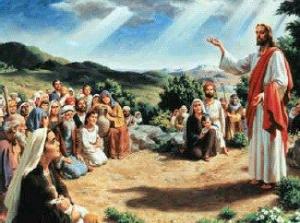
We may think about the Beatitudes one way and Jesus another. And that’s OK.
It was in the middle of a plain, or was it on a mountain? It started with what we call the Beatitudes, and it was a great speech. Or was it an editor’s gathering of things Jesus said on many separate occasions?
The story appears in Matthew and Luke, both of whom relied on an earlier source now lost. Matthew is the one who gives us the “Sermon on the Mountain.” The mountain makes us think of Jesus as the fulfillment of the law, the new Moses. As Moses receives the Law from God on a mountain in the Exodus story, so — in Matthew — Jesus gives the new Law on a mountain. Luke, perhaps less theologically motivated in this instance than Matthew, gives us a sermon on a plain.
Beatitudes in two versions
The Beatitudes, which start the sermon, wherever it occurred, comprise one of the more misunderstood—or decisively reinterpreted—teachings of Jesus. To understand what Jesus meant by the Beatitudes, it’s necessary to find out what he actually, probably, said. The two versions are very different. Here is Matthew’s version, followed by Luke’s (the numbers, of course, are not in the original):
Matthew
- Blessed are the poor in spirit, for theirs is the kingdom of heaven.
- Blessed are they who mourn, for they will be comforted.
- Blessed are the meek, for they will inherit the land.
- Blessed are they who hunger and thirst for righteousness, for they will be satisfied.
- Blessed are the merciful, for they will be shown mercy.
- Blessed are the clean of heart, for they will see God.
- Blessed are the peacemakers, for they will be called children of God.
- Blessed are they who are persecuted for the sake of righteousness, for theirs is the kingdom of heaven. Blessed are you when they insult you and persecute you and utter every kind of evil against you (falsely) because of me. Rejoice and be glad, for your reward will be great in heaven. Thus they persecuted the prophets who were before you. (Matthew 5: 3-12)
Luke
- Blessed are you who are poor, for the kingdom of God is yours.
- Blessed are you who are now hungry, for you will be satisfied.
- Blessed are you who are now weeping, for you will laugh.
- Blessed are you when people hate you, and when they exclude and insult you, and denounce your name as evil on account of the Son of Man. Rejoice and leap for joy on that day! Behold, your reward will be great in heaven. For their ancestors treated the prophets in the same way. (Luke 6:20-23)
The new law or something else
People often think of the Beatitudes as Jesus’ addition to and improvement on the 10 Commandments of Moses. They show us how to live in ways that go beyond the ‘Thou shalt not’s of the Mosaic Law. This interpretation comes naturally from Matthew’s version of what Jesus said. For six of the eight Beatitudes, Matthew’s are all actions or attitudes that we can choose—new laws we can follow. No matter how rich or poor you are, you can be poor “in spirit.” You can be meek and mild mannered, if you try. You can have hope that the right will triumph, extend mercy to others, avoid the distractions that turn your heart away from your true purpose in life, work for peace.
Luke’s version of the Beatitudes is a lot shorter. None of Luke’s Beatitudes are things that a person does or controls. Here Jesus isn’t adding to the commandments, giving prescriptions for how to live or telling us to shape up our attitudes. He’s not telling rich people to be poor in spirit and not even talking to rich people. He’s addressing very intimately “you who are poor.” His concern is just the practical situation of life for most of the people in his audience.
In this sermon there’s no metaphorical hunger for righteousness. Jesus’ audience consists of people who literally don’t have enough to eat. There are people who are not just mourning (Matthew’s word) but weeping. And Jesus describes the situation of every poor person in Judea and Galilee with “when people hate you, and when they exclude and insult you.” Jesus’ listeners were overwhelmingly, even if not entirely, from among those who were poor; but this last saying indicates the situation of any of his followers (and his own situation). People will “denounce your name as evil on account of the Son of Man.” That is, they will consider you a heretic. And Jesus calls these people blessed.
Jesus’ poverty, and God’s?
Most scholars think Luke has the more accurate rendering of Jesus’ words. Matthew reinterprets. That’s not to say there’s something wrong with Matthew’s version. It’s a beautiful and justly loved statement of what the ideal Christian life is like. I think Jesus would agree with all of it. But Jesus was actually talking about the reality of the lives of the people in front of him, and his own life as well. For Jesus the poor are “we.” And “We” are blessed. Jesus was poor.
I’m accustomed to saying “Jesus is God.” It’s a statement that seems to be about Jesus, but it’s odd. “Jesus” is the subject, and “God,” the predicate, is expected to help me understand something about Jesus. But God is what I understand least of all. When I try to apply what I seem to understand about God, things like omnipotence, omniscience, impassibility, etc., it doesn’t work. Jesus doesn’t seem like any of those things. “Jesus is God” works best backwards. I do know quite a bit about Jesus. For believers Jesus is the one who helps understand God.
And Jesus was poor. What does that fact about Jesus tell me about God? God’s poverty consists in God’s giving his very self away, first to the Son, then to the world God creates. I imagine it’s a true gift, not calculated on getting something back. Jesus imitates this original poverty:
For you know the grace of our Lord Jesus Christ, that though he was rich, yet for your sake he became poor, so that you through his poverty might become rich. (2 Corinthians 8:9)
Then Matthew is on the right track, after all. The very first blessedness is being “poor in spirit.”
Image credit: Mike’s Place on the Web via Google Images
Previous Post

April 1, 2019
The Unbrokered Kingdom and Jesus’ Wandering Ways
Next Post
April 8, 2019 Unsuccessful Prophet: Jesus Fails to Win His Own
Browse Our Archives
Select a Category Advent Christmas Amazon Synod Angels Being Consumed Bible Catholic Modern Creed Ecology Economics Elizabeth Johnson Eucharist Fragments and Filaments Gender and Sex Gospel of Mark Herzog Historical Jesus Liturgy Luke Opening Scriptures on Way to Emmaus Ordinary radicals Parables Pro-Life Reincarnation Rosary Sacraments science Social Justice Souls Stories of Jesus The Creed Torture and Eucharist Tracy Uncategorized War and Peace
Select a Month October 2026 June 2025 April 2025 March 2025 February 2025 January 2025 November 2024 July 2024 March 2024 December 2023 October 2023 September 2023 August 2023 May 2023 April 2023 March 2023 February 2023 January 2023 December 2022 November 2022 October 2022 September 2022 August 2022 July 2022 June 2022 April 2022 March 2022 February 2022 January 2022 December 2021 November 2021 October 2021 August 2021 July 2021 June 2021 April 2021 March 2021 February 2021 December 2020 November 2020 October 2020 August 2020 July 2020 June 2020 May 2020 April 2020 March 2020 February 2020 January 2020 December 2019 November 2019 October 2019 September 2019 August 2019 July 2019 June 2019 May 2019 April 2019 March 2019 February 2019 January 2019 December 2018 November 2018 October 2018 September 2018 August 2018 July 2018 June 2018 May 2018
Follow Us!
TAKE THE
Religious Wisdom Quiz
Who was the brother of Moses and helped him confront Pharaoh?
Select your answer to see how you score.
Joseph David Joshua Aaron
Related posts from Lost in a One-Acre Wood
Resurrection: For the Apostles, It Took a While...
CRUCIFY HIM! -- What the Jews Did or...
Faith that can Move Mountains … or Not
The Misunderstood Messiah: Jesus’ Friends Don’t Get It
TRENDING AT PATHEOS Catholic

Rejecting Doom: Christian Hope And Human Action
Christianity is a religion of hope. We are to have hope and...

It’s What Comes From Within Which Matters
One of the most difficult things for us to understand is why...

Why I Choose the Eucharist Over the Sermon
Choose the Eucharist, Not the Sermon What are we supposed to get...

5 Design Elements Found in Spiritually Rooted Homes
Putting Spirituality Into Home Decor Our homes are more than our living...

Credo: A Story of God Told with the...
About 10 years ago, I began to imagine a personal "Credo" that...

The Anatomy of Divine Revelation in Catholic Thought
The claim that God has made Himself known to human beings is...
view all Catholic blogs
Ad-Free & Subscriber Log-In Subscription Support
- About Us
- 2026 Calendar
- Videos
- Podcasts
- Library of World Religions
- Faith In Media Tracker
- Advertise With Us
- Write for Us
- Privacy Policy
- Terms of Service
- Do Not Sell My Data
- Contact Us
- Radiant Digital
- Manage Newsletter Subscriptions
- Unsubscribe From Notifications
- Sitemap
Copyright 2008-2026, Patheos. All rights reserved.
Subscription Support Ad-Free & Subscriber Log-In
Follow Patheos