
BuddhistCatholicContemplativeEvangelicalGeneral ChristianHinduJewishLatter-day SaintMuslimNew VisionsProgressive Christian
Beliefs
- Buddhist
- Catholic
- Contemplative
- Evangelical
- General Christian
- Hindu
- Jewish
- Latter-day Saint
- More Voices
- Muslim
- New Visions
- Pagan
- Progressive Christian
Topics
- Religion News
- Food and Religion
- Sports and Religion
- Religious Art
- Religious Music and Entertainment
- Religious Events
- History and Religion
- Style and Religion
- Politics and Religion
- Women in Religion
- Recreation Outdoors and Religion
- Business Finance and Religion
- Careers Workplace and Religion
- Education and Religion
- Family Parenting and Religion
- Health Fitness and Religion
- Home and Religion
- Relationships and Religion
- Technology and Religion
- Travel and Religion
Columnists
- Buddhist Columnists
- Business Finance and Religion Columnists
- Careers Workplace and Religion Columnists
- Catholic Columnists
- Contemplative Columnists
- Education and Religion Columnists
- Evangelists Columnists
- Family Parenting and Religion Columnists
- General Christian Columnists
- Health Fitness and Religion Columnists
- Hindu Columnists
- History and Religion Columnists
- Home and Religion Columnists
- Jewish Columnists
- More Voices Columnists
- Latter Day Columnists
- Muslim Columnists
- New Visions Columnists
- Nonreligious Columnists
- Pagan Columnists
- Politics and Religion Columnists
- Progressive Columnists
- Recreation Outdoors and Religion Columnists
- Relationships and Religion Columnists
- Religion News Columnists
- Religious Art Columnists
- Religious Events Columnists
- Religious Music and Entertainment Columnists
- Sports and Religion Columnists
- Style and Religion Columnists
- Technology and Religion Columnists
- Travel and Religion Columnists
- Women in Religion Columnists
Resource Library
- 2026 Calendar
- Library of World Religions
- The 100 Most Holy Places on Earth
- Patheos Answers
- Podcasts
- Videos
- Faith Leaders Database
- Anglican Episcopalian
- Bahai
- Baptist
- Buddhism
- Christianity
- Confucianism
- Eastern Orthodoxy
- Hinduism
- Holiness and Pentecostal
- ISKCON
- Islam
- Judaism
- Lutheran
- Methodist
- The Church of Jesus Christ of Latter-day Saints
- New Age
- Paganism
- Presbytarian and Reformed
- Protestantism
- Religion Behind the Scenes
- Roman Catholic
- Scientology
- Shia Islam
- Sikhism
- Sufism
- Sunni Islam
- Taoism
- Zen
- See all religions
Research Tools
 Ad-Free & Subscriber Log-In Subscription Support
Ad-Free & Subscriber Log-In Subscription Support
Follow Patheos 

- Trending:
- Forgiveness
- |
- Marriage
- |
- Consciousness
- |
- Death Penalty
- |
- Election
- |
- Halloween

- Home
- Catholic
- The Unbrokered Kingdom and Jesus’ Wandering Ways
The Unbrokered Kingdom and Jesus’ Wandering Ways
Last updated on: April 1, 2019 at 6:51 am by Jack Hartjes
The Unbrokered Kingdom and Jesus’ Wandering Ways 2019-04-01T06:51:58-06:00 Jack Hartjes
Patheos Explore the world's faith through different perspectives on religion and spirituality! Patheos has the views of the prevalent religions and spiritualities of the world.
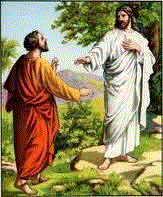
People of Capernaum may have wanted him to set up shop in their town, but instead he went throughout Galilee, heralding God’s unbrokered kingdom.
Looking at Jesus from a distance, an observer would notice one thing especially: he didn’t stay long in one place. If actions speak louder than words, one would want to understand what message Jesus’ wandering ways convey. This post traces a sort of journey in my thinking with help from John Dominic Crossan and his idea of the unbrokered kingdom.
I tend to think about Jesus’ poverty and imagine that says something important about God. Crossan, in The Historical Jesus: The Life of a Mediterranean, Jewish Peasant, brings up a more political dimension. Jesus’ itinerant lifestyle, going to where people are, replaces the usual power relations in society with an unbrokered kingdom. Brokers, intermediaries between the people and the high and mighty, are absent in the unbrokered kingdom Jesus heralds.
This is the 16th in the series “Stories of Jesus and the Character of God.” We’re looking at episodes of Jesus’ journey from Temptation to Cross. The whole series aims to find in Jesus clues to what God is like. Developing Table of Contents for the series here.
Going everywhere, but nowhere home
Jesus spoke loudest by his actions, and one typical action was to go wherever people were. It wasn’t what people expected of a charismatic religious figure. John the Baptist was more typical. He stayed in the wilderness areas along the Jordan River, eating locusts and wild honey and dressing inappropriately for social occasions. And people came to him by the hundreds or thousands.
Jesus was not comfortable when crowds came to him. Luke records that large crowds assembled after Jesus performed a miracle. They were hoping that they too would be cured of some ailment or at least be in on someone else’s good fortune. But Jesus withdrew to a secluded place to pray. (Luke 5:15-16) Another time when people from Capernaum were searching for Jesus, Jesus left saying he must preach the good news to other towns. (Mark 1:35-38)
Jesus didn’t set up shop and say “Come to me.” Instead of established figure, he enjoyed the role of wandering preacher. “Foxes have holes, and birds of the air have nests; but the Son of Man has nowhere to lay his head.” (Luke 9:58) That was Jesus’ choice.
A closer look at a “day” in Capernaum
It’s interesting to see in Jesus’ homeless state a clue to what God must be like. We think of the whole universe as God’s world, God’s possession, but does God think that way? We don’t really understand God except by looking at Jesus. In Jesus we see is one who gathers no possessions but scatters even himself among the people and towns of Galilee. Is it possible to think of a non-possessive God, a God who doesn’t have things that belong to him but instead gives himself to be possessed by all that is not God.
That is my first thought about the Jesus who has no home. John Dominic Crossan has another idea. It starts with a closer look at the “day” in Capernaum when “everyone” was searching for Jesus. Crossan thinks the day exists more in Mark’s mind than in actual fact. Mark probably brings together a number of separate incidents and adds his own color.) Here’s the story:
Jesus picks up followers around the Sea of Galilee—Simon, Andrew, James, John. All of them leave their occupations – they were fishers – and follow Jesus
They go to Capernaum, where Jesus preaches with amazing authority and exercises amazing power over an unclean spirit. At Simon and Andrew’s house the find that Simon’s mother-in-law has a fever. Jesus helps her out of bed and the fever leaves her. It’s still the Sabbath. Work is not allowed, but I guess that hardly counts as work.
That evening, after Sabbath is over, crowds come and Jesus gets down to serious work. He cures many who were sick or possessed, gaining quite a following. Surprisingly, the next morning, “while it was still very dark,” he leaves them all behind. Simon and companions find him and inform him, “Everyone is searching for you.” Jesus says he came out to go on to the neighboring towns.
The unbrokered kingdom
Crossan isn’t satisfied with the bare bones of a story where Jesus acquires an admiring crowd and then leaves them. (The Historical Jesus, p. 345-48) He looks at the crowd’s and Peter’s motivation, at typical expectations of a person with remarkable powers, and Jesus’ radical departure from the norm.
First, the expectations. The normal thing was for a person with healing powers to set up shop somewhere. It would be an efficient way to provide a service. More than that, it would be an economic boon to whatever locality could host such a facility. Crossan thinks that’s at least part of the motivation of the crowd who went in search of Jesus.
As for Peter’s motivation, Mark in several places highlights the difference between Peter’s and other apostles’ goals and those of Jesus. In every case the disciple desires a position of influence or glory. In this particular case the disciples would be the ones who organized access to Jesus and Jesus the one who created access to God’s healing power.
Crossan says that is the typical way the world organizes itself – into a hierarchy of honor and power. You go through an intermediary, a broker, or perhaps even a series of them, before you get to the one whose help you need. The radicalness of Jesus consists precisely in that people’s access to him is unbrokered. He goes to them directly. Or they come to him – even children, whom the disciples tried to keep away.
Jesus doesn’t regard himself as the ultimate broker between people and God. “The kingdom of God is among you.” (Luke 17:21) Jesus heralds an unbrokered kingdom. There must be no hierarchies in God’s kingdom. God is infinitely approachable. Well, that’s what John Dominic Crossan reads into story about events at Capernaum. I think it makes sense.
Image credit: Pinterest via Google Images
Next Post

April 4, 2019 The Beatitudes: Blessed are We Poor
Browse Our Archives
Select a Category Advent Christmas Amazon Synod Angels Being Consumed Bible Catholic Modern Creed Ecology Economics Elizabeth Johnson Eucharist Fragments and Filaments Gender and Sex Gospel of Mark Herzog Historical Jesus Liturgy Luke Opening Scriptures on Way to Emmaus Ordinary radicals Parables Pro-Life Reincarnation Rosary Sacraments science Social Justice Souls Stories of Jesus The Creed Torture and Eucharist Tracy Uncategorized War and Peace
Select a Month October 2026 June 2025 April 2025 March 2025 February 2025 January 2025 November 2024 July 2024 March 2024 December 2023 October 2023 September 2023 August 2023 May 2023 April 2023 March 2023 February 2023 January 2023 December 2022 November 2022 October 2022 September 2022 August 2022 July 2022 June 2022 April 2022 March 2022 February 2022 January 2022 December 2021 November 2021 October 2021 August 2021 July 2021 June 2021 April 2021 March 2021 February 2021 December 2020 November 2020 October 2020 August 2020 July 2020 June 2020 May 2020 April 2020 March 2020 February 2020 January 2020 December 2019 November 2019 October 2019 September 2019 August 2019 July 2019 June 2019 May 2019 April 2019 March 2019 February 2019 January 2019 December 2018 November 2018 October 2018 September 2018 August 2018 July 2018 June 2018 May 2018
Follow Us!
TAKE THE
Religious Wisdom Quiz
What Christian group believes in baptism for the dead?
Select your answer to see how you score.
Presbyterians Latter-day Saints Pentecostals Anglicans
Related posts from Lost in a One-Acre Wood
Resurrection: For the Apostles, It Took a While...
CRUCIFY HIM! -- What the Jews Did or...
Faith that can Move Mountains … or Not
The Misunderstood Messiah: Jesus’ Friends Don’t Get It
TRENDING AT PATHEOS Catholic

Creation, Preservation, and Teleology in Catholic Theology
As I write this, it is very early Monday morning. Like millions...

The Parable Of The Sower And The Word...
One of Christ’s most famous parables is that of the sower who...

Rejecting Doom: Christian Hope And Human Action
Christianity is a religion of hope. We are to have hope and...

Why I Choose the Eucharist Over the Sermon
Choose the Eucharist, Not the Sermon What are we supposed to get...

5 Design Elements Found in Spiritually Rooted Homes
Putting Spirituality Into Home Decor Our homes are more than our living...

Credo: A Story of God Told with the...
About 10 years ago, I began to imagine a personal "Credo" that...
view all Catholic blogs
Ad-Free & Subscriber Log-In Subscription Support
- About Us
- 2026 Calendar
- Videos
- Podcasts
- Library of World Religions
- Faith In Media Tracker
- Advertise With Us
- Write for Us
- Privacy Policy
- Terms of Service
- Do Not Sell My Data
- Contact Us
- Radiant Digital
- Manage Newsletter Subscriptions
- Unsubscribe From Notifications
- Sitemap
Copyright 2008-2026, Patheos. All rights reserved.
Subscription Support Ad-Free & Subscriber Log-In
Follow Patheos