
BuddhistCatholicContemplativeEvangelicalGeneral ChristianHinduJewishLatter-day SaintMuslimNew VisionsProgressive Christian
Beliefs
- Buddhist
- Catholic
- Contemplative
- Evangelical
- General Christian
- Hindu
- Jewish
- Latter-day Saint
- More Voices
- Muslim
- New Visions
- Pagan
- Progressive Christian
Topics
- Religion News
- Food and Religion
- Sports and Religion
- Religious Art
- Religious Music and Entertainment
- Religious Events
- History and Religion
- Style and Religion
- Politics and Religion
- Women in Religion
- Recreation Outdoors and Religion
- Business Finance and Religion
- Careers Workplace and Religion
- Education and Religion
- Family Parenting and Religion
- Health Fitness and Religion
- Home and Religion
- Relationships and Religion
- Technology and Religion
- Travel and Religion
Columnists
- Buddhist Columnists
- Business Finance and Religion Columnists
- Careers Workplace and Religion Columnists
- Catholic Columnists
- Contemplative Columnists
- Education and Religion Columnists
- Evangelists Columnists
- Family Parenting and Religion Columnists
- General Christian Columnists
- Health Fitness and Religion Columnists
- Hindu Columnists
- History and Religion Columnists
- Home and Religion Columnists
- Jewish Columnists
- More Voices Columnists
- Latter Day Columnists
- Muslim Columnists
- New Visions Columnists
- Nonreligious Columnists
- Pagan Columnists
- Politics and Religion Columnists
- Progressive Columnists
- Recreation Outdoors and Religion Columnists
- Relationships and Religion Columnists
- Religion News Columnists
- Religious Art Columnists
- Religious Events Columnists
- Religious Music and Entertainment Columnists
- Sports and Religion Columnists
- Style and Religion Columnists
- Technology and Religion Columnists
- Travel and Religion Columnists
- Women in Religion Columnists
Resource Library
- 2026 Calendar
- Library of World Religions
- The 100 Most Holy Places on Earth
- Patheos Answers
- Podcasts
- Videos
- Faith Leaders Database
- Anglican Episcopalian
- Bahai
- Baptist
- Buddhism
- Christianity
- Confucianism
- Eastern Orthodoxy
- Hinduism
- Holiness and Pentecostal
- ISKCON
- Islam
- Judaism
- Lutheran
- Methodist
- The Church of Jesus Christ of Latter-day Saints
- New Age
- Paganism
- Presbytarian and Reformed
- Protestantism
- Religion Behind the Scenes
- Roman Catholic
- Scientology
- Shia Islam
- Sikhism
- Sufism
- Sunni Islam
- Taoism
- Zen
- See all religions
Research Tools
 Ad-Free & Subscriber Log-In Subscription Support
Ad-Free & Subscriber Log-In Subscription Support
Follow Patheos 

- Trending:
- Forgiveness
- |
- Marriage
- |
- Consciousness
- |
- Death Penalty
- |
- Election
- |
- Halloween

- Home
- Catholic
- Glutton and Drunkard or how the Least and the Greatest Stack Up
Glutton and Drunkard or how the Least and the Greatest Stack Up
Last updated on: April 29, 2019 at 7:52 am by Jack Hartjes
Glutton and Drunkard or how the Least and the Greatest Stack Up 2019-04-29T07:52:34-06:00 Jack Hartjes
Patheos Explore the world's faith through different perspectives on religion and spirituality! Patheos has the views of the prevalent religions and spiritualities of the world.
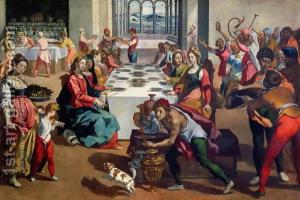
Jesus enjoyed a merry feast, but glutton and drunkard?
Eating seems to have been a rather large part of Jesus’ ministry, and many criticized him for it. They compared him to John the Baptist, who seemed more authentically pious. Not that they were entirely consistent. John the Baptist was a bit too strange. They thought he had a devil. Like a bunch of children, they wouldn’t dance to a merry tune or mourn to a dirge, replied Jesus to the charge of being a glutton and drunkard.
We’re in the series “Stories of Jesus and the Character of God,” looking at a few episodes of Jesus’ journey from Temptation to Cross. The whole series aims to find in Jesus clues to what God is like. This is the 15th in the series. Developing Table of Contents for the series here.
Some of Jesus’ most characteristic teachings come in the context of a meal. While dining he accepts the “sinful” woman who washes his feet with her tears. At another meal he notices and criticizes the custom of seating at a banquet according to rank and vying for the places of honor.
Glutton and drunkard, really?
The gospels report many occasions in which Jesus eats at someone’s home. Most of the stories we have put the meal in the home of a rich person. There are Zaccheus (a tax collector), a synagogue official, Levi (another tax collector), a Pharisee, a “leading” Pharisee.
Jesus must have eaten at poor people’s homes, too. Some critics scolded Jesus for eating with tax collectors and “sinners,” often a code word for the poor. Poor people could not afford the time, effort, and education to know, much less follow, all the rules as interpreted by the Pharisees. Jesus offended certain sensibilities by eating with the tax collectors. They were hated Jews who collaborated with Rome. He offended other sensibilities by eating with the poor. They were merely despised.
Mark, whom Matthew and Luke follow in this, is entirely consistent with the tenor of Jesus’ ministry in telling two stories of feeding the multitudes. (I discussed the reason for the duplication in a previous post.) The theme of eating a meal is strong in Jewish religious practice, from the Passover tradition to the obligation of hospitality to strangers. Jesus’ final gift, himself as food, continues those traditions. I like to think Jesus may have thought about the hospitality obligation in reverse. It’s also a kindness to accept hospitality from another. Jesus went so far as to invite himself over to Zachaeus’ place. (Luke 19:1-10)
Greatness in the Kingdom of God
Jesus’ disciples also faced the glutton and drunkard charge. People complained the disciples didn’t fast the way the Pharisees and John’s disciples did. (Luke 5:33) But the disciples can’t fast while the “bridegroom” (Jesus) is still around. I think I see the early Church wrestling with the contrast between Jesus, glutton and drunkard, and John, the abstemious one. John’s and the Pharisees’ style must have seemed more devout, more heroically religious.
Jesus doesn’t criticize John for not joining the “wedding” party. In fact, he says that, up to now, there has been none greater than John the Baptist. But, he continues, “the least in the kingdom of heaven is greater than he.” (Luke 7:28)
It’s a strange saying. It makes over, if it doesn’t totally undo, our idea of greatness. Jesus also called a child into the midst of the disciples. He said, “Whoever humbles himself like this child is the greatest in the kingdom of heaven.” (Matthew 18:2-4)
We call God great. Could God’s greatness be more like the child’s than the ones who called Jesus glutton and drunkard or even the ones we consider greatest? When we think of great love, we tend to think of great sacrifices or difficult deeds, but maybe God’s love is like the love of a child—easily, blissfully enjoying something or someone. Maybe that’s how Jesus could say:
Come to me, all you that are weary and are carrying heavy burdens, and I will give you rest. Take my yoke upon you, and learn from me; for I am gentle and humble in heart, and you will find rest for your souls. For my yoke is easy, and my burden is light. (Matthew 11:28-29)
Image credit: liveregnumchristi.org via Google Images
Previous Post

March 22, 2019
John the Baptist Mentors Jesus until they Part Ways
Next Post
March 27, 2019 Adultery and a Story of Jesus Writing on the Ground
Browse Our Archives
Select a Category Advent Christmas Amazon Synod Angels Being Consumed Bible Catholic Modern Creed Ecology Economics Elizabeth Johnson Eucharist Fragments and Filaments Gender and Sex Gospel of Mark Herzog Historical Jesus Liturgy Luke Opening Scriptures on Way to Emmaus Ordinary radicals Parables Pro-Life Reincarnation Rosary Sacraments science Social Justice Souls Stories of Jesus The Creed Torture and Eucharist Tracy Uncategorized War and Peace
Select a Month October 2026 June 2025 April 2025 March 2025 February 2025 January 2025 November 2024 July 2024 March 2024 December 2023 October 2023 September 2023 August 2023 May 2023 April 2023 March 2023 February 2023 January 2023 December 2022 November 2022 October 2022 September 2022 August 2022 July 2022 June 2022 April 2022 March 2022 February 2022 January 2022 December 2021 November 2021 October 2021 August 2021 July 2021 June 2021 April 2021 March 2021 February 2021 December 2020 November 2020 October 2020 August 2020 July 2020 June 2020 May 2020 April 2020 March 2020 February 2020 January 2020 December 2019 November 2019 October 2019 September 2019 August 2019 July 2019 June 2019 May 2019 April 2019 March 2019 February 2019 January 2019 December 2018 November 2018 October 2018 September 2018 August 2018 July 2018 June 2018 May 2018
Follow Us!
TAKE THE
Religious Wisdom Quiz
Skin for skin! All that a man has he will give for something precious. What is it?
Select your answer to see how you score.
His wealth His family His life His soul
Related posts from Lost in a One-Acre Wood

Resurrection: For the Apostles, It Took a While...

CRUCIFY HIM! -- What the Jews Did or...

Faith that can Move Mountains … or Not
The Misunderstood Messiah: Jesus’ Friends Don’t Get It
TRENDING AT PATHEOS Catholic

Rejecting Doom: Christian Hope And Human Action
Christianity is a religion of hope. We are to have hope and...

It’s What Comes From Within Which Matters
One of the most difficult things for us to understand is why...

Why I Choose the Eucharist Over the Sermon
Choose the Eucharist, Not the Sermon What are we supposed to get...

5 Design Elements Found in Spiritually Rooted Homes
Putting Spirituality Into Home Decor Our homes are more than our living...

Credo: A Story of God Told with the...
About 10 years ago, I began to imagine a personal "Credo" that...

The Anatomy of Divine Revelation in Catholic Thought
The claim that God has made Himself known to human beings is...
view all Catholic blogs
Ad-Free & Subscriber Log-In Subscription Support
- About Us
- 2026 Calendar
- Videos
- Podcasts
- Library of World Religions
- Faith In Media Tracker
- Advertise With Us
- Write for Us
- Privacy Policy
- Terms of Service
- Do Not Sell My Data
- Contact Us
- Radiant Digital
- Manage Newsletter Subscriptions
- Unsubscribe From Notifications
- Sitemap
Copyright 2008-2026, Patheos. All rights reserved.
Subscription Support Ad-Free & Subscriber Log-In
Follow Patheos