
BuddhistCatholicContemplativeEvangelicalGeneral ChristianHinduJewishLatter-day SaintMuslimNew VisionsProgressive Christian
Beliefs
- Buddhist
- Catholic
- Contemplative
- Evangelical
- General Christian
- Hindu
- Jewish
- Latter-day Saint
- More Voices
- Muslim
- New Visions
- Pagan
- Progressive Christian
Topics
- Religion News
- Food and Religion
- Sports and Religion
- Religious Art
- Religious Music and Entertainment
- Religious Events
- History and Religion
- Style and Religion
- Politics and Religion
- Women in Religion
- Recreation Outdoors and Religion
- Business Finance and Religion
- Careers Workplace and Religion
- Education and Religion
- Family Parenting and Religion
- Health Fitness and Religion
- Home and Religion
- Relationships and Religion
- Technology and Religion
- Travel and Religion
Columnists
- Buddhist Columnists
- Business Finance and Religion Columnists
- Careers Workplace and Religion Columnists
- Catholic Columnists
- Contemplative Columnists
- Education and Religion Columnists
- Evangelists Columnists
- Family Parenting and Religion Columnists
- General Christian Columnists
- Health Fitness and Religion Columnists
- Hindu Columnists
- History and Religion Columnists
- Home and Religion Columnists
- Jewish Columnists
- More Voices Columnists
- Latter Day Columnists
- Muslim Columnists
- New Visions Columnists
- Nonreligious Columnists
- Pagan Columnists
- Politics and Religion Columnists
- Progressive Columnists
- Recreation Outdoors and Religion Columnists
- Relationships and Religion Columnists
- Religion News Columnists
- Religious Art Columnists
- Religious Events Columnists
- Religious Music and Entertainment Columnists
- Sports and Religion Columnists
- Style and Religion Columnists
- Technology and Religion Columnists
- Travel and Religion Columnists
- Women in Religion Columnists
Resource Library
- 2026 Calendar
- Library of World Religions
- The 100 Most Holy Places on Earth
- Patheos Answers
- Podcasts
- Videos
- Faith Leaders Database
- Anglican Episcopalian
- Bahai
- Baptist
- Buddhism
- Christianity
- Confucianism
- Eastern Orthodoxy
- Hinduism
- Holiness and Pentecostal
- ISKCON
- Islam
- Judaism
- Lutheran
- Methodist
- The Church of Jesus Christ of Latter-day Saints
- New Age
- Paganism
- Presbytarian and Reformed
- Protestantism
- Religion Behind the Scenes
- Roman Catholic
- Scientology
- Shia Islam
- Sikhism
- Sufism
- Sunni Islam
- Taoism
- Zen
- See all religions
Research Tools
 Ad-Free & Subscriber Log-In Subscription Support
Ad-Free & Subscriber Log-In Subscription Support
Follow Patheos 

- Trending:
- Forgiveness
- |
- Marriage
- |
- Consciousness
- |
- Death Penalty
- |
- Election
- |
- Halloween

- Home
- Catholic
- Praying the Sorrowful Mysteries of the Rosary with Scripture
Praying the Sorrowful Mysteries of the Rosary with Scripture
Last updated on: August 13, 2021 at 2:25 pm by Jack Hartjes
Praying the Sorrowful Mysteries of the Rosary with Scripture 2021-08-13T14:25:03-06:00 Jack Hartjes
Patheos Explore the world's faith through different perspectives on religion and spirituality! Patheos has the views of the prevalent religions and spiritualities of the world.
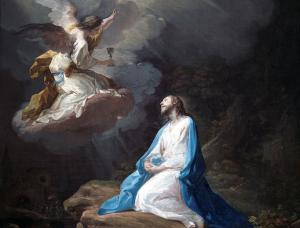
In the first of the Sorrowful Mysteries, Jesus rejects the temptation to get away and accepts the cup of his destiny.
Many questions occur as I pray the Sorrowful Mysteries of the Rosary: Why did Jesus have to die as he did? Why did he walk the path toward his death? Why was he poor instead of rich? If he had lived longer, he might have been able to convince more people to follow God’s way. If he had been richer, he might have had more influence with people who mattered in society. He could have made some great changes. Money might have protected him from the cross. As it is, it’s hard not to rate Jesus’ career as a failure.
On the cross Jesus felt like a failure, but the revelation that God approved this “failure” changed what needed to be changed. Ever since Jesus resurrection it has been impossible to see success and failure in quite the same way as before.
Words for the Five Sorrowful Mysteries
- The Agony in the Garden. Jesus prayed, “Father, if you are willing, take this cup away from me; still, not my will but yours be done.” (Luke 22:42)
- The Scourging at the Pillar. The prophet Isaiah said, “It was our infirmities that he bore, our suffering that he endured. … But he was pierced for our offenses, crushed for our sins. Upon him was the chastisement that makes us whole. With his stripes we were healed. … Through his suffering my servant shall justify many, and their guilt he shall bear. therefore I will give him his portion among the great.” (Isaiah 53:4-12)
- The Crowning with Thorns. The soldiers mocked Jesus saying, “Hail, King of the Jews!” (Matthew 27:29) Jesus answered Pilate, “My kingdom does not belong to this world.” (John 9:36)
- The Carrying of the Cross. Jesus said, “Come to me all you who labor and are burdened, and I will give you rest. Take my yoke upon you and learn from me, for I am meek and humble of heart, and you will find rest for yourselves, for my yoke is easy and my burden light.” (Matthew 11:28-30)
- The Crucifixion. Jesus cried out, “My God, my God, why have you forsaken me.” … (Mark 15:34) … Jesus said, “Father, forgive them for they know not what they do.” (Luke 23:34) … Jesus cried out in a loud voice, “Father, into your hands I commend my spirit.” (Luke 23:46)
More thoughts about the Sorrowful Mysteries:
The First Sorrowful Mystery, the Agony in the Garden.
This mystery could be called “The Temptation in the Garden.” The devil has been haunting Jesus’ ministry from its beginning after the baptism until now. Just lately this haunting has taken the form of the apostles’ inability to understand or believe Jesus when he mentions the cross, the cost of discipleship.
That must have been hard on Jesus. Now in the garden Jesus’ all-too-human spirit wrestles with the devils of his own doubts as well as fears. Two thousand years later we struggle to understand what Jesus’ Father’s will must have been in these last hours.
In Luke’s account angels come and minister to Jesus in the garden. In Matthew the angels do their ministering after the first temptation in the desert.
The Second Sorrowful Mystery, the Scourging at the Pillar.
I have to face the second of the sorrowful mysteries honestly. It’s hard for me to understand. I know what I don’t like about it. You see it in Mel Gibson’s The Passion of the Christ. In that film the historically inaccurate scourging scene shows Jesus receiving many more blows than Roman law allowed. Finally Jesus slumps to the ground. The centurion in charge indicates that the beating is over. But, amazingly, Jesus rises again, and the beating continues.
The picture is one of Jesus willing his own suffering to be as great as possible. For this mystery I chose Scripture that I could not avoid, though I would have liked to: “By his stripes we are healed.” Are we really healed by suffering? Does greater suffering translate to greater healing? I don’t believe it, and so this mystery is a real mystery to me.
The Third Sorrowful Mystery, the Crowning with Thorns.
If it wasn’t obvious before, it is now that Jesus’ crucifixion was a political response to a political crime. Kings and presidents have felt secure in their station, remembering Jesus’ words, “My kingdom is not of this world.’ The Church has imagined being “in” the world and not “of” the world. Pilate knew better. He knew the danger that Jesus posed to the worldly system of Roman domination and his own place in it.
Jesus’ kingdom was not of the world in the sense that its authority comes from humans or empires. It’s the Kingdom of God, but it is definitely in the world and for the world and a threat to the world’s established procedures.
The Fourth Sorrowful Mystery, the Carrying of the Cross.
Jesus welcomes us to come to him and share his cross, for “my yoke is easy and my burden light.” I think he means in comparison to the things we carry without noticing they are burdens.
The Fifth Sorrowful Mystery, the Crucifixion.
“My God, my God, why have you abandoned me.” In Jesus all the forsaken ones of the world can find a fellow traveler.
This may be the only time in Jesus’ life that he addressed God without saying “Father.” In Jesus’ sense of abandonment, of distance from God, he identifies completely with us sinners down to the very depths into which we so often sink. In that identification lies our salvation.
Image credit: National Catholic Register via Google Images
Previous Post

March 6, 2019
Angels of the Cosmos or, Are We Alone in the Universe?
Next Post
March 11, 2019 Cosmos and History: Connecting the Angels
Browse Our Archives
Select a Category Advent Christmas Amazon Synod Angels Being Consumed Bible Catholic Modern Creed Ecology Economics Elizabeth Johnson Eucharist Fragments and Filaments Gender and Sex Gospel of Mark Herzog Historical Jesus Liturgy Luke Opening Scriptures on Way to Emmaus Ordinary radicals Parables Pro-Life Reincarnation Rosary Sacraments science Social Justice Souls Stories of Jesus The Creed Torture and Eucharist Tracy Uncategorized War and Peace
Select a Month October 2026 June 2025 April 2025 March 2025 February 2025 January 2025 November 2024 July 2024 March 2024 December 2023 October 2023 September 2023 August 2023 May 2023 April 2023 March 2023 February 2023 January 2023 December 2022 November 2022 October 2022 September 2022 August 2022 July 2022 June 2022 April 2022 March 2022 February 2022 January 2022 December 2021 November 2021 October 2021 August 2021 July 2021 June 2021 April 2021 March 2021 February 2021 December 2020 November 2020 October 2020 August 2020 July 2020 June 2020 May 2020 April 2020 March 2020 February 2020 January 2020 December 2019 November 2019 October 2019 September 2019 August 2019 July 2019 June 2019 May 2019 April 2019 March 2019 February 2019 January 2019 December 2018 November 2018 October 2018 September 2018 August 2018 July 2018 June 2018 May 2018
Follow Us!
TAKE THE
Religious Wisdom Quiz
Who said, "Surely this man was the Son of God!" at Jesus' crucifixion?
Select your answer to see how you score.
A Roman centurion Pilate Judas Peter
Related posts from Lost in a One-Acre Wood
Jesus’ Second Coming Should Be the Rosary’s Last...

Praying the Glorious Mysteries of the Rosary with Scripture
Praying the Luminous Mysteries of the Rosary with Scripture
Praying the Joyful Mysteries with Scripture
TRENDING AT PATHEOS Catholic

Rejecting Doom: Christian Hope And Human Action
Christianity is a religion of hope. We are to have hope and...

It’s What Comes From Within Which Matters
One of the most difficult things for us to understand is why...

Why I Choose the Eucharist Over the Sermon
Choose the Eucharist, Not the Sermon What are we supposed to get...

5 Design Elements Found in Spiritually Rooted Homes
Putting Spirituality Into Home Decor Our homes are more than our living...

Credo: A Story of God Told with the...
About 10 years ago, I began to imagine a personal "Credo" that...

The Anatomy of Divine Revelation in Catholic Thought
The claim that God has made Himself known to human beings is...
view all Catholic blogs
Ad-Free & Subscriber Log-In Subscription Support
- About Us
- 2026 Calendar
- Videos
- Podcasts
- Library of World Religions
- Faith In Media Tracker
- Advertise With Us
- Write for Us
- Privacy Policy
- Terms of Service
- Do Not Sell My Data
- Contact Us
- Radiant Digital
- Manage Newsletter Subscriptions
- Unsubscribe From Notifications
- Sitemap
Copyright 2008-2026, Patheos. All rights reserved.
Subscription Support Ad-Free & Subscriber Log-In
Follow Patheos