
BuddhistCatholicContemplativeEvangelicalGeneral ChristianHinduJewishLatter-day SaintMuslimNew VisionsProgressive Christian
Beliefs
- Buddhist
- Catholic
- Contemplative
- Evangelical
- General Christian
- Hindu
- Jewish
- Latter-day Saint
- More Voices
- Muslim
- New Visions
- Pagan
- Progressive Christian
Topics
- Religion News
- Food and Religion
- Sports and Religion
- Religious Art
- Religious Music and Entertainment
- Religious Events
- History and Religion
- Style and Religion
- Politics and Religion
- Women in Religion
- Recreation Outdoors and Religion
- Business Finance and Religion
- Careers Workplace and Religion
- Education and Religion
- Family Parenting and Religion
- Health Fitness and Religion
- Home and Religion
- Relationships and Religion
- Technology and Religion
- Travel and Religion
Columnists
- Buddhist Columnists
- Business Finance and Religion Columnists
- Careers Workplace and Religion Columnists
- Catholic Columnists
- Contemplative Columnists
- Education and Religion Columnists
- Evangelists Columnists
- Family Parenting and Religion Columnists
- General Christian Columnists
- Health Fitness and Religion Columnists
- Hindu Columnists
- History and Religion Columnists
- Home and Religion Columnists
- Jewish Columnists
- More Voices Columnists
- Latter Day Columnists
- Muslim Columnists
- New Visions Columnists
- Nonreligious Columnists
- Pagan Columnists
- Politics and Religion Columnists
- Progressive Columnists
- Recreation Outdoors and Religion Columnists
- Relationships and Religion Columnists
- Religion News Columnists
- Religious Art Columnists
- Religious Events Columnists
- Religious Music and Entertainment Columnists
- Sports and Religion Columnists
- Style and Religion Columnists
- Technology and Religion Columnists
- Travel and Religion Columnists
- Women in Religion Columnists
Resource Library
- 2026 Calendar
- Library of World Religions
- The 100 Most Holy Places on Earth
- Patheos Answers
- Podcasts
- Videos
- Faith Leaders Database
- Anglican Episcopalian
- Bahai
- Baptist
- Buddhism
- Christianity
- Confucianism
- Eastern Orthodoxy
- Hinduism
- Holiness and Pentecostal
- ISKCON
- Islam
- Judaism
- Lutheran
- Methodist
- The Church of Jesus Christ of Latter-day Saints
- New Age
- Paganism
- Presbytarian and Reformed
- Protestantism
- Religion Behind the Scenes
- Roman Catholic
- Scientology
- Shia Islam
- Sikhism
- Sufism
- Sunni Islam
- Taoism
- Zen
- See all religions
Research Tools
 Ad-Free & Subscriber Log-In Subscription Support
Ad-Free & Subscriber Log-In Subscription Support
Follow Patheos 

- Trending:
- Forgiveness
- |
- Marriage
- |
- Consciousness
- |
- Death Penalty
- |
- Election
- |
- Halloween

- Home
- Catholic
- How Monotheism Arose with the Jews’ God of history
How Monotheism Arose with the Jews’ God of history
Last updated on: March 13, 2019 at 3:42 pm by Jack Hartjes
How Monotheism Arose with the Jews’ God of history 2019-03-13T15:42:04-06:00 Jack Hartjes
Patheos Explore the world's faith through different perspectives on religion and spirituality! Patheos has the views of the prevalent religions and spiritualities of the world.
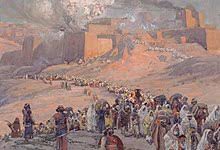
Monotheism began to take hold among the Jewish people in the context of the tragedy of the Babylonian Captivity, the destruction of the Israelite nation.
The story the Bible tells is a story of monotheism from beginning to end. But that does not reflect the real history of the Jewish people. For them monotheism only gradually became the general rule. The process started with the novel idea of a god of history, then developed into a whole new mindset about history and reality.
This is the eighth in a series on the Creed of Christians. An introduction consists of my retelling of the Creed’s story. That and links to other posts in the series are here.
The change that the Jews accomplished, abandoning all gods but one and rejecting the cyclical worldview of all their neighbors, must have been difficult. The Israelites knew how others lived. To their neighbors belonged the familiarity of a world of repeating cycles. The new insight of the Jews was less comfortable and sometimes hard to believe:
Vanity of vanities, says Qoheleth, vanity of vanities! All things are vanity! … One generation passes and another comes, but the world forever stays. The sun rises and the sun goes down; then it presses on to the place where it rises. … What has been, that will be; what has been done, that will be done. Nothing is new under the sun. (Ecclesiastes 1:2-9)
You can see that, unlike the Pagans, Jews, or some of them, hated this feeling. But their God also said, in the words of the prophet:
See, I am doing something new! Now it springs forth, do you not perceive it? In the desert I make a way, in the wasteland, rivers. (Isaiah 43:19)
I think Israel’s amazing, if not miraculous, beginning had something to do with their belief that God could do new things in history.
A rocky career for Israel
That beginning wasn’t the only new thing “God,” in this interpretation of history did for and to Israel. In the year 587 BCE Israel disappeared as a nation, and about 40 years later it came back to life again. Here are some facts about Israel’s history between its birth and this rebirth:
- There was a period during which Israel was only a loosely knit conglomeration of tribes without a central leader. (Late 1200’s to late 1000’s B.C.E.
- David and Solomon succeeded in establishing a united and fairly prosperous kingdom. (1000-931)
- Archaeological remains and the biblical record both show that monotheism wasn’t quite the norm. The worship of gods other than Yahweh was going on during these periods. Solomon set up shrines to foreign gods. I suppose that was partly to keep his many foreign wives and girlfriends happy, but certainly it was also a way to conduct affairs of state—good foreign relations.
- After Solomon the kingdom split in two. There was a larger Northern Kingdom, usually called simply Israel, and a Southern Kingdom consisting of the Tribes of Judah and Benjamin, called Judah. Jerusalem was the capital of the Southern Kingdom. The two kingdoms were usually hostile to each other.
- Neither kingdom was consistent in the exclusive worship of Yahweh. Prophets dared to oppose political and economic powers with the word of Yahweh, but there were false prophets, too.
- In 722 Assyria conquered the Northern Kingdom. In 587 Babylon finished off the Southern Kingdom. They forced the king, whom they blinded, and the elite of the people into exile. This, the Babylonian Captivity, was the end of the nation of the Israelites.
What comes after the end?
I suppose you could consider this a success story.Monotheism was barely started, but Israel lasted almost 500 years. Compared to Egypt that’s not much, but it’s twice as long as U.S. history. The ones in exile couldn’t see it that way, though. They had been God’s people, but now they were no longer a people. God had been active in their history, but now their history was over. They had risen and fallen in apparent obedience to the cyclical pattern of all the rest of the world.
What could the people possibly believe about God in a situation like this? What kind of vision of themselves could they have now? How could they continue to trust? Why should they be faithful to Yahweh now that their story seemed to be over?
These Israelites continued to be a distinct people even in exile in a foreign land. That fact, I think, is almost as miraculous as their birth as the Bible tells it. Without land or temple the Jews became people of the book. Synagogue services based on readings from sacred texts may have started around this time. It was a time of collecting, editing, combining, rewriting, and composing texts.
Jeremiah and other prophets interpreted anew the Jews’ history as God’s people: When they were faithful to God and God’s commands, God favored them. When they were unfaithful, which seems to have been most of the time, God punished. Most important, when they repented and turned back to their covenant with God, God was merciful. This pattern occurs over and over in the sacred writings, most of which were put into final form around the time of these huge defeats or later.
Monotheism: One god for all the nations
According to the new interpretation, God wasn’t showing weakness compared to other gods when Israelites suffered. The suffering was God’s punishment, and God’s instruments for punishment included the hated Assyrians and Babylonians. That meant God was more than a tribal deity. God was actually using other nations, whose own gods turned out to be irrelevant. That might not have seemed like such good news. A person might have preferred to be free of God’s interference. But for the Jews it saved their identity as a people.
The Israelites might have given up on their national god and gone wholeheartedly into the service of a more powerful god of a more powerful nation. They had done that before in less dire circumstances. Instead they reached for a god not limited to any one nation. In a crucible where torture and death could be the price for faithfulness to Yahweh, Jews began to think of the foreign gods as no gods at all. Monotheism was born in agony. It was about this time that the people began to be called Jews.
While Israel was still a going concern, the story was about Israel and Israel’s God. In the aftermath of national tragedy, the Jews’ story couldn’t remain the same; it had to die or grow. The Jews kept their story alive by expanding it to the world. God became the god of all the nations.
History is God’s story.
The new thing that the Jews added to our understanding of our lives and our world is that meaning is found not just in the regularities, the repeating patterns, the laws of nature but also in history. History is not just one thing after another and not just a repetition of the same things over and over. History, as the Jews conceived it, has a new kind of meaning; it’s a story. History goes from somewhere to somewhere else. New things happen in history.
There was no historical or psychological necessity for the Jews to take this step, but there is a kind of narrative necessity, after the fact, in the story of a historical god. Psychologically, the Jews may have wanted to switch to a more powerful god. History would seem to dictate that the nation that ends up on top gets to keep its story intact. But at least some Jews, perhaps realizing that no nation stays on top forever, decided against a temporary fix. They leaped with both feet into the story itself, the story of a historical God, and history as God’s story. It could no longer be a story of any one nation; it had to be universal. The God of such a story had to be not just Israel’s but everyone’s.
Image credit: Wikipedia
Next Post

February 13, 2019 Two Worldviews We Inherit, One Task Before Us
Browse Our Archives
Select a Category Advent Christmas Amazon Synod Angels Being Consumed Bible Catholic Modern Creed Ecology Economics Elizabeth Johnson Eucharist Fragments and Filaments Gender and Sex Gospel of Mark Herzog Historical Jesus Liturgy Luke Opening Scriptures on Way to Emmaus Ordinary radicals Parables Pro-Life Reincarnation Rosary Sacraments science Social Justice Souls Stories of Jesus The Creed Torture and Eucharist Tracy Uncategorized War and Peace
Select a Month October 2026 June 2025 April 2025 March 2025 February 2025 January 2025 November 2024 July 2024 March 2024 December 2023 October 2023 September 2023 August 2023 May 2023 April 2023 March 2023 February 2023 January 2023 December 2022 November 2022 October 2022 September 2022 August 2022 July 2022 June 2022 April 2022 March 2022 February 2022 January 2022 December 2021 November 2021 October 2021 August 2021 July 2021 June 2021 April 2021 March 2021 February 2021 December 2020 November 2020 October 2020 August 2020 July 2020 June 2020 May 2020 April 2020 March 2020 February 2020 January 2020 December 2019 November 2019 October 2019 September 2019 August 2019 July 2019 June 2019 May 2019 April 2019 March 2019 February 2019 January 2019 December 2018 November 2018 October 2018 September 2018 August 2018 July 2018 June 2018 May 2018
Follow Us!
TAKE THE
Religious Wisdom Quiz
What book comes directly after Lamentations?
Select your answer to see how you score.
Jeremiah Ezekiel Daniel Hosea
Related posts from Lost in a One-Acre Wood
The Nicene Creed: Thinking with the Bishop Barron...
The Creed, Entering God’s Dangerous World

What about the Traditional Angels, and What’s the...

Cosmos and History: Connecting the Angels
TRENDING AT PATHEOS Catholic

Rejecting Doom: Christian Hope And Human Action
Christianity is a religion of hope. We are to have hope and...

It’s What Comes From Within Which Matters
One of the most difficult things for us to understand is why...

Why I Choose the Eucharist Over the Sermon
Choose the Eucharist, Not the Sermon What are we supposed to get...

5 Design Elements Found in Spiritually Rooted Homes
Putting Spirituality Into Home Decor Our homes are more than our living...

Credo: A Story of God Told with the...
About 10 years ago, I began to imagine a personal "Credo" that...

The Anatomy of Divine Revelation in Catholic Thought
The claim that God has made Himself known to human beings is...
view all Catholic blogs
Ad-Free & Subscriber Log-In Subscription Support
- About Us
- 2026 Calendar
- Videos
- Podcasts
- Library of World Religions
- Faith In Media Tracker
- Advertise With Us
- Write for Us
- Privacy Policy
- Terms of Service
- Do Not Sell My Data
- Contact Us
- Radiant Digital
- Manage Newsletter Subscriptions
- Unsubscribe From Notifications
- Sitemap
Copyright 2008-2026, Patheos. All rights reserved.
Subscription Support Ad-Free & Subscriber Log-In
Follow Patheos