
BuddhistCatholicContemplativeEvangelicalGeneral ChristianHinduJewishLatter-day SaintMuslimNew VisionsProgressive Christian
Beliefs
- Buddhist
- Catholic
- Contemplative
- Evangelical
- General Christian
- Hindu
- Jewish
- Latter-day Saint
- More Voices
- Muslim
- New Visions
- Pagan
- Progressive Christian
Topics
- Religion News
- Food and Religion
- Sports and Religion
- Religious Art
- Religious Music and Entertainment
- Religious Events
- History and Religion
- Style and Religion
- Politics and Religion
- Women in Religion
- Recreation Outdoors and Religion
- Business Finance and Religion
- Careers Workplace and Religion
- Education and Religion
- Family Parenting and Religion
- Health Fitness and Religion
- Home and Religion
- Relationships and Religion
- Technology and Religion
- Travel and Religion
Columnists
- Buddhist Columnists
- Business Finance and Religion Columnists
- Careers Workplace and Religion Columnists
- Catholic Columnists
- Contemplative Columnists
- Education and Religion Columnists
- Evangelists Columnists
- Family Parenting and Religion Columnists
- General Christian Columnists
- Health Fitness and Religion Columnists
- Hindu Columnists
- History and Religion Columnists
- Home and Religion Columnists
- Jewish Columnists
- More Voices Columnists
- Latter Day Columnists
- Muslim Columnists
- New Visions Columnists
- Nonreligious Columnists
- Pagan Columnists
- Politics and Religion Columnists
- Progressive Columnists
- Recreation Outdoors and Religion Columnists
- Relationships and Religion Columnists
- Religion News Columnists
- Religious Art Columnists
- Religious Events Columnists
- Religious Music and Entertainment Columnists
- Sports and Religion Columnists
- Style and Religion Columnists
- Technology and Religion Columnists
- Travel and Religion Columnists
- Women in Religion Columnists
Resource Library
- 2026 Calendar
- Library of World Religions
- The 100 Most Holy Places on Earth
- Patheos Answers
- Podcasts
- Videos
- Faith Leaders Database
- Anglican Episcopalian
- Bahai
- Baptist
- Buddhism
- Christianity
- Confucianism
- Eastern Orthodoxy
- Hinduism
- Holiness and Pentecostal
- ISKCON
- Islam
- Judaism
- Lutheran
- Methodist
- The Church of Jesus Christ of Latter-day Saints
- New Age
- Paganism
- Presbytarian and Reformed
- Protestantism
- Religion Behind the Scenes
- Roman Catholic
- Scientology
- Shia Islam
- Sikhism
- Sufism
- Sunni Islam
- Taoism
- Zen
- See all religions
Research Tools
 Ad-Free & Subscriber Log-In Subscription Support
Ad-Free & Subscriber Log-In Subscription Support
Follow Patheos 

- Trending:
- Forgiveness
- |
- Marriage
- |
- Consciousness
- |
- Death Penalty
- |
- Election
- |
- Halloween

- Home
- Catholic
- Bible Criticism and Jesus, the Miracle Worker
Bible Criticism and Jesus, the Miracle Worker
Last updated on: January 7, 2019 at 1:50 pm by Jack Hartjes
Bible Criticism and Jesus, the Miracle Worker 2019-01-07T13:50:37-06:00 Jack Hartjes
Patheos Explore the world's faith through different perspectives on religion and spirituality! Patheos has the views of the prevalent religions and spiritualities of the world.
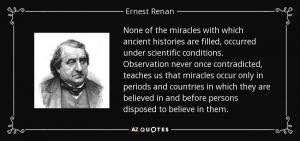
Early historical Jesus scholars doubted that Jesus was a miracle worker.
Jesus fully human is more central to Christian belief than Jesus the miracle worker. We have this image of Jesus walking on water and we use that image conversationally for people who think way too much of themselves – “She thinks she can walk on water.” But that’s a criticism; it’s not a proper way for a person to think. Is it proper for Jesus and not for us? Did Jesus think he could “walk on water,” work a miracle anytime he wanted?
I have to admit to having a distaste for that image of Jesus. It seems to make Jesus both more and less than, but not really, human. In my last post a generic, but realistic, atheist asks, ”Why didn’t Jesus cure everyone in Palestine?” The answer I would like to give, based on my personal bias, is: Because he couldn’t. But personal biases are exactly what a person ought to distrust.
Bible scholars have done much critical analysis of the biblical traditions that give us Jesus as miracle worker. This post takes a look at that research and concludes Jesus really did work miracles. Squaring that historical probability with a fully human Jesus is a task for the future.
Early scientific bias in Jesus research
Early searchers for the historical Jesus generally did not like to think of Jesus as a miracle worker. They tried to show that the miracle stories in the Bible do not go back to Jesus himself but arose later as legends and stories told by overly enthusiastic followers. These 18th and 19th century scholars had absorbed the scientific tenor of their age. They were biased against anything supernatural interrupting the natural flow of things (like me, I confess).
Later, more controlled scholarship revealed the uncomfortable truth: Miracle stories go back as far as we can detect in the development of the early Church’s writings and oral traditions about Jesus. Most scholars, whether believers or not, don’t accept every miracle story in the gospels at face value, but they do say Jesus had the reputation of miracle worker even during his lifetime, and they say that reputation must have had some basis in fact. (Walter Kasper, Jesus the Christ, p. 90-91)
How did those early scholars imagine they could slice out all the miracle stories from the gospels, as if they were just later lore added to an original gospel? How do later scholars say something like that, but only about some of the miracle stories? Answering that requires a look at …
Layers of traditions about Jesus.
When you look at a book published today, the first bits of information you see are the book’s title and author. Turn a page and you can usually find the publication date. This information is missing from the books we call the gospels. There is a title, which scholars think was added later: “The Gospel of Jesus Christ.” We’re never told the author or the date of composition. The names that we have for the Gospels, Matthew, Mark, Luke, and John, are later guesses and probably wrong.
Date and authorship are things that scholars would really like to know. It would be very helpful for assessing the historical accuracy of the material contained in a book if we knew how close to the actual events and from what possibly biased perspective the author wrote.
The priority of Mark and the hypothetical Q
Very early in modern historical Jesus research, scholars found a way to tell the order in which the various gospels were composed. They noticed that the first three gospels, Matthew, Mark, and Luke, are very similar. They called these gospels “synoptic” (syn=together, optein=see). You can line these gospels up side by side and see the same story–with some changes, additions, and deletions–unfolding in each one. Then scholars noticed that nearly all of Mark is present in Matthew and Luke and in the same order. They concluded that somebody copied from somebody. The near universal opinion among these scholars today is that Mark was first and Matthew and Luke followed.
Looking at Matthew and Luke, you can see they have a great deal of material in common that was not in Mark. This consists largely of sayings of Jesus. Matthew and Luke could have had another source in common, which scholars call the “Sayings Gospel” or “Q.” Q is the first letter of the German word for source. No copy of Q has ever turned up. It remains a hypothesis, but a widely held one. A minority theory is that the author of Luke may have known the gospel of Matthew. That would make Q unnecessary as an explanation for the material they have in common outside of Mark.
In addition to Mark and a possible Q, Matthew and Luke each had their own unique material, either written or oral, which they added to Jesus’ story.
Miracles in very early traditions
Here’s the majority opinion on the order of various sources with some commonly attributed dates:
- First were seven authentic letters of Paul, all probably composed in the decade of the 50’s. Six other letters attributed to Paul are thought to be later compositions by disciples of Paul.
- Then came Mark, around the year 70.
- Then Matthew and Luke in the decade of the 80’s.
- Finally John in the 90’s.
- The Q document, if it existed, it must have been pretty early but not necessarily earlier than Paul.
- The special materials used by Matthew and Luke could have been fairly early as well.
- All of these sources rely on earlier written or oral traditions, and sometimes these can be identified, for example, when Paul quotes a hymn that was being sung in his local churches.
I count five or six “original,” i.e., not copied, sources for the story of Jesus: Paul, Mark, Q (if it existed), Matthew’s special material, Luke’s special material, and John. Paul and Q have little to say about the deeds (as opposed to the words) of Jesus during his earthly lifetime. All the rest contain accounts of miracles. Even Q has a saying of Jesus that refers to miracles.
The upshot is that scholars cannot find an original “layer” of information about Jesus that does not contain miraculous deeds. Historians don’t like to attribute impossible deeds to any historical person, but one conclusion is nearly inescapable: Whatever Jesus thought of himself, people who knew Jesus thought he was a miracle worker.
It seems we need to accept both the miracles and the humanity of Jesus. Our reality is that we can‘t work miracles. In what way is Jesus’ reality like ours? Future posts put the humanity of Jesus front and center. We can’t cure anyone we might want to. That’s just reality for us; the science is settled. Is it Jesus’ reality as well?
Next Post

January 4, 2019 Evangelization and a Thought about the Three Kings
Browse Our Archives
Select a Category Advent Christmas Amazon Synod Angels Being Consumed Bible Catholic Modern Creed Ecology Economics Elizabeth Johnson Eucharist Fragments and Filaments Gender and Sex Gospel of Mark Herzog Historical Jesus Liturgy Luke Opening Scriptures on Way to Emmaus Ordinary radicals Parables Pro-Life Reincarnation Rosary Sacraments science Social Justice Souls Stories of Jesus The Creed Torture and Eucharist Tracy Uncategorized War and Peace
Select a Month October 2026 June 2025 April 2025 March 2025 February 2025 January 2025 November 2024 July 2024 March 2024 December 2023 October 2023 September 2023 August 2023 May 2023 April 2023 March 2023 February 2023 January 2023 December 2022 November 2022 October 2022 September 2022 August 2022 July 2022 June 2022 April 2022 March 2022 February 2022 January 2022 December 2021 November 2021 October 2021 August 2021 July 2021 June 2021 April 2021 March 2021 February 2021 December 2020 November 2020 October 2020 August 2020 July 2020 June 2020 May 2020 April 2020 March 2020 February 2020 January 2020 December 2019 November 2019 October 2019 September 2019 August 2019 July 2019 June 2019 May 2019 April 2019 March 2019 February 2019 January 2019 December 2018 November 2018 October 2018 September 2018 August 2018 July 2018 June 2018 May 2018
Follow Us!
TAKE THE
Religious Wisdom Quiz
True or False: Luke's Gospel is dedicated to someone named Theophilus.
Select your answer to see how you score.
FALSE TRUE
Related posts from Lost in a One-Acre Wood
Resurrection: For the Apostles, It Took a While...
CRUCIFY HIM! -- What the Jews Did or...
Faith that can Move Mountains … or Not
The Misunderstood Messiah: Jesus’ Friends Don’t Get It
TRENDING AT PATHEOS Catholic

The Parable Of The Sower And The Word...
One of Christ’s most famous parables is that of the sower who...

Rejecting Doom: Christian Hope And Human Action
Christianity is a religion of hope. We are to have hope and...

Why I Choose the Eucharist Over the Sermon
Choose the Eucharist, Not the Sermon What are we supposed to get...

5 Design Elements Found in Spiritually Rooted Homes
Putting Spirituality Into Home Decor Our homes are more than our living...

Credo: A Story of God Told with the...
About 10 years ago, I began to imagine a personal "Credo" that...

The Anatomy of Divine Revelation in Catholic Thought
The claim that God has made Himself known to human beings is...
view all Catholic blogs
Ad-Free & Subscriber Log-In Subscription Support
- About Us
- 2026 Calendar
- Videos
- Podcasts
- Library of World Religions
- Faith In Media Tracker
- Advertise With Us
- Write for Us
- Privacy Policy
- Terms of Service
- Do Not Sell My Data
- Contact Us
- Radiant Digital
- Manage Newsletter Subscriptions
- Unsubscribe From Notifications
- Sitemap
Copyright 2008-2026, Patheos. All rights reserved.
Subscription Support Ad-Free & Subscriber Log-In
Follow Patheos