
BuddhistCatholicContemplativeEvangelicalGeneral ChristianHinduJewishLatter-day SaintMuslimNew VisionsProgressive Christian
Beliefs
- Buddhist
- Catholic
- Contemplative
- Evangelical
- General Christian
- Hindu
- Jewish
- Latter-day Saint
- More Voices
- Muslim
- New Visions
- Pagan
- Progressive Christian
Topics
- Religion News
- Food and Religion
- Sports and Religion
- Religious Art
- Religious Music and Entertainment
- Religious Events
- History and Religion
- Style and Religion
- Politics and Religion
- Women in Religion
- Recreation Outdoors and Religion
- Business Finance and Religion
- Careers Workplace and Religion
- Education and Religion
- Family Parenting and Religion
- Health Fitness and Religion
- Home and Religion
- Relationships and Religion
- Technology and Religion
- Travel and Religion
Columnists
- Buddhist Columnists
- Business Finance and Religion Columnists
- Careers Workplace and Religion Columnists
- Catholic Columnists
- Contemplative Columnists
- Education and Religion Columnists
- Evangelists Columnists
- Family Parenting and Religion Columnists
- General Christian Columnists
- Health Fitness and Religion Columnists
- Hindu Columnists
- History and Religion Columnists
- Home and Religion Columnists
- Jewish Columnists
- More Voices Columnists
- Latter Day Columnists
- Muslim Columnists
- New Visions Columnists
- Nonreligious Columnists
- Pagan Columnists
- Politics and Religion Columnists
- Progressive Columnists
- Recreation Outdoors and Religion Columnists
- Relationships and Religion Columnists
- Religion News Columnists
- Religious Art Columnists
- Religious Events Columnists
- Religious Music and Entertainment Columnists
- Sports and Religion Columnists
- Style and Religion Columnists
- Technology and Religion Columnists
- Travel and Religion Columnists
- Women in Religion Columnists
Resource Library
- 2026 Calendar
- Library of World Religions
- The 100 Most Holy Places on Earth
- Patheos Answers
- Podcasts
- Videos
- Faith Leaders Database
- Anglican Episcopalian
- Bahai
- Baptist
- Buddhism
- Christianity
- Confucianism
- Eastern Orthodoxy
- Hinduism
- Holiness and Pentecostal
- ISKCON
- Islam
- Judaism
- Lutheran
- Methodist
- The Church of Jesus Christ of Latter-day Saints
- New Age
- Paganism
- Presbytarian and Reformed
- Protestantism
- Religion Behind the Scenes
- Roman Catholic
- Scientology
- Shia Islam
- Sikhism
- Sufism
- Sunni Islam
- Taoism
- Zen
- See all religions
Research Tools
 Ad-Free & Subscriber Log-In Subscription Support
Ad-Free & Subscriber Log-In Subscription Support
Follow Patheos 

- Trending:
- Forgiveness
- |
- Marriage
- |
- Consciousness
- |
- Death Penalty
- |
- Election
- |
- Halloween

- Home
- Catholic
- The Creed, a Story that I Tell, Embellished a Bit
The Creed, a Story that I Tell, Embellished a Bit
Last updated on: February 5, 2019 at 9:15 pm by Jack Hartjes
The Creed, a Story that I Tell, Embellished a Bit 2019-02-05T21:15:04-06:00 Jack Hartjes
Patheos Explore the world's faith through different perspectives on religion and spirituality! Patheos has the views of the prevalent religions and spiritualities of the world.
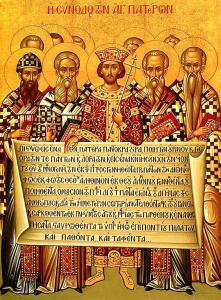
The Nicene Creed originated in the First Council at Nicene (present day İznik, Turkey) in 325.
When I say the Creed, make my Profession of Faith at Mass, I’m not reciting a list of things I believe. I am confessing whom I believe in. To believe in someone is to commit oneself to be part of that one’s story. So the Creed isn’t much like an essay on the topic “Things I Believe.” It’s a story and it’s dramatic. Here I tell the story, filling in some details as they strike me. I don’t imagine it improves the traditional Creed or (heaven forbid!) replaces it. I just like the story and tried, in a small way, to own it.
This post introduces series on the first part of the Creed of Christians. The introduction continues after this list of links to other posts in the series.
A Table of Contents
- Introduction and my “story” Creed (below)
- God Pantokrator. What does the Creed say about God’s Power
- The Weakness of God is Stronger than … Strength
- I Believe in the Father
- God as Mother
- Inclusive Language
- One God, Part One: The Worldview behind the Many Gods of Paganism
- What the Jews Gave us: The Story of a World Going Somewhere
The Creed is a telling of the story of salvation history. The first part begins the story with God as creator. I extend this part to include God’s creating and sustaining the Jewish people. In the second part the Creed narrates the story of Jesus and salvation wrought through him. Jesus’ story begins before creation and continues to the Second Coming. I add details to this story. The Holy Spirit, in the third part, brings us, with the Church, into the story and into God’s Trinitarian life. This part, like the second, retells the whole story, from God’s inner life before creation to the renewal of the world at the end of the age.
The embellished Creed (Asterisks are links to a few notes at the end.)
-
I believe in God, whom I know as Father and by many other names, *
-
who calls into being powers and peoples with all their varied splendors, *
- leading, disciplining them with the power and weakness of love, *
-
who in ages past, with particular care, gave birth to the Jews,
- intending one people to be a blessing to all nations,
- then bore them and bore with them through persecution and their own sin,
- as witnessed in the Jewish Scriptures.
-
-
I believe in God’s anointed one, Jesus,
-
Son of God from all eternity, first heir of the Father’s self-sacrificing love,
- eternally offering back that gift, to the Father’s ever-growing delight, *
-
yet formed in time of the flesh of this world in the womb of the virgin Mary,
-
born a child of a laborer at carpentry, a Jew, a member of an oppressed tribe,
- even a Galilean, from where, as the saying went, “What good can come?” *
-
Obedient, he made his own the concerns of all he met, *
- whether friend or enemy, rich or destitute, high-society or rebel.
-
Rejected for proclaiming the Reign of God over all those human concerns,
-
tried for blasphemy, calling sinners forgiven and those we reject blessed,
-
abandoned by friends, and left alone by God,
- with not a single success to own at the end, only a cross,
-
he suffered under Pontius Pilate the Roman punishment for sedition,
- was crucified, died, and was buried.
-
-
In fulfillment of the Scriptures,
-
he came to the limit of parting from God
- and unity with us failing sinners, the depths of hell; *
-
and God approved him, raising him bodily in the Spirit, the first of many;
-
and he ascended, glorified, to his place with the all-loving God.
-
-
From there he will come again to preside over a renewed creation
-
with all who will accept mercy and disown comforting idols
- of pride or hopeless submission to the way things have to be.
-
-
-
I believe in the Holy Spirit,
-
Life and Fire blowing in the play and passion of Father and Son’s love,
-
who does love’s work
- in God’s Trinitarian life,
- in the created world,
- and between world and God,
-
who embraces all in unity and blesses each one’s uniqueness;
-
who has inspired many scriptures, *
-
who gave life to Jesus’ despairing followers,
-
who brings people to the Father in their different ways, all in Jesus’ arms.
-
In that Spirit I believe
- with the Communion of Saints on earth and in heaven, the Catholic Church, *
- with apostles, martyrs, teachers, and all who encourage by word and deed,
- with the ones who gave me life, Dave, Rose Marie, and all my forebears.
-
I believe in the mission Jesus gave us, when he breathed his Spirit upon us,
-
to be part of his story, to honor and purify the human concerns we meet
- in the names of the Father and the Son and the Holy Spirit,
-
looking forward, past our many failures, to God’s reign in all things.
-
-
I believe that God’s Spirit is always doing something new on earth, *
-
that there is, not Fate, but forgiving and being forgiven, *
- bodily resurrection in a world renewed and transformed in God,
- and life with God and brothers and sisters ever-growing in love. *
-
-
Notes:
- Names from the Bible, including Mother. I know of a calendar that lists a biblical name for God for each day of the year. Add to that the “99 Names of Allah” of the Muslim faith, Plotinus’s “One,” and the many ways, other than “God” that religions name the Ultimate.
- Powers include the powers of the natural and human worlds and the powers of heaven. Karl Rahner thinks these two must be related somehow.
- Through Jesus we learn that God’s weakness is much more effective at changing hearts than any display of power.
- Hans Urs von Balthasar imagines an interplay in Father and Son’s mutual self-sacrificing love, through which each eternally grows in blessedness.
- Nathaniel’s quoting of a common phrase notes God’s self-abasement at the very beginning of Jesus’ ministry in John’s Gospel.
- The notion of human concerns, which Jesus takes over and purifies comes from Franz Jozef van Beeck.
- I’ve borrowed but expressed in my way Balthasar’s idea of the “descent into hell.” It seems to me that Jesus identification with us in the depths of our misery and sin, as well as his resurrection, is how Jesus fulfills the Scriptures.
- Catholic theology has not finished considering whether and how other religions are used by God for the salvation of the human race. I suspect that the Holy Spirit gets involved in these in some way.
- Where the Creed says “I believe in the Church,” some theologians say that “in” has the force of “with” or “on the strength of.”
- When God’s Spirit or a symbol thereof is mentioned in the Old Testament, it always seems to be a time when something radically new is happening. The Spirit also embarks on something new in Jesus’ baptism and at Pentecost.
- “Fate” is the idol that traps us in spiraling cycles of revenge or just ever-repeating cycles. Forgiveness conquers this false god.
- Again Balthasar insists that heaven is not a static happiness but continuing growth.
Image credit: Wikipedia via Google Images
Previous Post

December 24, 2018
Christmas Proclamation Puts Whole World into Jesus’ Story
Next Post
December 28, 2018 Returning to the Rosary: Catholics Pray to God with the Saints Sometimes
Browse Our Archives
Select a Category Advent Christmas Amazon Synod Angels Being Consumed Bible Catholic Modern Creed Ecology Economics Elizabeth Johnson Eucharist Fragments and Filaments Gender and Sex Gospel of Mark Herzog Historical Jesus Liturgy Luke Opening Scriptures on Way to Emmaus Ordinary radicals Parables Pro-Life Reincarnation Rosary Sacraments science Social Justice Souls Stories of Jesus The Creed Torture and Eucharist Tracy Uncategorized War and Peace
Select a Month October 2026 June 2025 April 2025 March 2025 February 2025 January 2025 November 2024 July 2024 March 2024 December 2023 October 2023 September 2023 August 2023 May 2023 April 2023 March 2023 February 2023 January 2023 December 2022 November 2022 October 2022 September 2022 August 2022 July 2022 June 2022 April 2022 March 2022 February 2022 January 2022 December 2021 November 2021 October 2021 August 2021 July 2021 June 2021 April 2021 March 2021 February 2021 December 2020 November 2020 October 2020 August 2020 July 2020 June 2020 May 2020 April 2020 March 2020 February 2020 January 2020 December 2019 November 2019 October 2019 September 2019 August 2019 July 2019 June 2019 May 2019 April 2019 March 2019 February 2019 January 2019 December 2018 November 2018 October 2018 September 2018 August 2018 July 2018 June 2018 May 2018
Follow Us!
TAKE THE
Religious Wisdom Quiz
What was the name of the disciple in Damascus who was sent to pray for Saul after his conversion?
Select your answer to see how you score.
Ananias Silas Barnabas Philip
Related posts from Lost in a One-Acre Wood
The Nicene Creed: Thinking with the Bishop Barron...
The Creed, Entering God’s Dangerous World

What about the Traditional Angels, and What’s the...

Cosmos and History: Connecting the Angels
TRENDING AT PATHEOS Catholic

Rejecting Doom: Christian Hope And Human Action
Christianity is a religion of hope. We are to have hope and...

It’s What Comes From Within Which Matters
One of the most difficult things for us to understand is why...

Why I Choose the Eucharist Over the Sermon
Choose the Eucharist, Not the Sermon What are we supposed to get...

5 Design Elements Found in Spiritually Rooted Homes
Putting Spirituality Into Home Decor Our homes are more than our living...

Credo: A Story of God Told with the...
About 10 years ago, I began to imagine a personal "Credo" that...

The Anatomy of Divine Revelation in Catholic Thought
The claim that God has made Himself known to human beings is...
view all Catholic blogs
Ad-Free & Subscriber Log-In Subscription Support
- About Us
- 2026 Calendar
- Videos
- Podcasts
- Library of World Religions
- Faith In Media Tracker
- Advertise With Us
- Write for Us
- Privacy Policy
- Terms of Service
- Do Not Sell My Data
- Contact Us
- Radiant Digital
- Manage Newsletter Subscriptions
- Unsubscribe From Notifications
- Sitemap
Copyright 2008-2026, Patheos. All rights reserved.
Subscription Support Ad-Free & Subscriber Log-In
Follow Patheos