
BuddhistCatholicContemplativeEvangelicalGeneral ChristianHinduJewishLatter-day SaintMuslimNew VisionsProgressive Christian
Beliefs
- Buddhist
- Catholic
- Contemplative
- Evangelical
- General Christian
- Hindu
- Jewish
- Latter-day Saint
- More Voices
- Muslim
- New Visions
- Pagan
- Progressive Christian
Topics
- Religion News
- Food and Religion
- Sports and Religion
- Religious Art
- Religious Music and Entertainment
- Religious Events
- History and Religion
- Style and Religion
- Politics and Religion
- Women in Religion
- Recreation Outdoors and Religion
- Business Finance and Religion
- Careers Workplace and Religion
- Education and Religion
- Family Parenting and Religion
- Health Fitness and Religion
- Home and Religion
- Relationships and Religion
- Technology and Religion
- Travel and Religion
Columnists
- Buddhist Columnists
- Business Finance and Religion Columnists
- Careers Workplace and Religion Columnists
- Catholic Columnists
- Contemplative Columnists
- Education and Religion Columnists
- Evangelists Columnists
- Family Parenting and Religion Columnists
- General Christian Columnists
- Health Fitness and Religion Columnists
- Hindu Columnists
- History and Religion Columnists
- Home and Religion Columnists
- Jewish Columnists
- More Voices Columnists
- Latter Day Columnists
- Muslim Columnists
- New Visions Columnists
- Nonreligious Columnists
- Pagan Columnists
- Politics and Religion Columnists
- Progressive Columnists
- Recreation Outdoors and Religion Columnists
- Relationships and Religion Columnists
- Religion News Columnists
- Religious Art Columnists
- Religious Events Columnists
- Religious Music and Entertainment Columnists
- Sports and Religion Columnists
- Style and Religion Columnists
- Technology and Religion Columnists
- Travel and Religion Columnists
- Women in Religion Columnists
Resource Library
- 2026 Calendar
- Library of World Religions
- The 100 Most Holy Places on Earth
- Patheos Answers
- Podcasts
- Videos
- Faith Leaders Database
- Anglican Episcopalian
- Bahai
- Baptist
- Buddhism
- Christianity
- Confucianism
- Eastern Orthodoxy
- Hinduism
- Holiness and Pentecostal
- ISKCON
- Islam
- Judaism
- Lutheran
- Methodist
- The Church of Jesus Christ of Latter-day Saints
- New Age
- Paganism
- Presbytarian and Reformed
- Protestantism
- Religion Behind the Scenes
- Roman Catholic
- Scientology
- Shia Islam
- Sikhism
- Sufism
- Sunni Islam
- Taoism
- Zen
- See all religions
Research Tools
 Ad-Free & Subscriber Log-In Subscription Support
Ad-Free & Subscriber Log-In Subscription Support
Follow Patheos 

- Trending:
- Forgiveness
- |
- Marriage
- |
- Consciousness
- |
- Death Penalty
- |
- Election
- |
- Halloween

- Home
- Catholic
- Ruth, a Romantic Tale of a Victim who Wins Out in the End, Like Jesus
Ruth, a Romantic Tale of a Victim who Wins Out in the End, Like Jesus
Last updated on: November 14, 2018 at 6:03 am by Jack Hartjes
Ruth, a Romantic Tale of a Victim who Wins Out in the End, Like Jesus 2018-11-14T06:03:26-06:00 Jack Hartjes
Patheos Explore the world's faith through different perspectives on religion and spirituality! Patheos has the views of the prevalent religions and spiritualities of the world.
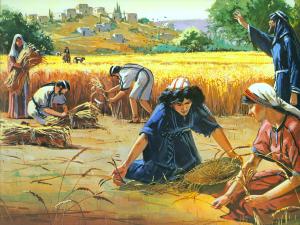
The story of Ruth provides analogies to the life of Jesus.
In the Book of Ruth a member of a nation that Israel traded and warred with off and on becomes one of the Israelite people and an ancestor of Israel’s most loved king, King David. Jesus career is like Ruth’s.
Episode 10 in Opening the Scriptures on the Way to Emmaus: Why Messiah had to Suffer. Introduction and links to other posts in the series here.
Ruth’s story begins.
Naomi is an Israelite woman living in the land of Moab at a time before there were kings in Israel. Her two sons have married two Moabite women, but both sons and Naomi’s husband have died. As Naomi starts her journey back to Israel and an uncertain future, she tells her daughters-in-law to stay behind and marry again to Moabite men. Ruth won’t leave Naomi, insisting,
Wherever you go I will go. Wherever you lodge I will lodge. Your people shall be my people, and your God my God. Wherever you die I will die, and there be buried. May the Lord do so and so to me, and more besides, if aught but death separates me from you!” (Ruth 1:16-17)
To us it sounds like a moving story of a daughter-in-law’s devotion. At the time it was written I imagine what many people saw first in Ruth is that she is a foreigner.
Ruth ekes out a living for herself and Naomi by following up the harvesters in a field belonging to Boaz, gleaning what they left behind. Israelite law required harvesters to leave something behind for the poorest people. She eventually marries Boaz. King David is her great grandson.
Ruth and Jesus
The story includes three details worth noting.
First detail: Ruth is subject to the typical prejudice against foreigners. She deals with it by gleaning only in fields belonging to Boaz, a relative of Naomi.
Second detail: Ruth engages in behavior that, at least by the time the story was written, was considered questionable. On the advice of Naomi she gets cleaned and dressed up and finds Boaz asleep on the threshing floor after he’s taken on some wine in honor of a hard day’s work. The Bible says she “uncovered a place at his feet and lay down.” Commentators inform us that “feet” could be a euphemism for a man’s genitals. The action was risqué enough, in any case, that some later versions of the story make Naomi the one who lay at Boaz’s “feet,” preferring incest to having any suspicion clinging to David’s blood line.
The third detail is an experience of rejection, a happy one as it turns out. Boaz can’t automatically marry Ruth because a closer relative to Naomi has, legally, a prior claim. Boaz informs the man that Naomi is selling a piece of property, and the man is eager to buy it. But when informed that Ruth comes along with the property, he backs out, probably thinking he doesn’t want to share his estate with any children he might sire by her.
A protest against a theology of exclusion
The Encyclopedia Judaica says the Book of Ruth is a “subtle but forceful protest against the Ezra-Nehemiah attitude toward foreign women.” It’s easy enough to see Jesus in the figure of Ruth. She’s a stranger who freely goes to a place where she will be the lowest in society. She scandalizes. She is rejected (before being vindicated). This story challenges the common thinking of the Jews after the Exile in the same way Jesus challenges his time and ours.
In Jesus’ words, “The Son of Man has nowhere to rest his head.” That was a choice very much like Ruth’s. I can imagine Jesus saying to the two on the way to Emmaus, repeating Ruth: “Wherever you lodge I shall lodge.” Jesus says the same to us, especially to the most rejected, from his place on the cross.
Image credit: WordPress.com via Google Images
Opening Scriptures on Way to Emmaus
Previous Post

November 12, 2018
Ezra and Nehemiah: Tribal Identity vs. Compassion
Next Post
November 16, 2018 Cheating Death, Cheating Extinction
Browse Our Archives
Select a Category Advent Christmas Amazon Synod Angels Being Consumed Bible Catholic Modern Creed Ecology Economics Elizabeth Johnson Eucharist Fragments and Filaments Gender and Sex Gospel of Mark Herzog Historical Jesus Liturgy Luke Opening Scriptures on Way to Emmaus Ordinary radicals Parables Pro-Life Reincarnation Rosary Sacraments science Social Justice Souls Stories of Jesus The Creed Torture and Eucharist Tracy Uncategorized War and Peace
Select a Month October 2026 June 2025 April 2025 March 2025 February 2025 January 2025 November 2024 July 2024 March 2024 December 2023 October 2023 September 2023 August 2023 May 2023 April 2023 March 2023 February 2023 January 2023 December 2022 November 2022 October 2022 September 2022 August 2022 July 2022 June 2022 April 2022 March 2022 February 2022 January 2022 December 2021 November 2021 October 2021 August 2021 July 2021 June 2021 April 2021 March 2021 February 2021 December 2020 November 2020 October 2020 August 2020 July 2020 June 2020 May 2020 April 2020 March 2020 February 2020 January 2020 December 2019 November 2019 October 2019 September 2019 August 2019 July 2019 June 2019 May 2019 April 2019 March 2019 February 2019 January 2019 December 2018 November 2018 October 2018 September 2018 August 2018 July 2018 June 2018 May 2018
Follow Us!
TAKE THE
Religious Wisdom Quiz
Which book comes last in the New Testament?
Select your answer to see how you score.
Jude Acts Revelation 2 Peter
Related posts from Lost in a One-Acre Wood
Good News on the Way to Emmaus: Why...
The Sign of Jonah and a Tall Tale...
Ezra and Nehemiah: Tribal Identity vs. Compassion
Nothing is holy now. More Kings and Prophets
TRENDING AT PATHEOS Catholic

The Parable Of The Sower And The Word...
One of Christ’s most famous parables is that of the sower who...

Rejecting Doom: Christian Hope And Human Action
Christianity is a religion of hope. We are to have hope and...

Why I Choose the Eucharist Over the Sermon
Choose the Eucharist, Not the Sermon What are we supposed to get...

5 Design Elements Found in Spiritually Rooted Homes
Putting Spirituality Into Home Decor Our homes are more than our living...

Credo: A Story of God Told with the...
About 10 years ago, I began to imagine a personal "Credo" that...

The Anatomy of Divine Revelation in Catholic Thought
The claim that God has made Himself known to human beings is...
view all Catholic blogs
Ad-Free & Subscriber Log-In Subscription Support
- About Us
- 2026 Calendar
- Videos
- Podcasts
- Library of World Religions
- Faith In Media Tracker
- Advertise With Us
- Write for Us
- Privacy Policy
- Terms of Service
- Do Not Sell My Data
- Contact Us
- Radiant Digital
- Manage Newsletter Subscriptions
- Unsubscribe From Notifications
- Sitemap
Copyright 2008-2026, Patheos. All rights reserved.
Subscription Support Ad-Free & Subscriber Log-In
Follow Patheos