
BuddhistCatholicContemplativeEvangelicalGeneral ChristianHinduJewishLatter-day SaintMuslimNew VisionsProgressive Christian
Beliefs
- Buddhist
- Catholic
- Contemplative
- Evangelical
- General Christian
- Hindu
- Jewish
- Latter-day Saint
- More Voices
- Muslim
- New Visions
- Pagan
- Progressive Christian
Topics
- Religion News
- Food and Religion
- Sports and Religion
- Religious Art
- Religious Music and Entertainment
- Religious Events
- History and Religion
- Style and Religion
- Politics and Religion
- Women in Religion
- Recreation Outdoors and Religion
- Business Finance and Religion
- Careers Workplace and Religion
- Education and Religion
- Family Parenting and Religion
- Health Fitness and Religion
- Home and Religion
- Relationships and Religion
- Technology and Religion
- Travel and Religion
Columnists
- Buddhist Columnists
- Business Finance and Religion Columnists
- Careers Workplace and Religion Columnists
- Catholic Columnists
- Contemplative Columnists
- Education and Religion Columnists
- Evangelists Columnists
- Family Parenting and Religion Columnists
- General Christian Columnists
- Health Fitness and Religion Columnists
- Hindu Columnists
- History and Religion Columnists
- Home and Religion Columnists
- Jewish Columnists
- More Voices Columnists
- Latter Day Columnists
- Muslim Columnists
- New Visions Columnists
- Nonreligious Columnists
- Pagan Columnists
- Politics and Religion Columnists
- Progressive Columnists
- Recreation Outdoors and Religion Columnists
- Relationships and Religion Columnists
- Religion News Columnists
- Religious Art Columnists
- Religious Events Columnists
- Religious Music and Entertainment Columnists
- Sports and Religion Columnists
- Style and Religion Columnists
- Technology and Religion Columnists
- Travel and Religion Columnists
- Women in Religion Columnists
Resource Library
- 2026 Calendar
- Library of World Religions
- The 100 Most Holy Places on Earth
- Patheos Answers
- Podcasts
- Videos
- Faith Leaders Database
- Anglican Episcopalian
- Bahai
- Baptist
- Buddhism
- Christianity
- Confucianism
- Eastern Orthodoxy
- Hinduism
- Holiness and Pentecostal
- ISKCON
- Islam
- Judaism
- Lutheran
- Methodist
- The Church of Jesus Christ of Latter-day Saints
- New Age
- Paganism
- Presbytarian and Reformed
- Protestantism
- Religion Behind the Scenes
- Roman Catholic
- Scientology
- Shia Islam
- Sikhism
- Sufism
- Sunni Islam
- Taoism
- Zen
- See all religions
Research Tools
 Ad-Free & Subscriber Log-In Subscription Support
Ad-Free & Subscriber Log-In Subscription Support
Follow Patheos 

- Trending:
- Forgiveness
- |
- Marriage
- |
- Consciousness
- |
- Death Penalty
- |
- Election
- |
- Halloween

- Home
- Catholic
- “Everything is Holy Now” — King David
“Everything is Holy Now” — King David
Last updated on: November 14, 2018 at 6:04 am by Jack Hartjes
“Everything is Holy Now” — King David 2018-11-14T06:04:46-06:00 Jack Hartjes
Patheos Explore the world's faith through different perspectives on religion and spirituality! Patheos has the views of the prevalent religions and spiritualities of the world.

David’s men are holy enough to eat the temple’s bread of offering to God.
Peter Mayer is a singer-songwriter occasionally heard on Minnesota Public Radio. One of his songs is titled “Everything is Holy Now.” It seems like a new-age idea, but Walter Brueggemann finds something like that thought in the life of King David of Israel. A couple not-so-famous David stories will be this focus of this episode of the Emmaus series.
Episode 7 in Opening the Scriptures on the Way to Emmaus: Why Messiah had to Suffer. Introduction and links to other posts in the series here.
The system of sacred violence tends to separate people. When it doesn’t kill its victims, it still makes victims. It divides the holy from the unholy—the “People” from foreigners, the healthy and whole from those with certain diseases or disabilities. It defines things and actions that defile—eating certain foods, touching a dead body, sex. The latter stain, in Jewish lore, lasts only three days, but others require ritual purification.
David and an unconventional way of being holy
With the building of the temple in Jerusalem, along with the rise of the monarchy in Israel, the divisions became much greater. But David didn’t build the temple. A story says he wanted to but wasn’t allowed. Two other stories make David a religious person with unconventional ideas about holiness and a leader who refuses to separate himself from his fellows. (On these stories I’m getting help from Walter Brueggeman’s book In Man We Trust: The Neglected Side of Biblical Faith, pp. 32-38.)
David has been in the service of King Saul ever since the day he killed the giant Goliath. He has married Saul’s daughter and become best friends with his son Jonathan. He also outshines Saul in deeds of valor, and Saul, apparently an unstable character, is insanely, murderously jealous. By a secretly arranged signal Jonathan informs David that it’s not safe for him to be at a royal feast that he is expected to attend.
David flees with some loyal companions, but in their haste they neglect to take food with them. They come to the city of Nob, where David talks to the priest Ahimelech and asks for some bread for his men. Ahimelech replies, “I have no ordinary bread on hand, only holy bread; if the men have abstained from women, you may eat some of that.” (This was a matter of ritual uncleanness, and the rule was no women for three days.)
David assures Ahimelech that his men are indeed ritually clean—though he couldn’t, I would think, have known that. They go ahead and eat the bread, and David and his men survive to take on Saul another day. (1 Samuel 21:1-6)
The “Son of David”
David decides for himself what holiness means. As long as he’s in the right he knows God is with him. He is holy, and his men are holy. He doesn’t need a law or a rubric to tell him what is holy and what isn’t.
One of Jesus’ titles is “Son of David,” and on this issue he follows David’s lead perfectly:
On a Sabbath day Jesus and some followers are making their way through a field of grain, and the disciples start picking the heads of grain. Some Pharisees object, “Look, why are they doing what is unlawful on the Sabbath?” Jesus answers, “Have you never read what David did when he was in need and he and his companions were hungry? How he went into the house of God when Abiathar was high priest and ate the bread of offering that only the priests could lawfully eat, and shared it with his companions?”
He gets the name of the priest wrong, and he doesn’t quite agree with Ahimelech on the matter of who should and shouldn’t be eating that bread. Other than that he shows that he is a true Son of David.
Jesus’ companions, like David’s, are holy enough. Holiness doesn’t need a priest’s say-so and special rules other than what decency and an accurate view of the situation requires. Neither does a person stop being holy by eating the wrong food:
Nothing that enters one from outside can defile that person; but the things that come out from within are what defile. (Mark 7:16)
David breaks with tradition in the matter of who is holy and under what circumstances, and Jesus follows that lead. The next story is an example of what holiness does. Hint: It’s not necessarily offering sacrifice to God.
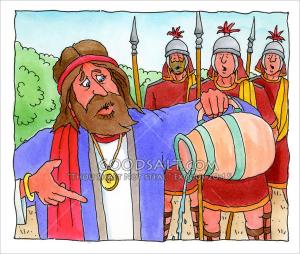
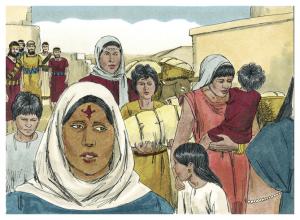
David acts in solidarity with him men.
David’s sacrifice
A second David story sounds like a legend. Historical or not, it shows the kind of thinking that became possible among the Israelite people because of the leadership of David. It’s a story about a sacrifice. Like Jephthah’s sacrifice of his daughter (see this post) it’s not a sacrifice to God. You’ll see how unlike Jephthah’s David’s sacrifice is.
A garrison of Philistines has occupied Bethlehem, and David and his men are taking refuge in a nearby cave. David has “a strong craving” for water. He’s really thirsty! He says, “Oh, that someone would give me a drink of water from the cistern that is by the gate of Bethlehem!”
There happen to be three very brave and mighty warriors among the crew. They break through the Philistine lines, get the water and bring it back to David. David refuses to drink it and pours it out on the ground. “Can I drink the blood of these men who went at the risk of their lives?” (2 Samuel 12:16-23)
David acts in solidarity with his men. It’s a new direction for a sacrifice to go. The sacrifice of Achan (and countless other victims of purity codes) divided insiders from outsiders. Abraham’s intended sacrifice of Isaac was about a relationship with God. Jephthah’s sacrifice was all about himself. The Israelite women who mourned Jephthah’s daughter were more like David, sacrificing their time in solidarity with Jephthah’s victim.
Whether that last custom predated David is impossible to say. The point is not who did what first or even what David’s motivation was. The David story may be only a legend. What matters is that at some time it became possible to think about religion in a new way. It became possible to identify and reject the sort of religion that makes distinctions among people.
Distinctions still abound, but bishops who revel in palatial residences can no longer be thought of as practicing true religion. Instead we look to, and canonize, someone like Oscar Romero. David poured out that Bethlehem water, declining a privileged position in relation to his men. Similarly, Romero refused to live in the bishop’s palace when the people lived in huts.
Identifying with the other
We call Jesus the “Son of David.” Let’s imagine Jesus, on the way to Emmaus, interpreting this David story in reference to himself. Jesus might justifiably say that his whole life, including his death on the cross, was like David’s simple act of pouring water on the ground in solidarity with others. As David knew thirst with his companions, Jesus experienced all that our human life is. And like the women mourning with Jephthah’s daughter, he made a special point to identify with society’s victims, the outcast, the ones who don’t measure up to someone’s standard of holiness.
Jesus died no ordinary death but death on a cross, a condemned man. To Jews that would seem to say Jesus is not holy but under a curse:
God’s curse rests on him who hangs on a tree. (Deuteronomy 21:23)
But Jesus’ death by crucifixion didn’t defile him any more than the act of sex would have made David’s men unworthy to eat the holy bread. In the crucified Jesus Christians were able to see brought to completion a concept of holiness that may have started as far back as the time of David.
Jesus made a career of identifying with others, especially in their lowest moments. That lets us into the heart of God. God is love. We tend to think of love as doing good for another. That sounds like work, but love is best if it includes actually liking the other. Jesus takes it a step further. Love is identifying with another. God’s essence, the heart of God, includes identifying with us. Jesus brings the heart of God into the midst of human history.
Image credits:
- Michael Dewberry and Votive Interiors Project, via Google Images
- Goodsalt via Google Images
Opening Scriptures on Way to Emmaus
Previous Post

November 2, 2018
Caravan is a Nice Word: Pre-election Rhetoric versus Compassion
Next Post
November 7, 2018 Nothing is holy now. More Kings and Prophets
Browse Our Archives
Select a Category Advent Christmas Amazon Synod Angels Being Consumed Bible Catholic Modern Creed Ecology Economics Elizabeth Johnson Eucharist Fragments and Filaments Gender and Sex Gospel of Mark Herzog Historical Jesus Liturgy Luke Opening Scriptures on Way to Emmaus Ordinary radicals Parables Pro-Life Reincarnation Rosary Sacraments science Social Justice Souls Stories of Jesus The Creed Torture and Eucharist Tracy Uncategorized War and Peace
Select a Month October 2026 June 2025 April 2025 March 2025 February 2025 January 2025 November 2024 July 2024 March 2024 December 2023 October 2023 September 2023 August 2023 May 2023 April 2023 March 2023 February 2023 January 2023 December 2022 November 2022 October 2022 September 2022 August 2022 July 2022 June 2022 April 2022 March 2022 February 2022 January 2022 December 2021 November 2021 October 2021 August 2021 July 2021 June 2021 April 2021 March 2021 February 2021 December 2020 November 2020 October 2020 August 2020 July 2020 June 2020 May 2020 April 2020 March 2020 February 2020 January 2020 December 2019 November 2019 October 2019 September 2019 August 2019 July 2019 June 2019 May 2019 April 2019 March 2019 February 2019 January 2019 December 2018 November 2018 October 2018 September 2018 August 2018 July 2018 June 2018 May 2018
Follow Us!
TAKE THE
Religious Wisdom Quiz
Which city did King Nebuchadnezzar rule from?
Select your answer to see how you score.
Jerusalem Nineveh Babylon Capernaum
Related posts from Lost in a One-Acre Wood
Good News on the Way to Emmaus: Why...
The Sign of Jonah and a Tall Tale...
Ruth, a Romantic Tale of a Victim who...
Ezra and Nehemiah: Tribal Identity vs. Compassion
TRENDING AT PATHEOS Catholic

The Parable Of The Sower And The Word...
One of Christ’s most famous parables is that of the sower who...

Rejecting Doom: Christian Hope And Human Action
Christianity is a religion of hope. We are to have hope and...

Why I Choose the Eucharist Over the Sermon
Choose the Eucharist, Not the Sermon What are we supposed to get...

5 Design Elements Found in Spiritually Rooted Homes
Putting Spirituality Into Home Decor Our homes are more than our living...

Credo: A Story of God Told with the...
About 10 years ago, I began to imagine a personal "Credo" that...

The Anatomy of Divine Revelation in Catholic Thought
The claim that God has made Himself known to human beings is...
view all Catholic blogs
Ad-Free & Subscriber Log-In Subscription Support
- About Us
- 2026 Calendar
- Videos
- Podcasts
- Library of World Religions
- Faith In Media Tracker
- Advertise With Us
- Write for Us
- Privacy Policy
- Terms of Service
- Do Not Sell My Data
- Contact Us
- Radiant Digital
- Manage Newsletter Subscriptions
- Unsubscribe From Notifications
- Sitemap
Copyright 2008-2026, Patheos. All rights reserved.
Subscription Support Ad-Free & Subscriber Log-In
Follow Patheos