
BuddhistCatholicContemplativeEvangelicalGeneral ChristianHinduJewishLatter-day SaintMuslimNew VisionsProgressive Christian
Beliefs
- Buddhist
- Catholic
- Contemplative
- Evangelical
- General Christian
- Hindu
- Jewish
- Latter-day Saint
- More Voices
- Muslim
- New Visions
- Pagan
- Progressive Christian
Topics
- Religion News
- Food and Religion
- Sports and Religion
- Religious Art
- Religious Music and Entertainment
- Religious Events
- History and Religion
- Style and Religion
- Politics and Religion
- Women in Religion
- Recreation Outdoors and Religion
- Business Finance and Religion
- Careers Workplace and Religion
- Education and Religion
- Family Parenting and Religion
- Health Fitness and Religion
- Home and Religion
- Relationships and Religion
- Technology and Religion
- Travel and Religion
Columnists
- Buddhist Columnists
- Business Finance and Religion Columnists
- Careers Workplace and Religion Columnists
- Catholic Columnists
- Contemplative Columnists
- Education and Religion Columnists
- Evangelists Columnists
- Family Parenting and Religion Columnists
- General Christian Columnists
- Health Fitness and Religion Columnists
- Hindu Columnists
- History and Religion Columnists
- Home and Religion Columnists
- Jewish Columnists
- More Voices Columnists
- Latter Day Columnists
- Muslim Columnists
- New Visions Columnists
- Nonreligious Columnists
- Pagan Columnists
- Politics and Religion Columnists
- Progressive Columnists
- Recreation Outdoors and Religion Columnists
- Relationships and Religion Columnists
- Religion News Columnists
- Religious Art Columnists
- Religious Events Columnists
- Religious Music and Entertainment Columnists
- Sports and Religion Columnists
- Style and Religion Columnists
- Technology and Religion Columnists
- Travel and Religion Columnists
- Women in Religion Columnists
Resource Library
- 2026 Calendar
- Library of World Religions
- The 100 Most Holy Places on Earth
- Patheos Answers
- Podcasts
- Videos
- Faith Leaders Database
- Anglican Episcopalian
- Bahai
- Baptist
- Buddhism
- Christianity
- Confucianism
- Eastern Orthodoxy
- Hinduism
- Holiness and Pentecostal
- ISKCON
- Islam
- Judaism
- Lutheran
- Methodist
- The Church of Jesus Christ of Latter-day Saints
- New Age
- Paganism
- Presbytarian and Reformed
- Protestantism
- Religion Behind the Scenes
- Roman Catholic
- Scientology
- Shia Islam
- Sikhism
- Sufism
- Sunni Islam
- Taoism
- Zen
- See all religions
Research Tools
 Ad-Free & Subscriber Log-In Subscription Support
Ad-Free & Subscriber Log-In Subscription Support
Follow Patheos 

- Trending:
- Forgiveness
- |
- Marriage
- |
- Consciousness
- |
- Death Penalty
- |
- Election
- |
- Halloween

- Home
- Catholic
- A Sacrificial Victim, the Unnamed Daughter of Jephthah
A Sacrificial Victim, the Unnamed Daughter of Jephthah
Last updated on: November 14, 2018 at 6:05 am by Jack Hartjes
A Sacrificial Victim, the Unnamed Daughter of Jephthah 2018-11-14T06:05:09-06:00 Jack Hartjes
Patheos Explore the world's faith through different perspectives on religion and spirituality! Patheos has the views of the prevalent religions and spiritualities of the world.
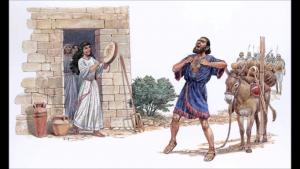
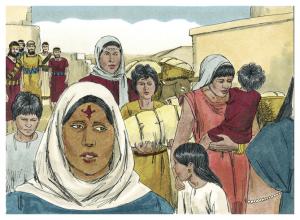
Jephthah finds out that his vow to offer a sacrifice to the Lord has made his own daughter the sacrificial victim.
A story of a sacrifice that shouldn’t have happened seems an unlikely candidate for Jesus to use to explain his own death. But the story of Jephthah and his daughter makes us focus intently on the sacrificial victim. In this case the victim is the real winner, at least long-term in Israel’s memory. So I’m proposing this as another of the Scriptures that Jesus opens up for the disciples on the way to Emmaus.
Episode 6 in Opening the Scriptures on the Way to Emmaus: Why Messiah had to Suffer. Introduction and links to other posts in the series here.
The victim’s point of view
The ability to see the point of view of the victim is part of the genius of Hebrew Scripture, but it’s sometimes there and sometimes not. God punishes Cain for the murder of Abel, but God also sympathizes with Cain, giving him a mark so that no one will dare kill him. God doesn’t want a second victim after Abel’s death.
In another story God saves a victim people—the Hebrew slaves in Egypt—and in the process creates another large group of victims. Egyptians suffer and die; and not all of the ones who suffered were guilty. The account in Exodus shows not the slightest sympathy for them. There’ is, however, this custom in the Jewish Seder celebration:
During the course of the Passover meal, wine is ritually spilled in compassion for, and solidarity with, the suffering caused to the Egyptians by God’s deliverance of Israel at the exodus. (This is a quote from J. Richard Middleton and Brian J. Walsh, Truth is Stranger Than it Used to Be, p. 93.)
The sacrificial victim remembered
Jephthah’s story forces us to see a victim’s point of view. The victim is Jephthah’s daughter. Here’s the story more or less as the Book of Judges presents it:
Jephthah, a judge of Israel, is worried about an upcoming military campaign. As insurance, he promises God that, if he wins the battle, he will sacrifice the first individual who comes out the door of his house to greet him on his return.
He wins the battle, and the first person out the door to greet him (you could guess this) is no slave but his beloved daughter. There’s no divine intervention to save the sacrificial victim this time, and the unnamed daughter says,
“Father, you have made a vow to the Lord. Do with me as you have vowed, because the Lord has wrought vengeance for you on your enemies the Ammonites.”
She does request, and is granted, two months reprieve to go off and “mourn her virginity” with her girlfriends—no boyfriends allowed. (Judges 11:29-40)
We can see the rashness of Jephthah’s vow, and there’s that moment of sympathy for the daughter at the end. This way the story makes it clear again that God does not approve of human sacrifice. But the victim is the lasting interest of the story:
It then became a custom in Israel for Israelite women to go yearly to mourn the daughter of Jephthah the Gileadite for four days of the year.
Undermining the common idea about sacrifice
There’s something especially touching about the daughter’s acceptance of her role as sacrificial victim. The connection with Jesus is impossible to miss.
The strangest part is God’s honoring Jephthah’s vow. If I had written this story, I would have cut it off half-way through. Jephthah would have lost the battle for making such a stupid vow. My story would have spoken against human sacrifice, but the Bible’s story helps to undermine a whole false ideology of sacrifice.
Jephthah gets what he asked for even though his promised sacrifice is completely inappropriate. And was the ensuing murder of the child a sacrifice made to God? Not at all! It was a sacrifice to Jephthah—not to secure his victory because that was already won, but to safeguard his honor. He could have broken his vow, but he would have had to admit he was wrong and stupid to have made it. He might have lost some status as Israel’s leader.
If this story is one that Jesus would have used to tell about himself, then Jesus is Jephthah’s daughter. A tender ego and delicate power relationships needed her as their sacrificial victim. We can imagine the powers that controlled the world of first-century Judea needing Jesus’ death to keep going.
Now the important question is: Can we imagine Jesus willingly going along with that system and somehow defeating the system in the process? Maybe so, since Jephthah’s daughter without a name triumphs over her father in the long run, in Israel’s memory.
Image credit: Carelink Ministries via Google Images
Opening Scriptures on Way to Emmaus
Previous Post

October 29, 2018
Cain and Abel: About Rivalry and What Jesus’ Gift of Himself is Not
Next Post
November 2, 2018 Caravan is a Nice Word: Pre-election Rhetoric versus Compassion
Browse Our Archives
Select a Category Advent Christmas Amazon Synod Angels Being Consumed Bible Catholic Modern Creed Ecology Economics Elizabeth Johnson Eucharist Fragments and Filaments Gender and Sex Gospel of Mark Herzog Historical Jesus Liturgy Luke Opening Scriptures on Way to Emmaus Ordinary radicals Parables Pro-Life Reincarnation Rosary Sacraments science Social Justice Souls Stories of Jesus The Creed Torture and Eucharist Tracy Uncategorized War and Peace
Select a Month October 2026 June 2025 April 2025 March 2025 February 2025 January 2025 November 2024 July 2024 March 2024 December 2023 October 2023 September 2023 August 2023 May 2023 April 2023 March 2023 February 2023 January 2023 December 2022 November 2022 October 2022 September 2022 August 2022 July 2022 June 2022 April 2022 March 2022 February 2022 January 2022 December 2021 November 2021 October 2021 August 2021 July 2021 June 2021 April 2021 March 2021 February 2021 December 2020 November 2020 October 2020 August 2020 July 2020 June 2020 May 2020 April 2020 March 2020 February 2020 January 2020 December 2019 November 2019 October 2019 September 2019 August 2019 July 2019 June 2019 May 2019 April 2019 March 2019 February 2019 January 2019 December 2018 November 2018 October 2018 September 2018 August 2018 July 2018 June 2018 May 2018
Follow Us!
TAKE THE
Religious Wisdom Quiz
What year was the King James Bible first published?
Select your answer to see how you score.
1611 1492 1701 1517
Related posts from Lost in a One-Acre Wood
Good News on the Way to Emmaus: Why...
The Sign of Jonah and a Tall Tale...
Ruth, a Romantic Tale of a Victim who...
Ezra and Nehemiah: Tribal Identity vs. Compassion
TRENDING AT PATHEOS Catholic

Creation, Preservation, and Teleology in Catholic Theology
As I write this, it is very early Monday morning. Like millions...

The Parable Of The Sower And The Word...
One of Christ’s most famous parables is that of the sower who...

Rejecting Doom: Christian Hope And Human Action
Christianity is a religion of hope. We are to have hope and...

Why I Choose the Eucharist Over the Sermon
Choose the Eucharist, Not the Sermon What are we supposed to get...

5 Design Elements Found in Spiritually Rooted Homes
Putting Spirituality Into Home Decor Our homes are more than our living...

Credo: A Story of God Told with the...
About 10 years ago, I began to imagine a personal "Credo" that...
view all Catholic blogs
Ad-Free & Subscriber Log-In Subscription Support
- About Us
- 2026 Calendar
- Videos
- Podcasts
- Library of World Religions
- Faith In Media Tracker
- Advertise With Us
- Write for Us
- Privacy Policy
- Terms of Service
- Do Not Sell My Data
- Contact Us
- Radiant Digital
- Manage Newsletter Subscriptions
- Unsubscribe From Notifications
- Sitemap
Copyright 2008-2026, Patheos. All rights reserved.
Subscription Support Ad-Free & Subscriber Log-In
Follow Patheos