
BuddhistCatholicContemplativeEvangelicalGeneral ChristianHinduJewishLatter-day SaintMuslimNew VisionsProgressive Christian
Beliefs
- Buddhist
- Catholic
- Contemplative
- Evangelical
- General Christian
- Hindu
- Jewish
- Latter-day Saint
- More Voices
- Muslim
- New Visions
- Pagan
- Progressive Christian
Topics
- Religion News
- Food and Religion
- Sports and Religion
- Religious Art
- Religious Music and Entertainment
- Religious Events
- History and Religion
- Style and Religion
- Politics and Religion
- Women in Religion
- Recreation Outdoors and Religion
- Business Finance and Religion
- Careers Workplace and Religion
- Education and Religion
- Family Parenting and Religion
- Health Fitness and Religion
- Home and Religion
- Relationships and Religion
- Technology and Religion
- Travel and Religion
Columnists
- Buddhist Columnists
- Business Finance and Religion Columnists
- Careers Workplace and Religion Columnists
- Catholic Columnists
- Contemplative Columnists
- Education and Religion Columnists
- Evangelists Columnists
- Family Parenting and Religion Columnists
- General Christian Columnists
- Health Fitness and Religion Columnists
- Hindu Columnists
- History and Religion Columnists
- Home and Religion Columnists
- Jewish Columnists
- More Voices Columnists
- Latter Day Columnists
- Muslim Columnists
- New Visions Columnists
- Nonreligious Columnists
- Pagan Columnists
- Politics and Religion Columnists
- Progressive Columnists
- Recreation Outdoors and Religion Columnists
- Relationships and Religion Columnists
- Religion News Columnists
- Religious Art Columnists
- Religious Events Columnists
- Religious Music and Entertainment Columnists
- Sports and Religion Columnists
- Style and Religion Columnists
- Technology and Religion Columnists
- Travel and Religion Columnists
- Women in Religion Columnists
Resource Library
- 2026 Calendar
- Library of World Religions
- The 100 Most Holy Places on Earth
- Patheos Answers
- Podcasts
- Videos
- Faith Leaders Database
- Anglican Episcopalian
- Bahai
- Baptist
- Buddhism
- Christianity
- Confucianism
- Eastern Orthodoxy
- Hinduism
- Holiness and Pentecostal
- ISKCON
- Islam
- Judaism
- Lutheran
- Methodist
- The Church of Jesus Christ of Latter-day Saints
- New Age
- Paganism
- Presbytarian and Reformed
- Protestantism
- Religion Behind the Scenes
- Roman Catholic
- Scientology
- Shia Islam
- Sikhism
- Sufism
- Sunni Islam
- Taoism
- Zen
- See all religions
Research Tools
 Ad-Free & Subscriber Log-In Subscription Support
Ad-Free & Subscriber Log-In Subscription Support
Follow Patheos 

- Trending:
- Forgiveness
- |
- Marriage
- |
- Consciousness
- |
- Death Penalty
- |
- Election
- |
- Halloween

- Home
- Catholic
- Cain and Abel: About Rivalry and What Jesus’ Gift of Himself is Not
Cain and Abel: About Rivalry and What Jesus’ Gift of Himself is Not
Last updated on: November 14, 2018 at 6:05 am by Jack Hartjes
Cain and Abel: About Rivalry and What Jesus’ Gift of Himself is Not 2018-11-14T06:05:34-06:00 Jack Hartjes
Patheos Explore the world's faith through different perspectives on religion and spirituality! Patheos has the views of the prevalent religions and spiritualities of the world.
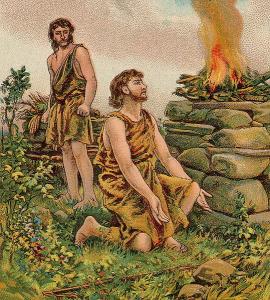
A disgruntled Cain imagines he will never be able to keep up with Abel in the matter of giving gifts to God.
Rivalry looms large in human history. We make ourselves rivals with each other and with God. We even take rivalry into our gift giving, comparing one gift with another. My search for Scriptures that Jesus would have “opened up” for the disciples on the way to Emmaus lands on just such a rivalry. But Jesus, who gave himself on the cross, doesn’t interpret gift giving the way Cain does.
Episode 5 in Opening the Scriptures on the Way to Emmaus: Why Messiah had to Suffer. Introduction and links to other posts in the series here.
In the story of Cain and Abel we see that one of Adam and Eve’s first children engaging in rivalry.
Abel is a keeper of sheep and Cain a tiller of the soil. Both of them decide to offer sacrifice to God Cain offers some fruit of the ground and Abel the firstlings of his flock. He chooses their fat portions as the Bible clarifies, in other words, the best parts. God looks with favor upon Abel’s sacrifice but distains Cain’s offering.
I remember a picture of this event in a book called “Bible History,” from my childhood religion classes. The smoke from Abel’s sacrifice goes straight up to heaven, and Cain’s smoke meanders lazily along the ground. That’s not in the Bible, but it’s a story so I guess it’s fair to add our own details.
Tradition interprets the distinction that God makes between the two sacrifices by saying Abel offered God the best that he had while Cain gave God something less than the best. That Cain gave less than his best is not in the story either. One has to wonder, anyway, why God would require the best. No such command is reported in this story. Indeed, I wonder why God would give a gift and require anything at all in exchange, if it’s really a gift. I’m looking for a deeper source of Cain’s sin than just being stingy.
Cain goes off and sulks, and God gives Cain some fatherly advice: “If you do well, will you not be accepted?” (Notice God doesn’t say Cain’s gift must match Abel’s, just that Cain should “do well.”) Soon Cain invites Abel out into the field, where he murders him.
Responding to a gift: a Cain Way and an Abel Way
I’d like to look in a new direction for motives in this story. When a human person gives a gift, it may be with no strings attached. That is, the person isn’t looking for anything in return. Still the recipient will often offer something in return. It’s not out of a sense of obligation. The original giving was a good thing and humans, being imitative creatures, will sometimes imitate something good. Could it be that Abel’s gift is of that sort, a free response to God, whose giving is without strings?
Meanwhile Cain is thinking in terms of obligation or even rivalry with God. Maybe giving something back to God would put him and God on an even keel? That’s another common way for a human to respond to someone’s gift. We don’t want to be “beholden.” We want to have accounts set right. We sometimes even get into a game of one-upmanship in the matter of giving gifts. A clue to Cain’s attitude is the murderous anger he feels toward Abel. He thinks of Abel (as well as God) as a rival and maybe one he can’t beat.
The spirit of rivalry makes sacrifices go wrong
What does this tell us about offering sacrifice to God? Clearly one thing is that it’s a religious practice that can go wrong. We can imagine we are paying off an obligation to God, either for things we have received or in reparation for sins we have committed. That makes us other Cains and God’s rivals. We’re looking for a way out of an obligation, and most likely the cheapest way.
Jesus didn’t settle for the cheapest way. A drop of his precious blood would have been enough, a teacher once told me, to satisfy God for all the sins humans had ever committed. That Jesus went overboard and gave not the minimum price but all he had, impresses us as an act of superabundant love—so I was taught.
Along the same line, I was taught that Jesus’ sacrifice was a continuation and a perfection of the temple sacrifices of the Old Testament. Those sacrifices were inferior, by comparison. They hadn’t been able to accomplish the complete reconciliation of humanity with God so priests had to repeat them over and over. Jesus’ “perfect” sacrifice sufficed, once and for all, and didn’t need to be repeated. But doesn’t this just make Jesus the perfect Cain. Jesus’ gift gift tops all the others and finally matches God’s own gift.
Surprising God
What if God doesn’t demand a price either for gifts given or for offenses taken? What if the gifts we give to God are truly gifts, not things God expects, but surprises for God? Could that even apply to Jesus’ gift?
A true gift to God is not an obligation we have to fulfill but a worry-free imitating of God’s overflowing goodness. I’m thinking God doesn’t expect Abel’s offering. It’s not taking anything away from God to imagine that God enjoys surprises. I’m thinking Jesus isn’t Cain at all. Jesus didn’t put closure to Old Testament sacrifices by doing them perfectly. Not every Old Testament sacrifice was of the repayment sort anyway. Jesus does something different. Jesus’ offering to God, through his whole life, was gift, not repayment.
If Jesus spoke about Cain and Abel on that walk to Emmaus, it was as much to tell what his suffering was not as to tell what it was. It wasn’t to satisfy God for anything. But what was it for, and what does Jesus’ suffering have to do with salvation? One clue comes with the next story that I imagine Jesus interpreting for the disciples.
Opening Scriptures on Way to Emmaus
Next Post

October 31, 2018 A Sacrificial Victim, the Unnamed Daughter of Jephthah
Browse Our Archives
Select a Category Advent Christmas Amazon Synod Angels Being Consumed Bible Catholic Modern Creed Ecology Economics Elizabeth Johnson Eucharist Fragments and Filaments Gender and Sex Gospel of Mark Herzog Historical Jesus Liturgy Luke Opening Scriptures on Way to Emmaus Ordinary radicals Parables Pro-Life Reincarnation Rosary Sacraments science Social Justice Souls Stories of Jesus The Creed Torture and Eucharist Tracy Uncategorized War and Peace
Select a Month October 2026 June 2025 April 2025 March 2025 February 2025 January 2025 November 2024 July 2024 March 2024 December 2023 October 2023 September 2023 August 2023 May 2023 April 2023 March 2023 February 2023 January 2023 December 2022 November 2022 October 2022 September 2022 August 2022 July 2022 June 2022 April 2022 March 2022 February 2022 January 2022 December 2021 November 2021 October 2021 August 2021 July 2021 June 2021 April 2021 March 2021 February 2021 December 2020 November 2020 October 2020 August 2020 July 2020 June 2020 May 2020 April 2020 March 2020 February 2020 January 2020 December 2019 November 2019 October 2019 September 2019 August 2019 July 2019 June 2019 May 2019 April 2019 March 2019 February 2019 January 2019 December 2018 November 2018 October 2018 September 2018 August 2018 July 2018 June 2018 May 2018
Follow Us!
TAKE THE
Religious Wisdom Quiz
Who was Mary's cousin, mother of John the Baptist?
Select your answer to see how you score.
Elizabeth Rachel Sarah Martha
Related posts from Lost in a One-Acre Wood

Good News on the Way to Emmaus: Why...
The Sign of Jonah and a Tall Tale...
Ruth, a Romantic Tale of a Victim who...
Ezra and Nehemiah: Tribal Identity vs. Compassion
TRENDING AT PATHEOS Catholic

Rejecting Doom: Christian Hope And Human Action
Christianity is a religion of hope. We are to have hope and...

It’s What Comes From Within Which Matters
One of the most difficult things for us to understand is why...

Why I Choose the Eucharist Over the Sermon
Choose the Eucharist, Not the Sermon What are we supposed to get...

5 Design Elements Found in Spiritually Rooted Homes
Putting Spirituality Into Home Decor Our homes are more than our living...

Credo: A Story of God Told with the...
About 10 years ago, I began to imagine a personal "Credo" that...

The Anatomy of Divine Revelation in Catholic Thought
The claim that God has made Himself known to human beings is...
view all Catholic blogs
Ad-Free & Subscriber Log-In Subscription Support
- About Us
- 2026 Calendar
- Videos
- Podcasts
- Library of World Religions
- Faith In Media Tracker
- Advertise With Us
- Write for Us
- Privacy Policy
- Terms of Service
- Do Not Sell My Data
- Contact Us
- Radiant Digital
- Manage Newsletter Subscriptions
- Unsubscribe From Notifications
- Sitemap
Copyright 2008-2026, Patheos. All rights reserved.
Subscription Support Ad-Free & Subscriber Log-In
Follow Patheos