
BuddhistCatholicContemplativeEvangelicalGeneral ChristianHinduJewishLatter-day SaintMuslimNew VisionsProgressive Christian
Beliefs
- Buddhist
- Catholic
- Contemplative
- Evangelical
- General Christian
- Hindu
- Jewish
- Latter-day Saint
- More Voices
- Muslim
- New Visions
- Pagan
- Progressive Christian
Topics
- Religion News
- Food and Religion
- Sports and Religion
- Religious Art
- Religious Music and Entertainment
- Religious Events
- History and Religion
- Style and Religion
- Politics and Religion
- Women in Religion
- Recreation Outdoors and Religion
- Business Finance and Religion
- Careers Workplace and Religion
- Education and Religion
- Family Parenting and Religion
- Health Fitness and Religion
- Home and Religion
- Relationships and Religion
- Technology and Religion
- Travel and Religion
Columnists
- Buddhist Columnists
- Business Finance and Religion Columnists
- Careers Workplace and Religion Columnists
- Catholic Columnists
- Contemplative Columnists
- Education and Religion Columnists
- Evangelists Columnists
- Family Parenting and Religion Columnists
- General Christian Columnists
- Health Fitness and Religion Columnists
- Hindu Columnists
- History and Religion Columnists
- Home and Religion Columnists
- Jewish Columnists
- More Voices Columnists
- Latter Day Columnists
- Muslim Columnists
- New Visions Columnists
- Nonreligious Columnists
- Pagan Columnists
- Politics and Religion Columnists
- Progressive Columnists
- Recreation Outdoors and Religion Columnists
- Relationships and Religion Columnists
- Religion News Columnists
- Religious Art Columnists
- Religious Events Columnists
- Religious Music and Entertainment Columnists
- Sports and Religion Columnists
- Style and Religion Columnists
- Technology and Religion Columnists
- Travel and Religion Columnists
- Women in Religion Columnists
Resource Library
- 2026 Calendar
- Library of World Religions
- The 100 Most Holy Places on Earth
- Patheos Answers
- Podcasts
- Videos
- Faith Leaders Database
- Anglican Episcopalian
- Bahai
- Baptist
- Buddhism
- Christianity
- Confucianism
- Eastern Orthodoxy
- Hinduism
- Holiness and Pentecostal
- ISKCON
- Islam
- Judaism
- Lutheran
- Methodist
- The Church of Jesus Christ of Latter-day Saints
- New Age
- Paganism
- Presbytarian and Reformed
- Protestantism
- Religion Behind the Scenes
- Roman Catholic
- Scientology
- Shia Islam
- Sikhism
- Sufism
- Sunni Islam
- Taoism
- Zen
- See all religions
Research Tools
 Ad-Free & Subscriber Log-In Subscription Support
Ad-Free & Subscriber Log-In Subscription Support
Follow Patheos 

- Trending:
- Forgiveness
- |
- Marriage
- |
- Consciousness
- |
- Death Penalty
- |
- Election
- |
- Halloween

- Home
- Catholic
- Two Original Sin Stories, the Devil’s and the Bible’s
Two Original Sin Stories, the Devil’s and the Bible’s
Last updated on: October 22, 2018 at 5:21 am by Jack Hartjes
Two Original Sin Stories, the Devil’s and the Bible’s 2018-10-22T05:21:15-06:00 Jack Hartjes
Patheos Explore the world's faith through different perspectives on religion and spirituality! Patheos has the views of the prevalent religions and spiritualities of the world.
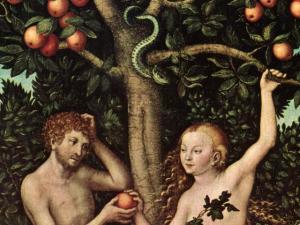
The snake tells a story of rivalry with God and convinces Adam and eve to commit the Original Sin.
The last post was a trip away from Bible stories for another story by René Girard. Girard’s theory purports to explain the origin, in rivalry, the scapegoat, and sacred violence of practically everything that distinguished humans from animals. Soon we return to the Bible, specifically the story in Genesis of Adam and Eve’s Original Sin. We’ll see imagined rivalry and the first instance of violence in the Bible. Before that, here’s a story that’s not exactly in the Bible. You can think of it as a story that the devil might have told if he were the story-telling type.
Episode 3 in the series “Opening the Scriptures on the Way to Emmaus: Why Did Jesus Have to Suffer.” Introduction and a Table of Contents here.
Original sin, devil’s version
God had everything anybody could possibly want, but he still wasn’t happy. There was no one to admire his greatness. So he decided to make a world. He would share much of his wealth but not all of it. God planted a garden and put a woman there. He told her she could eat all the food she wanted except the fruit of one tree, placed right in the loveliest spot in the garden so the woman would be sure to see it often and be reminded that he was God and she was not.
Eve—that was the woman’s name—liked pretty things and often wandered in that part of the garden where the forbidden tree grew. She really wanted some of the fruit of that tree, but she was afraid to touch it. God had told her if she did she would die. She didn’t understand why she wanted the fruit so badly, but the snake knew. He told her, “You’re mad at God, and you should be. God knows if you eat from that tree you’ll be like him. You feel it in your gut. God is just using your fear of death to keep you in your place.”
Eve reached up and touched, then picked, and ate the fruit of that tree. She didn’t die; instead her eyes were opened and she understood what God had been doing to her. The snake was right. She left God’s garden and would have nothing to do with God from that day on. Life suddenly got a great deal harder for Eve as God found ways to take revenge, but she didn’t care.
Rivalry
That was a story about rivalry between a deity and a human being. It projects feelings humans often feel (and nearly always deny that they feel them) onto God. It nourishes a lie about a divine rival, a god of petty rules and arbitrary consequences.
The Original Sin story in the Bible also contains the idea that God is a rival for the humans, but it’s the snake, not the narrator, who says it; and the snake is lying. Adam and Eve set themselves up as God’s rivals because they believe the snake and misunderstand God. The Bible’s story exposes the lie.
Two people live in a beautiful garden, a man and a woman. They exist in harmony and equality. They’re naked. Without rankings they don’t need the signals of rank that clothes send. At the end, when the husband outranks the wife, the reader sees clearly that it’s because of sin. God didn’t mean things to be that way. In fact, God, like the woman, like one in the lower place, sews some decent clothes for the couple before sending them out into the wilder world. God sacrifices some of his own animal creatures to do so. (Genesis, Chapter 3)
This is not a god who is anyone’s rival.
Jesus in the story
Imagine Jesus placing himself in this story as he interprets Scripture on the way to Emmaus. I think Jesus would be the innocent animals that gave themselves up to clothe the two wayward but still loved humans. A friend who was pastor at the local Assembly of God Church takes the whole story as literal history. He believes that these animals were the very first living things on earth ever to die, the first blood that was ever shed. God himself commits the first act of violence.
Most of us would find that incredible scientifically, but I like the symbolism. Nature gives herself and keeps on giving even though we continually abuse her. Jesus telling this story would identify with Nature, represented by the animals, who gave their skins to help the humans.
The Church has always found hints of the Gospel in the story of the Original Sin. It is seen in a curse God invokes on the snake. But that curse is really indefinite, especially in modern, more accurate translation:
The descendant of the woman “will strike at your head, while you strike at his heel.” (Genesis 3:15)
For a positive outcome it doesn’t say much. You have to do a lot of reading-in to see Jesus’ victory over Satan there. I see good news in this story where God and the animals provide new clothes for the two sinners. You could call that a sacrifice, but it’s about the opposite of a violent, sacred offering that restores friendship with God. The offering isn’t to God; it’s to the people. And God’s friendship doesn’t have to be restored because God always loved Adam and Eve.
We call Jesus’ death on the cross a sacrifice, but a sacrifice to whom? Can we think of it as an offering to human beings rather than to God?
Image credit: Evidence for God from Science, via Google Images
Opening Scriptures on Way to Emmaus
Previous Post

October 19, 2018
Memorial Statues, Memorial Days, and the Uses of History
Next Post
October 24, 2018 Sacrifice Isaac? What Got into Abraham?
Browse Our Archives
Select a Category Advent Christmas Amazon Synod Angels Being Consumed Bible Catholic Modern Creed Ecology Economics Elizabeth Johnson Eucharist Fragments and Filaments Gender and Sex Gospel of Mark Herzog Historical Jesus Liturgy Luke Opening Scriptures on Way to Emmaus Ordinary radicals Parables Pro-Life Reincarnation Rosary Sacraments science Social Justice Souls Stories of Jesus The Creed Torture and Eucharist Tracy Uncategorized War and Peace
Select a Month October 2026 June 2025 April 2025 March 2025 February 2025 January 2025 November 2024 July 2024 March 2024 December 2023 October 2023 September 2023 August 2023 May 2023 April 2023 March 2023 February 2023 January 2023 December 2022 November 2022 October 2022 September 2022 August 2022 July 2022 June 2022 April 2022 March 2022 February 2022 January 2022 December 2021 November 2021 October 2021 August 2021 July 2021 June 2021 April 2021 March 2021 February 2021 December 2020 November 2020 October 2020 August 2020 July 2020 June 2020 May 2020 April 2020 March 2020 February 2020 January 2020 December 2019 November 2019 October 2019 September 2019 August 2019 July 2019 June 2019 May 2019 April 2019 March 2019 February 2019 January 2019 December 2018 November 2018 October 2018 September 2018 August 2018 July 2018 June 2018 May 2018
Follow Us!
TAKE THE
Religious Wisdom Quiz
In 2 Corinthians, Paul describes a man being caught up to the third heaven. How many years before writing did this happen?
Select your answer to see how you score.
Fourteen years Seven years Twelve years Ten years
Related posts from Lost in a One-Acre Wood
Good News on the Way to Emmaus: Why...
The Sign of Jonah and a Tall Tale...
Ruth, a Romantic Tale of a Victim who...
Ezra and Nehemiah: Tribal Identity vs. Compassion
TRENDING AT PATHEOS Catholic

Creation, Preservation, and Teleology in Catholic Theology
As I write this, it is very early Monday morning. Like millions...

The Parable Of The Sower And The Word...
One of Christ’s most famous parables is that of the sower who...

Rejecting Doom: Christian Hope And Human Action
Christianity is a religion of hope. We are to have hope and...

Why I Choose the Eucharist Over the Sermon
Choose the Eucharist, Not the Sermon What are we supposed to get...

5 Design Elements Found in Spiritually Rooted Homes
Putting Spirituality Into Home Decor Our homes are more than our living...

Credo: A Story of God Told with the...
About 10 years ago, I began to imagine a personal "Credo" that...
view all Catholic blogs
Ad-Free & Subscriber Log-In Subscription Support
- About Us
- 2026 Calendar
- Videos
- Podcasts
- Library of World Religions
- Faith In Media Tracker
- Advertise With Us
- Write for Us
- Privacy Policy
- Terms of Service
- Do Not Sell My Data
- Contact Us
- Radiant Digital
- Manage Newsletter Subscriptions
- Unsubscribe From Notifications
- Sitemap
Copyright 2008-2026, Patheos. All rights reserved.
Subscription Support Ad-Free & Subscriber Log-In
Follow Patheos