
BuddhistCatholicContemplativeEvangelicalGeneral ChristianHinduJewishLatter-day SaintMuslimNew VisionsProgressive Christian
Beliefs
- Buddhist
- Catholic
- Contemplative
- Evangelical
- General Christian
- Hindu
- Jewish
- Latter-day Saint
- More Voices
- Muslim
- New Visions
- Pagan
- Progressive Christian
Topics
- Religion News
- Food and Religion
- Sports and Religion
- Religious Art
- Religious Music and Entertainment
- Religious Events
- History and Religion
- Style and Religion
- Politics and Religion
- Women in Religion
- Recreation Outdoors and Religion
- Business Finance and Religion
- Careers Workplace and Religion
- Education and Religion
- Family Parenting and Religion
- Health Fitness and Religion
- Home and Religion
- Relationships and Religion
- Technology and Religion
- Travel and Religion
Columnists
- Buddhist Columnists
- Business Finance and Religion Columnists
- Careers Workplace and Religion Columnists
- Catholic Columnists
- Contemplative Columnists
- Education and Religion Columnists
- Evangelists Columnists
- Family Parenting and Religion Columnists
- General Christian Columnists
- Health Fitness and Religion Columnists
- Hindu Columnists
- History and Religion Columnists
- Home and Religion Columnists
- Jewish Columnists
- More Voices Columnists
- Latter Day Columnists
- Muslim Columnists
- New Visions Columnists
- Nonreligious Columnists
- Pagan Columnists
- Politics and Religion Columnists
- Progressive Columnists
- Recreation Outdoors and Religion Columnists
- Relationships and Religion Columnists
- Religion News Columnists
- Religious Art Columnists
- Religious Events Columnists
- Religious Music and Entertainment Columnists
- Sports and Religion Columnists
- Style and Religion Columnists
- Technology and Religion Columnists
- Travel and Religion Columnists
- Women in Religion Columnists
Resource Library
- 2026 Calendar
- Library of World Religions
- The 100 Most Holy Places on Earth
- Patheos Answers
- Podcasts
- Videos
- Faith Leaders Database
- Anglican Episcopalian
- Bahai
- Baptist
- Buddhism
- Christianity
- Confucianism
- Eastern Orthodoxy
- Hinduism
- Holiness and Pentecostal
- ISKCON
- Islam
- Judaism
- Lutheran
- Methodist
- The Church of Jesus Christ of Latter-day Saints
- New Age
- Paganism
- Presbytarian and Reformed
- Protestantism
- Religion Behind the Scenes
- Roman Catholic
- Scientology
- Shia Islam
- Sikhism
- Sufism
- Sunni Islam
- Taoism
- Zen
- See all religions
Research Tools
 Ad-Free & Subscriber Log-In Subscription Support
Ad-Free & Subscriber Log-In Subscription Support
Follow Patheos 

- Trending:
- Forgiveness
- |
- Marriage
- |
- Consciousness
- |
- Death Penalty
- |
- Election
- |
- Halloween

- Home
- Catholic
- Memorial Statues, Memorial Days, and the Uses of History
Memorial Statues, Memorial Days, and the Uses of History
Last updated on: July 23, 2019 at 6:48 pm by Jack Hartjes
Memorial Statues, Memorial Days, and the Uses of History 2019-07-23T18:48:15-06:00 Jack Hartjes
Patheos Explore the world's faith through different perspectives on religion and spirituality! Patheos has the views of the prevalent religions and spiritualities of the world.

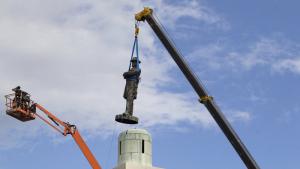
Destroying two statues, of Saddam Hussein and of a Confederate general: morally the same or different?
“The study of history has absolutely no use whatsoever.” That’s what a museum guide told me once. (I can’t remember the guide’s name or the museum’s.) It’s a sentiment that, I guess, most people would disagree with. Why else would people argue about Confederate s statues and memorial days like Columbus Day?
What brings this thought to mind is a friend’s comment about my post of last Friday, October 12. In it I praised the citizens of Mankato, Minnesota, for changing Columbus Day to Indigenous Peoples Day. My friend made me understand, helpfully, that the position I took was a bit controversial.
Not everyone agrees that changing Columbus Day is a good idea. Neither do we all agree about keeping or removing statues of Confederate heroes from public places. Isn’t the removal side saying, “Let’s just forget certain parts of American history”?
Different statues, different moral discernments?
The two pictures above show the removal of two statues. One is of Saddam Hussein, hated Iraqi ruler. The other is of a general in the Confederate army. Almost every American cheered the first action, but many question the second. Is the moral calculus of these two actions really all that different?
To me it seems exactly the same except that the Confederacy is quite a bit farther away in history than Saddam Hussein. Confederate statues themselves, though, are not as old as one might think.
The number of Confederate memorial installations peaked around 1910 — 50 years after the end of the Civil War and at the height of Jim Crow, an era defined by segregation and disenfranchisement laws against black Americans. Confederate installations spiked again in the 1950s and 1960s, during the Civil Rights Movement. (Business Insider article, “There are hundreds of Confederate monuments across the US – here’s when they were built”)
The purpose of these statues was less to honor a confederate ideal and Southern pride than to push back against Reconstruction first and the civil rights movement later.
The American Historical Society comments in “AHA Statement on Confederate Monuments” (August 2017):
Memorials to the Confederacy were intended, in part, to obscure the terrorism required to overthrow Reconstruction, and to intimidate African Americans politically and isolate them from the mainstream of public life. A reprise of commemoration during the mid-20th century coincided with the Civil Rights Movement and included a wave of renaming and the popularization of the Confederate flag as a political symbol. Events in Charlottesville and elsewhere indicate that these symbols of white supremacy are still being invoked for similar purposes.
Remembering history
People who object to removing statues and changing memorial days argue that to do so is to forget parts of American history. But when you think only of whatever good a Confederate statue might represent, you ignore more history than you remember.
Still one must remember history. Perhaps, as my friend believes, we should keep Columbus Day, keep the statues, but make special efforts to tell history correctly. We would teach clearly the harms native peoples and peoples of color suffered throughout most of American history. The point, though, is that these memorials themselves are ways of remembering history wrong.
Take statues, say, a statue of a Confederate general riding a horse. That statue does not honor the horse; it honors the man on the horse. It doesn’t honor the man for being a good person. He may well have been that to his family and his community and in his own conscience. But it honors what the man did on the horse. He carried on a war to perpetuate the institution of slavery. The statue does not remember history correctly.
Likewise, we remember Columbus on Columbus Day for the history that he started in these lands. For native peoples it was a history of cruel oppression. We must remember it, of course, but not celebrate it. A family celebration is not a good celebration unless it’s for every member of the family. Columbus Day is not a joyful occasion for Native Americans. Neither can a descendant of slaves feel good about a memorial to the Confederacy.
To remove such monuments is neither to “change” history nor “erase” it. What changes with such removals is what American communities decide is worthy of civic honor. (AHA article cited above)
What about George Washington?
George Washington had slaves, too. Maybe we should tear down their statues as well.
So goes one argument. It has a rhetorical kind of power. It makes the removal of Confederate statues seem absurd. Of course, we shouldn’t remove statues of the American hero George Washington, so why the others?
But the cases are not as similar as they sound. Statues honor the role a person played in history. Washington’s role had nothing to do with his possession of slaves. Slavery is a black spot on both a country and an individual who owned slaves. But a statue of George Washington doesn’t make one think of slavery. We honor his brave leadership in a war for freedom, his years as a country’s first president, and his wise decision to step down after eight years.
Again the American Historical Society:
George Washington owned enslaved people, but the Washington Monument exists because of his contributions to the building of a nation. There is no logical equivalence between the builders and protectors of a nation—however imperfect—and the men who sought to sunder that nation in the name of slavery.
Minnesota State Capitol Paintings of Native Americans
Controversy erupted around paintings in the Minnesota State Capitol Building during its renovation a few years ago. Native Americans and others objected to the ways the state’s first peoples appeared in these paintings. The Minnesota Historical Society eventually reached a compromise solution that could also work for some of the objectionable statues.
The compromise removes or relocates some, but not all, of the paintings that were offensive to Native Americans. Here are the relevant paragraphs of their report:
- “Father Hennepin Discovering the Falls of St. Anthony”and “The Treaty of Traverse des Sioux” paintings in the Governor’s Reception Room will be relocated and interpreted more robustly elsewhere in the Capitol to share more fully the history of this time period, the significance and historical context of the paintings and the perspectives of American Indians and others.
- The “Attack on New Ulm”and “Eighth Minnesota at the Battle of Ta-Ha-Kouty” paintings will be removed from exhibition at the Capitol. Discussions will continue about how best to interpret American Indian history within the Capitol, including interactions with other cultures and the contributions of American Indians today. Neither painting is original to the Capitol design and both are painful reminders of our shared history.
I can imagine a similar solution for many Confederate statues. In fact, some of them now stand in museums where their true story is told and history remembered correctly.
The American Historical Society suggests, finally:
We also encourage communities to remember that all memorials remain artifacts of their time and place. They should be preserved, just like any other historical document, whether in a museum or some other appropriate venue. Prior to removal they should be photographed and measured in their original contexts. These documents should accompany the memorials as part of the historical record.
Image credits: The Guardian and NPR, via Google Images
Previous Post

October 17, 2018
René Girard, Rivalry, the Scapegoat, Sacred Violence
Next Post
October 22, 2018 Two Original Sin Stories, the Devil's and the Bible's
Browse Our Archives
Select a Category Advent Christmas Amazon Synod Angels Being Consumed Bible Catholic Modern Creed Ecology Economics Elizabeth Johnson Eucharist Fragments and Filaments Gender and Sex Gospel of Mark Herzog Historical Jesus Liturgy Luke Opening Scriptures on Way to Emmaus Ordinary radicals Parables Pro-Life Reincarnation Rosary Sacraments science Social Justice Souls Stories of Jesus The Creed Torture and Eucharist Tracy Uncategorized War and Peace
Select a Month October 2026 June 2025 April 2025 March 2025 February 2025 January 2025 November 2024 July 2024 March 2024 December 2023 October 2023 September 2023 August 2023 May 2023 April 2023 March 2023 February 2023 January 2023 December 2022 November 2022 October 2022 September 2022 August 2022 July 2022 June 2022 April 2022 March 2022 February 2022 January 2022 December 2021 November 2021 October 2021 August 2021 July 2021 June 2021 April 2021 March 2021 February 2021 December 2020 November 2020 October 2020 August 2020 July 2020 June 2020 May 2020 April 2020 March 2020 February 2020 January 2020 December 2019 November 2019 October 2019 September 2019 August 2019 July 2019 June 2019 May 2019 April 2019 March 2019 February 2019 January 2019 December 2018 November 2018 October 2018 September 2018 August 2018 July 2018 June 2018 May 2018
Follow Us!
TAKE THE
Religious Wisdom Quiz
What animal did David protect his sheep from as a young shepherd?
Select your answer to see how you score.
Eagle and serpent Lion and bear Wolf and fox Horse and boar
Related posts from Lost in a One-Acre Wood

Axios News, Inflation, Justice, and Young Workers in...
Catholic Church Repudiates the Doctrine of Discovery

Holy Thursday Theology and the Scientific Quest for...
‘Render to Caesar’ – or Not. The Speech...
TRENDING AT PATHEOS Catholic

Rejecting Doom: Christian Hope And Human Action
Christianity is a religion of hope. We are to have hope and...

It’s What Comes From Within Which Matters
One of the most difficult things for us to understand is why...

Why I Choose the Eucharist Over the Sermon
Choose the Eucharist, Not the Sermon What are we supposed to get...

5 Design Elements Found in Spiritually Rooted Homes
Putting Spirituality Into Home Decor Our homes are more than our living...

Credo: A Story of God Told with the...
About 10 years ago, I began to imagine a personal "Credo" that...

The Anatomy of Divine Revelation in Catholic Thought
The claim that God has made Himself known to human beings is...
view all Catholic blogs
Ad-Free & Subscriber Log-In Subscription Support
- About Us
- 2026 Calendar
- Videos
- Podcasts
- Library of World Religions
- Faith In Media Tracker
- Advertise With Us
- Write for Us
- Privacy Policy
- Terms of Service
- Do Not Sell My Data
- Contact Us
- Radiant Digital
- Manage Newsletter Subscriptions
- Unsubscribe From Notifications
- Sitemap
Copyright 2008-2026, Patheos. All rights reserved.
Subscription Support Ad-Free & Subscriber Log-In
Follow Patheos