
BuddhistCatholicContemplativeEvangelicalGeneral ChristianHinduJewishLatter-day SaintMuslimNew VisionsProgressive Christian
Beliefs
- Buddhist
- Catholic
- Contemplative
- Evangelical
- General Christian
- Hindu
- Jewish
- Latter-day Saint
- More Voices
- Muslim
- New Visions
- Pagan
- Progressive Christian
Topics
- Religion News
- Food and Religion
- Sports and Religion
- Religious Art
- Religious Music and Entertainment
- Religious Events
- History and Religion
- Style and Religion
- Politics and Religion
- Women in Religion
- Recreation Outdoors and Religion
- Business Finance and Religion
- Careers Workplace and Religion
- Education and Religion
- Family Parenting and Religion
- Health Fitness and Religion
- Home and Religion
- Relationships and Religion
- Technology and Religion
- Travel and Religion
Columnists
- Buddhist Columnists
- Business Finance and Religion Columnists
- Careers Workplace and Religion Columnists
- Catholic Columnists
- Contemplative Columnists
- Education and Religion Columnists
- Evangelists Columnists
- Family Parenting and Religion Columnists
- General Christian Columnists
- Health Fitness and Religion Columnists
- Hindu Columnists
- History and Religion Columnists
- Home and Religion Columnists
- Jewish Columnists
- More Voices Columnists
- Latter Day Columnists
- Muslim Columnists
- New Visions Columnists
- Nonreligious Columnists
- Pagan Columnists
- Politics and Religion Columnists
- Progressive Columnists
- Recreation Outdoors and Religion Columnists
- Relationships and Religion Columnists
- Religion News Columnists
- Religious Art Columnists
- Religious Events Columnists
- Religious Music and Entertainment Columnists
- Sports and Religion Columnists
- Style and Religion Columnists
- Technology and Religion Columnists
- Travel and Religion Columnists
- Women in Religion Columnists
Resource Library
- 2026 Calendar
- Library of World Religions
- The 100 Most Holy Places on Earth
- Patheos Answers
- Podcasts
- Videos
- Faith Leaders Database
- Anglican Episcopalian
- Bahai
- Baptist
- Buddhism
- Christianity
- Confucianism
- Eastern Orthodoxy
- Hinduism
- Holiness and Pentecostal
- ISKCON
- Islam
- Judaism
- Lutheran
- Methodist
- The Church of Jesus Christ of Latter-day Saints
- New Age
- Paganism
- Presbytarian and Reformed
- Protestantism
- Religion Behind the Scenes
- Roman Catholic
- Scientology
- Shia Islam
- Sikhism
- Sufism
- Sunni Islam
- Taoism
- Zen
- See all religions
Research Tools
 Ad-Free & Subscriber Log-In Subscription Support
Ad-Free & Subscriber Log-In Subscription Support
Follow Patheos 

- Trending:
- Forgiveness
- |
- Marriage
- |
- Consciousness
- |
- Death Penalty
- |
- Election
- |
- Halloween

- Home
- Catholic
- René Girard, Rivalry, the Scapegoat, Sacred Violence
René Girard, Rivalry, the Scapegoat, Sacred Violence
Last updated on: October 20, 2018 at 7:47 am by Jack Hartjes
René Girard, Rivalry, the Scapegoat, Sacred Violence 2018-10-20T07:47:11-06:00 Jack Hartjes
Patheos Explore the world's faith through different perspectives on religion and spirituality! Patheos has the views of the prevalent religions and spiritualities of the world.
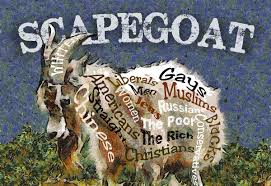
Rene Girard thinks the scapegoat is a mechanism that motivates much of human history.
I’ve been searching through the Old Testament for stories Jesus might have told the disciples on the way to Emmaus. Jesus, without their knowing who he was, explains why the Messiah had to suffer in this story from Luke’s Gospel. My guide in this search is René Girard. His theory about rivalry, the scapegoat, and religious violence helps me select and interpret certain Bible stories. Here I take a look at Girard and a theory about the scapegoat that explains what lies behind much of human history.
Episode 2 in the series “Opening the Scriptures on the Way to Emmaus: Why Did Jesus Have to Suffer.” Introduction and a Table of Contents here.
In the last post’s story a “human sacrifice” was able to restore a dysfunctional community to a cooperating unit. The Israelites had known a big defeat; they blamed Achan; they killed him. This victim’s death renewed the harmony that enabled the ensuing victories. All of this was orchestrated, according to the story, by the unseen force they called God. In their minds it was God whom they offended, God who punished, and God who rewarded when satisfaction was complete. But really it was a mechanism that we see all the time in human relations. It’s called the scapegoat.
The scapegoat in the Bible and history
The Israelites had a ceremony in which the people would symbolically lay all the sins of the community on a goat and then send the sin-laden creature out into the wilderness to starve or be eaten by wild animals. (Leviticus 16:20-22)
This scapegoat mechanism has played an important role in human history. It singles out and shuns someone or some group who are not “WE.” It strengthens the sense of “US.” We become a more cohesive group, and we can forget whatever may have been dividing us and go out and do “great” things.
Here’s the catch. For one who understands the mechanism the way I just explained, it won’t work. The truth has to be hiding, the mechanism unconscious. In human history purity and taboo, sacrifice and myth are the tools, the lies, that have accomplished that. Another word for it is “religion.” René Girard discovered the scapegoat mechanism, hidden or more or less exposed, at work in literature and religion.
Girard imagines a much older history: Religion’s Beginning
You might guess where Girard takes his theory – toward an explanation of the origin of religion that doesn’t require any real gods. It just needs a few reasonable assumptions about human nature and a plausible story.
Humans, by nature, are especially good at imitating each other. In particular we imitate each other’s desires. What we think of as our own desires are really, Girard thinks, imitations of the desires of another. Advertising illustrates this dynamic: a sports hero praises some shoes, and we go out and buy that brand. A child contentedly playing with one toy sees another child with a different toy, and suddenly wants that one. Adults always want to “keep up with the Joneses.” Scientists have even discovered a gene they called “mimetic” – related to imitation. Such rivalry often leads to conflict.
As a species we very early lost the instinctive restraint that, in other imitative animals, ends a conflict before it becomes a fight to the death. These other animals establish hierarchies rather easily, but we have no instinct for accepting our place, especially if it’s a lower one. Something must have restored that restraint or we would long ago have disappeared as a species. How that may have happened constitutes Girard’s plausible story.
Girard hypothesizes a story about human beginnings
A band of proto-humans was on the verge of self-destruction. Possibly some toy or tool had become the object of every creature’s desire. Everyone was everyone else’s rival in the struggle to possess that object. Chaos threatened. But the human tendency to imitate each other’s desires turned from rivalry to cooperation in a process very familiar to all of us—“ganging up on someone.” Usually it would be someone who is different from the others in some way. We project onto that other the blame for our troubles.
Suddenly in that ancient gang there’s this new thing to imitate: “Get Shorty!” Poor Shorty doesn’t stand a chance. Everyone else feels great to belong to such a wonderfully cooperative group again. As often happens, in the rush of solidarity they’ve forgotten what the original fight was about.
Nobody knows how that new unity among the gang came about. It’s like a miracle. But everybody knows who belongs and who doesn’t because they have the wrong look about them or violated some spoken or unspoken rule. Nazi Germany is a perfect example of this “miracle” of solidarity that arises from blaming a scapegoat.
Religion begins
Girard thinks that this dynamic—which no one understood or it wouldn’t have worked—tended to be sacrilized. Taboo and ritual, purity codes and sacrifices, especially human sacrifices, arose as a more stable form of this same mechanism. Eventually a story, or myth, makes sense of all these while hiding the real truth. In a word, we have religion.
With a religion you don’t have to wait for a crisis before calling forth the mechanism, the “sacred violence,” that strengthens the group’s identity and unity. You can have regularly scheduled sacrifices, priests, maybe kings. A whole bureaucracy and a system of laws, lawyers, judges, and politicians follows. We get hierarchy and layers of prestige and authority after all. This time it’s by custom instead of, as in other animals, by instinct. The human race, minus a few sacrificial victims, survives.
Girard thinks that human culture and the hierarchies that instruct everyone on where they belong arose this way. Human history started with this deceitful and cruel mechanism of sacred violence. So, in terms of one Christian myth, religion is about the same as Original Sin. Salvation, as Girard sees the Christian concept, would start with the unmasking of the mechanism of sacred violence.
Girard surprises everybody
I expect that religion could have a natural explanation. I like this theory better than some others by atheist scientists (religion as faulty science) or psychologists (religion as a coping mechanism). Admittedly, it connects religion with some of the worst things humans do to each other, but religion obviously has such connections. Girard’s theory places humans within the natural world. From there we step out into an artificial space, where the uniquely human begins.
I imagine quite a few of Girard’s atheist readers were pleased to have a new theory to “explain away” religion. Reading his later work, they found out he was not doing that at all. Quite the opposite, in fact. Girard is a Catholic, a convert. Actually he returned to the Catholicism of his youth. A number of theologians have praised Girard’s work.
The way Girard manage to combine Christian faith and theorizing about the origin of religion is by looking closely at the Bible. It’s a place where episodes of sacred violence (fictional or historical) are recounted. More important, it’s a place that exposes and criticizes the mechanism of sacred violence. This critique gradually develops in the Hebrew Scriptures and comes to particular clarity in the story of Jesus.
In the next posts I’m going to look at more stories from the Hebrew Scriptures that unmask the scapegoat mechanism. In the process they have something to say about Jesus and the meaning of his death.
Opening Scriptures on Way to Emmaus
Previous Post

October 15, 2018
Achan Suffers for the Israelites
Next Post
October 19, 2018 Memorial Statues, Memorial Days, and the Uses of History
Browse Our Archives
Select a Category Advent Christmas Amazon Synod Angels Being Consumed Bible Catholic Modern Creed Ecology Economics Elizabeth Johnson Eucharist Fragments and Filaments Gender and Sex Gospel of Mark Herzog Historical Jesus Liturgy Luke Opening Scriptures on Way to Emmaus Ordinary radicals Parables Pro-Life Reincarnation Rosary Sacraments science Social Justice Souls Stories of Jesus The Creed Torture and Eucharist Tracy Uncategorized War and Peace
Select a Month October 2026 June 2025 April 2025 March 2025 February 2025 January 2025 November 2024 July 2024 March 2024 December 2023 October 2023 September 2023 August 2023 May 2023 April 2023 March 2023 February 2023 January 2023 December 2022 November 2022 October 2022 September 2022 August 2022 July 2022 June 2022 April 2022 March 2022 February 2022 January 2022 December 2021 November 2021 October 2021 August 2021 July 2021 June 2021 April 2021 March 2021 February 2021 December 2020 November 2020 October 2020 August 2020 July 2020 June 2020 May 2020 April 2020 March 2020 February 2020 January 2020 December 2019 November 2019 October 2019 September 2019 August 2019 July 2019 June 2019 May 2019 April 2019 March 2019 February 2019 January 2019 December 2018 November 2018 October 2018 September 2018 August 2018 July 2018 June 2018 May 2018
Follow Us!
TAKE THE
Religious Wisdom Quiz
Which Psalm contains "Create in me a clean heart, O God"?
Select your answer to see how you score.
Psalm 110 Psalm 70 Psalm 51 Psalm 33
Related posts from Lost in a One-Acre Wood
Good News on the Way to Emmaus: Why...
The Sign of Jonah and a Tall Tale...
Ruth, a Romantic Tale of a Victim who...
Ezra and Nehemiah: Tribal Identity vs. Compassion
TRENDING AT PATHEOS Catholic

Creation, Preservation, and Teleology in Catholic Theology
As I write this, it is very early Monday morning. Like millions...

The Parable Of The Sower And The Word...
One of Christ’s most famous parables is that of the sower who...

Rejecting Doom: Christian Hope And Human Action
Christianity is a religion of hope. We are to have hope and...

Why I Choose the Eucharist Over the Sermon
Choose the Eucharist, Not the Sermon What are we supposed to get...

5 Design Elements Found in Spiritually Rooted Homes
Putting Spirituality Into Home Decor Our homes are more than our living...

Credo: A Story of God Told with the...
About 10 years ago, I began to imagine a personal "Credo" that...
view all Catholic blogs
Ad-Free & Subscriber Log-In Subscription Support
- About Us
- 2026 Calendar
- Videos
- Podcasts
- Library of World Religions
- Faith In Media Tracker
- Advertise With Us
- Write for Us
- Privacy Policy
- Terms of Service
- Do Not Sell My Data
- Contact Us
- Radiant Digital
- Manage Newsletter Subscriptions
- Unsubscribe From Notifications
- Sitemap
Copyright 2008-2026, Patheos. All rights reserved.
Subscription Support Ad-Free & Subscriber Log-In
Follow Patheos