
BuddhistCatholicContemplativeEvangelicalGeneral ChristianHinduJewishLatter-day SaintMuslimNew VisionsProgressive Christian
Beliefs
- Buddhist
- Catholic
- Contemplative
- Evangelical
- General Christian
- Hindu
- Jewish
- Latter-day Saint
- More Voices
- Muslim
- New Visions
- Pagan
- Progressive Christian
Topics
- Religion News
- Food and Religion
- Sports and Religion
- Religious Art
- Religious Music and Entertainment
- Religious Events
- History and Religion
- Style and Religion
- Politics and Religion
- Women in Religion
- Recreation Outdoors and Religion
- Business Finance and Religion
- Careers Workplace and Religion
- Education and Religion
- Family Parenting and Religion
- Health Fitness and Religion
- Home and Religion
- Relationships and Religion
- Technology and Religion
- Travel and Religion
Columnists
- Buddhist Columnists
- Business Finance and Religion Columnists
- Careers Workplace and Religion Columnists
- Catholic Columnists
- Contemplative Columnists
- Education and Religion Columnists
- Evangelists Columnists
- Family Parenting and Religion Columnists
- General Christian Columnists
- Health Fitness and Religion Columnists
- Hindu Columnists
- History and Religion Columnists
- Home and Religion Columnists
- Jewish Columnists
- More Voices Columnists
- Latter Day Columnists
- Muslim Columnists
- New Visions Columnists
- Nonreligious Columnists
- Pagan Columnists
- Politics and Religion Columnists
- Progressive Columnists
- Recreation Outdoors and Religion Columnists
- Relationships and Religion Columnists
- Religion News Columnists
- Religious Art Columnists
- Religious Events Columnists
- Religious Music and Entertainment Columnists
- Sports and Religion Columnists
- Style and Religion Columnists
- Technology and Religion Columnists
- Travel and Religion Columnists
- Women in Religion Columnists
Resource Library
- 2026 Calendar
- Library of World Religions
- The 100 Most Holy Places on Earth
- Patheos Answers
- Podcasts
- Videos
- Faith Leaders Database
- Anglican Episcopalian
- Bahai
- Baptist
- Buddhism
- Christianity
- Confucianism
- Eastern Orthodoxy
- Hinduism
- Holiness and Pentecostal
- ISKCON
- Islam
- Judaism
- Lutheran
- Methodist
- The Church of Jesus Christ of Latter-day Saints
- New Age
- Paganism
- Presbytarian and Reformed
- Protestantism
- Religion Behind the Scenes
- Roman Catholic
- Scientology
- Shia Islam
- Sikhism
- Sufism
- Sunni Islam
- Taoism
- Zen
- See all religions
Research Tools
 Ad-Free & Subscriber Log-In Subscription Support
Ad-Free & Subscriber Log-In Subscription Support
Follow Patheos 

- Trending:
- Forgiveness
- |
- Marriage
- |
- Consciousness
- |
- Death Penalty
- |
- Election
- |
- Halloween

- Home
- Catholic
- Not Rendering to Caesar and Other Challenges on a Tuesday in Passover Week
Not Rendering to Caesar and Other Challenges on a Tuesday in Passover Week
Last updated on: April 5, 2023 at 9:26 pm by Jack Hartjes
Not Rendering to Caesar and Other Challenges on a Tuesday in Passover Week 2023-04-05T21:26:42-06:00 Jack Hartjes
Patheos Explore the world's faith through different perspectives on religion and spirituality! Patheos has the views of the prevalent religions and spiritualities of the world.
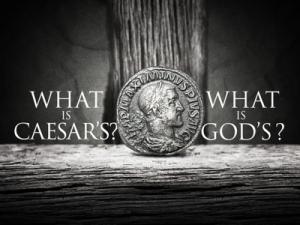
Separation of church and state is not a first-century idea. Rendering something to Caesar and another something to God, getting along well enough with both Rome and the temple establishment, is not Jesus’ way.
Nineteenth in a series on “The Worldly Spirituality of Mark’s Gospel” with help from Ched Myers’ Binding the Strongman: A Political Reading of Mark’s Story of Jesus. The Introduction and a Table of Contents are HERE.
Jesus knows how the world works. There’s the overarching power of Rome and the subordinate Jewish religious apparatus. The latter holds on to as much of its own power as the greater power allows, getting along well enough. In this context Jesus utters the famous statement:
Repay to Caesar what belongs to Caesar and to God what belongs to God.” (Mark 12:17)
Up to this point, traditionally, the whole Gospel of Mark has gotten a non-political, spiritual interpretation. Here the interpretation can’t get around the politics. Jesus addresses Roman power directly. Having missed the political implications of all that has gone before, interpreters have applied their own modern political categories. The favorite of these is separatio;n of church and state, a formula for accomodation. Myers abandons this tradition. (Myers 312-314)
Reviewing the politics in Mark’s Gospel
Throughout his book Myers helps us see incidents with their political import. For example, there’s the devil named “legion,” a Roman military division. Jesus dismissed this devil into a battalion of pigs and they were cast into the sea like Pharaoh’s horsemen. Even the title of Mark’s book and Jesus’ favorite word, “Gospel,” is political. The “good news,” was originally empirical propaganda; now Jesus commandeers it for his own purposes. (See this post and this.) With such a history it’s hard to believe Jesus would suddenly turn accommodationist and just get along.
Jesus hasn’t been getting along with either of the great powers, the religious elite or the Roman conquerors. Tuesday in that first Holy Week arrives and Jesus engages in two more confrontations. He stands against the one power and then the other. First he shows up the authority of the Jewish leaders for the spurious thing that it is. Then he tackles the Caesar question.
By what authority?
Representatives of the highest Jerusalem authority, the Sanhedrin, try to take Jesus down in front of the crowds. They only end up humiliating themselves. (Mark 11:27-33)
Chief priests, scribes, and elders demand to know by what authority Jesus does “these things.” (This is the day after the demonstration in the Temple.) Jesus counters with a question about John the Baptist’s authority. Is it from God or from people? Jesus knows that they won’t dare say it’s from people for fear of angering the crowds, who regard John as a prophet. On the other hand, they can’t say from God because they obviously aren’t following John.
Sheepishly they claim, “We do not know.” Fair or not, Jesus gets away with not answering the Sanhedrin’s question either. But everybody knows now what the temple rulers’ authority is worth. They can’t even speak their minds for fear of the crowd.
The tenant farmers (Mark 12:1-12)
Now Jesus goes on the offensive with a parable that deals with the fundamental economic reality that peasants faced. Mark 12:1-9) A peasant worked land that may once have belonged to his family but was lost due to debt. Every 50th year, the “Jubilee Year,” land was supposed to return to its original owners. Then the process of accumulation by the wealthy and powerful and dispossession of the poor would have to start over. But the people who count had long since been ignoring that rule had long since been ignoring that rule. By Jesus’ day—as in ours—nobody had to start over. Most of the land was in the hands of the temple aristocracy, absentee landlords collecting exorbitant rent from peasant tenant farmers.
Jesus’ Parable of the Wicked Tenants turns the tables. The members of the aristocracy are now the tenant farmers and God is the absentee landlord. Jesus describes the vineyard deliberately to bring to mind its symbolic reference to Israel, which the aristocracy should be tending. The landlord sends servants to obtain some of the produce, but the tenants mistreat and kill them. Finally the landlord’s son comes, and the tenants plot to kill him, thinking that then the vineyard will be theirs. This is not as crazy a scheme as it sounds. Seeing the son, the tenants reasonably conclude that the landlord is dead. The property being ownerless, anyone may claim it, first come first served. (Myers, p. 308)
The chief priests, scribes, and elders rightly conclude that the parable is directed against them. Instead of tending God’s field properly or even badly “they have contrived to ‘own’ it, (i.e., turn the worship of God into a profitable commercial interest).” (Myers, page 309)
Jesus and David’s kingdom
Jesus concludes the parable with the Old Testament passage most often quoted in the New:
The stone that the builders rejected has become the cornerstone; by the Lord has this been done, and it is wonderful in our eyes. (Mark 12:10-11, from Psalm 118:22-23)
“Most rabbinic literature interpreted David as the ‘rejected one’ of the Psalm,” Myers says. (p. 309) It sees the elevation of the “stone” as the restoration of the Kingdom of David. On Sunday with palms the crowd thought Jesus would be the great restorer. But Jesus is not interested in a Davidic Kingdom lifting its head again in triumph. He will soon (Mark 12:37) disown any link to David by quoting David’s own words.
David himself calls him [the messiah] ‘lord’; so how is he his son? (How could the Messiah be David’s son and David’s lord? The implication is, He can’t be both.)
Again I find myself understanding a saying of Jesus in a completely new way just by having the political context brought to the fore. Jesus here is refusing the title Son of David. Jesus has no intention of restoring a kingdom from the past.
What about the payment to Caesar?
Jesus has rejected Jewish leaders and even the concept of a Kingdom of David. How does he stand with the other power in the Mediterranean world? That is the dangerous challenge some Pharisees and Herodians raise:
Is it lawful to pay the census tax to Caesar or not? Should we pay or should we not pay? (Mark 12:14)
This is about the same as asking, Do you support us, who collaborate with Rome, or side with the rebels? There’s capitulation on one hand and peril on the other. Jesus does not capitulate. He insists that we
… pay back to Caesar what is Caesar’s and to God what is God’s. (Mark 12:17)
It looks like a nice parallel. Christians have found in this saying a way of living comfortably with whatever worldly kingdom happens to be in force. But the parallel breaks down because of the infinite distance between Caesar and God. Myers says,
In other words, no Jew could have allowed for a valid analogy between the debt Israel owed to Yahweh and any other human claim. There are simply no grounds for assuming (as so many bourgois exegetes do) that Jesus was exhorting his opponents to pay the tax. (Myers, p. 312)
I would add: “As if Caesar had ever given the Jews anything that was due to be paid back.” What at first seems to be an answer to the question (a convenient answer at that) turns out, on second thought, to be no answer at all. Jesus has simply reversed the challenge. Now it’s a choice between God and Caesar. Where do Jesus’ opponents place their allegiance? My translation says they were “amazed.” Looking at the Greek word (exethaumazon), I’d say it was more like “wonder-struck” or even “thunderstruck.”
Jesus lets his opponents make their own choice, but his choice is clear. Pay back to Caesar his due, i.e., nothing. Pay to God everything.
The most dangerous way
Myers’ method is to read the entire Gospel of Mark politically. He looks for political meaning throughout—and finds it! Thus he also finds the appropriate context for interpreting the saying about rendering to Caesar. Without that the saying is ambiguous enough for a commentator to insert his or her own political leanings.
Myers says most commentators do exactly that. They ignore the context and the political challenge facing Mark’s community. Should they align with the rebels fighting to restore a Davidic empire or with those who collaborate with Rome? Jesus’ choice, Mark says, is the most dangerous of all: Don’t line up with either of these powers.
The next post is on what’s called Mark’s “little apocalypse.” This is where Jesus gets eloquent about his third way.
Previous Post

September 21, 2018
Hurricane Florence, Global Warming, and Ember Days
Next Post
September 26, 2018 Apocalypse: A Plague (or is it Stars Falling) on Both Your Houses
Browse Our Archives
Select a Category Advent Christmas Amazon Synod Angels Being Consumed Bible Catholic Modern Creed Ecology Economics Elizabeth Johnson Eucharist Fragments and Filaments Gender and Sex Gospel of Mark Herzog Historical Jesus Liturgy Luke Opening Scriptures on Way to Emmaus Ordinary radicals Parables Pro-Life Reincarnation Rosary Sacraments science Social Justice Souls Stories of Jesus The Creed Torture and Eucharist Tracy Uncategorized War and Peace
Select a Month October 2026 June 2025 April 2025 March 2025 February 2025 January 2025 November 2024 July 2024 March 2024 December 2023 October 2023 September 2023 August 2023 May 2023 April 2023 March 2023 February 2023 January 2023 December 2022 November 2022 October 2022 September 2022 August 2022 July 2022 June 2022 April 2022 March 2022 February 2022 January 2022 December 2021 November 2021 October 2021 August 2021 July 2021 June 2021 April 2021 March 2021 February 2021 December 2020 November 2020 October 2020 August 2020 July 2020 June 2020 May 2020 April 2020 March 2020 February 2020 January 2020 December 2019 November 2019 October 2019 September 2019 August 2019 July 2019 June 2019 May 2019 April 2019 March 2019 February 2019 January 2019 December 2018 November 2018 October 2018 September 2018 August 2018 July 2018 June 2018 May 2018
Follow Us!
TAKE THE
Religious Wisdom Quiz
What does the name "Abraham" mean?
Select your answer to see how you score.
Shelter Strong leader Father of many Blessed man
Related posts from Lost in a One-Acre Wood
Atonement and Some Odd Hypothetical Questions about Disciples
Civil Disobedience and the Puzzle that was Thursday:...

The Sacrament of Touch: We Touch Jesus’ Body...

Apocalypse: A Plague (or is it Stars Falling)...
TRENDING AT PATHEOS Catholic

Rejecting Doom: Christian Hope And Human Action
Christianity is a religion of hope. We are to have hope and...

It’s What Comes From Within Which Matters
One of the most difficult things for us to understand is why...

Why I Choose the Eucharist Over the Sermon
Choose the Eucharist, Not the Sermon What are we supposed to get...

5 Design Elements Found in Spiritually Rooted Homes
Putting Spirituality Into Home Decor Our homes are more than our living...

Credo: A Story of God Told with the...
About 10 years ago, I began to imagine a personal "Credo" that...

The Anatomy of Divine Revelation in Catholic Thought
The claim that God has made Himself known to human beings is...
view all Catholic blogs
Ad-Free & Subscriber Log-In Subscription Support
- About Us
- 2026 Calendar
- Videos
- Podcasts
- Library of World Religions
- Faith In Media Tracker
- Advertise With Us
- Write for Us
- Privacy Policy
- Terms of Service
- Do Not Sell My Data
- Contact Us
- Radiant Digital
- Manage Newsletter Subscriptions
- Unsubscribe From Notifications
- Sitemap
Copyright 2008-2026, Patheos. All rights reserved.
Subscription Support Ad-Free & Subscriber Log-In
Follow Patheos