
BuddhistCatholicContemplativeEvangelicalGeneral ChristianHinduJewishLatter-day SaintMuslimNew VisionsProgressive Christian
Beliefs
- Buddhist
- Catholic
- Contemplative
- Evangelical
- General Christian
- Hindu
- Jewish
- Latter-day Saint
- More Voices
- Muslim
- New Visions
- Pagan
- Progressive Christian
Topics
- Religion News
- Food and Religion
- Sports and Religion
- Religious Art
- Religious Music and Entertainment
- Religious Events
- History and Religion
- Style and Religion
- Politics and Religion
- Women in Religion
- Recreation Outdoors and Religion
- Business Finance and Religion
- Careers Workplace and Religion
- Education and Religion
- Family Parenting and Religion
- Health Fitness and Religion
- Home and Religion
- Relationships and Religion
- Technology and Religion
- Travel and Religion
Columnists
- Buddhist Columnists
- Business Finance and Religion Columnists
- Careers Workplace and Religion Columnists
- Catholic Columnists
- Contemplative Columnists
- Education and Religion Columnists
- Evangelists Columnists
- Family Parenting and Religion Columnists
- General Christian Columnists
- Health Fitness and Religion Columnists
- Hindu Columnists
- History and Religion Columnists
- Home and Religion Columnists
- Jewish Columnists
- More Voices Columnists
- Latter Day Columnists
- Muslim Columnists
- New Visions Columnists
- Nonreligious Columnists
- Pagan Columnists
- Politics and Religion Columnists
- Progressive Columnists
- Recreation Outdoors and Religion Columnists
- Relationships and Religion Columnists
- Religion News Columnists
- Religious Art Columnists
- Religious Events Columnists
- Religious Music and Entertainment Columnists
- Sports and Religion Columnists
- Style and Religion Columnists
- Technology and Religion Columnists
- Travel and Religion Columnists
- Women in Religion Columnists
Resource Library
- 2026 Calendar
- Library of World Religions
- The 100 Most Holy Places on Earth
- Patheos Answers
- Podcasts
- Videos
- Faith Leaders Database
- Anglican Episcopalian
- Bahai
- Baptist
- Buddhism
- Christianity
- Confucianism
- Eastern Orthodoxy
- Hinduism
- Holiness and Pentecostal
- ISKCON
- Islam
- Judaism
- Lutheran
- Methodist
- The Church of Jesus Christ of Latter-day Saints
- New Age
- Paganism
- Presbytarian and Reformed
- Protestantism
- Religion Behind the Scenes
- Roman Catholic
- Scientology
- Shia Islam
- Sikhism
- Sufism
- Sunni Islam
- Taoism
- Zen
- See all religions
Research Tools
 Ad-Free & Subscriber Log-In Subscription Support
Ad-Free & Subscriber Log-In Subscription Support
Follow Patheos 

- Trending:
- Forgiveness
- |
- Marriage
- |
- Consciousness
- |
- Death Penalty
- |
- Election
- |
- Halloween

- Home
- Catholic
- The Fig Tree and the Temple: Monday and Tuesday Morning
The Fig Tree and the Temple: Monday and Tuesday Morning
Last updated on: April 13, 2025 at 1:14 pm by Jack Hartjes
The Fig Tree and the Temple: Monday and Tuesday Morning 2025-04-13T13:14:39-06:00 Jack Hartjes
Patheos Explore the world's faith through different perspectives on religion and spirituality! Patheos has the views of the prevalent religions and spiritualities of the world.
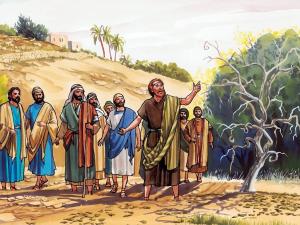
What happens to a fig tree that Jesus cursed symbolizes the fate of the sacrificial system centered around the temple.
A fig tree helps us interpret one of the surest, but not always understood, facts about Jesus’ life. Jesus committed an act of civil disobedience in the Temple. We usually call it a “cleansing” but, as Mark tells it, it’s more likely a symbolic destruction. What happens to a fig tree indicates what Jesus thinks needs to happen to the oppressive system that the temple embodies.
Eighteenth in a series on “The Worldly Spirituality of Mark’s Gospel”with help from Ched Myers’ Binding the Strongman: A Political Reading of Mark’s Story of Jesus. The Introduction and a Table of Contents are HERE.
After Palm Sunday’s street theater, Jesus spends Sunday night in Bethany. Monday Jesus stages another demonstration, whose meaning escapes many commentators. Even the choice of a heading in my Bible, “Cleansing of the Temple,” misses the point. Jesus, in Mark at least, is not cleansing the temple but symbolically destroying it.
A demonstration planned in advance
The picture of this incident that I held at one time, I think, is a common one. Jesus enters the temple and sees how poor people are being swindled by money changers and by sellers of animals for sacrifice. He gets worked up into a rage and starts beating up (more or less) people and animals for turning God’s house of quiet prayer into raucous “den of thieves.” (Mark 11:17)
That scenario seems unlikely for a few reasons. First, Jesus surely knew all along what went on in the temple during major feasts. He’d been there many times before. So he couldn’t have been taken by surprise on that Monday morning. He knew what he was going to do. Second, it no doubt was raucous in that outer court of the temple, but the selling of animals and money changing were an ordonary part of preparation for worship in the temple. There’s no indication that anybody was cheating anybody. Jesus’ words about the “den of thieves” tell a different story. After all, thieves don’t do their stealing in their own den. The den is where they hide out after doing their evil work somewhere else.
Fianlly, in Mark’s story there’s a curious incident with a fig tree, the telling of which both precedes and follows the temple demonstration. This split episode, another example of Mark’s sandwiching technique, helps us interpret Jesus’ behavior in the temple. Jesus is not just cleaning. Let’s look at the story and symbolism of the fig tree.
Fig tree symbolics
Jesus, on his way from his friends’ place in Bethany back to Jerusalem, is hungry. (A Markan touch, or did Jesus forget breakfast that morning?) He sees a fig tree in the distance, but approaching he finds no figs. It wasn’t the time for figs. (Didn’t Jesus know that without having to get a closer look?) Jesus curses the fig tree, “May no one ever eat of your fruit again!” (Mark 11:14)
I have to believe Mark made this story up to symbolize something. Myers says trees in the Old Testament are practically always symbolic. (Myers, p. 297) The fig tree often symbolizes Israel. Flourishing, it means blessing on the nation. When it withers, it foretells judgment. In this case, Mark is showing us Jesus’ judgment on the temple because it provides religious cover for a financial systems that favors the rich, including the high priestly families, and dispossesses the poor.
When Mark’s readers come to Tuesday morning and the second slice of bread sandwiching the action in the temple, they will see the fig tree has withered. They will easily apply the tree’s fate to what Jesus intends for the temple.
Direct action in the temple
But now it’s still Monday morning and Jesus is in the temple. With three separate actions he makes three decisive attacks against the sacrificial system that the temple represents. Jesus
- drives out “those who were selling and those who were buying in the temple.”
- overturns “the tables of the money changers and the seats of those who sold doves.”
- “would not allow anyone to carry anything [any ‘goods’] through the temple.” Mark 11:15-16)
The first action targets the temple as a marketplace. The second brings crashing down two essentials of the sacrificial system—changing foreign money into temple money and selling doves.
The action against the dove sellers is especially telling. Doves were the sacrificial animal that the poor could afford and also the proper sacrifice for purifying women. (Myers, p. 201) Jesus has already shown particular interest in both those groups. Here he shows what he thinks about their having to pay anything for God’s favor.
The third action is the most radical of the three. “Goods” are any of the items necessary for the temple cult, and Jesus interrupts their flow. Mark’s readers will remember that Jesus threatened to plunder the devil’s “goods.” I wrote about this before. Some scribes had accused Jesus of casting out devils by Beelzebul. Jesus subtly turned the accusation against them and made a not very well-disguised threat about plundering their (meaning the devil’s) “goods.” (Mark 3:20-27) The same word is used in that incident and here.
A diabolical kingdom and house
It’s worth quoting Jesus’ words on that earlier occasion. Notice how many times he repeats himself—unnecessarily if all he is saying is that he is not working with the devil:
How can Satan drive out Satan? If a kingdom is divided against itself, that kingdom cannot stand. And if a house is divided against itself, that house will not be able to stand. And if Satan has risen up against himself and is divided, he cannot stand; that is the end of him. (Emphasis mine)
The key words “kingdom” and “house” represent the scribes’ concerns. They are the supposed heirs of the Davidic kingdom and custodians of the house of God, the temple. But when Jesus applies these words to the devil, he makes a subtle reference to the scribes’ own identity. He puts the scribes in the same class as the devil. Then comes the threat, which Jesus will fulfill symbolically by his action in the temple:
But no one can enter a strong man’s house to plunder his property [“goods”] unless he first ties up the strong man. (Mark 3:25-27)
Our translations obscure an important point. “Property” in Jesus’ threat is the same word as “goods” in the temple action. Jesus equates these temple accessories with the devil’s goods. Jesus, the one whom the Baptist called the “stronger one” (Mark 1:7) is making good on his earlier threat by his action in the temple. Jesus’ goal is “a shutting down of temple operations altogether.” (Myers, p. 301)
Jesus appeals to Scripture
Finally, Jesus teaches:
Is it not written, “My house shall be called a house of prayer for all the nations?” [quoting what scholars call Third Isaiah] But you have made it a den of robbers [quoting Jeremiah].” (Mark 11:17)
In Third Isaiah (56:3-8) the Old Testament finds its fullest statement of inclusiveness, of gathering in the foreigner and the despised. In Jeremiah (7:3-15) God intends to destroy the temple in Jerusalem because of failure to deal justly with the neighbor, failure to refrain from oppressing the alien, the orphan, and the widow, failure to stop going after false gods.
These condemned practices against the ones Jesus favored most, the poor and marginalized, were standard in the temple-driven economy of Jesus’ time. Jesus knows his Scriptures. He has concluded that the system needs more than reform if it is to be true to its Jewish identity.
Previous Post

September 17, 2018
Palm Sunday: A Procession with an Anti-climax
Next Post
September 21, 2018 Hurricane Florence, Global Warming, and Ember Days
Browse Our Archives
Select a Category Advent Christmas Amazon Synod Angels Being Consumed Bible Catholic Modern Creed Ecology Economics Elizabeth Johnson Eucharist Fragments and Filaments Gender and Sex Gospel of Mark Herzog Historical Jesus Liturgy Luke Opening Scriptures on Way to Emmaus Ordinary radicals Parables Pro-Life Reincarnation Rosary Sacraments science Social Justice Souls Stories of Jesus The Creed Torture and Eucharist Tracy Uncategorized War and Peace
Select a Month October 2026 June 2025 April 2025 March 2025 February 2025 January 2025 November 2024 July 2024 March 2024 December 2023 October 2023 September 2023 August 2023 May 2023 April 2023 March 2023 February 2023 January 2023 December 2022 November 2022 October 2022 September 2022 August 2022 July 2022 June 2022 April 2022 March 2022 February 2022 January 2022 December 2021 November 2021 October 2021 August 2021 July 2021 June 2021 April 2021 March 2021 February 2021 December 2020 November 2020 October 2020 August 2020 July 2020 June 2020 May 2020 April 2020 March 2020 February 2020 January 2020 December 2019 November 2019 October 2019 September 2019 August 2019 July 2019 June 2019 May 2019 April 2019 March 2019 February 2019 January 2019 December 2018 November 2018 October 2018 September 2018 August 2018 July 2018 June 2018 May 2018
Follow Us!
TAKE THE
Religious Wisdom Quiz
Who walked on water besides Jesus?
Select your answer to see how you score.
Elijah Moses Peter Paul
Related posts from Lost in a One-Acre Wood
Atonement and Some Odd Hypothetical Questions about Disciples
Civil Disobedience and the Puzzle that was Thursday:...

The Sacrament of Touch: We Touch Jesus’ Body...

Apocalypse: A Plague (or is it Stars Falling)...
TRENDING AT PATHEOS Catholic

Rejecting Doom: Christian Hope And Human Action
Christianity is a religion of hope. We are to have hope and...

It’s What Comes From Within Which Matters
One of the most difficult things for us to understand is why...

Why I Choose the Eucharist Over the Sermon
Choose the Eucharist, Not the Sermon What are we supposed to get...

5 Design Elements Found in Spiritually Rooted Homes
Putting Spirituality Into Home Decor Our homes are more than our living...

Credo: A Story of God Told with the...
About 10 years ago, I began to imagine a personal "Credo" that...

The Anatomy of Divine Revelation in Catholic Thought
The claim that God has made Himself known to human beings is...
view all Catholic blogs
Ad-Free & Subscriber Log-In Subscription Support
- About Us
- 2026 Calendar
- Videos
- Podcasts
- Library of World Religions
- Faith In Media Tracker
- Advertise With Us
- Write for Us
- Privacy Policy
- Terms of Service
- Do Not Sell My Data
- Contact Us
- Radiant Digital
- Manage Newsletter Subscriptions
- Unsubscribe From Notifications
- Sitemap
Copyright 2008-2026, Patheos. All rights reserved.
Subscription Support Ad-Free & Subscriber Log-In
Follow Patheos