
BuddhistCatholicContemplativeEvangelicalGeneral ChristianHinduJewishLatter-day SaintMuslimNew VisionsProgressive Christian
Beliefs
- Buddhist
- Catholic
- Contemplative
- Evangelical
- General Christian
- Hindu
- Jewish
- Latter-day Saint
- More Voices
- Muslim
- New Visions
- Pagan
- Progressive Christian
Topics
- Religion News
- Food and Religion
- Sports and Religion
- Religious Art
- Religious Music and Entertainment
- Religious Events
- History and Religion
- Style and Religion
- Politics and Religion
- Women in Religion
- Recreation Outdoors and Religion
- Business Finance and Religion
- Careers Workplace and Religion
- Education and Religion
- Family Parenting and Religion
- Health Fitness and Religion
- Home and Religion
- Relationships and Religion
- Technology and Religion
- Travel and Religion
Columnists
- Buddhist Columnists
- Business Finance and Religion Columnists
- Careers Workplace and Religion Columnists
- Catholic Columnists
- Contemplative Columnists
- Education and Religion Columnists
- Evangelists Columnists
- Family Parenting and Religion Columnists
- General Christian Columnists
- Health Fitness and Religion Columnists
- Hindu Columnists
- History and Religion Columnists
- Home and Religion Columnists
- Jewish Columnists
- More Voices Columnists
- Latter Day Columnists
- Muslim Columnists
- New Visions Columnists
- Nonreligious Columnists
- Pagan Columnists
- Politics and Religion Columnists
- Progressive Columnists
- Recreation Outdoors and Religion Columnists
- Relationships and Religion Columnists
- Religion News Columnists
- Religious Art Columnists
- Religious Events Columnists
- Religious Music and Entertainment Columnists
- Sports and Religion Columnists
- Style and Religion Columnists
- Technology and Religion Columnists
- Travel and Religion Columnists
- Women in Religion Columnists
Resource Library
- 2026 Calendar
- Library of World Religions
- The 100 Most Holy Places on Earth
- Patheos Answers
- Podcasts
- Videos
- Faith Leaders Database
- Anglican Episcopalian
- Bahai
- Baptist
- Buddhism
- Christianity
- Confucianism
- Eastern Orthodoxy
- Hinduism
- Holiness and Pentecostal
- ISKCON
- Islam
- Judaism
- Lutheran
- Methodist
- The Church of Jesus Christ of Latter-day Saints
- New Age
- Paganism
- Presbytarian and Reformed
- Protestantism
- Religion Behind the Scenes
- Roman Catholic
- Scientology
- Shia Islam
- Sikhism
- Sufism
- Sunni Islam
- Taoism
- Zen
- See all religions
Research Tools
 Ad-Free & Subscriber Log-In Subscription Support
Ad-Free & Subscriber Log-In Subscription Support
Follow Patheos 

- Trending:
- Forgiveness
- |
- Marriage
- |
- Consciousness
- |
- Death Penalty
- |
- Election
- |
- Halloween

- Home
- Catholic
- Palm Sunday: A Procession with an Anti-climax
Palm Sunday: A Procession with an Anti-climax
Last updated on: October 3, 2018 at 1:10 pm by Jack Hartjes
Palm Sunday: A Procession with an Anti-climax 2018-10-03T13:10:44-06:00 Jack Hartjes
Patheos Explore the world's faith through different perspectives on religion and spirituality! Patheos has the views of the prevalent religions and spiritualities of the world.
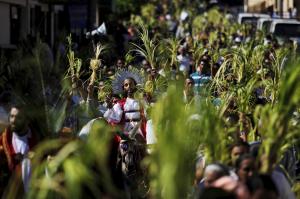
The crowd’s enthusiasm on Palm Sunday will soon turn to disappointment.
It’s Sunday in Passover Week—later for Christians it becomes the first Palm Sunday—and it’s a big day. It includes a healing miracle, some advance planning, a procession with an enthusiastic crowd, and a disappointing ending. In church Palm Sunday liturgy begins in sync with that ancient mood, but soon we look ahead to the somber mood of Good Friday. Mark’s story of that Sunday before Passover turns sober quickly as well.
Seventeenth in a series on “The Worldly Spirituality of Mark’s Gospel”with help from Ched Myers’ Binding the Strongman: A Political Reading of Mark’s Story of Jesus. The Introduction and a Table of Contents are HERE.
We name the crowd of Passover celebrators in Jesus’ last week fickle. On Palm Sunday they are wild about Jesus, hailing him as “the one who comes in the name of the Lord.” Friday they’re calling for his execution. That’s to misrepresent them, though.
The crowd’s enthusiasm on Sunday responds to their hope for a savior from the oppressive power of Rome. By Friday, if not before, they realize their mistake. Their hope and Jesus’ purpose are not the same. On Sunday they imagine a triumphant leader who will restore “the kingdom of our father David.” (11:9-10) By Friday they are sure that isn’t going to happen. But, Myers shows, they may have had doubts already by Sunday evening.
Palm Sunday begins well
It’s hard to distinguish days exactly in Mark’s account. I’m beginning Palm Sunday in the middle of verse 46 of Chapter 10. Jesus arrives in Jericho Saturday evening (46a) and leaves Sunday morning (46b). Immediately something happens that turns out to be the best part of Jesus’ day.
Bartimaeus, a blind beggar, calls out, ignoring the bystanders who try to silence him, “Jesus, Son of David, have pity on me.” His next words on being called into Jesus’ presence serve as symbol for much more than physical sight: “Lord, I want to see.” Jesus cures him. “Go your way; your faith has saved you.” (Mark 10:46-52)
The last time Jesus cured a man’s blindness, it took two tries. This time the miracle comes off without a hitch, and the man sees right away. That earlier miracle was a metaphor for the difficulty the disciples and we have “seeing” who Jesus really is. Bartimaeus “sees” right away and does something remarkable in consequence. At Jesus’ words “Go your way” he decides for himself what he will do. Without even being asked, he follows Jesus “on the way.” Mark’s readers get another clue that discipleship is possible.
The entry into Jerusalem
Jesus plans his entry into the city of Jerusalem carefully. He intends to squelch the triumphalistic fervor surrounding the idea of messiah. His entry will not look like a military parade. It will not challenge the Roman army, marching into the city at about the same time, there to enforce order during the politically dangerous Passover festival.
At Jesus’ instruction the disciples commandeer a colt for Jesus’ ride into the city. Some bystanders express surprise.
“What are you doing, untying the colt?” (Mark 11:1-5)
Is it because the colt belonged to someone else or because it’s only a colt, not a warhorse?
In Mark the description of this entry into Jerusalem is much sparer than in the three Gospels that came later. There are the shouts of “Hosannah!” and cloaks and palm branches spread out before Jesus, but no more. The demonstration winds down as it approaches the city. Mark’s account of the day ends with these anti-climactic words:
He entered Jerusalem and went into the temple area. He looked around at everything and, since it was already late, went out to Bethany with the Twelve. (Mark 11:11)
Mark’s purpose
If I had told the story, I would have made a bigger deal out of this “looking around” in the temple. I would have said Jesus was “casing the joint” in preparation for the next day’s demonstration. But maybe Jesus already knew all he needed to know to pull off the temple disruption he planned. Anyway, Mark’s telling depends more on contrasting Jesus’ reality to the crowd’s nationalistic expectations. Sunday’s commotion ends in a whimper rather than a bang.
Mark wrote shortly before or shortly after the Roman army destroyed a rebellious Jerusalem. Many in Mark’s community may have thought to join the rebels—or wondered if they should have. Mark, whose Gospel is shot through with its own political purpose, doesn’t let the crowd’s feverish expectations take hold of the story. Mark’s readers, with nationalistic aspirations of their own, feel the letdown. But, then, they know what’s coming.
Image credit: Times India
Previous Post

September 14, 2018
Ye Old Ember Days, a Good Fit for This Time of Prayer for Creation
Next Post
September 19, 2018 The Fig Tree and the Temple: Monday and Tuesday Morning
Browse Our Archives
Select a Category Advent Christmas Amazon Synod Angels Being Consumed Bible Catholic Modern Creed Ecology Economics Elizabeth Johnson Eucharist Fragments and Filaments Gender and Sex Gospel of Mark Herzog Historical Jesus Liturgy Luke Opening Scriptures on Way to Emmaus Ordinary radicals Parables Pro-Life Reincarnation Rosary Sacraments science Social Justice Souls Stories of Jesus The Creed Torture and Eucharist Tracy Uncategorized War and Peace
Select a Month October 2026 June 2025 April 2025 March 2025 February 2025 January 2025 November 2024 July 2024 March 2024 December 2023 October 2023 September 2023 August 2023 May 2023 April 2023 March 2023 February 2023 January 2023 December 2022 November 2022 October 2022 September 2022 August 2022 July 2022 June 2022 April 2022 March 2022 February 2022 January 2022 December 2021 November 2021 October 2021 August 2021 July 2021 June 2021 April 2021 March 2021 February 2021 December 2020 November 2020 October 2020 August 2020 July 2020 June 2020 May 2020 April 2020 March 2020 February 2020 January 2020 December 2019 November 2019 October 2019 September 2019 August 2019 July 2019 June 2019 May 2019 April 2019 March 2019 February 2019 January 2019 December 2018 November 2018 October 2018 September 2018 August 2018 July 2018 June 2018 May 2018
Follow Us!
TAKE THE
Religious Wisdom Quiz
Who said: "Yet I hold this against you: You have forsaken the love you had at first"?
Select your answer to see how you score.
An angel Jesus (to the church in Ephesus) The Spirit John
Related posts from Lost in a One-Acre Wood
Atonement and Some Odd Hypothetical Questions about Disciples
Civil Disobedience and the Puzzle that was Thursday:...

The Sacrament of Touch: We Touch Jesus’ Body...

Apocalypse: A Plague (or is it Stars Falling)...
TRENDING AT PATHEOS Catholic

Creation, Preservation, and Teleology in Catholic Theology
As I write this, it is very early Monday morning. Like millions...

The Parable Of The Sower And The Word...
One of Christ’s most famous parables is that of the sower who...

Rejecting Doom: Christian Hope And Human Action
Christianity is a religion of hope. We are to have hope and...

Why I Choose the Eucharist Over the Sermon
Choose the Eucharist, Not the Sermon What are we supposed to get...

5 Design Elements Found in Spiritually Rooted Homes
Putting Spirituality Into Home Decor Our homes are more than our living...

Credo: A Story of God Told with the...
About 10 years ago, I began to imagine a personal "Credo" that...
view all Catholic blogs
Ad-Free & Subscriber Log-In Subscription Support
- About Us
- 2026 Calendar
- Videos
- Podcasts
- Library of World Religions
- Faith In Media Tracker
- Advertise With Us
- Write for Us
- Privacy Policy
- Terms of Service
- Do Not Sell My Data
- Contact Us
- Radiant Digital
- Manage Newsletter Subscriptions
- Unsubscribe From Notifications
- Sitemap
Copyright 2008-2026, Patheos. All rights reserved.
Subscription Support Ad-Free & Subscriber Log-In
Follow Patheos