
BuddhistCatholicContemplativeEvangelicalGeneral ChristianHinduJewishLatter-day SaintMuslimNew VisionsProgressive Christian
Beliefs
- Buddhist
- Catholic
- Contemplative
- Evangelical
- General Christian
- Hindu
- Jewish
- Latter-day Saint
- More Voices
- Muslim
- New Visions
- Pagan
- Progressive Christian
Topics
- Religion News
- Food and Religion
- Sports and Religion
- Religious Art
- Religious Music and Entertainment
- Religious Events
- History and Religion
- Style and Religion
- Politics and Religion
- Women in Religion
- Recreation Outdoors and Religion
- Business Finance and Religion
- Careers Workplace and Religion
- Education and Religion
- Family Parenting and Religion
- Health Fitness and Religion
- Home and Religion
- Relationships and Religion
- Technology and Religion
- Travel and Religion
Columnists
- Buddhist Columnists
- Business Finance and Religion Columnists
- Careers Workplace and Religion Columnists
- Catholic Columnists
- Contemplative Columnists
- Education and Religion Columnists
- Evangelists Columnists
- Family Parenting and Religion Columnists
- General Christian Columnists
- Health Fitness and Religion Columnists
- Hindu Columnists
- History and Religion Columnists
- Home and Religion Columnists
- Jewish Columnists
- More Voices Columnists
- Latter Day Columnists
- Muslim Columnists
- New Visions Columnists
- Nonreligious Columnists
- Pagan Columnists
- Politics and Religion Columnists
- Progressive Columnists
- Recreation Outdoors and Religion Columnists
- Relationships and Religion Columnists
- Religion News Columnists
- Religious Art Columnists
- Religious Events Columnists
- Religious Music and Entertainment Columnists
- Sports and Religion Columnists
- Style and Religion Columnists
- Technology and Religion Columnists
- Travel and Religion Columnists
- Women in Religion Columnists
Resource Library
- 2026 Calendar
- Library of World Religions
- The 100 Most Holy Places on Earth
- Patheos Answers
- Podcasts
- Videos
- Faith Leaders Database
- Anglican Episcopalian
- Bahai
- Baptist
- Buddhism
- Christianity
- Confucianism
- Eastern Orthodoxy
- Hinduism
- Holiness and Pentecostal
- ISKCON
- Islam
- Judaism
- Lutheran
- Methodist
- The Church of Jesus Christ of Latter-day Saints
- New Age
- Paganism
- Presbytarian and Reformed
- Protestantism
- Religion Behind the Scenes
- Roman Catholic
- Scientology
- Shia Islam
- Sikhism
- Sufism
- Sunni Islam
- Taoism
- Zen
- See all religions
Research Tools
 Ad-Free & Subscriber Log-In Subscription Support
Ad-Free & Subscriber Log-In Subscription Support
Follow Patheos 

- Trending:
- Forgiveness
- |
- Marriage
- |
- Consciousness
- |
- Death Penalty
- |
- Election
- |
- Halloween

- Home
- Catholic
- Ye Old Ember Days, a Good Fit for This Time of Prayer for Creation
Ye Old Ember Days, a Good Fit for This Time of Prayer for Creation
Last updated on: April 29, 2019 at 8:19 am by Jack Hartjes
Ye Old Ember Days, a Good Fit for This Time of Prayer for Creation 2019-04-29T08:19:00-06:00 Jack Hartjes
Patheos Explore the world's faith through different perspectives on religion and spirituality! Patheos has the views of the prevalent religions and spiritualities of the world.
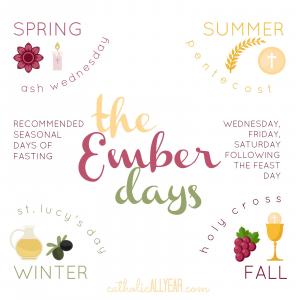
This is a time of prayer for creation. (See this post on the World Day of Prayer for Creation.) Perhaps not coincidentally, it is also the time of the Fall Ember Days. Ember Days were a thing in the Church before Vatican II. Not so much anymore. We observed them on Wednesday, Friday, and Saturday at various times during the year. Next week is Ember Week. September 18, 20, and 21 are the Ember Days.
Note that it’s the terrestrial, not the liturgical, year that counts here. Ember Days are close to the earth. Ancient Rome celebrated three of these groups of three days to honor grain harvest (summer), vintage (Fall), and seed time (winter). The Church continued the tradition for the benefit of converts from Paganism and later added a fourth set for spring.
Ember Days and care for creation
Ember Days observance connects well with care for the earth. Traditionally one prayed, fasted (no food between meals) and half-abstained (meat allowed at one meal). The Catholic Encyclopedia says the purpose of Ember Days is
to thank God for the gifts of nature, to teach [people] to make use of them in moderation, and to assist the needy.
Making use of the gifts of nature in moderation is exactly the prescription of environmentalists for the health of the planet. Imagine three days in which Catholics commit publicly to moderate their consumption of earth’s resources, especially of meat. The reduction of our collective carbon footprint would be considerable and the witness value also.
The Catholic bishops of Australia say,
Ember Days in the 21st century will need to focus on the environment, climate change, and our stewardship of the world’s resources. They will help us connect our intercession for favourable conditions with a conversion of heart in relation to our care of the earth.
Season or days? What’s appropriate to honor creation?
Several church leaders in the past few years have called the faithful to observe a month-long Season of Creation. It would begin on September 1, the World Day of Prayer for the Care of Creation, and end on October 4, the Feast of St. Francis of Assisi, patron of ecologists. The Catholic Bishops of the Philippines in 2003, the Third European Ecumenical Assembly in Sibiu in 2007 and the World Council of Churches in 2008 have made such proposals
Still there is little to no movement in the Church to add a “Season of Creation” to the Church’s Liturgical Year. I think that’s for good reasons. Actually, the traditional year does address the salvation of the world God made. In particular:
- The season of Advent looks forward to the restoration of creation.
- Christmas celebrates the joining of the divine with creation.
- Easter proclaims the story of creation and the wedding of heaven and earth.
- Every Sunday remembers and imitates God’s rest at the completion of the good work of creation.
The mysteries of the Liturgical Year proclaim God’s work of saving the world, not just humans out of the world. The Bible does not present creation as a work of God separate from salvation. The non-human world and humanity are not saved separately but in one saving act.
More Ember Days
Every season is a season of creation. Special days, rather than a special season, seem right for celebrating creation and evaluating our relationship to God’s earth. For that purpose, why not go with the seasons earth gives us? The traditional schedule for the four Ember Weeks is:
- Spring—after the first Sunday of Lent
- Summer—after Pentecost
- Fall—after the Feast of the Holy Cross, September 14
- Winter—after the Feast of Lucy—December 13.
Prayers for Ember Days
The Australian bishops desire Ember days to “express our solidarity with those who are disadvantaged, especially those who suffer through famine and the inequitable distribution of the world’s goods.” They recommend the Opening Prayer of the Mass for the Progress of Peoples for liturgical and private prayer:
Father, you have given all peoples one common origin,
and your will is to gather them as one family in yourself.
Fill the hearts of all with the fire of your love
and the desire to ensure justice for all their brothers and sisters.
By sharing the good things you give us
may we secure justice and equality for every human being,
an end to all division, and a human society built on love and peace.
Next week’s Ember Days are a good time for praising God, blessing creation, and assessing our relationship to our brothers and sisters and our common home. Here are some more prayers and Bible readings:
- The Creation Hymn, Colossians 1:15-20
- The praises of Shadrach, Misach, and Abednego in the fiery furnace, Daniel 3:52-90,
- The Canticle of the Creatures by St. Francis of Assisi,
- Pope Francis’ prayers for creation at the end of his encyclical Laudato Si.
Previous Post

September 12, 2018
Mark’s Catechism, House Rules for God’s Kingdom
Next Post
September 17, 2018 Palm Sunday: A Procession with an Anti-climax
Browse Our Archives
Select a Category Advent Christmas Amazon Synod Angels Being Consumed Bible Catholic Modern Creed Ecology Economics Elizabeth Johnson Eucharist Fragments and Filaments Gender and Sex Gospel of Mark Herzog Historical Jesus Liturgy Luke Opening Scriptures on Way to Emmaus Ordinary radicals Parables Pro-Life Reincarnation Rosary Sacraments science Social Justice Souls Stories of Jesus The Creed Torture and Eucharist Tracy Uncategorized War and Peace
Select a Month October 2026 June 2025 April 2025 March 2025 February 2025 January 2025 November 2024 July 2024 March 2024 December 2023 October 2023 September 2023 August 2023 May 2023 April 2023 March 2023 February 2023 January 2023 December 2022 November 2022 October 2022 September 2022 August 2022 July 2022 June 2022 April 2022 March 2022 February 2022 January 2022 December 2021 November 2021 October 2021 August 2021 July 2021 June 2021 April 2021 March 2021 February 2021 December 2020 November 2020 October 2020 August 2020 July 2020 June 2020 May 2020 April 2020 March 2020 February 2020 January 2020 December 2019 November 2019 October 2019 September 2019 August 2019 July 2019 June 2019 May 2019 April 2019 March 2019 February 2019 January 2019 December 2018 November 2018 October 2018 September 2018 August 2018 July 2018 June 2018 May 2018
Follow Us!
TAKE THE
Religious Wisdom Quiz
Who was Jesus' legal father?
Select your answer to see how you score.
Heli Matthat Jacob Joseph
Related posts from Lost in a One-Acre Wood

Global Warming, Glaciers, and Nearly Silent Catholic Wisdom
Norman Wirzba Roots Humanity in a Sacred World

“Drink the Cup” – Liturgy Teaches Us Eucharistic...

Kneeling Through the Communion Rite: Now I Get...
TRENDING AT PATHEOS Catholic

Rejecting Doom: Christian Hope And Human Action
Christianity is a religion of hope. We are to have hope and...

It’s What Comes From Within Which Matters
One of the most difficult things for us to understand is why...

Why I Choose the Eucharist Over the Sermon
Choose the Eucharist, Not the Sermon What are we supposed to get...

5 Design Elements Found in Spiritually Rooted Homes
Putting Spirituality Into Home Decor Our homes are more than our living...

Credo: A Story of God Told with the...
About 10 years ago, I began to imagine a personal "Credo" that...

The Anatomy of Divine Revelation in Catholic Thought
The claim that God has made Himself known to human beings is...
view all Catholic blogs
Ad-Free & Subscriber Log-In Subscription Support
- About Us
- 2026 Calendar
- Videos
- Podcasts
- Library of World Religions
- Faith In Media Tracker
- Advertise With Us
- Write for Us
- Privacy Policy
- Terms of Service
- Do Not Sell My Data
- Contact Us
- Radiant Digital
- Manage Newsletter Subscriptions
- Unsubscribe From Notifications
- Sitemap
Copyright 2008-2026, Patheos. All rights reserved.
Subscription Support Ad-Free & Subscriber Log-In
Follow Patheos