
BuddhistCatholicContemplativeEvangelicalGeneral ChristianHinduJewishLatter-day SaintMuslimNew VisionsProgressive Christian
Beliefs
- Buddhist
- Catholic
- Contemplative
- Evangelical
- General Christian
- Hindu
- Jewish
- Latter-day Saint
- More Voices
- Muslim
- New Visions
- Pagan
- Progressive Christian
Topics
- Religion News
- Food and Religion
- Sports and Religion
- Religious Art
- Religious Music and Entertainment
- Religious Events
- History and Religion
- Style and Religion
- Politics and Religion
- Women in Religion
- Recreation Outdoors and Religion
- Business Finance and Religion
- Careers Workplace and Religion
- Education and Religion
- Family Parenting and Religion
- Health Fitness and Religion
- Home and Religion
- Relationships and Religion
- Technology and Religion
- Travel and Religion
Columnists
- Buddhist Columnists
- Business Finance and Religion Columnists
- Careers Workplace and Religion Columnists
- Catholic Columnists
- Contemplative Columnists
- Education and Religion Columnists
- Evangelists Columnists
- Family Parenting and Religion Columnists
- General Christian Columnists
- Health Fitness and Religion Columnists
- Hindu Columnists
- History and Religion Columnists
- Home and Religion Columnists
- Jewish Columnists
- More Voices Columnists
- Latter Day Columnists
- Muslim Columnists
- New Visions Columnists
- Nonreligious Columnists
- Pagan Columnists
- Politics and Religion Columnists
- Progressive Columnists
- Recreation Outdoors and Religion Columnists
- Relationships and Religion Columnists
- Religion News Columnists
- Religious Art Columnists
- Religious Events Columnists
- Religious Music and Entertainment Columnists
- Sports and Religion Columnists
- Style and Religion Columnists
- Technology and Religion Columnists
- Travel and Religion Columnists
- Women in Religion Columnists
Resource Library
- 2026 Calendar
- Library of World Religions
- The 100 Most Holy Places on Earth
- Patheos Answers
- Podcasts
- Videos
- Faith Leaders Database
- Anglican Episcopalian
- Bahai
- Baptist
- Buddhism
- Christianity
- Confucianism
- Eastern Orthodoxy
- Hinduism
- Holiness and Pentecostal
- ISKCON
- Islam
- Judaism
- Lutheran
- Methodist
- The Church of Jesus Christ of Latter-day Saints
- New Age
- Paganism
- Presbytarian and Reformed
- Protestantism
- Religion Behind the Scenes
- Roman Catholic
- Scientology
- Shia Islam
- Sikhism
- Sufism
- Sunni Islam
- Taoism
- Zen
- See all religions
Research Tools
 Ad-Free & Subscriber Log-In Subscription Support
Ad-Free & Subscriber Log-In Subscription Support
Follow Patheos 

- Trending:
- Forgiveness
- |
- Marriage
- |
- Consciousness
- |
- Death Penalty
- |
- Election
- |
- Halloween

- Home
- Catholic
- Gentiles in the Kingdom of God. Jesus Feeds the Multitude Twice
Gentiles in the Kingdom of God. Jesus Feeds the Multitude Twice
Last updated on: August 31, 2018 at 5:11 am by Jack Hartjes
Gentiles in the Kingdom of God. Jesus Feeds the Multitude Twice 2018-08-31T05:11:06-06:00 Jack Hartjes
Patheos Explore the world's faith through different perspectives on religion and spirituality! Patheos has the views of the prevalent religions and spiritualities of the world.
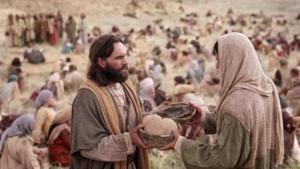
In Mark Jesus performs two feeding miracles, and the reader needs to think about Jews and Gentiles.
Why does Mark put two long stories of feeding the multitude into his short Gospel? There also are two long exorcism stories? Why? It may be that Jesus performed the same miracles more than once, but that doesn’t answer the question. Mark doesn’t include everything Jesus did in his story. He has a purpose beyond historical accuracy. Ched Myers argues that the point of these duplications is to illustrate the presence of Gentiles alongside Jews in the Kingdom of God.
Eleventh in a series on “The Worldly Spirituality of Mark’s Gospel” with help from Ched Myers’ Binding the Strongman: A Political Reading of Mark’s Story of Jesus. The Introduction and, looking ahead, a Table of Contents are HERE.
In Chapters 1 to 4 Mark has brought the myth of combat between good and evil down from heaven to “the concrete political geography of Palestine.” (Myers, page 181-2) There a new kind of polity is taking shape in the midst of the old. The next three chapters use symbolic, miraculous actions to show what the new Kingdom of God will be like and the kind of enemy it engages.
Kingdom challenges
Jesus will deal with two challenges to the lifestyle of the Kingdom. One, Jews and Gentiles are estranged from each other. Two, Jewish society isolates the poor in their midst. A third estrangement is building in Mark’s account. Jesus’ ideological distance from the powers that be will extend gradually to his own followers.
Here in order is a list of Jesus’ many actions in this section. I will consider the ones in italics in this post, the rest in the next post. The first group deals with Jews and Gentiles, the second with rich and poor. The disciples’ lack of understanding, their growing isolation from Jesus, figures in both.
- Calming the storm at sea
- Healing the Gerasene demoniac
- Curing the woman with hemorrhages and the synagogue official’s daughter
- Teaching and being rejected at Nazareth
- Sending the twelve on mission and later hearing their report (these two sandwiched around the account of the Baptist’s death)
- Feeding the five thousand
- Walking on water
- Arguing with the Pharisees about fasting and other traditions
- Losing an argument with the Syrophoenician woman
- Healing a deaf man
- Feeding the four thousand
- Refusing to give a sign from heaven
- Remonstrating with his disciples about loaves
The disciples don’t understand about Gentiles
From first to last in this section the disciples’ lack of understanding is prominent. Jesus calms a storm at sea. In this first scene the disciples wonder who Jesus might be, whom “even the winds and the sea obey.” In the last scene Jesus reviews with his disciples the two episodes of feeding the multitudes and says, “Have you still not understood.”
I always figured the disciples should have understood what I understood quite well. Jesus is God incarnate or something very close to that, at any rate a person with God-like power. All those miracles sounded to me like something really powerful going on. Myers digs deeper, clearing up my misunderstanding, and showing what the disciples still have to understand. It turns out to be more than Jesus and his powers. Two concerns in particular are foreigners and poor people. To get started on the first of these, Jesus enters the territory of the Gentiles.
The Gerasene demoniac. (Mark 5:1-21; Myers, page 190)
Jesus and the disciples are on “the other side of the sea,” Gentile (non-Jewish) territory. There a man is possessed and so strong that not even chains can contain him. He cries out in a loud voice and identifies Jesus as “Son of the Most High God.” That’s a Hellenistic (non-Jewish) title. When Jesus asks for his name, he replies, “Legion is my name. There are many of us.” “Legion” calls to mind a division of Roman soldiers (definitely non-Jewish). We’re seeing a pattern of here that has something to do with Gentiles.
The devils’ military name prompts Mark’s readers to look for other military imagery in the story. The demons ask to be sent into a “herd” of pigs. Pigs don’t travel in herds, but that word in Greek often refers to a band of army recruits. When the legion of devils asks to be sent into the pigs, Jesus “lets” them. “Lets” is my bible’s translation, but better is “dismisses” them, an army command. The pigs “charge” like troops rushing into battle and are swallowed by the hostile waters of the lake. Now we recall Pharaoh’s army, whom Yahweh cast into the sea.
In a previous exorcism in the synagogue, the Jesus identified the demon with the scribal class. Here the identification is with the Roman occupiers. First Jewish power, then power of the Gentiles comes under Jesus’ authority. Again Jesus proves to be the “stronger one,” able to command even Rome’s military might.
The villagers send Jesus away.
The villagers marvel, seeing the formerly possessed man now in full possession of his faculties. Oddly they beg Jesus to leave that country.
Jesus has exposed a common sociological fact. Demon possession is often a symptom of and an unconscious protest against occupation. The power of the occupiers is too frightening for conscious protest. These Gentiles are not ready to enter into open defiance of Rome. They certainly are not ready for Jesus’ kind of defiance, without army or arms.
Jesus, with this second exorcism, has opened up a second front in the exercise of his Kingdom ministry. He will engage on behalf of Gentiles as well as Jewish oppressed people. The next miracles powerfully express the same theme.
Feeding the multitudes twice
I could never figure out the two feeding miracles (Mark 6:34-44 and 8:1-9). That there are two is puzzling enough. But if there are going to be two, why is the second one less impressive? It starts with more loaves (7 instead of 5) and feeds fewer people (4000 instead of 5000) with fewer baskets of leftovers (7 instead of 12). You’d think with practice Jesus’ power would be growing.
Scholars have wondered if the same event was perhaps being handed down in two different traditions. But then why did Mark include both of them in his rather short Gospel, devoting plenty of time to each, and later recapping both but none of Jesus’ other amazing deeds? And, stylistically, shouldn’t he have put the bigger miracle second?
Myers explains the symbolism of the two feeding miracles and why there are two of them (pages 205-210 and 225-26). Together they reveal the shape of the Kingdom of God, a kingdom which will include both Jews and non-Jews. Later Jesus reviews the two feeding miracles in a stern remonstration with his disciples. Jesus repeats all the numbers of loaves, people, and baskets; and the numbers tell the story.
In the first feeding, fives loaves, 5000 men, and 12 baskets represent Jewish concerns—the five books of the Law and the 12 tribes. In the second, the numbers – seven loaves, seven baskets, and 4000 people – belong to Greek symbolism. Driving the point home, Mark uses different words for basket. The first miracle gets the Hebrew word for basket; the second, a Greek word. The first occurs in Jewish territory; the second where Gentiles predominate.
The duplication with their respective numbers, names, and locations reveal Mark’s point. Jews and Greeks belong equally in God’s Kingdom. If the disciples had understood the symbolism, they would have found the second miracle really mind blowing, even if less impressive quantitatively. Perhaps they did understand and couldn’t accept it. Gentiles on equal footing with Jews?
Conclusion and looking ahead
Two reconciliations will characterize the Kingdom of God. In one, Jews will reconcile with non-Jews and both enjoy equal status in the Kingdom. In the second, poor and rich will sit together at table, and no one will know the shame or the pride of varying degrees of honor. The second reconciliation will be the theme of the next post. Both moves put the Kingdom in danger. Both seem to be too much for the disciples, who become more and more estranged from their leader.
Previous Post

August 24, 2018
Bishops Should Heed Call to End “Imperial Episcopate”
Browse Our Archives
Select a Category Advent Christmas Amazon Synod Angels Being Consumed Bible Catholic Modern Creed Ecology Economics Elizabeth Johnson Eucharist Fragments and Filaments Gender and Sex Gospel of Mark Herzog Historical Jesus Liturgy Luke Opening Scriptures on Way to Emmaus Ordinary radicals Parables Pro-Life Reincarnation Rosary Sacraments science Social Justice Souls Stories of Jesus The Creed Torture and Eucharist Tracy Uncategorized War and Peace
Select a Month October 2026 June 2025 April 2025 March 2025 February 2025 January 2025 November 2024 July 2024 March 2024 December 2023 October 2023 September 2023 August 2023 May 2023 April 2023 March 2023 February 2023 January 2023 December 2022 November 2022 October 2022 September 2022 August 2022 July 2022 June 2022 April 2022 March 2022 February 2022 January 2022 December 2021 November 2021 October 2021 August 2021 July 2021 June 2021 April 2021 March 2021 February 2021 December 2020 November 2020 October 2020 August 2020 July 2020 June 2020 May 2020 April 2020 March 2020 February 2020 January 2020 December 2019 November 2019 October 2019 September 2019 August 2019 July 2019 June 2019 May 2019 April 2019 March 2019 February 2019 January 2019 December 2018 November 2018 October 2018 September 2018 August 2018 July 2018 June 2018 May 2018
Follow Us!
TAKE THE
Religious Wisdom Quiz
What does Paul say in 1 Thessalonians about the day of the Lord?
Select your answer to see how you score.
It will come like a thief in the night It will come with great signs It will come after the tribulation It will come when peace is declared
Related posts from Lost in a One-Acre Wood
Atonement and Some Odd Hypothetical Questions about Disciples

Civil Disobedience and the Puzzle that was Thursday:...

The Sacrament of Touch: We Touch Jesus’ Body...

Apocalypse: A Plague (or is it Stars Falling)...
TRENDING AT PATHEOS Catholic

The Parable Of The Sower And The Word...
One of Christ’s most famous parables is that of the sower who...

Rejecting Doom: Christian Hope And Human Action
Christianity is a religion of hope. We are to have hope and...

Why I Choose the Eucharist Over the Sermon
Choose the Eucharist, Not the Sermon What are we supposed to get...

5 Design Elements Found in Spiritually Rooted Homes
Putting Spirituality Into Home Decor Our homes are more than our living...

Credo: A Story of God Told with the...
About 10 years ago, I began to imagine a personal "Credo" that...

The Anatomy of Divine Revelation in Catholic Thought
The claim that God has made Himself known to human beings is...
view all Catholic blogs
Ad-Free & Subscriber Log-In Subscription Support
- About Us
- 2026 Calendar
- Videos
- Podcasts
- Library of World Religions
- Faith In Media Tracker
- Advertise With Us
- Write for Us
- Privacy Policy
- Terms of Service
- Do Not Sell My Data
- Contact Us
- Radiant Digital
- Manage Newsletter Subscriptions
- Unsubscribe From Notifications
- Sitemap
Copyright 2008-2026, Patheos. All rights reserved.
Subscription Support Ad-Free & Subscriber Log-In
Follow Patheos