
BuddhistCatholicContemplativeEvangelicalGeneral ChristianHinduJewishLatter-day SaintMuslimNew VisionsProgressive Christian
Beliefs
- Buddhist
- Catholic
- Contemplative
- Evangelical
- General Christian
- Hindu
- Jewish
- Latter-day Saint
- More Voices
- Muslim
- New Visions
- Pagan
- Progressive Christian
Topics
- Religion News
- Food and Religion
- Sports and Religion
- Religious Art
- Religious Music and Entertainment
- Religious Events
- History and Religion
- Style and Religion
- Politics and Religion
- Women in Religion
- Recreation Outdoors and Religion
- Business Finance and Religion
- Careers Workplace and Religion
- Education and Religion
- Family Parenting and Religion
- Health Fitness and Religion
- Home and Religion
- Relationships and Religion
- Technology and Religion
- Travel and Religion
Columnists
- Buddhist Columnists
- Business Finance and Religion Columnists
- Careers Workplace and Religion Columnists
- Catholic Columnists
- Contemplative Columnists
- Education and Religion Columnists
- Evangelists Columnists
- Family Parenting and Religion Columnists
- General Christian Columnists
- Health Fitness and Religion Columnists
- Hindu Columnists
- History and Religion Columnists
- Home and Religion Columnists
- Jewish Columnists
- More Voices Columnists
- Latter Day Columnists
- Muslim Columnists
- New Visions Columnists
- Nonreligious Columnists
- Pagan Columnists
- Politics and Religion Columnists
- Progressive Columnists
- Recreation Outdoors and Religion Columnists
- Relationships and Religion Columnists
- Religion News Columnists
- Religious Art Columnists
- Religious Events Columnists
- Religious Music and Entertainment Columnists
- Sports and Religion Columnists
- Style and Religion Columnists
- Technology and Religion Columnists
- Travel and Religion Columnists
- Women in Religion Columnists
Resource Library
- 2026 Calendar
- Library of World Religions
- The 100 Most Holy Places on Earth
- Patheos Answers
- Podcasts
- Videos
- Faith Leaders Database
- Anglican Episcopalian
- Bahai
- Baptist
- Buddhism
- Christianity
- Confucianism
- Eastern Orthodoxy
- Hinduism
- Holiness and Pentecostal
- ISKCON
- Islam
- Judaism
- Lutheran
- Methodist
- The Church of Jesus Christ of Latter-day Saints
- New Age
- Paganism
- Presbytarian and Reformed
- Protestantism
- Religion Behind the Scenes
- Roman Catholic
- Scientology
- Shia Islam
- Sikhism
- Sufism
- Sunni Islam
- Taoism
- Zen
- See all religions
Research Tools
 Ad-Free & Subscriber Log-In Subscription Support
Ad-Free & Subscriber Log-In Subscription Support
Follow Patheos 

- Trending:
- Forgiveness
- |
- Marriage
- |
- Consciousness
- |
- Death Penalty
- |
- Election
- |
- Halloween

- Home
- Catholic
- Bishops Should Heed Call to End “Imperial Episcopate”
Bishops Should Heed Call to End “Imperial Episcopate”
Last updated on: August 24, 2018 at 6:15 am by Jack Hartjes
Bishops Should Heed Call to End “Imperial Episcopate” 2018-08-24T06:15:29-06:00 Jack Hartjes
Patheos Explore the world's faith through different perspectives on religion and spirituality! Patheos has the views of the prevalent religions and spiritualities of the world.
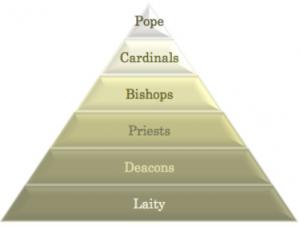
Does this picture of bishops, cardinals, and pope at the top of a pyramid represent a truly biblical church?
Bishops have a lot to think about these days. Maybe they should resign as a group like Chile’s bishops. Maybe they should open up voluntarily diocesan records concerning abusive clergy as Pennsylvania’s dioceses did. (The latter was under court order.) I hope they also read this article in First Things by a priest of the Diocese of Charleston, SC. Fr. Jay Scott Newman calls for “The End of the Imperial Episcopate.” I’ll include some of Fr. Newman’s suggestions at the end of this piece.
Bishops need to show us finally that they take clerical sexual abuse seriously. They need to own up to their own role in cover-ups, in effect facilitating continued abuse. They need to show appropriate remorse and show us that they mean it. The Chilean bishops did it, and Pope Francis accepted, to my knowledge, three resignations. In light of the Cardinal, now Archbishop, McCarrick affair and the Pennsylvania Grand Jury Report, one has to conclude that the situation in the U.S. is at least as serious as that in Chile. If Pope Francis acts in like proportion here as in Chile, he might accept up to 50 U.S. bishop resignations.
Catholic theology: Can you still say it to the victims?
Here’s a daring comparison that I want to make. The murder of six million Jews by Nazi Germany forced upon theologians a major rethinking of the Church’s teaching. That teaching with regard to Jews contributed to the atmosphere that made the Holocaust possible. The crisis of sexual abuse in the Church likewise makes us rethink theology.
With regard to the Holocaust, a proposal by Johann Baptist Metz has met with some approval. In essence it says, “Every theological statement, no matter how honored by the tradition, has to be re-evaluated according whether you can say it to one of the Nazis’ victims.” I believe the same is true with regard to sex abuse in the Church. Can you take a theological statement and quote it to a traumatized victim of clerical sexual abuse?
I believe there are theological statements that fail this test. We’ve been taught and tradition holds that ordination to the priesthood confers an ontological status on a person beyond that of Baptism. We talk about a special “mark” on the priestly soul that can’t be erased. A priest in my diocese once told me that every Catholic has a guardian angel, but a priest has two. Who would dare make such statements to a victim of sexual abuse by a priest? This can’t be done, or shouldn’t be. The same goes for bishops and a fortiori for deacons. Claiming that members of the clergy have higher status than lay people now has to be out of bounds.
The Church needs leaders, but perhaps we should retire the word “hierarchy.” It sounds too much like “higher-up-archy.” Actually the Greek root “hier” means holy, with implications that we’d best avoid today.
Bishops as lords: The imperial episcopate
“Imperial episcopate” is Fr. Newman’s term in the article cited above. The Church has developed a leadership style, he says, that derives from Roman Empire connections rather than from any connection with the Bible. It has led to treating bishops like the high and mighty, to the Church’s detriment and their own moral danger. It made the scandalous covering up of clerical sexual predation almost inevitable. Especially inevitable, I’d add, given the lack of women in positions of authority in the Church. I can’t imagine a mother approving the transfer of a sexual predator. But the boys’ club had its own rules and its own interests to protect.
Newman decries “grotesque unchastity” but also bishops behaving as “managers and bureaucrats” instead of “pastors and evangelists. ”Superficial flattery and fawning … too often leads to the growth of vanity, ambition, and clerical careerism.” The evil exposed recently is deeply ingrained in clerical culture. Clearly that culture must end.
Some suggestions for bishops and the Church
I like Fr. Newman’s simple, commonsense suggestions for making some headway in that direction. Here are some them:
- Call bishops “Father.” Common titles like Your Eminence, Your Excellency, Your Grace don’t come from the Bible. They “obscure the scriptural and familial nature” of the office bishops hold. Bishops and flock are members of a family. They are not lord and subjects.
- Abandon fancy regalia and paraphernalia – “colored sashes, buttons, piping, and capes” and “stick to simple black.” “For the purification of the priesthood and the authentic reform of the Church everything that is of imperium rather than evangelium needs to go.”
- I wasn’t aware of the next practice Newman says has to disappear. That is bishops celebrating Masses at parishes throughout the diocese instead of at their own parish. “If the bishop remains in his cathedral on Sunday, then he will remain rooted in priestly ministry rather than in bureaucratic administration.”
- All bishops should be pastors of dioceses. Get rid of bishops for dioceses that no longer exist. Curial officials don’t need to be bishops. Only dioceses that are too big need auxiliary bishops. Doing away with these mere functionaries will ensure that all bishops are true pastors united to their flocks. It will also “remove a chief temptation to clerical careerism.”
In conclusion
The reasons for the tragedy of clerical abuse lie deep. I’m not sure we can find a solution without changing some long-cherished theological positions. The hearts of individual perpetrators too need transforming. Especially do the hearts and minds of leaders. They have shown more care about their place in an institution than about vulnerable people. These are difficult tasks.
The steps Newman proposes are on the surface. They don’t change hearts. Their aim is only to rearrange conditions and habits away from fostering personal careerism and service to an institution. They at least open a door to another kind of service and a church that from the leadership on down lives the Gospel that it proclaims.
Image credit: Australian Catholic Church
Previous Post

August 22, 2018
Parables, Earthly Stories with Heavenly Meanings? ... Maybe Not
Next Post
August 27, 2018 Gentiles in the Kingdom of God. Jesus Feeds the Multitude Twice
Browse Our Archives
Select a Category Advent Christmas Amazon Synod Angels Being Consumed Bible Catholic Modern Creed Ecology Economics Elizabeth Johnson Eucharist Fragments and Filaments Gender and Sex Gospel of Mark Herzog Historical Jesus Liturgy Luke Opening Scriptures on Way to Emmaus Ordinary radicals Parables Pro-Life Reincarnation Rosary Sacraments science Social Justice Souls Stories of Jesus The Creed Torture and Eucharist Tracy Uncategorized War and Peace
Select a Month October 2026 June 2025 April 2025 March 2025 February 2025 January 2025 November 2024 July 2024 March 2024 December 2023 October 2023 September 2023 August 2023 May 2023 April 2023 March 2023 February 2023 January 2023 December 2022 November 2022 October 2022 September 2022 August 2022 July 2022 June 2022 April 2022 March 2022 February 2022 January 2022 December 2021 November 2021 October 2021 August 2021 July 2021 June 2021 April 2021 March 2021 February 2021 December 2020 November 2020 October 2020 August 2020 July 2020 June 2020 May 2020 April 2020 March 2020 February 2020 January 2020 December 2019 November 2019 October 2019 September 2019 August 2019 July 2019 June 2019 May 2019 April 2019 March 2019 February 2019 January 2019 December 2018 November 2018 October 2018 September 2018 August 2018 July 2018 June 2018 May 2018
Follow Us!
TAKE THE
Religious Wisdom Quiz
What nation took Israel into captivity in 722 BC?
Select your answer to see how you score.
Assyria Persia Babylon Egypt
Related posts from Lost in a One-Acre Wood

Credo: A Story of God Told with the...

With Carbon Dioxide, 0.014 is a big number
Crucifixion as Breakthrough, Horsley’s Nerviest Claim

Jesus’ Politics of Resistance and Renewal
TRENDING AT PATHEOS Catholic

The Parable Of The Sower And The Word...
One of Christ’s most famous parables is that of the sower who...

Rejecting Doom: Christian Hope And Human Action
Christianity is a religion of hope. We are to have hope and...

Why I Choose the Eucharist Over the Sermon
Choose the Eucharist, Not the Sermon What are we supposed to get...

5 Design Elements Found in Spiritually Rooted Homes
Putting Spirituality Into Home Decor Our homes are more than our living...

Credo: A Story of God Told with the...
About 10 years ago, I began to imagine a personal "Credo" that...

The Anatomy of Divine Revelation in Catholic Thought
The claim that God has made Himself known to human beings is...
view all Catholic blogs
Ad-Free & Subscriber Log-In Subscription Support
- About Us
- 2026 Calendar
- Videos
- Podcasts
- Library of World Religions
- Faith In Media Tracker
- Advertise With Us
- Write for Us
- Privacy Policy
- Terms of Service
- Do Not Sell My Data
- Contact Us
- Radiant Digital
- Manage Newsletter Subscriptions
- Unsubscribe From Notifications
- Sitemap
Copyright 2008-2026, Patheos. All rights reserved.
Subscription Support Ad-Free & Subscriber Log-In
Follow Patheos