
BuddhistCatholicContemplativeEvangelicalGeneral ChristianHinduJewishLatter-day SaintMuslimNew VisionsProgressive Christian
Beliefs
- Buddhist
- Catholic
- Contemplative
- Evangelical
- General Christian
- Hindu
- Jewish
- Latter-day Saint
- More Voices
- Muslim
- New Visions
- Pagan
- Progressive Christian
Topics
- Religion News
- Food and Religion
- Sports and Religion
- Religious Art
- Religious Music and Entertainment
- Religious Events
- History and Religion
- Style and Religion
- Politics and Religion
- Women in Religion
- Recreation Outdoors and Religion
- Business Finance and Religion
- Careers Workplace and Religion
- Education and Religion
- Family Parenting and Religion
- Health Fitness and Religion
- Home and Religion
- Relationships and Religion
- Technology and Religion
- Travel and Religion
Columnists
- Buddhist Columnists
- Business Finance and Religion Columnists
- Careers Workplace and Religion Columnists
- Catholic Columnists
- Contemplative Columnists
- Education and Religion Columnists
- Evangelists Columnists
- Family Parenting and Religion Columnists
- General Christian Columnists
- Health Fitness and Religion Columnists
- Hindu Columnists
- History and Religion Columnists
- Home and Religion Columnists
- Jewish Columnists
- More Voices Columnists
- Latter Day Columnists
- Muslim Columnists
- New Visions Columnists
- Nonreligious Columnists
- Pagan Columnists
- Politics and Religion Columnists
- Progressive Columnists
- Recreation Outdoors and Religion Columnists
- Relationships and Religion Columnists
- Religion News Columnists
- Religious Art Columnists
- Religious Events Columnists
- Religious Music and Entertainment Columnists
- Sports and Religion Columnists
- Style and Religion Columnists
- Technology and Religion Columnists
- Travel and Religion Columnists
- Women in Religion Columnists
Resource Library
- 2026 Calendar
- Library of World Religions
- The 100 Most Holy Places on Earth
- Patheos Answers
- Podcasts
- Videos
- Faith Leaders Database
- Anglican Episcopalian
- Bahai
- Baptist
- Buddhism
- Christianity
- Confucianism
- Eastern Orthodoxy
- Hinduism
- Holiness and Pentecostal
- ISKCON
- Islam
- Judaism
- Lutheran
- Methodist
- The Church of Jesus Christ of Latter-day Saints
- New Age
- Paganism
- Presbytarian and Reformed
- Protestantism
- Religion Behind the Scenes
- Roman Catholic
- Scientology
- Shia Islam
- Sikhism
- Sufism
- Sunni Islam
- Taoism
- Zen
- See all religions
Research Tools
 Ad-Free & Subscriber Log-In Subscription Support
Ad-Free & Subscriber Log-In Subscription Support
Follow Patheos 

- Trending:
- Forgiveness
- |
- Marriage
- |
- Consciousness
- |
- Death Penalty
- |
- Election
- |
- Halloween

- Home
- Catholic
- Parables, Earthly Stories with Heavenly Meanings? … Maybe Not
Parables, Earthly Stories with Heavenly Meanings? … Maybe Not
Last updated on: August 25, 2018 at 1:26 pm by Jack Hartjes
Parables, Earthly Stories with Heavenly Meanings? … Maybe Not 2018-08-25T13:26:47-06:00 Jack Hartjes
Patheos Explore the world's faith through different perspectives on religion and spirituality! Patheos has the views of the prevalent religions and spiritualities of the world.
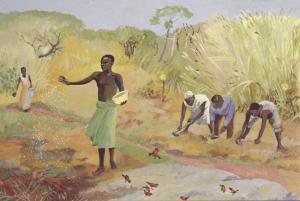
Jesus tells parables about peasant farmers’ revolutionary hopes.
Jesus tells parables, stories with comfortably familiar scenes and, often, strange twists. The tendency of interpreters has been to find heavenly meaning in the earthy tones, but in Mark at least the meaning as well as the tone is quite earthly. Tenth in a series on “The Worldly Spirituality of Mark’s Gospel” with help from Ched Myers’ Binding the Strongman: A Political Reading of Mark’s Story of Jesus. The Introduction and a Table of Contents are HERE.
The scribes base their opposition to Jesus on a dualistic fiction. They are the good guys. Anyone who is against them is in league with the devil. It’s a common tactic by those who are in power to slander those who threaten them. They need a way to cast their opponents as “other,” not one of “us.” Dom Helder Camera, archbishop of Recife, Brazil, experienced it. When he helped the poor they called him a saint, but “when I asked why they are poor, they called me a Communist.”
Jesus has his own dualism to replace that of the scribes. There are those who do the will of God and those who don’t. In another place it’s those who are with me and those who are against me, or those inside and those outside. But Jesus’ new dualism does not really divide people. Though he has cast the scribes as agents of the devil, he will later literally call Peter Satan. (Mark 8:33) Jesus castigates enemies who “hear and listen but don’t understand.” But only a little later will rebuke his disciples during the storm at sea: “Why are you terrified? Do you not yet have faith?” (Mark 4:40)
Parables
At the moment Jesus is giving an extended sermon, including the Parable of the Sower and two more parables about seeds. All of this is spoken from a boat a little way offshore to a crowd on the shore.
Coming on the heels of conflicts with both scribal authorities and Jesus’ own family, it would be surprising if this teaching episode, even with no opponents present, were not a further elucidation of the conflict. Jesus speaks his challenge in parables.
In the Parable of the Sower, the majority of the seed is wasted. It falls on the path or rocky soil or among thorns. None of this seed produces fruit. Others have noted that this method of planting was a normal procedure. Sowing occurred before plowing. After sowing the seed, the farmer would tear up the path, loosen the rocky soil, and uproot the thorns. It was not as wasteful as Jesus makes it out to be. In Jesus’ telling the end result is even more amazing than it would normally appear.
Regardless of planting method, the harvest comes in at a ratio of 30, 60, or 100 parts to one part seed sown. Compared to a typical crop of seven to one or a bumper crop of 10 to one, that puts the peasant farmer in a pretty good position. He can now “not only eat and pay his rent, tithes, and debts, but indeed even purchase the land, and thus end his servitude forever.” (Myers, 177) That’s what the Kingdom is like. Mark’s Jesus is promising the fulfillment of the revolutionary hopes of those who work the land in a condition of oppression.
Myers follows with an acerbic remark:
All this is of course lost upon modern urban theological commentators, preoccupied as they are with romanticizing the ‘earthly stories’ of rural Palestine on the one hand, and probing for ‘heavenly meanings’ on the other.” (Myers, page 177)
An explanation and a misinterpretation
Jesus follows up the Parable of the Sower with an explanation. The seed becomes the word of God and the people who hear the word are subject to various dangers. You could name them world, flesh, and devil–factors that prevent the seed from bearing fruit. Still the harvest comes in superabundantly. That’s in the Gospel. Some commentators doubt that Jesus really said this part. Mark or Mark’s source would have made up the explanation. A common interpretation makes the story a representation of both the perils and the fantastic growth of the Christian community.
I’m thinking back to Jesus “fishers of people” saying. People have made this also a saying about the growth of the Christian community. On the contrary, Myers claims, it’s a reference to Old Testament passages where God catches evil actors with “fishhooks.” (See this post.)
Myers doesn’t directly criticize the common interpretation of the Parable of the Sower. Unfortunately, he doesn’t even mention its explanation in terms of word and the dangers that face the community that hears it. I think, though, that he would say this explanation doesn’t leap completely out of the agricultural situation of the peasant farmer. Rather, it broadens the picture from one farmer’s success within an oppressive system and ties it in with what Jesus has been preaching. All along Jesus has stood against the system and for the ones it keeps down.
Myers’ interpretation fits much better than the common interpretation with what Jesus says next.
Everyday wisdom and a warning
Jesus introduces two more seed parables with two quotes from folk wisdom that has perplexed me and many others:
The measure with which you measure will be measured out to you, and still more will be given to you. To the one who has, more will be given; from the one who has not, even what he has will be taken away. (Mark 4:24-25)
Scholars and ordinary folks have stumbled around trying to figure out why Jesus would say such things, especially that second part about those who have and have not. One solution has been to appeal to God’s free will in assigning grace to whomever he wills and in whatever quantities he wills. There’s a better way, one that takes the sayings back down to earth.
The solution to the puzzling sayings lies in what Jesus says just before: “Take care what you hear.” The often missed plain meaning of these words is that they are a warning. Jesus doesn’t agree with these sayings. These are things that “you” (i.e., people in general) hear, common sayings bandied about. Jesus is warning against them.
We say the same sorts of things today: “You can’t beat city hall.” “The rich get richer and the poor get poorer.” “You scratch my back and I’ll scratch yours.” (That last is the closest I can come to Jesus’ measuring and being measured back unto.) These are the defeatist sayings of people with no hope for change or the cynical realism of those who are happy with the way things are. Jesus says, “Take care what you hear.” Watch out. God’s Kingdom is not like this.
Kingdom wisdom and new hope
The two parables that follow are the antidote to the common wisdom. One counsels patience. Sow the seed and it will grow in its own good time; you don’t know how. God, not the violence of the rebel, will bring it about. The other speaks of hope. The Kingdom of God is like a mustard seed. No matter how small it seems now, it will grow. The surprising conclusion to this last parable is that the birds of the sky come and dwell in the shade of the mustard plant’s large branches. I don’t think that would ever happen to mustard. So what is Jesus’ angle now?
There was another kingdom—in figure, a tree large enough for birds to nest in its branches. The kingdom was Egypt, and the figure is Ezekiel’s. (Ez. 31: 4-14) But Ezekiel is using satire. Yahweh will eventually cut the tree down “and upon its ruin will dwell all the birds of the air.” The mustard seed parable isn’t just a pleasant picture of the growth of God’s Kingdom, as others have interpreted it. It’s double edged. God’s tree is the smallest of shrubs, and who would think it could outlast the might of Rome? But Mark’s apocalyptic hope is, as Ezekiel expresses in another place, that Yahweh will “bring low the high tree and lift high the lowly tree.” (Ez. 17:24) It’s less like steady, organic growth and more like revolution.
In Mark, at least, parables aren’t homey stories with heavenly meanings. They’re stories designed to illustrate the criticism Jesus makes of the conditions under which his favorite people, the poor, have to live. They’re signs of hope for all oppressed people.
Image credit: Emerging Scholars Network
Previous Post

August 20, 2018
Beelzebul -- Who or What, Exactly, is in Service to this Demon?
Next Post
August 24, 2018 Bishops Should Heed Call to End “Imperial Episcopate”
Browse Our Archives
Select a Category Advent Christmas Amazon Synod Angels Being Consumed Bible Catholic Modern Creed Ecology Economics Elizabeth Johnson Eucharist Fragments and Filaments Gender and Sex Gospel of Mark Herzog Historical Jesus Liturgy Luke Opening Scriptures on Way to Emmaus Ordinary radicals Parables Pro-Life Reincarnation Rosary Sacraments science Social Justice Souls Stories of Jesus The Creed Torture and Eucharist Tracy Uncategorized War and Peace
Select a Month October 2026 June 2025 April 2025 March 2025 February 2025 January 2025 November 2024 July 2024 March 2024 December 2023 October 2023 September 2023 August 2023 May 2023 April 2023 March 2023 February 2023 January 2023 December 2022 November 2022 October 2022 September 2022 August 2022 July 2022 June 2022 April 2022 March 2022 February 2022 January 2022 December 2021 November 2021 October 2021 August 2021 July 2021 June 2021 April 2021 March 2021 February 2021 December 2020 November 2020 October 2020 August 2020 July 2020 June 2020 May 2020 April 2020 March 2020 February 2020 January 2020 December 2019 November 2019 October 2019 September 2019 August 2019 July 2019 June 2019 May 2019 April 2019 March 2019 February 2019 January 2019 December 2018 November 2018 October 2018 September 2018 August 2018 July 2018 June 2018 May 2018
Follow Us!
TAKE THE
Religious Wisdom Quiz
In 2 Corinthians, Paul describes a man being caught up to the third heaven. How many years before writing did this happen?
Select your answer to see how you score.
Fourteen years Seven years Twelve years Ten years
Related posts from Lost in a One-Acre Wood
Atonement and Some Odd Hypothetical Questions about Disciples

Civil Disobedience and the Puzzle that was Thursday:...

The Sacrament of Touch: We Touch Jesus’ Body...

Apocalypse: A Plague (or is it Stars Falling)...
TRENDING AT PATHEOS Catholic

Creation, Preservation, and Teleology in Catholic Theology
As I write this, it is very early Monday morning. Like millions...

The Parable Of The Sower And The Word...
One of Christ’s most famous parables is that of the sower who...

Rejecting Doom: Christian Hope And Human Action
Christianity is a religion of hope. We are to have hope and...

Why I Choose the Eucharist Over the Sermon
Choose the Eucharist, Not the Sermon What are we supposed to get...

5 Design Elements Found in Spiritually Rooted Homes
Putting Spirituality Into Home Decor Our homes are more than our living...

Credo: A Story of God Told with the...
About 10 years ago, I began to imagine a personal "Credo" that...
view all Catholic blogs
Ad-Free & Subscriber Log-In Subscription Support
- About Us
- 2026 Calendar
- Videos
- Podcasts
- Library of World Religions
- Faith In Media Tracker
- Advertise With Us
- Write for Us
- Privacy Policy
- Terms of Service
- Do Not Sell My Data
- Contact Us
- Radiant Digital
- Manage Newsletter Subscriptions
- Unsubscribe From Notifications
- Sitemap
Copyright 2008-2026, Patheos. All rights reserved.
Subscription Support Ad-Free & Subscriber Log-In
Follow Patheos