
BuddhistCatholicContemplativeEvangelicalGeneral ChristianHinduJewishLatter-day SaintMuslimNew VisionsProgressive Christian
Beliefs
- Buddhist
- Catholic
- Contemplative
- Evangelical
- General Christian
- Hindu
- Jewish
- Latter-day Saint
- More Voices
- Muslim
- New Visions
- Pagan
- Progressive Christian
Topics
- Religion News
- Food and Religion
- Sports and Religion
- Religious Art
- Religious Music and Entertainment
- Religious Events
- History and Religion
- Style and Religion
- Politics and Religion
- Women in Religion
- Recreation Outdoors and Religion
- Business Finance and Religion
- Careers Workplace and Religion
- Education and Religion
- Family Parenting and Religion
- Health Fitness and Religion
- Home and Religion
- Relationships and Religion
- Technology and Religion
- Travel and Religion
Columnists
- Buddhist Columnists
- Business Finance and Religion Columnists
- Careers Workplace and Religion Columnists
- Catholic Columnists
- Contemplative Columnists
- Education and Religion Columnists
- Evangelists Columnists
- Family Parenting and Religion Columnists
- General Christian Columnists
- Health Fitness and Religion Columnists
- Hindu Columnists
- History and Religion Columnists
- Home and Religion Columnists
- Jewish Columnists
- More Voices Columnists
- Latter Day Columnists
- Muslim Columnists
- New Visions Columnists
- Nonreligious Columnists
- Pagan Columnists
- Politics and Religion Columnists
- Progressive Columnists
- Recreation Outdoors and Religion Columnists
- Relationships and Religion Columnists
- Religion News Columnists
- Religious Art Columnists
- Religious Events Columnists
- Religious Music and Entertainment Columnists
- Sports and Religion Columnists
- Style and Religion Columnists
- Technology and Religion Columnists
- Travel and Religion Columnists
- Women in Religion Columnists
Resource Library
- 2026 Calendar
- Library of World Religions
- The 100 Most Holy Places on Earth
- Patheos Answers
- Podcasts
- Videos
- Faith Leaders Database
- Anglican Episcopalian
- Bahai
- Baptist
- Buddhism
- Christianity
- Confucianism
- Eastern Orthodoxy
- Hinduism
- Holiness and Pentecostal
- ISKCON
- Islam
- Judaism
- Lutheran
- Methodist
- The Church of Jesus Christ of Latter-day Saints
- New Age
- Paganism
- Presbytarian and Reformed
- Protestantism
- Religion Behind the Scenes
- Roman Catholic
- Scientology
- Shia Islam
- Sikhism
- Sufism
- Sunni Islam
- Taoism
- Zen
- See all religions
Research Tools
 Ad-Free & Subscriber Log-In Subscription Support
Ad-Free & Subscriber Log-In Subscription Support
Follow Patheos 

- Trending:
- Forgiveness
- |
- Marriage
- |
- Consciousness
- |
- Death Penalty
- |
- Election
- |
- Halloween

- Home
- Catholic
- Beelzebul — Who or What, Exactly, is in Service to this Demon?
Beelzebul — Who or What, Exactly, is in Service to this Demon?
Last updated on: August 25, 2018 at 1:27 pm by Jack Hartjes
Beelzebul — Who or What, Exactly, is in Service to this Demon? 2018-08-25T13:27:22-06:00 Jack Hartjes
Patheos Explore the world's faith through different perspectives on religion and spirituality! Patheos has the views of the prevalent religions and spiritualities of the world.
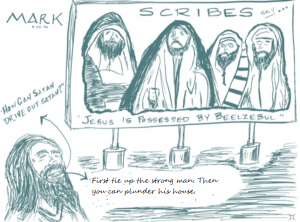
Name calling is a favorite tactic of challenged establishments. Today you might be called a communist or (heaven forbid!) a liberal. Here the establishment figures are scribes, and the insult of the day is Beelzebul. “By this prince of demons Jesus casts out devils.” In a subtle twist Jesus turns the charge around. Once again Jesus locates the spiritual realm (here the demonic) in real-life situations of Palestinian power. Ninth in a series on “The Worldly Spirituality of Mark’s Gospel” with help from Ched Myers’ Binding the Strongman: A Political Reading of Mark’s Story of Jesus. The Introduction and a Table of Contents are HERE.
The last post saw the formation of what Ched Myers calls the “community of resistance.” Resistance against what? The next scene partly explains. (Mark 3:20-35)
Jesus goes “home.” We don’t know where that is, and that may be deliberate on Mark’s part. Crowds gather again, and two more conflicts arise, one of which we would expect but not the other. Mark puts these in the form of a sandwich to show that they are meant to illuminate each other. The conflict we expect is with scribes. This time they’re from Jerusalem, raising the tension in Mark’s story to a new level. On either side of this conflict Mark places a tension we don’t expect between Jesus and his “relatives” or “mother and brothers.”
The conflict we expect, the Beelzebul charge
A huge, boisterous crowd gathers around Jesus. Scribes who had come down from Jerusalem said, “He has Beelzebul, and by the ruler of the demons he casts out demons.” Jesus handily disposes of the charge.
Myers helps me see that Jesus is doing much more than claiming innocence. Jesus first lays bare the contradiction in the scribes’ claim: Why would Satan drive out Satan? But he doesn’t stop there. Next he talks about a kingdom which can’t stand if it’s divided against itself. Is he simply repeating the same thought in other words? But Jesus continues. Now it’s about a house that can’t stand if it’s divided against itself. Why would he say the same thing three times?
Myers explains. By end of Jesus’ triple broadside, the scribes are wondering if Jesus may be hitting close to home. He talks about a “kingdom” and a “house.” Maybe their own kingdom, the Davidic state, is under attack in these words. And maybe the “house divided” is the Temple, the house of God.
Jesus is not just reassuring the scribes, “No, I’m not on the devil’s side; where the devil is concerned, you and I can agree to agree.” Jesus’ “kingdom” and “house” hew uncomfortably close to the way the scribes think of Jerusalem’s centralized politics and religion.
Later Jesus will separate himself from David’s kingdom:
David himself calls [the Messiah] ‘Lord’; so how is he his son? (Mark 12:37)
He will also exorcise the Temple, throwing the sellers and buyers out (Mark 11:15-17). In the light of these later events, Myers thinks that Jesus is already here calling his opponents the devil’s agents. (Myers, pages 165-66)
If that’s true then the following passage has an ominous meaning which I never suspected:
No one can enter a strong man’s house to plunder his property unless he first ties up the strong man. Then he can plunder his house. (Mark 3:27)
You have to be stronger than the strong man to plunder his house, and Jesus is the “stronger one.” (Remember what John the Baptist said in 1:7.) Whose house is Jesus going to plunder? Remember the ones who don’t need a physician, the ones whom Jesus does not call as he calls the “sinners.” They are the strong, self-righteous ones, the very ones now trying to discredit Jesus. Jesus locates Beelzebul, the Satanic strong man, right in the middle of Jerusalem. He gives the scribes fair warning of the plundering he intends to do.
The conflict we didn’t expect.
Mark says Jesus is at home for this Beelzebul episode without telling us where that is. At any rate, that is where Jesus’ relatives have come. “Home” here may be symbolic of more than just a house where Jesus stays. Jesus’ “relatives” at the beginning of this section and his “mother and brothers” at the end are not able to enter this home. Ostensibly that’s because of the crowds, but it may be that the “home” is simply not theirs spiritually.
At the beginning his relatives are going to “seize” him, almost like a police action. They say, “He is out of his mind.” Jesus doesn’t find out that his mother and brothers are outside asking for him until the end of the scene. Then he says, looking at the folks surrounding him, “Here are my mother and my brothers. For whoever does the will of God is my brother and sister and mother.” Jesus is “at home” with his new brothers and sisters and mother.
Family values
In our age of many words honoring “family values,” it’s jarring to see how Jesus relates to his own family. No doubt family values are Christian values, but Jesus doesn’t often stick up for them. Sometimes he seems to do the opposite:
A prospective disciple asks leave to perform the essential family duty of burying a parent. Jesus says, “Let the dead bury their own dead.” (Luke 9:60)
Jesus says to a large crowd, “Whoever comes to me and does not hate father and mother, wife and children, brothers and sisters, yes, and even life itself, cannot be my disciple.” (Luke 14:26)
There’s more than one kind of family value. Myers says kinship “is the backbone of the very social order Jesus is struggling to overturn.” (Page 168) It’s the seat of not only personality and identity but also socialization and job prospects. (Networking, Myers could have said). It’s one of the forces in society that keep people separated into their places.
Matthew and Luke both have genealogies, placing Jesus in a long list of ancestors. Mark is uninterested in Jesus’ family line. Jesus’ biological family is outside the house; inside Jesus finds his real family. Obedience to God is its hallmark, not service to Beelzebul in Jerusalem or even in first-century Mediterranean “family values.”
Next Post

August 22, 2018 Parables, Earthly Stories with Heavenly Meanings? ... Maybe Not
Browse Our Archives
Select a Category Advent Christmas Amazon Synod Angels Being Consumed Bible Catholic Modern Creed Ecology Economics Elizabeth Johnson Eucharist Fragments and Filaments Gender and Sex Gospel of Mark Herzog Historical Jesus Liturgy Luke Opening Scriptures on Way to Emmaus Ordinary radicals Parables Pro-Life Reincarnation Rosary Sacraments science Social Justice Souls Stories of Jesus The Creed Torture and Eucharist Tracy Uncategorized War and Peace
Select a Month October 2026 June 2025 April 2025 March 2025 February 2025 January 2025 November 2024 July 2024 March 2024 December 2023 October 2023 September 2023 August 2023 May 2023 April 2023 March 2023 February 2023 January 2023 December 2022 November 2022 October 2022 September 2022 August 2022 July 2022 June 2022 April 2022 March 2022 February 2022 January 2022 December 2021 November 2021 October 2021 August 2021 July 2021 June 2021 April 2021 March 2021 February 2021 December 2020 November 2020 October 2020 August 2020 July 2020 June 2020 May 2020 April 2020 March 2020 February 2020 January 2020 December 2019 November 2019 October 2019 September 2019 August 2019 July 2019 June 2019 May 2019 April 2019 March 2019 February 2019 January 2019 December 2018 November 2018 October 2018 September 2018 August 2018 July 2018 June 2018 May 2018
Follow Us!
TAKE THE
Religious Wisdom Quiz
Who prepared spices for Jesus' burial?
Select your answer to see how you score.
Martha Salome Mary Magdalene Mary
Related posts from Lost in a One-Acre Wood
Atonement and Some Odd Hypothetical Questions about Disciples

Civil Disobedience and the Puzzle that was Thursday:...

The Sacrament of Touch: We Touch Jesus’ Body...

Apocalypse: A Plague (or is it Stars Falling)...
TRENDING AT PATHEOS Catholic

Creation, Preservation, and Teleology in Catholic Theology
As I write this, it is very early Monday morning. Like millions...

The Parable Of The Sower And The Word...
One of Christ’s most famous parables is that of the sower who...

Rejecting Doom: Christian Hope And Human Action
Christianity is a religion of hope. We are to have hope and...

Why I Choose the Eucharist Over the Sermon
Choose the Eucharist, Not the Sermon What are we supposed to get...

5 Design Elements Found in Spiritually Rooted Homes
Putting Spirituality Into Home Decor Our homes are more than our living...

Credo: A Story of God Told with the...
About 10 years ago, I began to imagine a personal "Credo" that...
view all Catholic blogs
Ad-Free & Subscriber Log-In Subscription Support
- About Us
- 2026 Calendar
- Videos
- Podcasts
- Library of World Religions
- Faith In Media Tracker
- Advertise With Us
- Write for Us
- Privacy Policy
- Terms of Service
- Do Not Sell My Data
- Contact Us
- Radiant Digital
- Manage Newsletter Subscriptions
- Unsubscribe From Notifications
- Sitemap
Copyright 2008-2026, Patheos. All rights reserved.
Subscription Support Ad-Free & Subscriber Log-In
Follow Patheos