
BuddhistCatholicContemplativeEvangelicalGeneral ChristianHinduJewishLatter-day SaintMuslimNew VisionsProgressive Christian
Beliefs
- Buddhist
- Catholic
- Contemplative
- Evangelical
- General Christian
- Hindu
- Jewish
- Latter-day Saint
- More Voices
- Muslim
- New Visions
- Pagan
- Progressive Christian
Topics
- Religion News
- Food and Religion
- Sports and Religion
- Religious Art
- Religious Music and Entertainment
- Religious Events
- History and Religion
- Style and Religion
- Politics and Religion
- Women in Religion
- Recreation Outdoors and Religion
- Business Finance and Religion
- Careers Workplace and Religion
- Education and Religion
- Family Parenting and Religion
- Health Fitness and Religion
- Home and Religion
- Relationships and Religion
- Technology and Religion
- Travel and Religion
Columnists
- Buddhist Columnists
- Business Finance and Religion Columnists
- Careers Workplace and Religion Columnists
- Catholic Columnists
- Contemplative Columnists
- Education and Religion Columnists
- Evangelists Columnists
- Family Parenting and Religion Columnists
- General Christian Columnists
- Health Fitness and Religion Columnists
- Hindu Columnists
- History and Religion Columnists
- Home and Religion Columnists
- Jewish Columnists
- More Voices Columnists
- Latter Day Columnists
- Muslim Columnists
- New Visions Columnists
- Nonreligious Columnists
- Pagan Columnists
- Politics and Religion Columnists
- Progressive Columnists
- Recreation Outdoors and Religion Columnists
- Relationships and Religion Columnists
- Religion News Columnists
- Religious Art Columnists
- Religious Events Columnists
- Religious Music and Entertainment Columnists
- Sports and Religion Columnists
- Style and Religion Columnists
- Technology and Religion Columnists
- Travel and Religion Columnists
- Women in Religion Columnists
Resource Library
- 2026 Calendar
- Library of World Religions
- The 100 Most Holy Places on Earth
- Patheos Answers
- Podcasts
- Videos
- Faith Leaders Database
- Anglican Episcopalian
- Bahai
- Baptist
- Buddhism
- Christianity
- Confucianism
- Eastern Orthodoxy
- Hinduism
- Holiness and Pentecostal
- ISKCON
- Islam
- Judaism
- Lutheran
- Methodist
- The Church of Jesus Christ of Latter-day Saints
- New Age
- Paganism
- Presbytarian and Reformed
- Protestantism
- Religion Behind the Scenes
- Roman Catholic
- Scientology
- Shia Islam
- Sikhism
- Sufism
- Sunni Islam
- Taoism
- Zen
- See all religions
Research Tools
 Ad-Free & Subscriber Log-In Subscription Support
Ad-Free & Subscriber Log-In Subscription Support
Follow Patheos 

- Trending:
- Forgiveness
- |
- Marriage
- |
- Consciousness
- |
- Death Penalty
- |
- Election
- |
- Halloween

- Home
- Catholic
- Jonah Learns a Lesson: Chosen People, Part One
Jonah Learns a Lesson: Chosen People, Part One
Last updated on: February 20, 2020 at 6:17 am by Jack Hartjes
Jonah Learns a Lesson: Chosen People, Part One 2020-02-20T06:17:06-06:00 Jack Hartjes
Patheos Explore the world's faith through different perspectives on religion and spirituality! Patheos has the views of the prevalent religions and spiritualities of the world.
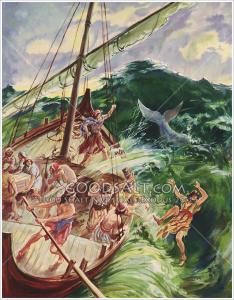
The lot falls to Jonah.
Jonah, a prophet of God’s Chosen People, learns a painful lesson about God’s all-inclusive love. Jews and Christians both identify themselves as chosen people. Others may wonder, Is their god being fair? Episode 16-1 of the Rowing with Michael Series: A journey through the Jewish/Christian Scriptures in Verse and Commentary. Introduction and Contents for this series HERE.
Michael, row the boat ashore. Alleluia….
Jonah was not a tasty dish. Alleluia.
He didn’t sit well with a hungry fish. Alleluia.
Finally he obeyed the Lord’s command. Alleluia.
Then sat and pouted on the desert sand. Alleluia.Ezechiel got a big surprise. Alleluia.
He didn’t think dry bones could rise. Alleluia.
If God could do that for those dead men, Alleluia.
God’s chosen people could live again. Alleluia.
In an age of rapid travel and instant mass communication, we have come to know many cultures other than our own. That God would choose just one nation, Israel, out of the dazzling variety of peoples and cultures of the world is a puzzle. But that God did choose one in particular is a central part of the faith of Jews and Christians.
Ezechiel’s vision of dry bones coming together, taking on muscle and skin, and rising to life shows how strongly the Jews of his age held this belief. Even when they were no nation, held in bondage in the Babylonian Captivity, they clung to their scriptures and to the visions and words of their prophets, encouraging them to trust that God had not abandoned them forever.
But this belief about being chosen was also a problem. The author of Book of Jonah disagreed with the way Jews of his day thought about being the chosen ones. The character Jonah learns a truth that upsets him: that God, who chose the Jews, also cares about other people.
Early Christians had a similar problem, especially when Paul turned his evangelizing efforts toward the Gentiles, people who were not Jews.
Three posts will deal with the issue of chosenness and what that implies about the rest of humanity. This post answers: Why was Jonah so upset?
A tall tale
The whole Book of Jonah is very funny. Its literary genre, I would say, is that of the tall tale. I think the Jewish author, writing long after the historical setting of his story, thought he had to write with humor because his point was so very contrary to what many Jews, including the powers of the day, wanted to believe. Here’s the story:
God commands Jonah to preach to the citizens of Nineveh. Nineveh was the capital of the Assyrian Empire, and the Assyrians were everything you can imagine bad about empires. Their evil deeds included plunder, rape, and ethnic cleansing. They did away with the whole Northern Kingdom of Israel and seriously compromised the small Southern Kingdom, forcing the king in Jerusalem to pay tribute in order to avoid annihilation.
Jonah thinks, “Those Ninevites will never repent. . . . But what if they do? God will let them off the hook just like that.” So he takes off in the other direction on a ship across the Mediterranean Sea.
The ship runs into a fierce storm and is in danger of sinking. The sailors cast lots to see which one on board offended his god. It’s a big storm so it must have a big explanation. The lot falls to Jonah. They throw him overboard, the storm ceases, and a big fish swallows Jonah.
Jonah is regurgitated after three days and, much chastened, goes on to prophecy in Nineveh: “Forty days more, and Nineveh shall be overthrown!” He’s still assuming, hoping, they won’t repent. But they do. Even the king, along with everybody else, sits in sackcloth and ashes—animals too. That’s a lot of sackcloth and ashes. They all go on a long fast. God relents and Nineveh is spared.
Jonah goes off in a huff and sits down and sulks. In one day God makes a bush come up over Jonah to give him shade. (I told you it’s a tall tale.) Jonah is very happy about the bush. On day two God appoints a sultry east wind and a very hot sun and also a worm to destroy the bush. Now Jonah is really angry about losing the bush, angry enough to die he tells God. God has the last word:
You are concerned about the bush, for which you did not labor and which you did not grow; it came into being in a night and perished in a night. And should I not be concerned about Nineveh, that great city, in which there are more than a hundred and twenty thousand persons who do not know their right hand from their left, and also many animals? (Jonah 4:10-11)
God is not the God of Jews only but of other peoples as well, and also animals. How does this lesson of the Book of Jonah square with “chosen people” idea we find so strong in Ezekiel, in many other places in the Old Testament, and also in Christianity, especially its Catholic version? That is what the next two posts explore.
Previous Post

July 13, 2018
Eye Contact for Lectors and the Assembly: Two Lessons Never Taught
Next Post
July 18, 2018 Chosen People, Part Two: Paul’s Vision, a New Tribe?
Browse Our Archives
Select a Category Advent Christmas Amazon Synod Angels Being Consumed Bible Catholic Modern Creed Ecology Economics Elizabeth Johnson Eucharist Fragments and Filaments Gender and Sex Gospel of Mark Herzog Historical Jesus Liturgy Luke Opening Scriptures on Way to Emmaus Ordinary radicals Parables Pro-Life Reincarnation Rosary Sacraments science Social Justice Souls Stories of Jesus The Creed Torture and Eucharist Tracy Uncategorized War and Peace
Select a Month October 2026 June 2025 April 2025 March 2025 February 2025 January 2025 November 2024 July 2024 March 2024 December 2023 October 2023 September 2023 August 2023 May 2023 April 2023 March 2023 February 2023 January 2023 December 2022 November 2022 October 2022 September 2022 August 2022 July 2022 June 2022 April 2022 March 2022 February 2022 January 2022 December 2021 November 2021 October 2021 August 2021 July 2021 June 2021 April 2021 March 2021 February 2021 December 2020 November 2020 October 2020 August 2020 July 2020 June 2020 May 2020 April 2020 March 2020 February 2020 January 2020 December 2019 November 2019 October 2019 September 2019 August 2019 July 2019 June 2019 May 2019 April 2019 March 2019 February 2019 January 2019 December 2018 November 2018 October 2018 September 2018 August 2018 July 2018 June 2018 May 2018
Follow Us!
TAKE THE
Religious Wisdom Quiz
What city is considered the holiest in Christianity?
Select your answer to see how you score.
Bethlehem Rome Nazareth Jerusalem
Related posts from Lost in a One-Acre Wood

Credo: A Story of God Told with the...

Richard A. Horsley Sees Jesus in the Context...
“Jesus Wept.” Don’t Take the Humanity out of...

Holy Thursday Theology and the Scientific Quest for...
TRENDING AT PATHEOS Catholic

The Parable Of The Sower And The Word...
One of Christ’s most famous parables is that of the sower who...

Rejecting Doom: Christian Hope And Human Action
Christianity is a religion of hope. We are to have hope and...

Why I Choose the Eucharist Over the Sermon
Choose the Eucharist, Not the Sermon What are we supposed to get...

5 Design Elements Found in Spiritually Rooted Homes
Putting Spirituality Into Home Decor Our homes are more than our living...

Credo: A Story of God Told with the...
About 10 years ago, I began to imagine a personal "Credo" that...

The Anatomy of Divine Revelation in Catholic Thought
The claim that God has made Himself known to human beings is...
view all Catholic blogs
Ad-Free & Subscriber Log-In Subscription Support
- About Us
- 2026 Calendar
- Videos
- Podcasts
- Library of World Religions
- Faith In Media Tracker
- Advertise With Us
- Write for Us
- Privacy Policy
- Terms of Service
- Do Not Sell My Data
- Contact Us
- Radiant Digital
- Manage Newsletter Subscriptions
- Unsubscribe From Notifications
- Sitemap
Copyright 2008-2026, Patheos. All rights reserved.
Subscription Support Ad-Free & Subscriber Log-In
Follow Patheos