
BuddhistCatholicContemplativeEvangelicalGeneral ChristianHinduJewishLatter-day SaintMuslimNew VisionsProgressive Christian
Beliefs
- Buddhist
- Catholic
- Contemplative
- Evangelical
- General Christian
- Hindu
- Jewish
- Latter-day Saint
- More Voices
- Muslim
- New Visions
- Pagan
- Progressive Christian
Topics
- Religion News
- Food and Religion
- Sports and Religion
- Religious Art
- Religious Music and Entertainment
- Religious Events
- History and Religion
- Style and Religion
- Politics and Religion
- Women in Religion
- Recreation Outdoors and Religion
- Business Finance and Religion
- Careers Workplace and Religion
- Education and Religion
- Family Parenting and Religion
- Health Fitness and Religion
- Home and Religion
- Relationships and Religion
- Technology and Religion
- Travel and Religion
Columnists
- Buddhist Columnists
- Business Finance and Religion Columnists
- Careers Workplace and Religion Columnists
- Catholic Columnists
- Contemplative Columnists
- Education and Religion Columnists
- Evangelists Columnists
- Family Parenting and Religion Columnists
- General Christian Columnists
- Health Fitness and Religion Columnists
- Hindu Columnists
- History and Religion Columnists
- Home and Religion Columnists
- Jewish Columnists
- More Voices Columnists
- Latter Day Columnists
- Muslim Columnists
- New Visions Columnists
- Nonreligious Columnists
- Pagan Columnists
- Politics and Religion Columnists
- Progressive Columnists
- Recreation Outdoors and Religion Columnists
- Relationships and Religion Columnists
- Religion News Columnists
- Religious Art Columnists
- Religious Events Columnists
- Religious Music and Entertainment Columnists
- Sports and Religion Columnists
- Style and Religion Columnists
- Technology and Religion Columnists
- Travel and Religion Columnists
- Women in Religion Columnists
Resource Library
- 2026 Calendar
- Library of World Religions
- The 100 Most Holy Places on Earth
- Patheos Answers
- Podcasts
- Videos
- Faith Leaders Database
- Anglican Episcopalian
- Bahai
- Baptist
- Buddhism
- Christianity
- Confucianism
- Eastern Orthodoxy
- Hinduism
- Holiness and Pentecostal
- ISKCON
- Islam
- Judaism
- Lutheran
- Methodist
- The Church of Jesus Christ of Latter-day Saints
- New Age
- Paganism
- Presbytarian and Reformed
- Protestantism
- Religion Behind the Scenes
- Roman Catholic
- Scientology
- Shia Islam
- Sikhism
- Sufism
- Sunni Islam
- Taoism
- Zen
- See all religions
Research Tools
 Ad-Free & Subscriber Log-In Subscription Support
Ad-Free & Subscriber Log-In Subscription Support
Follow Patheos 

- Trending:
- Forgiveness
- |
- Marriage
- |
- Consciousness
- |
- Death Penalty
- |
- Election
- |
- Halloween

- Home
- Catholic
- Revelation is a Dialogue with God’s Word: Biblical Violence, Part Three
Revelation is a Dialogue with God’s Word: Biblical Violence, Part Three
Last updated on: February 2, 2020 at 8:13 am by Jack Hartjes
Revelation is a Dialogue with God’s Word: Biblical Violence, Part Three 2020-02-02T08:13:28-06:00 Jack Hartjes
Patheos Explore the world's faith through different perspectives on religion and spirituality! Patheos has the views of the prevalent religions and spiritualities of the world.
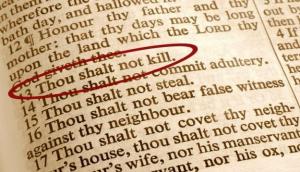
Does God violate this commandment in some of the Bible’s stories?
Violence in the Bible disturbs some Christians and makes it easier to reject Biblical faith altogether. One way to deal with some of the Bible’s disturbing passages is to locate God’s revelation not in the pages of a book but in the reader’s encounter with the ancient words.
Episode 13-3 of the Rowing with Michael Series: A journey through the Jewish/Christian Scriptures in Verse and Commentary. Introduction and Contents for this series HERE.
The Bible’s authors lived in a violent age. No doubt some of the violence they depict is exaggerated; some battles may be legendary rather than factual memories. But it remains true that these authors attributed to God actions and commands which we would consider immoral, even reaching the level of ethnic cleansing. Clearly they were mistaken about this, but the problem remains. What can biblical faith make of such stories in the Bible?
Thinking about revelation
I searched and found a long article on this issue. (Eryl W. Davies, “The Morally Dubious Passages of the Hebrew Bible: An Examination of Some Proposed Solutions,” Currents in Biblical Research 2005; 3; 197) The author mentions six ways of thinking about revelation and these disturbing parts of the Bible. He rejects five of the six, including two of my past guesses.
I always thought it was enough to understand that the Bible expresses God’s word in the words of human beings, and as such it is conditioned by the culture in which it developed. Davies calls this the “cultural relativist’s approach.” I also thought different parts of the Bible naturally would exhibit different moralities because people’s moral awareness develops over time. If God has anything to do with it, this development should go in the direction of God’s own moral standards. This is the “evolutionary approach.”
What’s wrong with these approaches? First, the evolutionary approach: It assumes that the earlier portions of the Bible would be more morally “primitive” than the later, but that is not exactly the case. Besides, think about how we judge moral progress. It has to be by our present-day standards. So what we think of as progress is movement toward the place where we are now. That’s perfectly reasonable, but you have to wonder then why we need a Bible.
Second, the cultural relativist’s approach: It helps us see that we can’t just lift ideas out of the Bible along with its culture and drop them into our very different culture and expect them to fit. So do we separate what is merely cultural in the Bible from what is universally valid? But we ourselves are culturally conditioned. What we find in the Bible to be “universally valid” will be only what is approved by our culture. Again, why do we need a Bible?
Revelation as encounter and dialogue
Davies prefers what he calls the “reader response” approach to revelation. It’s not just a new way of interpreting the Bible. It’s a new way of understanding what revelation is. He says the Bible is something we have to wrestle with. Revelation does not reside in the mere words of the Bible or even the thoughts and history behind the words. Revelation only happens when people interact with these words, thoughts, and history. Encounter and dialogue between reader and Bible characterize revelation. Sometimes that dialogue concludes with a resounding “No!”
Davies explains that we no longer expect the Bible to be scientifically or historically without mistakes. This is also the position of the Catholic Church. The “No” shouldn’t disturb us either, Davies says, when addressed to some of the Bible’s moral attitudes. I’m tentatively going along with this “reader response” view of revelation. There are some obvious questions, to which I propose answers here:
Is any reader’s response just as revelatory as anybody else’s?
No. Obviously bible scholars have a role. I think that the most important control over the process happens when the reading is done in the context of the community formed by this book, that is, the Church.
Can other scriptures play the same role as the Bible?
Yes, for their communities. Not the same, for the Christian. However, openness to ideas from other places, even ideas about God, is very Christian and has been since the early Christians started wrestling with Greek philosophy.
Do Christians very often say NO to their own Bible?
Yes, among us ordinary pew warmers as well as either conservative or liberal scholars–maybe more often than we should. Nobody just accepts everything the bible says.
What’s another time when Christians should say NO, besides the war stories?
The Bible says literally that baptism with water and faith in Jesus are necessary for salvation. I can imagine an interpretation that leaves heaven’s door open to sincere non-believers, but perhaps here it’s better to just say NO. God’s love is for everyone, as other parts of the Bible plainly indicate.
Do you ever have to say YES, and do we all have to agree when, or is just wrestling with the Bible enough to make one a Christian?
To ignore the Bible or to treat it as just another piece of literature is to be something other than Christian or Jew. This is the first mandatory YES for a believer.
A lesson from the war stories
One final question: Is there anything about the war stories that we can say YES to? This gets at the reason why these stories are in the Bible–a real puzzle, but here’s my attempt at an answer.
In the Hebrew Bible God doesn’t always win. He has an especially difficult time getting his way with his own people. Just where it counts most God seems weakest. We need to rethink the entire idea of power. The Bible makes us think hard about power, along with other things in which we put a lot of stock. In the war stories it’s never human power that conquers. God wields all the power in the Bible stories. Still humans cling to their foolish ideas about their own power.
War is the ultimate refusal on the part of human beings to recognize the truth about power, and biblical wars are no different, except for one thing. The Bible writers may not all have been clear about the moral use of power, but they were sure about the moral status of pride and self-sufficiency. They taught their country to attribute both their victories and their defeats to God. If the Bible insists on God’s power just where we imagine ourselves at our most powerful, then the real meaning must be that God is always acting. I think the correct response to the war stories is to say NO to the violence but YES to the ever-present activity of God and to what God is telling us about our pride.
.
Previous Post

July 4, 2018
Joshua Didn't Destroy Jericho: The Problem of Biblical Violence, Part Two
Next Post
July 9, 2018 Solomon and Embracing the Symbol King
Browse Our Archives
Select a Category Advent Christmas Amazon Synod Angels Being Consumed Bible Catholic Modern Creed Ecology Economics Elizabeth Johnson Eucharist Fragments and Filaments Gender and Sex Gospel of Mark Herzog Historical Jesus Liturgy Luke Opening Scriptures on Way to Emmaus Ordinary radicals Parables Pro-Life Reincarnation Rosary Sacraments science Social Justice Souls Stories of Jesus The Creed Torture and Eucharist Tracy Uncategorized War and Peace
Select a Month October 2026 June 2025 April 2025 March 2025 February 2025 January 2025 November 2024 July 2024 March 2024 December 2023 October 2023 September 2023 August 2023 May 2023 April 2023 March 2023 February 2023 January 2023 December 2022 November 2022 October 2022 September 2022 August 2022 July 2022 June 2022 April 2022 March 2022 February 2022 January 2022 December 2021 November 2021 October 2021 August 2021 July 2021 June 2021 April 2021 March 2021 February 2021 December 2020 November 2020 October 2020 August 2020 July 2020 June 2020 May 2020 April 2020 March 2020 February 2020 January 2020 December 2019 November 2019 October 2019 September 2019 August 2019 July 2019 June 2019 May 2019 April 2019 March 2019 February 2019 January 2019 December 2018 November 2018 October 2018 September 2018 August 2018 July 2018 June 2018 May 2018
Follow Us!
TAKE THE
Religious Wisdom Quiz
What Christian group believes in baptism for the dead?
Select your answer to see how you score.
Presbyterians Latter-day Saints Pentecostals Anglicans
Related posts from Lost in a One-Acre Wood

Credo: A Story of God Told with the...

Richard A. Horsley Sees Jesus in the Context...
“Jesus Wept.” Don’t Take the Humanity out of...

Holy Thursday Theology and the Scientific Quest for...
TRENDING AT PATHEOS Catholic

Creation, Preservation, and Teleology in Catholic Theology
As I write this, it is very early Monday morning. Like millions...

The Parable Of The Sower And The Word...
One of Christ’s most famous parables is that of the sower who...

Rejecting Doom: Christian Hope And Human Action
Christianity is a religion of hope. We are to have hope and...

Why I Choose the Eucharist Over the Sermon
Choose the Eucharist, Not the Sermon What are we supposed to get...

5 Design Elements Found in Spiritually Rooted Homes
Putting Spirituality Into Home Decor Our homes are more than our living...

Credo: A Story of God Told with the...
About 10 years ago, I began to imagine a personal "Credo" that...
view all Catholic blogs
Ad-Free & Subscriber Log-In Subscription Support
- About Us
- 2026 Calendar
- Videos
- Podcasts
- Library of World Religions
- Faith In Media Tracker
- Advertise With Us
- Write for Us
- Privacy Policy
- Terms of Service
- Do Not Sell My Data
- Contact Us
- Radiant Digital
- Manage Newsletter Subscriptions
- Unsubscribe From Notifications
- Sitemap
Copyright 2008-2026, Patheos. All rights reserved.
Subscription Support Ad-Free & Subscriber Log-In
Follow Patheos