
BuddhistCatholicContemplativeEvangelicalGeneral ChristianHinduJewishLatter-day SaintMuslimNew VisionsProgressive Christian
Beliefs
- Buddhist
- Catholic
- Contemplative
- Evangelical
- General Christian
- Hindu
- Jewish
- Latter-day Saint
- More Voices
- Muslim
- New Visions
- Pagan
- Progressive Christian
Topics
- Religion News
- Food and Religion
- Sports and Religion
- Religious Art
- Religious Music and Entertainment
- Religious Events
- History and Religion
- Style and Religion
- Politics and Religion
- Women in Religion
- Recreation Outdoors and Religion
- Business Finance and Religion
- Careers Workplace and Religion
- Education and Religion
- Family Parenting and Religion
- Health Fitness and Religion
- Home and Religion
- Relationships and Religion
- Technology and Religion
- Travel and Religion
Columnists
- Buddhist Columnists
- Business Finance and Religion Columnists
- Careers Workplace and Religion Columnists
- Catholic Columnists
- Contemplative Columnists
- Education and Religion Columnists
- Evangelists Columnists
- Family Parenting and Religion Columnists
- General Christian Columnists
- Health Fitness and Religion Columnists
- Hindu Columnists
- History and Religion Columnists
- Home and Religion Columnists
- Jewish Columnists
- More Voices Columnists
- Latter Day Columnists
- Muslim Columnists
- New Visions Columnists
- Nonreligious Columnists
- Pagan Columnists
- Politics and Religion Columnists
- Progressive Columnists
- Recreation Outdoors and Religion Columnists
- Relationships and Religion Columnists
- Religion News Columnists
- Religious Art Columnists
- Religious Events Columnists
- Religious Music and Entertainment Columnists
- Sports and Religion Columnists
- Style and Religion Columnists
- Technology and Religion Columnists
- Travel and Religion Columnists
- Women in Religion Columnists
Resource Library
- 2026 Calendar
- Library of World Religions
- The 100 Most Holy Places on Earth
- Patheos Answers
- Podcasts
- Videos
- Faith Leaders Database
- Anglican Episcopalian
- Bahai
- Baptist
- Buddhism
- Christianity
- Confucianism
- Eastern Orthodoxy
- Hinduism
- Holiness and Pentecostal
- ISKCON
- Islam
- Judaism
- Lutheran
- Methodist
- The Church of Jesus Christ of Latter-day Saints
- New Age
- Paganism
- Presbytarian and Reformed
- Protestantism
- Religion Behind the Scenes
- Roman Catholic
- Scientology
- Shia Islam
- Sikhism
- Sufism
- Sunni Islam
- Taoism
- Zen
- See all religions
Research Tools
 Ad-Free & Subscriber Log-In Subscription Support
Ad-Free & Subscriber Log-In Subscription Support
Follow Patheos 

- Trending:
- Forgiveness
- |
- Marriage
- |
- Consciousness
- |
- Death Penalty
- |
- Election
- |
- Halloween

- Home
- Catholic
- Joshua Didn’t Destroy Jericho: The Problem of Biblical Violence, Part Two
Joshua Didn’t Destroy Jericho: The Problem of Biblical Violence, Part Two
Last updated on: February 2, 2020 at 7:59 am by Jack Hartjes
Joshua Didn’t Destroy Jericho: The Problem of Biblical Violence, Part Two 2020-02-02T07:59:10-06:00 Jack Hartjes
Patheos Explore the world's faith through different perspectives on religion and spirituality! Patheos has the views of the prevalent religions and spiritualities of the world.
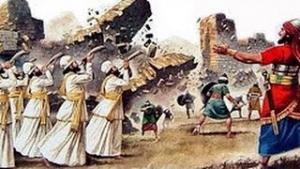
Did Joshua really fight the Battle of Jericho?
The Bible contains a lot of violence, much of it unjust by today’s standards. In this post I use findings of archaeologists that indicate that some of the worst violence, for example, the battles Joshua fought, didn’t really happen. I leave for the next post the question why these stories are in the Bible.
Episode 13-2 of the Rowing with Michael Series: A journey through the Jewish/Christian Scriptures in Verse and Commentary. Introduction and Contents for this series HERE.
People have tried to explain the violence in the Bible in various ways. One way that doesn’t work is to say those were violent times and you can’t expect the ancient Israelites to follow modern morality. The problem with that is that it’s not just the Israelites’ choosing excessive violence. God commands them to do it or even does it himself. The exuse of violent times does not work for God.
Joshua vs. just-war criteria
Some of God’s violence seems pointless, as when God slays 100 soldiers (50 at a time) to save Elijah from being brought to the court of King Ahaziah—and Elijah ends up going anyway. (2 Kings 1) Most of the really horrifying stories are in the Book of Joshua, Chapters 6-11. Over and over the Israelites engage in what we would have to call ethnic cleansing. And God commands them to do it! Here are some of the chilling details:
After capturing the city of Jericho, the Israelites “utterly destroy all in the city, both men and women, young and old, oxen, sheep, and asses, with the edge of the sword.” They spare a prostitute named Rahab and her family. See this post. But all the silver and gold and vessels of bronze and iron they put into “the treasury of the Lord.” (Joshua 6:19-21)
Then they march against the city of Ai. They round up and kill all the soldiers who ran away and then return to the city, which they “smote with the edge of the sword. And all who fell that day, both men and women, were twelve thousand, all the people of Ai.” (Joshua 8:24-25) They do the same to Libnah, Lachish, Eglon, Hebron, Debir, and Hazor. (Joshua 10:29 – 11:11.
To say the least, these battles do not meet the criteria the Church has established for just war. Some people say God needed to preserve the new monotheistic faith from contamination by Israel’s idol-worshiping neighbors, and the only way was to destroy the neighbors. Using that logic religious people have justified all sorts of atrocious acts in pursuit of supposedly noble ends. If that logic is God’s, then the devil is the lesser of two evils. Besides, the plan, if that’s what it was, didn’t even work. The Israelites went ahead and worshiped other gods anyway.
Doubts about the Bible stories
It helps a little that modern archaeology shows most of the battles never took place. Specifically, the cities mentioned in Joshua 6-11 didn’t even exist at the time that the events supposedly happened. That lets God off the hook. God couldn’t possibly have commanded the destruction of a non-existent city, even if a biblical author says he did. The Church tells us that human authors with human abilities and limitations wrote the Bible. We are free to hold that some of their interpretations of their own history are mistaken. They could have falsely attributed to God actions and ways of thinking that are merely human.
Still, why are these stories in the Bible? And what are we to make of a book that contains such things? How do we separate the merely human from the divine in the Bible? Should we even try to do that? These are difficult questions, but I don’t think they can be avoided if one wants to present biblical faith to a skeptical and often critical modern world. I have had to change my way of thinking about violence in the Bible. The next post will describe the way one scholar helped me do that.
Previous Post

July 2, 2018
The Problem of Biblical Violence, Part One
Next Post
July 6, 2018 Revelation is a Dialogue with God’s Word: Biblical Violence, Part Three
Browse Our Archives
Select a Category Advent Christmas Amazon Synod Angels Being Consumed Bible Catholic Modern Creed Ecology Economics Elizabeth Johnson Eucharist Fragments and Filaments Gender and Sex Gospel of Mark Herzog Historical Jesus Liturgy Luke Opening Scriptures on Way to Emmaus Ordinary radicals Parables Pro-Life Reincarnation Rosary Sacraments science Social Justice Souls Stories of Jesus The Creed Torture and Eucharist Tracy Uncategorized War and Peace
Select a Month October 2026 June 2025 April 2025 March 2025 February 2025 January 2025 November 2024 July 2024 March 2024 December 2023 October 2023 September 2023 August 2023 May 2023 April 2023 March 2023 February 2023 January 2023 December 2022 November 2022 October 2022 September 2022 August 2022 July 2022 June 2022 April 2022 March 2022 February 2022 January 2022 December 2021 November 2021 October 2021 August 2021 July 2021 June 2021 April 2021 March 2021 February 2021 December 2020 November 2020 October 2020 August 2020 July 2020 June 2020 May 2020 April 2020 March 2020 February 2020 January 2020 December 2019 November 2019 October 2019 September 2019 August 2019 July 2019 June 2019 May 2019 April 2019 March 2019 February 2019 January 2019 December 2018 November 2018 October 2018 September 2018 August 2018 July 2018 June 2018 May 2018
Follow Us!
TAKE THE
Religious Wisdom Quiz
What does Paul say in 1 Thessalonians about the day of the Lord?
Select your answer to see how you score.
It will come like a thief in the night It will come with great signs It will come after the tribulation It will come when peace is declared
Related posts from Lost in a One-Acre Wood

Credo: A Story of God Told with the...

Richard A. Horsley Sees Jesus in the Context...
“Jesus Wept.” Don’t Take the Humanity out of...

Holy Thursday Theology and the Scientific Quest for...
TRENDING AT PATHEOS Catholic

The Parable Of The Sower And The Word...
One of Christ’s most famous parables is that of the sower who...

Rejecting Doom: Christian Hope And Human Action
Christianity is a religion of hope. We are to have hope and...

Why I Choose the Eucharist Over the Sermon
Choose the Eucharist, Not the Sermon What are we supposed to get...

5 Design Elements Found in Spiritually Rooted Homes
Putting Spirituality Into Home Decor Our homes are more than our living...

Credo: A Story of God Told with the...
About 10 years ago, I began to imagine a personal "Credo" that...

The Anatomy of Divine Revelation in Catholic Thought
The claim that God has made Himself known to human beings is...
view all Catholic blogs
Ad-Free & Subscriber Log-In Subscription Support
- About Us
- 2026 Calendar
- Videos
- Podcasts
- Library of World Religions
- Faith In Media Tracker
- Advertise With Us
- Write for Us
- Privacy Policy
- Terms of Service
- Do Not Sell My Data
- Contact Us
- Radiant Digital
- Manage Newsletter Subscriptions
- Unsubscribe From Notifications
- Sitemap
Copyright 2008-2026, Patheos. All rights reserved.
Subscription Support Ad-Free & Subscriber Log-In
Follow Patheos