
BuddhistCatholicContemplativeEvangelicalGeneral ChristianHinduJewishLatter-day SaintMuslimNew VisionsProgressive Christian
Beliefs
- Buddhist
- Catholic
- Contemplative
- Evangelical
- General Christian
- Hindu
- Jewish
- Latter-day Saint
- More Voices
- Muslim
- New Visions
- Pagan
- Progressive Christian
Topics
- Religion News
- Food and Religion
- Sports and Religion
- Religious Art
- Religious Music and Entertainment
- Religious Events
- History and Religion
- Style and Religion
- Politics and Religion
- Women in Religion
- Recreation Outdoors and Religion
- Business Finance and Religion
- Careers Workplace and Religion
- Education and Religion
- Family Parenting and Religion
- Health Fitness and Religion
- Home and Religion
- Relationships and Religion
- Technology and Religion
- Travel and Religion
Columnists
- Buddhist Columnists
- Business Finance and Religion Columnists
- Careers Workplace and Religion Columnists
- Catholic Columnists
- Contemplative Columnists
- Education and Religion Columnists
- Evangelists Columnists
- Family Parenting and Religion Columnists
- General Christian Columnists
- Health Fitness and Religion Columnists
- Hindu Columnists
- History and Religion Columnists
- Home and Religion Columnists
- Jewish Columnists
- More Voices Columnists
- Latter Day Columnists
- Muslim Columnists
- New Visions Columnists
- Nonreligious Columnists
- Pagan Columnists
- Politics and Religion Columnists
- Progressive Columnists
- Recreation Outdoors and Religion Columnists
- Relationships and Religion Columnists
- Religion News Columnists
- Religious Art Columnists
- Religious Events Columnists
- Religious Music and Entertainment Columnists
- Sports and Religion Columnists
- Style and Religion Columnists
- Technology and Religion Columnists
- Travel and Religion Columnists
- Women in Religion Columnists
Resource Library
- 2026 Calendar
- Library of World Religions
- The 100 Most Holy Places on Earth
- Patheos Answers
- Podcasts
- Videos
- Faith Leaders Database
- Anglican Episcopalian
- Bahai
- Baptist
- Buddhism
- Christianity
- Confucianism
- Eastern Orthodoxy
- Hinduism
- Holiness and Pentecostal
- ISKCON
- Islam
- Judaism
- Lutheran
- Methodist
- The Church of Jesus Christ of Latter-day Saints
- New Age
- Paganism
- Presbytarian and Reformed
- Protestantism
- Religion Behind the Scenes
- Roman Catholic
- Scientology
- Shia Islam
- Sikhism
- Sufism
- Sunni Islam
- Taoism
- Zen
- See all religions
Research Tools
 Ad-Free & Subscriber Log-In Subscription Support
Ad-Free & Subscriber Log-In Subscription Support
Follow Patheos 

- Trending:
- Forgiveness
- |
- Marriage
- |
- Consciousness
- |
- Death Penalty
- |
- Election
- |
- Halloween

- Home
- Catholic
- Two Spiritualities of Banking—Dad’s and Wall Street’s
Two Spiritualities of Banking—Dad’s and Wall Street’s
Last updated on: June 20, 2022 at 7:16 am by Jack Hartjes
Two Spiritualities of Banking—Dad’s and Wall Street’s 2022-06-20T07:16:29-06:00 Jack Hartjes
Patheos Explore the world's faith through different perspectives on religion and spirituality! Patheos has the views of the prevalent religions and spiritualities of the world.
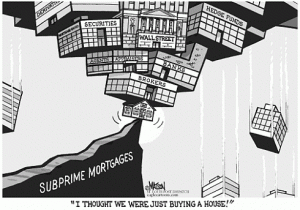 Banking is spiritual? That’s the idea here, also that the kind of spirituality matters. William T. Cavanaugh describes the spirituality of Wall Street as a flight away from material reality. My dad’s banking practice moved in the opposite direction, and that’s spirituality too. The first kind gave us the recession of 2008. The second is Christian. I’ll get to Dad later. Cavanaugh is going to help me with Wall Street.
A theologian based in DePaul University, Cavanaugh is interested in political theology and economic ethics. He has a number of books on economy and politics, which he analyzes from a Christian point of view. He has some lectures on economy published on YouTube. One in particular made me think about my dad. Also, there’s a book called God the Economist by M. Douglas Meeks, which deserves a post of its own but does enter into my thoughts here as well.
Cavanaugh’s youtube talk is called “The Myth of Prosperity.” In it he tells how banking practices led to the recession from which we have been recovering. He cautions us against blaming the crisis solely on greed. No doubt, there was greed involved but focusing on personal greed too easily lets the rest of us, and our economic system, off the hook. (Of course, we’re not greedy.) Cavanaugh digs quite a bit deeper. He says the global economy has been involved in a “flight from reality.” The crisis has been driven, he says, by a “desire to transcend the material world,” to get free of the things which essentially go along with matter, namely: limit, death, scarcity, risk, and dependence. Parts of that sound almost religious.
Well, Cavanaugh says, something religious was going on in the banking industry. The Meeks book, explains that, even though our economic system has pushed God to the sidelines or denied God outright, still god concepts of a particular type—not the Christian type—rule in the secular world. This is a god that wants to have as little connection as possible with material reality.
The disconnect from reality comes in a number of steps, all of which led to the most recent global financial meltdown:
- Banks lent money for the “American dream” of owning a home to people who couldn’t pay the money back. Very low interest rates made such a practice attractive, but it was mainly aided by the fantasy that homes would pay for themselves by rising in value. The problem was that the rise was fueled by the loans themselves–first step away from reality.
- Banks, knowing that at least some of the loans were risky, passed the risk on by packaging them for sale. Given AAA bond rating, high risks were sold as safe investments. Step two into unreality.
- These packages, i.e., debts, were listed as assets and used as collateral for borrowing more money. Step three.
- Then came credit default swaps, basically a way of gambling. A lender buys an insurance policy on a loan that might default. The insurer, of course, gambles that it won’t. If you’re John Paulson around 2007, you buy up as many of the insurance policies as you can because you believe the whole housing market is going to collapse, and you make $4 billion worth of insurance claims in what’s been called the greatest trade ever made. Not so great for the rest of the economy, though.
It was an economy detaching itself by steps from reality, built more and more on debt, that is, nothing. Its aspiration is not simply to make money but, in Cavanaugh’s words, “to leave behind physical constraints and limits that are created by being a mortal creature in space and time; it’s an attempt to transcend that, to cheat death…to get beyond our damnable servitude to material reality.”
Cavanaugh explains how this economy tries to avoid three essential characteristics of life in material reality: scarcity, risk, and the need for trust. I think he would agree to add location in time and space.
Scarcity is fundamentally a matter of unlimited desires facing limited resources. The obvious answer to that is the longstanding Christian (or Buddhist if you like) ideal of purposefully limiting desire; but our current economic “religion” preaches exactly the opposite of that. Instead, this economy tries to get around scarcity by financialization, that is, making wealth without any increase in material production.
Risk, of course, is a factor in any loan. Securitization dealt with that, supposedly, by deferring risk, passing it on or insuring it. It’s living on value borrowed from the future.
“Trust” is one of a number of words that could have come straight out of the Bible or a religion textbook. Funny how that word actually names a group of financial instruments, but, in today’s world of high finance, it’s an oxymoron. Money is made more quickly if the need for trust, in the Biblical sense, is done away with. Profit can be made on distrust itself. In the credit default swap game you can even root for another’s failure. The basic aspiration here is freedom from obligation to others or from relying on others.
Finally, locality becomes irrelevant in high finance. No one needs to know in what part of the world a loan originates or who owns the loan now. We transcended that too.
Spirituality of banking according to Dad. My dad’s banking practice was very different. As a loan officer in a small-town bank, he would spend hours reviewing the borrower’s finances. He would examine the purpose of the loan and its prospects for success if it was for, say, a business venture. Both borrower and lender were taking a risk and both knew and accepted it. Trust was important. You needed to know your neighbors. There was no flight from material reality in my dad’s banking practice. But that practice was merely quaint in the later world of high finance.
There is a split between two spiritualities. One tries to leave material reality behind so it appears a lot more spiritual than the other. My dad’s practice was well grounded in material reality, with a real place and time, real people who are neighbors to each other, a real project that might succeed or not–so real risk. It doesn’t sound very spiritual, but there are spiritual things involved. Only this spirituality is not a flight away from material reality but rather a move further in.
My dad’s kind of spirituality involved a thing that we call “credit.” Credit is another name for belief (from “credo” in Latin). It’s the lender’s belief that the borrower is credit-worthy, that he or she is able and willing to pay back the loan. Then there’s what we call “debt,” basically the borrower’s obligation to pay back the loan. Neither of these two spiritual realities takes one out of the material world at all; in fact, they’re just what’s there in the real-life situation of lender and borrower. It’s nothing like the fancy financial instruments of Wall Street.
That’s a Christian kind of spirituality, one that engages the world that God created and called good. These spiritual realities live in real flesh and blood; They are incarnational, like Jesus.
For Christians this world is not something to escape from, to be saved from. It’s something to save and, on the way, to rejoice in. Some myths depict creation as a fall away from God, but in the Christian story creation is a continuous, intimate, sustaining relationship between creator and created. Some sort of “fall,” some rebellion within that relationship, is real enough. So material reality also is something that needs repairing, reconnecting. That’s what Christian spirituality is about, too.
This Wikipedia article goes into more detail on the causes of the Recession of 2008.
Image credit: Modkraft
Next Post

June 27, 2018 Four Amazing Women in the Genealogy of Jesus
Browse Our Archives
Select a Category Advent Christmas Amazon Synod Angels Being Consumed Bible Catholic Modern Creed Ecology Economics Elizabeth Johnson Eucharist Fragments and Filaments Gender and Sex Gospel of Mark Herzog Historical Jesus Liturgy Luke Opening Scriptures on Way to Emmaus Ordinary radicals Parables Pro-Life Reincarnation Rosary Sacraments science Social Justice Souls Stories of Jesus The Creed Torture and Eucharist Tracy Uncategorized War and Peace
Select a Month October 2026 June 2025 April 2025 March 2025 February 2025 January 2025 November 2024 July 2024 March 2024 December 2023 October 2023 September 2023 August 2023 May 2023 April 2023 March 2023 February 2023 January 2023 December 2022 November 2022 October 2022 September 2022 August 2022 July 2022 June 2022 April 2022 March 2022 February 2022 January 2022 December 2021 November 2021 October 2021 August 2021 July 2021 June 2021 April 2021 March 2021 February 2021 December 2020 November 2020 October 2020 August 2020 July 2020 June 2020 May 2020 April 2020 March 2020 February 2020 January 2020 December 2019 November 2019 October 2019 September 2019 August 2019 July 2019 June 2019 May 2019 April 2019 March 2019 February 2019 January 2019 December 2018 November 2018 October 2018 September 2018 August 2018 July 2018 June 2018 May 2018
Follow Us!
TAKE THE
Religious Wisdom Quiz
Who was Jesus' legal father?
Select your answer to see how you score.
Jacob Matthat Heli Joseph
Related posts from Lost in a One-Acre Wood
Social Democracy Saves Capitalism: 'Tyranny, Inc.,' Part 2
Economic Coercion and 'Tyranny, Inc.' by Sohrab Ahmari

A Rich Man Follows All the Old Rules....
The Temple, Jesus, and the Little Traditions of...
TRENDING AT PATHEOS Catholic

Creation, Preservation, and Teleology in Catholic Theology
As I write this, it is very early Monday morning. Like millions...

The Parable Of The Sower And The Word...
One of Christ’s most famous parables is that of the sower who...

Rejecting Doom: Christian Hope And Human Action
Christianity is a religion of hope. We are to have hope and...

Why I Choose the Eucharist Over the Sermon
Choose the Eucharist, Not the Sermon What are we supposed to get...

5 Design Elements Found in Spiritually Rooted Homes
Putting Spirituality Into Home Decor Our homes are more than our living...

Credo: A Story of God Told with the...
About 10 years ago, I began to imagine a personal "Credo" that...
view all Catholic blogs
Ad-Free & Subscriber Log-In Subscription Support
- About Us
- 2026 Calendar
- Videos
- Podcasts
- Library of World Religions
- Faith In Media Tracker
- Advertise With Us
- Write for Us
- Privacy Policy
- Terms of Service
- Do Not Sell My Data
- Contact Us
- Radiant Digital
- Manage Newsletter Subscriptions
- Unsubscribe From Notifications
- Sitemap
Copyright 2008-2026, Patheos. All rights reserved.
Subscription Support Ad-Free & Subscriber Log-In
Follow Patheos