
BuddhistCatholicContemplativeEvangelicalGeneral ChristianHinduJewishLatter-day SaintMuslimNew VisionsProgressive Christian
Beliefs
- Buddhist
- Catholic
- Contemplative
- Evangelical
- General Christian
- Hindu
- Jewish
- Latter-day Saint
- More Voices
- Muslim
- New Visions
- Pagan
- Progressive Christian
Topics
- Religion News
- Food and Religion
- Sports and Religion
- Religious Art
- Religious Music and Entertainment
- Religious Events
- History and Religion
- Style and Religion
- Politics and Religion
- Women in Religion
- Recreation Outdoors and Religion
- Business Finance and Religion
- Careers Workplace and Religion
- Education and Religion
- Family Parenting and Religion
- Health Fitness and Religion
- Home and Religion
- Relationships and Religion
- Technology and Religion
- Travel and Religion
Columnists
- Buddhist Columnists
- Business Finance and Religion Columnists
- Careers Workplace and Religion Columnists
- Catholic Columnists
- Contemplative Columnists
- Education and Religion Columnists
- Evangelists Columnists
- Family Parenting and Religion Columnists
- General Christian Columnists
- Health Fitness and Religion Columnists
- Hindu Columnists
- History and Religion Columnists
- Home and Religion Columnists
- Jewish Columnists
- More Voices Columnists
- Latter Day Columnists
- Muslim Columnists
- New Visions Columnists
- Nonreligious Columnists
- Pagan Columnists
- Politics and Religion Columnists
- Progressive Columnists
- Recreation Outdoors and Religion Columnists
- Relationships and Religion Columnists
- Religion News Columnists
- Religious Art Columnists
- Religious Events Columnists
- Religious Music and Entertainment Columnists
- Sports and Religion Columnists
- Style and Religion Columnists
- Technology and Religion Columnists
- Travel and Religion Columnists
- Women in Religion Columnists
Resource Library
- 2026 Calendar
- Library of World Religions
- The 100 Most Holy Places on Earth
- Patheos Answers
- Podcasts
- Videos
- Faith Leaders Database
- Anglican Episcopalian
- Bahai
- Baptist
- Buddhism
- Christianity
- Confucianism
- Eastern Orthodoxy
- Hinduism
- Holiness and Pentecostal
- ISKCON
- Islam
- Judaism
- Lutheran
- Methodist
- The Church of Jesus Christ of Latter-day Saints
- New Age
- Paganism
- Presbytarian and Reformed
- Protestantism
- Religion Behind the Scenes
- Roman Catholic
- Scientology
- Shia Islam
- Sikhism
- Sufism
- Sunni Islam
- Taoism
- Zen
- See all religions
Research Tools
 Ad-Free & Subscriber Log-In Subscription Support
Ad-Free & Subscriber Log-In Subscription Support
Follow Patheos 

- Trending:
- Forgiveness
- |
- Marriage
- |
- Consciousness
- |
- Death Penalty
- |
- Election
- |
- Halloween

- Home
- Catholic
- A Journey for People Away from Home or for People Already in Their ‘Promised Land’
A Journey for People Away from Home or for People Already in Their ‘Promised Land’
Last updated on: February 2, 2020 at 7:12 am by Jack Hartjes
A Journey for People Away from Home or for People Already in Their ‘Promised Land’ 2020-02-02T07:12:05-06:00 Jack Hartjes
Patheos Explore the world's faith through different perspectives on religion and spirituality! Patheos has the views of the prevalent religions and spiritualities of the world.
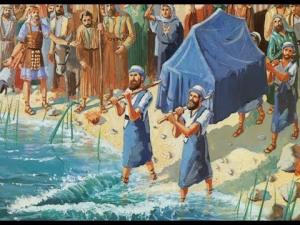
Across the Jordan to the Promised Land
Israel’s journey to the Promised Land is a metaphor for life. So Israel could have hope for the future. Israel combined that hope with justice for the oppressed. God had commanded them to remember when they themselves had been slaves in Egypt.
Episode 11 of the Rowing with Michael Series: A journey through the Jewish/Christian Scriptures in Verse and Commentary. Introduction and Contents for this series HERE.
Michael, row the boat ashore. Alleluia….
- The River Jordan was deep and wide. Alleluia.
- Milk and honey on the other side. Alleluia.
- The river was chilly and the river was cold, Alleluia.
- But the waters parted, so I’ve been told. Alleluia.
I changed a few words in this verse of the spiritual. My version makes you think of history and makes you wonder: Did it really happen? The story says God parted the waters of the Jordan River just like at the Red Sea. But did God really part waters twice, or even once?
The Israelites could have crossed the Jordan on their own without divine help. We don’t need to imagine a miracle every time something impossible or astounding occurs in a Bible story. It could be Israel’s faith interpreting history in the third chapter of Joshua. It could be just the way people remember things. Patterns get imposed on unique events. In this case the pattern might be “in cahoots with nature” or “nature in cahoots with God.” So Israel “remembered” nature assisting them when God willed it. On other occasions they “remembered” nature punishing them when that was God’s will. I think the correctness of the faith is a separate issue from the accuracy of the memory—but not totally separate. After all, Israel put her faith in a God who acts in history.
Journey, a metaphor for life
The original version of the song is poetic. It puts everything in the present—“The River Jordan is (now) chilly and cold.” It makes you think of your own life as a journey to the Promised Land. It makes the whole story of Israel’s journey from Egypt to the Promised Land into a metaphor for life. It’s a well-loved metaphor—life as a journey. It has given hope to oppressed people and meaning when life otherwise seemed to have none. I like it for its sense of adventure. It’s a journey with no coming back, so it’s not like a vacation or even a pilgrimage or vision quest. After any of those journeys you’re back where you started, changed maybe, but still back home.
If life is a journey, then home is a place we’ve never been. Where we are now has names like “exile,” “valley of tears,” a place we are “in” but not “of.” These are pretty much negative descriptions. They answer well to the experience of half of the people on the planet or more, not so well to my own. But I distance myself from my rather comfortable situation and remember that I am in the same category as the poor of the world when I think of life as a journey. God told Israel to remember their journey in the same spirit:
You shall not violate the rights of the alien or of the orphan, nor take the clothing of a widow as a pledge. For, remember, you were once slaves in Egypt, and the LORD, your God, ransomed you from there; that is why I command you to observe this rule. When you reap the harvest in your field and overlook a sheaf there, you shall not go back to get it; let it be for the alien, the orphan or the widow . . . . For remember that you were once slaves in Egypt; that is why I command you to observe this rule. (Deuteronomy 24:17-22)
It doesn’t say “Your ancestors” but “You were once slaves in Egypt.”
Justice and hope
There had passed many generations since the Israelites had become a nation. Israel had more pleasant memories than slavery in Egypt, some more imaginary than real, like this one—
Judah and Israel lived in security, every man under his vine or under his fig tree, from Dan to Beer-sheba, as long as Solomon lived. (1 Kings 5:5)
But they were not owners of the land, or vines and fig trees. Long after they had settled down in the land God had given them, they still could not do with the land or its produce whatever they liked. A farmer could work a particular piece of land for only six years. Then it had to take a “Sabbath” rest, lie fallow for a year. Every 50th year all land that was sold had to return to the family that had owned it originally. The price of land was greater or less depending on the number of years until that “year of restoration.”
Your land must not be sold on a permanent basis, because you do not own it; it belongs to God, and you are like foreigners who are allowed to make use of it. (Leviticus 25:23)
If destitute, Israelites could sell themselves into slavery. Other Israelites could acquire them for service as slaves, provided they observed rules for treating slaves. But it could only be temporary. Slaves, like purchased land, were freed during the year of restoration.
By Jesus’ time the wealthy had figured out ways to get around the letter of the law, as wealthy people generally do. But the idea didn’t die. From the metaphor of a journey an impressive sort of justice and hope sprang up—justice for us who may be resting too comfortably in the feeling of being at home and hope for people whose homelessness is not figurative but real.
Previous Post

June 20, 2018
Exodus and History, Israel's and Ours
Next Post
June 25, 2018 Two Spiritualities of Banking—Dad’s and Wall Street’s
Browse Our Archives
Select a Category Advent Christmas Amazon Synod Angels Being Consumed Bible Catholic Modern Creed Ecology Economics Elizabeth Johnson Eucharist Fragments and Filaments Gender and Sex Gospel of Mark Herzog Historical Jesus Liturgy Luke Opening Scriptures on Way to Emmaus Ordinary radicals Parables Pro-Life Reincarnation Rosary Sacraments science Social Justice Souls Stories of Jesus The Creed Torture and Eucharist Tracy Uncategorized War and Peace
Select a Month October 2026 June 2025 April 2025 March 2025 February 2025 January 2025 November 2024 July 2024 March 2024 December 2023 October 2023 September 2023 August 2023 May 2023 April 2023 March 2023 February 2023 January 2023 December 2022 November 2022 October 2022 September 2022 August 2022 July 2022 June 2022 April 2022 March 2022 February 2022 January 2022 December 2021 November 2021 October 2021 August 2021 July 2021 June 2021 April 2021 March 2021 February 2021 December 2020 November 2020 October 2020 August 2020 July 2020 June 2020 May 2020 April 2020 March 2020 February 2020 January 2020 December 2019 November 2019 October 2019 September 2019 August 2019 July 2019 June 2019 May 2019 April 2019 March 2019 February 2019 January 2019 December 2018 November 2018 October 2018 September 2018 August 2018 July 2018 June 2018 May 2018
Follow Us!
TAKE THE
Religious Wisdom Quiz
In 1 Peter, what does Peter say Christ was chosen before but revealed in when?
Select your answer to see how you score.
Before Abraham was born, revealed at his baptism Before the creation of the world, revealed in these last times Before time began, revealed at the resurrection Before the prophets spoke, revealed at Pentecost
Related posts from Lost in a One-Acre Wood

Credo: A Story of God Told with the...

Richard A. Horsley Sees Jesus in the Context...
“Jesus Wept.” Don’t Take the Humanity out of...

Holy Thursday Theology and the Scientific Quest for...
TRENDING AT PATHEOS Catholic

Creation, Preservation, and Teleology in Catholic Theology
As I write this, it is very early Monday morning. Like millions...

The Parable Of The Sower And The Word...
One of Christ’s most famous parables is that of the sower who...

Rejecting Doom: Christian Hope And Human Action
Christianity is a religion of hope. We are to have hope and...

Why I Choose the Eucharist Over the Sermon
Choose the Eucharist, Not the Sermon What are we supposed to get...

5 Design Elements Found in Spiritually Rooted Homes
Putting Spirituality Into Home Decor Our homes are more than our living...

Credo: A Story of God Told with the...
About 10 years ago, I began to imagine a personal "Credo" that...
view all Catholic blogs
Ad-Free & Subscriber Log-In Subscription Support
- About Us
- 2026 Calendar
- Videos
- Podcasts
- Library of World Religions
- Faith In Media Tracker
- Advertise With Us
- Write for Us
- Privacy Policy
- Terms of Service
- Do Not Sell My Data
- Contact Us
- Radiant Digital
- Manage Newsletter Subscriptions
- Unsubscribe From Notifications
- Sitemap
Copyright 2008-2026, Patheos. All rights reserved.
Subscription Support Ad-Free & Subscriber Log-In
Follow Patheos