
BuddhistCatholicContemplativeEvangelicalGeneral ChristianHinduJewishLatter-day SaintMuslimNew VisionsProgressive Christian
Beliefs
- Buddhist
- Catholic
- Contemplative
- Evangelical
- General Christian
- Hindu
- Jewish
- Latter-day Saint
- More Voices
- Muslim
- New Visions
- Pagan
- Progressive Christian
Topics
- Religion News
- Food and Religion
- Sports and Religion
- Religious Art
- Religious Music and Entertainment
- Religious Events
- History and Religion
- Style and Religion
- Politics and Religion
- Women in Religion
- Recreation Outdoors and Religion
- Business Finance and Religion
- Careers Workplace and Religion
- Education and Religion
- Family Parenting and Religion
- Health Fitness and Religion
- Home and Religion
- Relationships and Religion
- Technology and Religion
- Travel and Religion
Columnists
- Buddhist Columnists
- Business Finance and Religion Columnists
- Careers Workplace and Religion Columnists
- Catholic Columnists
- Contemplative Columnists
- Education and Religion Columnists
- Evangelists Columnists
- Family Parenting and Religion Columnists
- General Christian Columnists
- Health Fitness and Religion Columnists
- Hindu Columnists
- History and Religion Columnists
- Home and Religion Columnists
- Jewish Columnists
- More Voices Columnists
- Latter Day Columnists
- Muslim Columnists
- New Visions Columnists
- Nonreligious Columnists
- Pagan Columnists
- Politics and Religion Columnists
- Progressive Columnists
- Recreation Outdoors and Religion Columnists
- Relationships and Religion Columnists
- Religion News Columnists
- Religious Art Columnists
- Religious Events Columnists
- Religious Music and Entertainment Columnists
- Sports and Religion Columnists
- Style and Religion Columnists
- Technology and Religion Columnists
- Travel and Religion Columnists
- Women in Religion Columnists
Resource Library
- 2026 Calendar
- Library of World Religions
- The 100 Most Holy Places on Earth
- Patheos Answers
- Podcasts
- Videos
- Faith Leaders Database
- Anglican Episcopalian
- Bahai
- Baptist
- Buddhism
- Christianity
- Confucianism
- Eastern Orthodoxy
- Hinduism
- Holiness and Pentecostal
- ISKCON
- Islam
- Judaism
- Lutheran
- Methodist
- The Church of Jesus Christ of Latter-day Saints
- New Age
- Paganism
- Presbytarian and Reformed
- Protestantism
- Religion Behind the Scenes
- Roman Catholic
- Scientology
- Shia Islam
- Sikhism
- Sufism
- Sunni Islam
- Taoism
- Zen
- See all religions
Research Tools
 Ad-Free & Subscriber Log-In Subscription Support
Ad-Free & Subscriber Log-In Subscription Support
Follow Patheos 

- Trending:
- Forgiveness
- |
- Marriage
- |
- Consciousness
- |
- Death Penalty
- |
- Election
- |
- Halloween

- Home
- Catholic
- Exodus and History, Israel’s and Ours
Exodus and History, Israel’s and Ours
Last updated on: February 2, 2020 at 6:54 am by Jack Hartjes
Exodus and History, Israel’s and Ours 2020-02-02T06:54:13-06:00 Jack Hartjes
Patheos Explore the world's faith through different perspectives on religion and spirituality! Patheos has the views of the prevalent religions and spiritualities of the world.
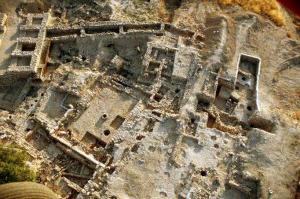
Hazor excavated, a city occupied by early Israelites.
The Bible’s second book, Exodus, tells about Israel’s beginning as a people. Is this a made-up story or real history or something between? What can we say, or guess, from non-biblical sources about Israel’s beginning? How did people in a collapsing civilization around the end of the Bronze Age find a way to go on?
This is Episode 10, Part 2 of the Rowingwith Michael Series: A journey through the Jewish/Christian Scriptures in Verse and Commentary. (See Part 1 here.) Introduction and Contents for this series HERE.
One thing we know for sure. The people who became Israelites found new stories to tell, stories of liberation from a powerful oppressor. From these stories liberation movements have derived life and power down to our present day.
For Christians it is not enough that they be just stories, no matter how inspiring. Christianity, following Judaism, is a historical religion. A scientific theory can forget the history of its discovery and be just as valid. A Confucian ethic is just as ethical if we forget who Confucius was. Buddha’s Eight-fold Path loses none of its power to enlighten if it turns out Buddha never existed. But biblical religion is more than teachings and practices. It lives with its history, past present and future. It presumes that its history is in essential respects true. Christianity is false if its history is false. If Jesus mythers (those who say Jesus’ existence is a myth) are correct, Christianity is not.
Christians share scriptures with Jews. Israel’s history is also Christianity’s. Responsible historical investigators come to a variety of conclusions about events that Jewish and Christian Scriptures relate. Christianity cannot ignore these investigations and ensuing doubts, not and continue to be a religion whose history belongs to its essence.
Investigating Israel’s beginning
The story that I will attempt to tell of Israel’s beginnings does indeed vary from a literal reading of the Book of Exodus, not because I am sure of an alternate story but because historians and archaeologists are pretty sure that much of the story Exodus presents cannot be historical.
Well, let’s draw back from that last statement a little, temporarily only. Nearly a million slaves and their families could have traveled heavily guarded paths out of Egypt, but only with divine assistance. Then that god would have had to make sure such a calamitous event never made it into Egyptian records. The same former slaves could have wandered for forty years in the desert, again with divine assistance. But that god would have had to erase all evidence of that huge company’s desert sojourn. There could be no traces of burial places or garbage heaps. God could have done that, too; but what kind of god is that? One who deliberately makes it look like something that happened never did happen?
I’m content to learn more about the Bible’s story from historians and archaeologists. I take their theories and conclusions under advisement, not as holy writ. In fact, I will make my own guess among possible scenarios. Whichever story one chooses, one still has to connect it the way the Bible tells the story. I will try to do that too. For a Christian history is that important.
Wanderers, slaves, farmers, herders, bandits
The Bible in the Book of Genesis presents Israel’s remote ancestors as wanderers into and out of Canaan and eventually south to Egypt. We know of such wanderings, especially in times of famine. Foreigners lived in Egypt both by choice and by being forced into slavery. We know of no mass uprising and escape of slaves, but we can’t rule out a drifting away of slaves or even a small determined breakout.
On the other end of the story’s geography, we know when and where the Israelites began a somewhat cohesive existence. That was in the 13th century, probably hear its end, in the central, highlands of Palestine. Uncertainty surrounds where these people came from and, especially, why. It’s likely there were farmers from Canaanite cities and villages joined by herders of cattle. Life for these peoples had been getting steadily worse due to rapacious overlords and the same rulers’ lessening ability to safeguard a once thriving economy. A disorganized or falling-apart economy needs even more protection as more people on the fringes take up a life of banditry. We can think of the people who became the Israelites as refugees from economic oppression, possibly joined or even led by these bandits, known by a name, “hapiru,” that even sounds like “Hebrew.”
Can we connect the Bible’s story? The Bible says Israelites invaded. Would a group that was in conflict with other groups over a piece of land tell that kind of story? More likely they’d tell a story that made them residents since time immemorial. That would give them the right to be there. Unless, that is, everyone knew they really were recent invaders from a foreign land.
A foreign name–Yahweh
Perhaps, and only perhaps, the Israelites’ god, if not all or most of the Israelites themselves, did make such an invasion. That god’s name was “Yahweh,” written in Hebrew without the consonants as YHWH. The Midianites, an archeological discovery shows, worshiped a god named YHW. Midian is located close to the route from Egypt to Canaan. In the Bible story Moses hightails it to Midian after killing an Egyptian slave driver. There he marries, has an encounter with a burning bush, and learns God’s name, YHWH.
From what I’ve read scholars don’t yet agree on what to make of this similarity of names. Is it a coincidence? Are the dates wrong? Or is it evidence for the existence of some Moses-like figure in real history, leading what might have been only a small group of slaves from a weakening Egypt and joining with other groups to form the first Israelites?
When they joined up with the new communities forming in Canaan, this hypothetical group would have had quite a story to tell. That story might have evolved to include a miraculous events orchestrated by a new god, Yahweh. It would have been a mixed population that came together around a single group of stories. No tyrant kings for these folks—not yet. That wouldn’t go well with the new stories they had to tell. They were stories of liberation from one sort of oppression or another, political or economic. The highland dwellers at first had no kings and, in fact, not much distinction between rich and poor.
From Exodus written by Carol Meyers for The New Cambridge Bible Commentary
Many archaeologists and biblical scholars thus identify the occupants of the new settlements as Canaanites who left their urban centers to strike out on their own in the hill country. Such movements of people apparently were the result of the profound turmoil at the end of the thirteenth century bce because of collapse of the Late Bronze Age urban culture and the disintegration of Egyptian imperial control over the Levant, to say nothing of extensive drought, famine, and disease. Joined by other similarly affected groups from the coast and the north and perhaps also by some pastoral elements from the east, they became known as Israelites. The relatively isolated villages of the highlands provided a congenial environment for the emergence of a new ethnic identity, with an ideological component acknowledging Yahweh as their god. (page 7)
Of particular interest in light of the story of Moses’ childhood is the Egyptian practice of taking children of vassal rulers as hostage and raising them in elite Egyptian households, as if they were Egyptian children. Some of the Asiatics in Egypt held important positions – as scribes, overseers of building operations, palace butlers, and heralds – in the government, and those with technical skills were valued in artisans’ workshops. But most of the immigrants, especially those brought into Egypt as captive or tribute, worked as menial laborers in state or temple projects. … [S]ometimes groups of foreigners were settled in enclaves, especially in the Delta in the late thirteenth or early twelfth centuries bce, and provide a reasonable parallel to the sojourn depicted in Exodus. (page 9)
[T]he general turmoil at the end of the Nineteenth Dynasty created precisely the kind of weakened Egyptian power that would have occasioned attempts of foreigners to leave Egypt. Moreover, the folklore and local Egyptian color embedded in the [Bible’s] narrative imply familiarity with conditions of this period. (page 10)
If the experience of freedom was the “what” that motivated this process, Moses would have been the “who.” It is not atypical for legendary figures to be part of the “revolution” of new national self- awareness among disparate groups such as would have been part of ancient Israel’s beginnings in the premonarchic and early monarchic periods. (page 15)
[A]cceptance of a new god [named Yahweh], brought in by a small group of refugees from Egypt, led by a charismatic figure convinced that the escape was the result of the will of this new deity who had been encountered in Midian, a new deity with a new narrative of journey and a commitment to freedom, would spread among the highlanders, creating a new collective identity and signifying a distinction from certain aspects of the surrounding culture. (page 15)
Yahweh and liberation
The meaning of the name YHWH is a mystery: “I am who I am” or something like that. It doesn’t tell you much and maybe that’s on purpose. Maybe God really meant, “Don’t ask who I am. Watch what I do.” For these people, when they were strong, the things God did were works of liberation—liberation from old authoritarian patterns and gods of the status quo. This Hebrew God has had that same meaning for oppressed people of many ages and places since. It turns out that the Bible really is about history. It’s about real Israelite history in some vague, imprecise ways, but not just ancient history. People in many places and times have been able to find their own hopes in this Israelite creed:
A wandering soul my father was.
Went down to Egypt just because.
There he became a people great,.
Whom the Egyptians loved to hate.“And the Egyptians treated us harshly, and afflicted us, and laid upon us hard bondage. Then we cried to the Lord the God of our fathers, and the Lord heard our voice, and saw our affliction, our toil, and our oppression. And the Lord brought us out of Egypt with a mighty hand and an outstretched arm with great terror, with signs and wonders. And he brought us into this place and gave us this land, a land flowing with milk and honey.” (Deuteronomy 26:5-9)
Previous Post

June 18, 2018
The Exodus Story and Israel’s Pre-history, Part 1
Browse Our Archives
Select a Category Advent Christmas Amazon Synod Angels Being Consumed Bible Catholic Modern Creed Ecology Economics Elizabeth Johnson Eucharist Fragments and Filaments Gender and Sex Gospel of Mark Herzog Historical Jesus Liturgy Luke Opening Scriptures on Way to Emmaus Ordinary radicals Parables Pro-Life Reincarnation Rosary Sacraments science Social Justice Souls Stories of Jesus The Creed Torture and Eucharist Tracy Uncategorized War and Peace
Select a Month October 2026 June 2025 April 2025 March 2025 February 2025 January 2025 November 2024 July 2024 March 2024 December 2023 October 2023 September 2023 August 2023 May 2023 April 2023 March 2023 February 2023 January 2023 December 2022 November 2022 October 2022 September 2022 August 2022 July 2022 June 2022 April 2022 March 2022 February 2022 January 2022 December 2021 November 2021 October 2021 August 2021 July 2021 June 2021 April 2021 March 2021 February 2021 December 2020 November 2020 October 2020 August 2020 July 2020 June 2020 May 2020 April 2020 March 2020 February 2020 January 2020 December 2019 November 2019 October 2019 September 2019 August 2019 July 2019 June 2019 May 2019 April 2019 March 2019 February 2019 January 2019 December 2018 November 2018 October 2018 September 2018 August 2018 July 2018 June 2018 May 2018
Follow Us!
TAKE THE
Religious Wisdom Quiz
How many books is the Book of Psalms divided into?
Select your answer to see how you score.
Three Seven Ten Five
Related posts from Lost in a One-Acre Wood

Credo: A Story of God Told with the...

Richard A. Horsley Sees Jesus in the Context...
“Jesus Wept.” Don’t Take the Humanity out of...

Holy Thursday Theology and the Scientific Quest for...
TRENDING AT PATHEOS Catholic

Creation, Preservation, and Teleology in Catholic Theology
As I write this, it is very early Monday morning. Like millions...

The Parable Of The Sower And The Word...
One of Christ’s most famous parables is that of the sower who...

Rejecting Doom: Christian Hope And Human Action
Christianity is a religion of hope. We are to have hope and...

Why I Choose the Eucharist Over the Sermon
Choose the Eucharist, Not the Sermon What are we supposed to get...

5 Design Elements Found in Spiritually Rooted Homes
Putting Spirituality Into Home Decor Our homes are more than our living...

Credo: A Story of God Told with the...
About 10 years ago, I began to imagine a personal "Credo" that...
view all Catholic blogs
Ad-Free & Subscriber Log-In Subscription Support
- About Us
- 2026 Calendar
- Videos
- Podcasts
- Library of World Religions
- Faith In Media Tracker
- Advertise With Us
- Write for Us
- Privacy Policy
- Terms of Service
- Do Not Sell My Data
- Contact Us
- Radiant Digital
- Manage Newsletter Subscriptions
- Unsubscribe From Notifications
- Sitemap
Copyright 2008-2026, Patheos. All rights reserved.
Subscription Support Ad-Free & Subscriber Log-In
Follow Patheos