
BuddhistCatholicContemplativeEvangelicalGeneral ChristianHinduJewishLatter-day SaintMuslimNew VisionsProgressive Christian
Beliefs
- Buddhist
- Catholic
- Contemplative
- Evangelical
- General Christian
- Hindu
- Jewish
- Latter-day Saint
- More Voices
- Muslim
- New Visions
- Pagan
- Progressive Christian
Topics
- Religion News
- Food and Religion
- Sports and Religion
- Religious Art
- Religious Music and Entertainment
- Religious Events
- History and Religion
- Style and Religion
- Politics and Religion
- Women in Religion
- Recreation Outdoors and Religion
- Business Finance and Religion
- Careers Workplace and Religion
- Education and Religion
- Family Parenting and Religion
- Health Fitness and Religion
- Home and Religion
- Relationships and Religion
- Technology and Religion
- Travel and Religion
Columnists
- Buddhist Columnists
- Business Finance and Religion Columnists
- Careers Workplace and Religion Columnists
- Catholic Columnists
- Contemplative Columnists
- Education and Religion Columnists
- Evangelists Columnists
- Family Parenting and Religion Columnists
- General Christian Columnists
- Health Fitness and Religion Columnists
- Hindu Columnists
- History and Religion Columnists
- Home and Religion Columnists
- Jewish Columnists
- More Voices Columnists
- Latter Day Columnists
- Muslim Columnists
- New Visions Columnists
- Nonreligious Columnists
- Pagan Columnists
- Politics and Religion Columnists
- Progressive Columnists
- Recreation Outdoors and Religion Columnists
- Relationships and Religion Columnists
- Religion News Columnists
- Religious Art Columnists
- Religious Events Columnists
- Religious Music and Entertainment Columnists
- Sports and Religion Columnists
- Style and Religion Columnists
- Technology and Religion Columnists
- Travel and Religion Columnists
- Women in Religion Columnists
Resource Library
- 2026 Calendar
- Library of World Religions
- The 100 Most Holy Places on Earth
- Patheos Answers
- Podcasts
- Videos
- Faith Leaders Database
- Anglican Episcopalian
- Bahai
- Baptist
- Buddhism
- Christianity
- Confucianism
- Eastern Orthodoxy
- Hinduism
- Holiness and Pentecostal
- ISKCON
- Islam
- Judaism
- Lutheran
- Methodist
- The Church of Jesus Christ of Latter-day Saints
- New Age
- Paganism
- Presbytarian and Reformed
- Protestantism
- Religion Behind the Scenes
- Roman Catholic
- Scientology
- Shia Islam
- Sikhism
- Sufism
- Sunni Islam
- Taoism
- Zen
- See all religions
Research Tools
 Ad-Free & Subscriber Log-In Subscription Support
Ad-Free & Subscriber Log-In Subscription Support
Follow Patheos 

- Trending:
- Forgiveness
- |
- Marriage
- |
- Consciousness
- |
- Death Penalty
- |
- Election
- |
- Halloween

- Home
- Catholic
- Abraham: What Kind of Story is He Father of?
Abraham: What Kind of Story is He Father of?
Last updated on: November 16, 2020 at 3:14 pm by Jack Hartjes
Abraham: What Kind of Story is He Father of? 2020-11-16T15:14:53-06:00 Jack Hartjes
Patheos Explore the world's faith through different perspectives on religion and spirituality! Patheos has the views of the prevalent religions and spiritualities of the world.
Is 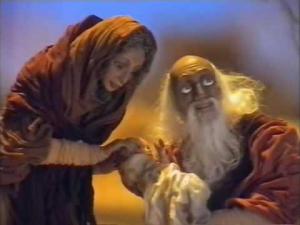 Abraham an imaginary figure or a historical person? If historical, what does a Catholic make of the fantastic stories the Bible tells about him. What can the rest of the world make of the god of Abraham?
Episode 7 of the Rowing with Michael Series: A journey through the Jewish/Christian Scriptures in Verse and Commentary. Introduction and Contents for this series HERE.
Michael, row the boat ashore. Alleluia….
- Abraham was as good as dead. Alleluia.
- Still he believed what the Lord had said. Alleluia.
- Sarah laughed when she heard the news. Alleluia.
- “We’re gonna need diapers and baby shoes.” Alleluia.
Catholic Bible scholars are fairly unanimous in characterizing the stories in the first 11 chapters of Genesis—Creation, the Fall of Adam and Eve, the Flood, the Tower of Babel. There may be mythical elements in some of them, but they are not just myths. They are, however, stories, made up by anonymous story-tellers or anonymous writers. Some may have originated in Israel, earlier or later in that nation’s history, some may have started in other cultures and been borrowed and adapted by Israelites. The long and the short of it is that they are fiction.
The same unanimity among scholars does not persist through the rest of Genesis. There is a great deal of uncertainty about how to describe the stories of the patriarchs, starting with Abraham. Was Abraham a real person? What about the other patriarchs? The Catechism of the Catholic Church acknowledges the uncertainty in these words:
Given the lack of decisive evidence, it is reasonable to accept the Bible’s own chronology [and] that the patriarchs were the ancestors of Israel. (U.S. Catholic bishops on Genesis)
In other words, the traditional view is “reasonable.” It is not demanded of Catholics who want to investigate further. In fact, the traditional view is not accepted by all Catholic scholars. I won’t be taking a position on this issue, but a related decision seems necessary. I think one must take many of the stories of the patriarchs, as opposed to their existence, as legendary tales with no or scant basis in historical fact.
Was Abraham really 100 years old when he and Sarah had their first child? Did Abraham really hear God telling him to offer Isaac in sacrifice? Did Abraham really almost successfully argue God out of destroying Sodom? Doubts about all these and more are well within the bounds of Catholic teaching about the Bible.
The Bible is a human as well as a divine product. The ways of humans are not always easy to figure out, but we know memory is imperfect, stories get exaggerated, details get added, and whole made-up stories can, after a time, come to seem real. It has happened in our country’s history—witness the made-up story of George Washington and the cherry tree (a morality tale that in my youth I learned as history) or the ride of Paul Revere (history that morphed into an inspirational lesson). There’s every reason to suspect that the same transformation of stories into seeming history happened also in the formation of the Bible.
What exactly is revelation?
Jews and Christians believe that God acted in history. Their religion is not just ideas about God and some moral expectations but a story in which God is the main character. The connection between the story and actual history is always an important question, so scholars undertake the difficult work of uncovering history from the traditions.
Believers can always bypass this difficulty by saying that God gave either the storytellers or the writers some supernatural help so we end up with a product that is “inerrant” (as the technical word goes) and actually beyond human ability to produce. That’s a common enough view of what revelation is, but I think most Protestant and Catholic scholars, except fundamentalists, reject it. The Catholic Church says God works within, not outside of or against, people’s human, God-given abilities.
How does a Catholic find history in the pages of the Bible? Since there is both story and history in the Bible, it’s one of the businesses of scholars to tell the two apart. Most scholars agree that this can be done, though imperfectly and with varying degrees of probability. We can detect a historical core in many of the stories. Even with the uncertainty in telling story and history apart, we can say that both are interpretations of real events in the light of the faith of indisputably real people.
That last point means there is history throughout even in the storytelling, but it also means that we never, even in the most historical writings, get history straight. It’s always history interpreted, history colored by the demands of faith. It’s exactly the way people all over, until fairly recently, have written and told their histories, whether sacred or not. I like to say God is OK with that.
Historical fiction
So the Israelites’ story of salvation begins with Abraham, a kind of historical fiction, if you will. And it’s historical fiction whether or not Abraham was real. As a religious story, it’s still quite distinctive. It’s not a myth, taking place in some aboriginal or dream time. It is set very deliberately in human history, around 8 or 9 hundred years before King David (a verifiable historical figure). Here time, place, and particular individuals and groups are important.
Abraham is not just another symbol standing for humanity in general, like those we find in the first 11 chapters of Genesis. The story of Abraham leads through definite times and places to the history of the Israelite/Jewish people and the Christians and Muslims too. The rest of the world does come into the story. God says that by Abraham and his descendants “all the families of the earth will bless themselves.” When parents bless their children they’ll say, “May you be like Abraham and Sarah, Ruth, David,” etc.
People ask: Why should the rest of the world bless themselves in the name of these people or even Jesus? There are other worthy heroes. Why not “May you be like Socrates, Buddha, or Confucius”? The Bible says God’s involvement in human history is particular. It starts in one time and place and reaches out from there to include everyone everywhere. Is it fair that God should lavish special attention on one small group of people?
Intellectually it’s weird. You can’t reason to such a God from general principles or universal human experience. But I find it very much like human love. There’s no such thing as love of everybody in general. It has to be particular and reach out from there. I can warm up to a god who becomes available in history slowly and haltingly, depending on often-erring men and women. A god anyone could reach independently of time and place—the way a scientific law has to apply “fairly” throughout space and time—would be intellectually satisfying and interesting, I suppose. The god of Deism is interesting, but I wouldn’t love such a God. And, anyway, it wouldn’t make a very good story.
Previous Post

June 4, 2018
Babel’s Ecological Warning
Next Post
June 8, 2018 “Sex Positive” and Ways to Play with a Truck
Browse Our Archives
Select a Category Advent Christmas Amazon Synod Angels Being Consumed Bible Catholic Modern Creed Ecology Economics Elizabeth Johnson Eucharist Fragments and Filaments Gender and Sex Gospel of Mark Herzog Historical Jesus Liturgy Luke Opening Scriptures on Way to Emmaus Ordinary radicals Parables Pro-Life Reincarnation Rosary Sacraments science Social Justice Souls Stories of Jesus The Creed Torture and Eucharist Tracy Uncategorized War and Peace
Select a Month October 2026 June 2025 April 2025 March 2025 February 2025 January 2025 November 2024 July 2024 March 2024 December 2023 October 2023 September 2023 August 2023 May 2023 April 2023 March 2023 February 2023 January 2023 December 2022 November 2022 October 2022 September 2022 August 2022 July 2022 June 2022 April 2022 March 2022 February 2022 January 2022 December 2021 November 2021 October 2021 August 2021 July 2021 June 2021 April 2021 March 2021 February 2021 December 2020 November 2020 October 2020 August 2020 July 2020 June 2020 May 2020 April 2020 March 2020 February 2020 January 2020 December 2019 November 2019 October 2019 September 2019 August 2019 July 2019 June 2019 May 2019 April 2019 March 2019 February 2019 January 2019 December 2018 November 2018 October 2018 September 2018 August 2018 July 2018 June 2018 May 2018
Follow Us!
TAKE THE
Religious Wisdom Quiz
A gentle answer turns away wrath, but harsh words stir up what?
Select your answer to see how you score.
Trouble Strife Anger Hatred
Related posts from Lost in a One-Acre Wood

Credo: A Story of God Told with the...

Richard A. Horsley Sees Jesus in the Context...
“Jesus Wept.” Don’t Take the Humanity out of...

Holy Thursday Theology and the Scientific Quest for...
TRENDING AT PATHEOS Catholic

Creation, Preservation, and Teleology in Catholic Theology
As I write this, it is very early Monday morning. Like millions...

The Parable Of The Sower And The Word...
One of Christ’s most famous parables is that of the sower who...

Rejecting Doom: Christian Hope And Human Action
Christianity is a religion of hope. We are to have hope and...

Why I Choose the Eucharist Over the Sermon
Choose the Eucharist, Not the Sermon What are we supposed to get...

5 Design Elements Found in Spiritually Rooted Homes
Putting Spirituality Into Home Decor Our homes are more than our living...

Credo: A Story of God Told with the...
About 10 years ago, I began to imagine a personal "Credo" that...
view all Catholic blogs
Ad-Free & Subscriber Log-In Subscription Support
- About Us
- 2026 Calendar
- Videos
- Podcasts
- Library of World Religions
- Faith In Media Tracker
- Advertise With Us
- Write for Us
- Privacy Policy
- Terms of Service
- Do Not Sell My Data
- Contact Us
- Radiant Digital
- Manage Newsletter Subscriptions
- Unsubscribe From Notifications
- Sitemap
Copyright 2008-2026, Patheos. All rights reserved.
Subscription Support Ad-Free & Subscriber Log-In
Follow Patheos