
BuddhistCatholicContemplativeEvangelicalGeneral ChristianHinduJewishLatter-day SaintMuslimNew VisionsProgressive Christian
Beliefs
- Buddhist
- Catholic
- Contemplative
- Evangelical
- General Christian
- Hindu
- Jewish
- Latter-day Saint
- More Voices
- Muslim
- New Visions
- Pagan
- Progressive Christian
Topics
- Religion News
- Food and Religion
- Sports and Religion
- Religious Art
- Religious Music and Entertainment
- Religious Events
- History and Religion
- Style and Religion
- Politics and Religion
- Women in Religion
- Recreation Outdoors and Religion
- Business Finance and Religion
- Careers Workplace and Religion
- Education and Religion
- Family Parenting and Religion
- Health Fitness and Religion
- Home and Religion
- Relationships and Religion
- Technology and Religion
- Travel and Religion
Columnists
- Buddhist Columnists
- Business Finance and Religion Columnists
- Careers Workplace and Religion Columnists
- Catholic Columnists
- Contemplative Columnists
- Education and Religion Columnists
- Evangelists Columnists
- Family Parenting and Religion Columnists
- General Christian Columnists
- Health Fitness and Religion Columnists
- Hindu Columnists
- History and Religion Columnists
- Home and Religion Columnists
- Jewish Columnists
- More Voices Columnists
- Latter Day Columnists
- Muslim Columnists
- New Visions Columnists
- Nonreligious Columnists
- Pagan Columnists
- Politics and Religion Columnists
- Progressive Columnists
- Recreation Outdoors and Religion Columnists
- Relationships and Religion Columnists
- Religion News Columnists
- Religious Art Columnists
- Religious Events Columnists
- Religious Music and Entertainment Columnists
- Sports and Religion Columnists
- Style and Religion Columnists
- Technology and Religion Columnists
- Travel and Religion Columnists
- Women in Religion Columnists
Resource Library
- 2026 Calendar
- Library of World Religions
- The 100 Most Holy Places on Earth
- Patheos Answers
- Podcasts
- Videos
- Faith Leaders Database
- Anglican Episcopalian
- Bahai
- Baptist
- Buddhism
- Christianity
- Confucianism
- Eastern Orthodoxy
- Hinduism
- Holiness and Pentecostal
- ISKCON
- Islam
- Judaism
- Lutheran
- Methodist
- The Church of Jesus Christ of Latter-day Saints
- New Age
- Paganism
- Presbytarian and Reformed
- Protestantism
- Religion Behind the Scenes
- Roman Catholic
- Scientology
- Shia Islam
- Sikhism
- Sufism
- Sunni Islam
- Taoism
- Zen
- See all religions
Research Tools
 Ad-Free & Subscriber Log-In Subscription Support
Ad-Free & Subscriber Log-In Subscription Support
Follow Patheos 

- Trending:
- Forgiveness
- |
- Marriage
- |
- Consciousness
- |
- Death Penalty
- |
- Election
- |
- Halloween

- Home
- Catholic
- Babel’s Ecological Warning
Babel’s Ecological Warning
Last updated on: November 16, 2020 at 3:06 pm by Jack Hartjes
Babel’s Ecological Warning 2020-11-16T15:06:05-06:00 Jack Hartjes
Patheos Explore the world's faith through different perspectives on religion and spirituality! Patheos has the views of the prevalent religions and spiritualities of the world.
*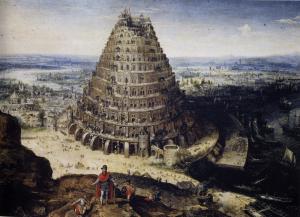 *The Tower of Babel was meant to reach the sky. This post explains what a scary prospect that is and draws parallels with some of our frightening technological possibilities today.
Episode 6 of the Rowing with Michael Series: A journey through the Jewish/Christian Scriptures in Verse and Commentary. Introduction and Contents for this series HERE.
Michael, row the boat ashore. Alleluia….
- The Tower of Babel was rising high. Alleluia.
- People bragged they would reach the sky. Alleluia.
- All at once the Lord came down, Alleluia.
- Scattered those babblers all around. Alleluia.
“Baby,” “babbling,” “Tower of Babel”
Daughter Marit and two grandchildren were visiting and Marit asked three-year-old Stella to sing for baby Dominic. So she did. She sang the ABC song and “Ba Ba Black Sheep” and then another song. I think this one was called “Hanna Bressa Waresah, Hanna Wasa Du.” That’s a language that I have forgotten how to speak. It shows the connection between “baby” and “babble,” though.
The dictionary says “babble” started out as a repetition of the babyish syllable “ba.” I always thought these words came from the Bible’s story of the Tower of Babel, but the Online Etymology Dictionary says, “No direct connection with Babel can be traced.”
The series of stories in the Bible up to and including this one follow a definite theme: God’s creation is good, but humankind introduces evil into the world. And this evil is steadily increasing. Funny thing is there’s hardly a clue as to just what these evil things that we keep doing are. There’s the disobedience of Adam and Eve, of course; but it’s not as though eating a piece of fruit in itself is evil. Then came the first murder. Other than that all we hear is something like “The Lord saw that the wickedness of man was great in the earth, and that every imagination of the thoughts of his heart was only evil continually.” It’s like being brought to trial without being told what the charges are.
The sin of pride
Maybe the story is telling us we’re not so dumb. We know what we’re doing wrong. At any rate, the Babel story finally specifies one charge: Folks are building a tower. How terrible! God seems to be condemning qualities that we value highly today—ingenuity and accomplishment. We shoot a rocket clear out of the Solar System, but God gets upset when the Babylonians build a tower to the sky.
I mention the Babylonians because the prototype for the Tower of Babel story may have been one of the ziggurats, pyramid-like structures found in the area around the Tigris and Euphrates Rivers. There was one in the city of Babylon. These people had no intention of reaching the sky. The ziggurats were meant as a place where a god could come down and stay awhile. If there was any pride in it, it was about the same as the pride the Israelites justly took in their temple.
But pride was the sin of the tower builders as the story comes down and as it’s been understood traditionally. They wanted to “make a name for ourselves.” The storyteller might have mentioned at the start that any resemblance between characters in the story and real Babylonians is purely coincidental. The Bible story isn’t about any particular individuals but all of us.
The scary part
I suspect the Israelites might have seen another side to the sin of building this tower “with its top in the heavens.” And there are frightening parallels in today’s world. We now know that we could create a “nuclear winter” and wipe out most higher forms of life in a nuclear war. Global warming, left unchecked, can be nearly as ruinous. And there are powers scientists are now gaining over the building blocks of life. We can modify genetics, maybe even someday engineer a new type of human, or a new disease, or create life from scratch. What human accomplishment could scare an ancient Israelite as badly as some technologies scare people today? A tower to the sky could.
Part of the appeal of the Tower of Babel story, as ancient Israelites told and retold it around evening campfires—I’m guessing now—is that it wasn’t just a morality tale about evil, prideful people. It was a delightfully scary story. It must have set impressionable minds to imagining all sorts of terrible possibilities. A look at Israelite science explains.
The sky according to the worldview of peoples in the ancient Near East is an upside down bowl fitted down tightly over the earth, holding out the water that completely surrounds us. The sun, moon, planets, and stars travel around the inside surface of this bowl. The sun and moon, of course, have a lot of influence down here on earth. Most ancient people believed that the stars and planets did, too. Scattered around the bowl are floodgates so God can let down just the right amount of water from above the firmament.
Now imagine a band of humans have just built a tower to the sky. Imagine that once there they can maneuver around this bowl. They might open the floodgates and flood the world again just so a few could have it all to themselves. They could change the courses of the lights in the sky, messing around with the cycles of life below. No wonder God says, as he sees this tower going up
If now, while they are one people, all speaking the same language, they have started to do this, nothing will later stop them from doing whatever they presume to do. (Genesis 11:6)
Humankind, having climbed outside and above nature, would have no limits. Back then some people knew that was a disastrous situation. I’m hoping it’s not too late to relearn what God’s people knew long ago. God is not going to come down and stop us from doing whatever we propose to do, as he does in the Tower of Babel story.
A look back and ahead
With the Tower of Babel we’ve come to the end of the introduction to the main theme of the whole Bible. The first 11 chapters of the Book of Genesis set the stage for the rest of the Bible story. They specify the relevant characteristics, according to Israelite belief, of the world in which God acts—a world where sin abounds and which, left to itself, is completely hopeless. This introduction to the Bible story says in no uncertain terms: God is our only hope.
These are stories. The real world was never completely hopeless. God never actually left the world on its own. The whole series from the Fall to the Tower of Babel, especially the last story, expresses in a creative way what the Israelites believed the world would be like without God and God’s mercy toward the world.
This last story is unlike the others. It doesn’t have a happy ending or even a moderately hopeful one. All the previous stories do. God drives Adam and Eve out of the garden, but at the end he makes some new clothes for them to wear. Then God sends Cain into exile for killing his brother but gives him a mark to protect him. Later God destroys the world by flood, but he saves one family and all the animal species. And God makes the rainbow, a sign that he won’t do it again.
In the story of the Tower of Babel, God prevents the building of the tower, and scatters the people all over the earth amidst a din of babbling voices. And that’s all the grace there is in this story, though it’s grace indeed. As a line from C. S. Lewis (in That Hideous Strength) explains, mercy imposes a limitation on man’s power “as a protection from the full results of his fall.” It’s a negative kind of saving grace and a marvelous bit of story-telling restraint. The real saving grace, which we call Salvation History, is about to begin—in the very next chapter of the book of Genesis.
- Now the introduction’s done.
- Salvation’s story has begun.
Previous Post

June 1, 2018
Climate Change for the Conservative Temperament
Next Post
June 6, 2018 Abraham: What Kind of Story is He Father of?
Browse Our Archives
Select a Category Advent Christmas Amazon Synod Angels Being Consumed Bible Catholic Modern Creed Ecology Economics Elizabeth Johnson Eucharist Fragments and Filaments Gender and Sex Gospel of Mark Herzog Historical Jesus Liturgy Luke Opening Scriptures on Way to Emmaus Ordinary radicals Parables Pro-Life Reincarnation Rosary Sacraments science Social Justice Souls Stories of Jesus The Creed Torture and Eucharist Tracy Uncategorized War and Peace
Select a Month October 2026 June 2025 April 2025 March 2025 February 2025 January 2025 November 2024 July 2024 March 2024 December 2023 October 2023 September 2023 August 2023 May 2023 April 2023 March 2023 February 2023 January 2023 December 2022 November 2022 October 2022 September 2022 August 2022 July 2022 June 2022 April 2022 March 2022 February 2022 January 2022 December 2021 November 2021 October 2021 August 2021 July 2021 June 2021 April 2021 March 2021 February 2021 December 2020 November 2020 October 2020 August 2020 July 2020 June 2020 May 2020 April 2020 March 2020 February 2020 January 2020 December 2019 November 2019 October 2019 September 2019 August 2019 July 2019 June 2019 May 2019 April 2019 March 2019 February 2019 January 2019 December 2018 November 2018 October 2018 September 2018 August 2018 July 2018 June 2018 May 2018
Follow Us!
TAKE THE
Religious Wisdom Quiz
Who fell out of a window and was restored to life by Paul?
Select your answer to see how you score.
Timothy Barnabas Silas Eutychus
Related posts from Lost in a One-Acre Wood

Credo: A Story of God Told with the...

Richard A. Horsley Sees Jesus in the Context...
“Jesus Wept.” Don’t Take the Humanity out of...

Holy Thursday Theology and the Scientific Quest for...
TRENDING AT PATHEOS Catholic

Creation, Preservation, and Teleology in Catholic Theology
As I write this, it is very early Monday morning. Like millions...

The Parable Of The Sower And The Word...
One of Christ’s most famous parables is that of the sower who...

Rejecting Doom: Christian Hope And Human Action
Christianity is a religion of hope. We are to have hope and...

Why I Choose the Eucharist Over the Sermon
Choose the Eucharist, Not the Sermon What are we supposed to get...

5 Design Elements Found in Spiritually Rooted Homes
Putting Spirituality Into Home Decor Our homes are more than our living...

Credo: A Story of God Told with the...
About 10 years ago, I began to imagine a personal "Credo" that...
view all Catholic blogs
Ad-Free & Subscriber Log-In Subscription Support
- About Us
- 2026 Calendar
- Videos
- Podcasts
- Library of World Religions
- Faith In Media Tracker
- Advertise With Us
- Write for Us
- Privacy Policy
- Terms of Service
- Do Not Sell My Data
- Contact Us
- Radiant Digital
- Manage Newsletter Subscriptions
- Unsubscribe From Notifications
- Sitemap
Copyright 2008-2026, Patheos. All rights reserved.
Subscription Support Ad-Free & Subscriber Log-In
Follow Patheos