
BuddhistCatholicContemplativeEvangelicalGeneral ChristianHinduJewishLatter-day SaintMuslimNew VisionsProgressive Christian
Beliefs
- Buddhist
- Catholic
- Contemplative
- Evangelical
- General Christian
- Hindu
- Jewish
- Latter-day Saint
- More Voices
- Muslim
- New Visions
- Pagan
- Progressive Christian
Topics
- Religion News
- Food and Religion
- Sports and Religion
- Religious Art
- Religious Music and Entertainment
- Religious Events
- History and Religion
- Style and Religion
- Politics and Religion
- Women in Religion
- Recreation Outdoors and Religion
- Business Finance and Religion
- Careers Workplace and Religion
- Education and Religion
- Family Parenting and Religion
- Health Fitness and Religion
- Home and Religion
- Relationships and Religion
- Technology and Religion
- Travel and Religion
Columnists
- Buddhist Columnists
- Business Finance and Religion Columnists
- Careers Workplace and Religion Columnists
- Catholic Columnists
- Contemplative Columnists
- Education and Religion Columnists
- Evangelists Columnists
- Family Parenting and Religion Columnists
- General Christian Columnists
- Health Fitness and Religion Columnists
- Hindu Columnists
- History and Religion Columnists
- Home and Religion Columnists
- Jewish Columnists
- More Voices Columnists
- Latter Day Columnists
- Muslim Columnists
- New Visions Columnists
- Nonreligious Columnists
- Pagan Columnists
- Politics and Religion Columnists
- Progressive Columnists
- Recreation Outdoors and Religion Columnists
- Relationships and Religion Columnists
- Religion News Columnists
- Religious Art Columnists
- Religious Events Columnists
- Religious Music and Entertainment Columnists
- Sports and Religion Columnists
- Style and Religion Columnists
- Technology and Religion Columnists
- Travel and Religion Columnists
- Women in Religion Columnists
Resource Library
- 2026 Calendar
- Library of World Religions
- The 100 Most Holy Places on Earth
- Patheos Answers
- Podcasts
- Videos
- Faith Leaders Database
- Anglican Episcopalian
- Bahai
- Baptist
- Buddhism
- Christianity
- Confucianism
- Eastern Orthodoxy
- Hinduism
- Holiness and Pentecostal
- ISKCON
- Islam
- Judaism
- Lutheran
- Methodist
- The Church of Jesus Christ of Latter-day Saints
- New Age
- Paganism
- Presbytarian and Reformed
- Protestantism
- Religion Behind the Scenes
- Roman Catholic
- Scientology
- Shia Islam
- Sikhism
- Sufism
- Sunni Islam
- Taoism
- Zen
- See all religions
Research Tools
 Ad-Free & Subscriber Log-In Subscription Support
Ad-Free & Subscriber Log-In Subscription Support
Follow Patheos 

- Trending:
- Forgiveness
- |
- Marriage
- |
- Consciousness
- |
- Death Penalty
- |
- Election
- |
- Halloween

- Home
- Catholic
- Climate Change for the Conservative Temperament
Climate Change for the Conservative Temperament
Last updated on: April 29, 2019 at 8:20 am by Jack Hartjes
Climate Change for the Conservative Temperament 2019-04-29T08:20:28-06:00 Jack Hartjes
Patheos Explore the world's faith through different perspectives on religion and spirituality! Patheos has the views of the prevalent religions and spiritualities of the world.
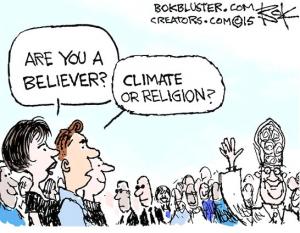 My last post was about rising seas (Noah and the Flood). The next one will be about technology’s dangers (the Tower of Babel). Both of them put me in mind of the theme for today’s break from the “Rowing through the Old Testament” series.
Climate change is real, caused by human activity, and a serious threat. That’s the majority opinion in the world today. Many conservatives, including religious conservatives, don’t but it. This post explores my puzzlement about the connection between conservatism and climate-change denial.
Religious voices encouraging action on climate change are being heard in greater numbers and with greater frequency. (See here (the Vatican), here (some 20 Protestant leaders), and here (500 religious leaders and scientists of Massachusetts). It’s time to address a phenomenon that has me puzzled. Why are so many conservatives, especially religious conservatives, taking a wait-and-see or even a denial position on climate change? In this post I address just such a conservative with what, to me, seems to be entirely conservative reasoning.
Can the fading, but still significant, connection between climate change denial and conservatism generally or conservative religion in particular be broken completely. Perhaps not for one friend, who has been pastor of the local Assembly of God Church. He holds that the Bible is inerrant in every respect. He’s a “young-earth creationist.” He believes the universe was created about 6000 years ago. That rules out the theory of evolution, which is at the heart of modern science. For him doubting science’s conclusions about climate is easy, especially since some of the evidence for climate change comes from studies of how the climate has changed over much more than 6000 years.
Most conservative Christians are not young earth creationists. Still there is a marked correlation between conservative Christianity and climate change denial. (But check out this online article,” where Brian McCammack sees much more diversity among rank and file Evangelicals than their leadership would indicate.) And that’s strange. How strange I hope to show by looking at the conservative temperament and applying what I see to climate change.
Here’s an unscientific, but I think fair, list of conservative attitudes:
- A preference for stability. Change is OK if it’s gradual and well thought out.
- A belief in truth, even absolute truth, and our ability to know the truth.
- An inclination to accept authority. This doesn’t exclude questioning, and it doesn’t have to mean submissiveness.
- A style of living that emphasizes prudence as opposed to risk taking.
- In this country a commitment to capitalism with minimal government interference and a high regard for individual freedom, especially concerning property rights.
- A sense that responsibility for others starts close to home.
Taken together these attitudes should support a person’s acceptance of the science on climate change. Let’s look at them more closely.
- Preference for stability. Climate change is quite possibly the most destabilizing factor in the world today. Of course, this matters not at all if climate change isn’t real, so we go on.
- Belief in truth and our ability to know it. A conservative person is the last one to say, “You have your truth and I have mine.” The facts about climate change are public and publicly available. But disagreements to arise, so where does a conservative turn?
- Acceptance of authority. I’m assuming a conservative who is not the world’s foremost expert on climate. An authoritative source is important for that person—and for me. Not everyone’s opinion is equal for a conservative. A conservative listens to the best informed opinions. When that’s hard to determine, a conservative follows the majority opinion among authorities as at least more probably right, recognizing that it could be wrong.
Here the real strangeness with conservatives and climate change comes out. The scientific authorities are in almost unanimous agreement. There are near unanimous agreements among other authorities as well. World governments have all signed on to the Paris Climate Agreement with only one major exception and that only since last year. Religions, have largely sided with the governments and the scientists. These include Judaism, Buddhism, Hinduism, Islam, and most of Christianity. The last three popes and the American Catholic bishops as well as bishops worldwide; the World Council of Churches and most Protestant denominations including the theologically conservative Southern Baptists; the Eastern Orthodox Churches—all of these have statements supporting the theory of climate change and calling for action. Even the oil companies officially accept the science of climate change, though their actions speak louder than their intra-company e-mails. And insurance companies are worrying about big payouts due to climate change. If authority means anything to a conservative, this amount of authority ought to be enough.
- The virtue of prudence. Still there’s no denying that authority can be wrong, even when it’s unanimous. The American Catholic bishops, as far back as the 1970’s, had the correct conservative advice at a time when climate science was in its infancy. The bishops appealed to the conservative virtue of prudence. The probabilities of the worst effects of climate change were not clear then, but the danger was great enough that the bishops said it was morally necessary to be prudent, to act even without certain knowledge. As everyone knows, we did not act. We were not conservative enough, and now it’s very late.
- Capitalism. What passes for a conservative view on the American economy is capitalism in a substantially unguided form. This economy is responsible for the most rapid and radical changes a society has ever seen. It’s been anything but gradual and well thought out. For truth, which ought to be susceptible to evidence, we’ve substituted a number of myths: More is better; progress is inevitable; wealth trickles down, an “invisible hand” guides individual selfish decisions, and “We’re just satisfying customer demand.” No authority can tell such an economy what to do, regardless of social or environmental harm that may accrue. Prudence, especially in the form of thrift, is the enemy to that economy’s most efficient functioning. This is a much too profligate “conservatism,” and easily recognizable as a major contributor to climate change.
- Responsibility. Two important concepts in Catholic social justice are subsidiarity and solidarity. Subsidiarity means dealing with problems at the smallest, most local level possible. That goes nicely with the conservative sense that responsibility for others starts close to home. If there’s any problem that does not fit well into that scheme, it’s global warming. Solidarity extends the reach of our concern to larger communities and the entire world. Solidarity means we act not only as individuals but also as communities, nations, and even, when necessary, the worldwide community of nations. We navigate between subsidiarity and solidarity by a traditional principle that I think conservatives and liberals can accept: Virtue stands in the middle, or the Golden Mean. One can’t go all out with either subsidiarity or solidarity. There are times when local action is required, and there are times when governments and even international institutions need to act. Prudence and an eye for what’s real and true help us know the difference. Neither of those qualities is especially liberal.
Conclusion: Climate change and conservatism are a natural fit. If anybody ought to be on board with climate change, it’s a conservative.
Image credit: Science Matters, WordPress.com
Previous Post

May 30, 2018
Noah’s Story: A World Saved and All the More Precious
Next Post
June 4, 2018 Babel’s Ecological Warning
Browse Our Archives
Select a Category Advent Christmas Amazon Synod Angels Being Consumed Bible Catholic Modern Creed Ecology Economics Elizabeth Johnson Eucharist Fragments and Filaments Gender and Sex Gospel of Mark Herzog Historical Jesus Liturgy Luke Opening Scriptures on Way to Emmaus Ordinary radicals Parables Pro-Life Reincarnation Rosary Sacraments science Social Justice Souls Stories of Jesus The Creed Torture and Eucharist Tracy Uncategorized War and Peace
Select a Month October 2026 June 2025 April 2025 March 2025 February 2025 January 2025 November 2024 July 2024 March 2024 December 2023 October 2023 September 2023 August 2023 May 2023 April 2023 March 2023 February 2023 January 2023 December 2022 November 2022 October 2022 September 2022 August 2022 July 2022 June 2022 April 2022 March 2022 February 2022 January 2022 December 2021 November 2021 October 2021 August 2021 July 2021 June 2021 April 2021 March 2021 February 2021 December 2020 November 2020 October 2020 August 2020 July 2020 June 2020 May 2020 April 2020 March 2020 February 2020 January 2020 December 2019 November 2019 October 2019 September 2019 August 2019 July 2019 June 2019 May 2019 April 2019 March 2019 February 2019 January 2019 December 2018 November 2018 October 2018 September 2018 August 2018 July 2018 June 2018 May 2018
Follow Us!
TAKE THE
Religious Wisdom Quiz
Why did Jesus often use parables?
Select your answer to see how you score.
To confuse listeners To entertain only To show off To reveal truths to those open to God
Related posts from Lost in a One-Acre Wood

Global Warming, Glaciers, and Nearly Silent Catholic Wisdom

Norman Wirzba Roots Humanity in a Sacred World
Faith Leaders on Climate Change: “Future Generations Will...

BirthStrike Movement to Dissolve Next Week
TRENDING AT PATHEOS Catholic

Rejecting Doom: Christian Hope And Human Action
Christianity is a religion of hope. We are to have hope and...

It’s What Comes From Within Which Matters
One of the most difficult things for us to understand is why...

Why I Choose the Eucharist Over the Sermon
Choose the Eucharist, Not the Sermon What are we supposed to get...

5 Design Elements Found in Spiritually Rooted Homes
Putting Spirituality Into Home Decor Our homes are more than our living...

Credo: A Story of God Told with the...
About 10 years ago, I began to imagine a personal "Credo" that...

The Anatomy of Divine Revelation in Catholic Thought
The claim that God has made Himself known to human beings is...
view all Catholic blogs
Ad-Free & Subscriber Log-In Subscription Support
- About Us
- 2026 Calendar
- Videos
- Podcasts
- Library of World Religions
- Faith In Media Tracker
- Advertise With Us
- Write for Us
- Privacy Policy
- Terms of Service
- Do Not Sell My Data
- Contact Us
- Radiant Digital
- Manage Newsletter Subscriptions
- Unsubscribe From Notifications
- Sitemap
Copyright 2008-2026, Patheos. All rights reserved.
Subscription Support Ad-Free & Subscriber Log-In
Follow Patheos