
BuddhistCatholicContemplativeEvangelicalGeneral ChristianHinduJewishLatter-day SaintMuslimNew VisionsProgressive Christian
Beliefs
- Buddhist
- Catholic
- Contemplative
- Evangelical
- General Christian
- Hindu
- Jewish
- Latter-day Saint
- More Voices
- Muslim
- New Visions
- Pagan
- Progressive Christian
Topics
- Religion News
- Food and Religion
- Sports and Religion
- Religious Art
- Religious Music and Entertainment
- Religious Events
- History and Religion
- Style and Religion
- Politics and Religion
- Women in Religion
- Recreation Outdoors and Religion
- Business Finance and Religion
- Careers Workplace and Religion
- Education and Religion
- Family Parenting and Religion
- Health Fitness and Religion
- Home and Religion
- Relationships and Religion
- Technology and Religion
- Travel and Religion
Columnists
- Buddhist Columnists
- Business Finance and Religion Columnists
- Careers Workplace and Religion Columnists
- Catholic Columnists
- Contemplative Columnists
- Education and Religion Columnists
- Evangelists Columnists
- Family Parenting and Religion Columnists
- General Christian Columnists
- Health Fitness and Religion Columnists
- Hindu Columnists
- History and Religion Columnists
- Home and Religion Columnists
- Jewish Columnists
- More Voices Columnists
- Latter Day Columnists
- Muslim Columnists
- New Visions Columnists
- Nonreligious Columnists
- Pagan Columnists
- Politics and Religion Columnists
- Progressive Columnists
- Recreation Outdoors and Religion Columnists
- Relationships and Religion Columnists
- Religion News Columnists
- Religious Art Columnists
- Religious Events Columnists
- Religious Music and Entertainment Columnists
- Sports and Religion Columnists
- Style and Religion Columnists
- Technology and Religion Columnists
- Travel and Religion Columnists
- Women in Religion Columnists
Resource Library
- 2026 Calendar
- Library of World Religions
- The 100 Most Holy Places on Earth
- Patheos Answers
- Podcasts
- Videos
- Faith Leaders Database
- Anglican Episcopalian
- Bahai
- Baptist
- Buddhism
- Christianity
- Confucianism
- Eastern Orthodoxy
- Hinduism
- Holiness and Pentecostal
- ISKCON
- Islam
- Judaism
- Lutheran
- Methodist
- The Church of Jesus Christ of Latter-day Saints
- New Age
- Paganism
- Presbytarian and Reformed
- Protestantism
- Religion Behind the Scenes
- Roman Catholic
- Scientology
- Shia Islam
- Sikhism
- Sufism
- Sunni Islam
- Taoism
- Zen
- See all religions
Research Tools
 Ad-Free & Subscriber Log-In Subscription Support
Ad-Free & Subscriber Log-In Subscription Support
Follow Patheos 

- Trending:
- Forgiveness
- |
- Marriage
- |
- Consciousness
- |
- Death Penalty
- |
- Election
- |
- Halloween
 Looking Closer
- Home
- Religious Music & Entertainment
- Now Streaming: One of 2014’s Most Meaningful Thrillers
Now Streaming: One of 2014’s Most Meaningful Thrillers
Last updated on: February 7, 2015 at 12:24 pm by Jeffrey Overstreet
Now Streaming: One of 2014’s Most Meaningful Thrillers 2015-02-07T12:24:06-07:00 Jeffrey Overstreet
Patheos Explore the world's faith through different perspectives on religion and spirituality! Patheos has the views of the prevalent religions and spiritualities of the world.
 I will not mention Terrence Malick when I review As It Is In Heaven. I will not mention Terrence Malick when I review As It Is In Heaven. I will not mention Terrence Malick when I review As It Is In Heaven. I will not…
Oh, forget it.
To reference Terrence Malick in reviews of films about faith is becoming as common as referencing Flannery O’Connor in reviews of Southern fiction. But that’s the power of an artist’s vision: Malick and O’Connor both sought to reflect hard truths without flinching. Both sought to find hope by marching through — instead of around — the darkness. And in doing so, they spoke to an audience that knew darkness and was thirsty for something meaningful. They presented a picture of faith in which there were actual stakes. Both refused to accept the vocabulary of their medium, and instead expanded it, showing us things we’ve never seen before, taking risks to convey beauty and truth in new ways. And in doing so, they did something far better than “send messages” — they captured imaginations.
Now, their artistic descendants are embracing and expanding those vocabularies.
What’s more — the best of them are going beyond imitation, and demonstrating that they have attended to and absorbed the visions and innovations of other great masters.
In the case of Joshua Overbay, the director of As It Is In Heaven, we have a unique debut that may remind audiences not only of Malick but also of Robert Bresson, Ingmar Bergman, and more recent visionaries like Jeff Nichols (Shotgun Stories, Take Shelter, Mud).
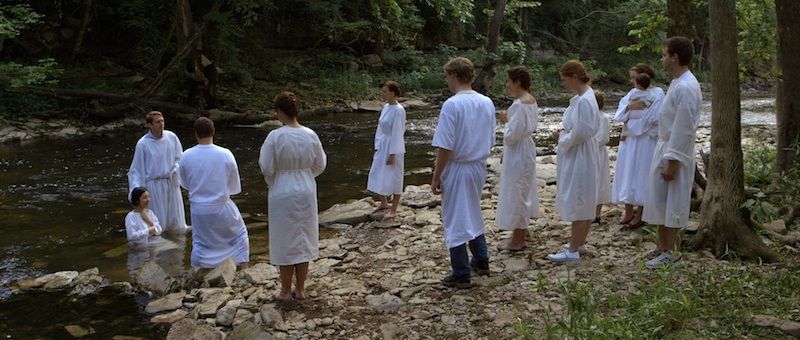 So forgive me but, yes — As It Is In Heaven, shot by Isaac Pletcher, looks a lot like a Terrence Malick film in its haunting opening shots of a woman in a white gown moving through Edenic environs toward a river where a baptism is underway.
Behold: A kindly older man they call “The Prophet” (John Lina) is baptizing a newcomer (Chris Nelson). Around him, the followers in this Kentucky church (cult?) rejoice at the salvation of another soul. Their community is growing.
Communities of faith tend to grow bolder and more secure in their beliefs when their numbers increase. (How many pastors take congregational growth as assurance of God’s blessing and approval?) In this case, the community needs assurances. They follow a leader who sees this small sect as distinct from the rest of the church. They want to believe that they are special, that they have found the answer. They want to believe that if they obey this man, they will be delivered from a world that has hurt them, let them down, and sent them in search of an escape.
The day of reckoning, says the Prophet, is very close.
Well, he’s right about that. A day of reckoning is coming. But not the way he thinks it is.
In a turn of events so portentous that you might even call them “Biblical,” the heir apparent — Eamon (Luke Beavers), the Prophet’s only son — is passed over for this humble, reluctant stranger. The one who has been given the rather loaded name of “David.”
 David seems earnest, eager to prepare the people. He wants to see them purified from sin so they will be worthy of redemption — an idea that anyone familiar with the Gospel will recognize as, well… the opposite of Jesus’ teachings, and rather like the teaching of those Jesus most firmly rebuked.
What’s remarkable is that all of these characters live within the cult. We’re not given an outsider’s perspective that will make us feel comfortable. We come to care about these people, and our hopes rest on anything that draws any of them closer to freedom, closer to truth. What’s more, we get a sense that each one has suffered some kind of alienation or severe loneliness — lacking a family or community or a sense of purpose. No wonder they might be drawn to this ready-made family, community, and purpose.
(I wonder — How often do we stop to consider what might lead other communities around the world to unite beneath the banner of some fanatical ideology? It’s so much easier just to say “They believe the wrong thing, and thus they deserve our condemnation.” Perhaps if we were stronger exemplars of our own beliefs, and showed the rewards of it to our neighbors, they would not seize upon such misguided causes, such communities where they can find a sense of belonging. But that’s a subject for another time.)
I’m tempted to argue that the cult itself just doesn’t seem very plausible. What kind of people would entrust their lives to such a mercurial, self-proclaimed “prophet”? But I watch the news. And I hear the stories. I know a lot of people who have been rattled by the collapse of a major church right here in Seattle, a church that placed far too much authority and power in the hands of one man, a man whose good intentions were not enough to make up for his misguided and legalistic ideas. Most people I know stood around saying “Why can’t these congregants see where their choices are leading them?” But that sense of satisfaction that comes from belonging to the right team, from being assured that the Right Man is doing the thinking for you, from believing that any kind of questioning or criticism is an attack… that will steer you away from the Gospel every time.
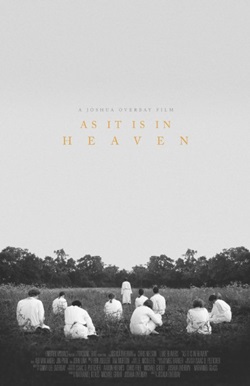 What’s more: The larger a cult becomes, the more persuasive and compelling their collective affirmation of a false prophet becomes. Who’s likely to volunteer as a nay-sayer when a barn full (or a sanctuary full) of congregants are cheering for their pastor?
It would have been easy to villainize David — to make him seem insane or malevolent. The film is far more troubling because we can see David’s eagerness to be a good leader. We can see him leaning into prayer and intuition for guidance. Oh, what a little theological guidance could do for him. Oh, what a close reading of the gospels would reveal. (If you want to argue for the importance of Biblical literacy, show people this movie.)
So, seeing David’s naivete and the burden of responsibility, we’re afraid for him as his followers distrust him and question his claim of authority. But we’re afraid most for those followers who have so much to lose if they are led any farther astray. Viewers won’t forget Deb (Shannon Kathleen Baker), the mother of an infant who is commanded to deny her baby nourishment during a cult-wide fast in the name of holiness.
It would have been easy to write this off as a story of “crazy Southerners.” But Overbay is careful to make the cultists seem as if they might have come from anywhere. (As he points out in this revealing interview with Alissa Wilkinson at Christianity Today, you won’t notice Southern accents in the cult.) That makes this group seem like it might be just about anywhere, around the corner.
The film stands as a convenient refutation of the common cliche “All religions are the same.” Perhaps you remember that moment in The Polar Express when the conductor said, “The thing about trains… it doesn’t matter where they’re going. What matters is deciding to get on.” Yeah, that sounded nice, but it’s total b.s. It matters very much which train you climb on. Because trains will take you in different directions, to different destinations, on different tracks. You know how that inspiring song goes: “People get ready, there’s a train comin’, pickin’ up passengers coast to coast… And faith is the key!” Ah, but faith in what? In whom?
Does this train exist under the tyranny of law, where you must earn your salvation with good behavior? It’s a seductive idea, this notion of earning your place on a Gospel train by following the rules of the conductor. And it’s an exciting thing for a lonely, lost soul to surrender freewill, or to learn a code, in order to purchase the embrace of a community called “The Chosen” in Jesus’ name. It’s even more exciting if you’re assured salvation for your behavior.
Here’s a hint: If you find that your train’s conductor
- claims to get “words from the Lord” that directly contradict Jesus’ teaching,
- casts off the good news of God’s unconditional love and grace for a new rule of law that makes him the judge of who’s “chosen” and who isn’t,
- sets himself up as “the shepherd” and the sole arbiter of truth,
- isolates the community from outside connections,
- teaches that God will “leave the earth to rot,” and
- interprets people’s hardships as evidence that they’re hiding secret sins …
… you’re probably on the wrong train.
I prefer a vision of the Gospel I stumbled onto in Joe Henry’s Invisible Hour:
There’s a train already come,
There’s a train already come,
Her hands are birds, her heart a drum —
Lo these many years…
In other words The Kingdom of God is at hand. Don’t feel like you need to go find it. It is, as Jesus said, within you.
It may surprise some viewers to learn that there were many Christians instrumental in the making of this film. It was directed by Joshua Overbay, written by him and his wife Ginny Lee Overbay, with the support of students from a Christian school — Asbury University. And I offer them my sincere congratulations. They have refused to take the path of so-called “Christian movies” — that growing industry of movies characterized by zealous evangelism, propaganda, and (alas) a destructively dualistic view of the world.
Most films that get branded as “Christian” demonstrate a fundamental misunderstanding of how art works and what it is for. But these filmmakers? Although many of them are Christians, they show no eagerness to make a “Christian Movie” — that is, a film designed to persuade viewers to become members of a particular team. Rather, they have employed imagination and excellence in carefully composed images and a subtly crafted narrative that respects viewers’ intelligence. By inviting us into an experience rather than subjecting us to an illustrated sermon, and by demonstrating compassion for all of their characters rather than setting up a false dichotomy of “good guys” and “bad guys,” they create a space for encounters with beauty, mystery, and truth, where all kinds of good contemplation and revelation can occur.
 Think of the countless hours of tedious work invested in the typical CGI-drenched Hollywood blockbuster. Then consider that this suspenseful film was shot without any special effects over the course of 17 days. This is powerful filmmaking, admirable for the resourcefulness of the artists. There is no substitute for the power of actual human beings, the actual rhythms of human relationships and dialogue, the power of silence, and the influence of actual environments in front of a camera.
I’m tempted to say that these filmmakers have asked us to consider how prone human beings are to desire a different Christ than the one we we’ve been given, and to reconsider what the claims of the Gospel might actually be. But no — that’s just what I find myself thinking about. The movie makes no move to preach or proselytize. Instead, it shows a path that moves in the wrong direction, so that the audience senses the deepening shadows, feels the disorientation that comes when we lose track of the sun’s true position in the sky.
In that sense, I’m tempted to say that As It Is In Heaven may have been influenced by, of all things, The Blair Witch Project. Just as that film limited our vision to what one wanderer’s handheld camera showed, cursing us to constant claustrophobia and motion-sickness in a maddeningly endless forest, so As It Is In Heaven gives in us an increasing sense of vertigo by closing us in — psychologically, communally, and spiritually.
If I have any trouble with the film at all, it’s that I suspect that life within cults is actually less stifling than this — that they discuss more than just their charismatic leader, that they talk about where they came from, what they miss, what about the world outside they might still love and covet. (I’m grateful to an insightful colleague who found the right words for this.) These characters might have come to life even more fully if the film had given us a fuller sense of their histories and interests.
But that’s quibbling. Watching As It Is In Heaven, I was never less than enthralled. As bizarre as the scenario might seem at first, it’s happening in all kinds of ways all around us. And if we’re not vigilant, it’s happening to us as well — in how we allow ourselves to be carried away by the charisma, the flattery, the promises, and visions of appealing figures like patriarchs, pop stars, pastors, presidents, CEOs, and even technological devices.
By asking these good-hearted but misguided people to make incredible sacrifices for his incomplete vision — and by limiting their environment to the houses, barns, and woods they’ve made the base of their separatist activities — the Prophet has doomed them all.
•
As It Is In Heaven is now streaming on iTunes and Vudu.
•
Looking Elsewhere
Michael Leary at Filmwell:
If Overbay can produce something so accomplished (truly, this film is marked by Overbay’s sense of nuance and precision) with so little, I am excited to see what he could put together with a bigger budget.
And I am not sure to what extent Overbay would agree, but this is Christian art in a clear, engaging, and historic sense. At times the film feels like a religious faith wrestling with its own object.
Wade Bearden at 1MoreFilmBlog:
The fact that Joshua and Ginny Lee Overbay have crafted a film that nourishes the mind and aesthetic sense of believer and atheist alike redounds to their credit. Here’s hoping the Overbays resist the temptation to pander to a niche market in subsequent films, and continue to create artful, broadly appealing movies.
Next Post

February 8, 2015 Looking Closer at Terrence Malick's Knight of Cups
Browse Our Archives
Select a Category Blog Bloggers on "Through a Screen Darkly" Browser Coming Soon Endorsements Fiction Books Film Forum Film Reviews Inspirations Interviews Journal Kindlings Muse Movie buzz Music Reviews Non-Fiction Books radio Reviewers on "Through a Screen Darkly" The Auralia Thread Through a Screen Darkly Through a Screen Darkly - Bonus Materials Top 10 (or 20 or 100) lists Uncategorized
Select a Month June 2015 May 2015 April 2015 March 2015 February 2015 January 2015 December 2014 November 2014 October 2014 September 2014 August 2014 July 2014 June 2014 May 2014 April 2014 March 2014 February 2014 January 2014 December 2013 November 2013 October 2013 September 2013 August 2013 July 2013 June 2013 May 2013 April 2013 March 2013 February 2013 January 2013 December 2012 November 2012 October 2012 September 2012 August 2012 July 2012 June 2012 May 2012 April 2012 March 2012 February 2012 January 2012 December 2011 November 2011 October 2011 September 2011 August 2011 July 2011 June 2011 May 2011 April 2011 March 2011 February 2011 January 2011 December 2010 November 2010 October 2010 September 2010 August 2010 July 2010 June 2010 May 2010 April 2010 March 2010 February 2010 January 2010 December 2009 November 2009 October 2009 September 2009 August 2009 July 2009 June 2009 May 2009 April 2009 March 2009 February 2009 January 2009 December 2008 November 2008 October 2008 September 2008 August 2008 July 2008 June 2008 May 2008 April 2008 March 2008 February 2008 January 2008 December 2007 November 2007 October 2007 September 2007 August 2007 July 2007 June 2007 May 2007 April 2007 March 2007 February 2007 January 2007 December 2006 November 2006 October 2006 September 2006 August 2006 July 2006 June 2006 May 2006 April 2006 March 2006 February 2006 January 2006 December 2005 November 2005 October 2005 September 2005 August 2005 July 2005 June 2005 May 2005 April 2005 March 2005 February 2005 January 2005 December 2004 November 2004 October 2004 September 2004 August 2004 July 2004 June 2004 May 2004 April 2004 July 2003 May 2003 March 2003 September 1999
Follow Us!
TAKE THE
Religious Wisdom Quiz
What does "Eden" mean in Hebrew?
Select your answer to see how you score.
Tree River Mountain Delight
Related posts from Looking Closer

This Is Not Goodbye. But It is... See...


What Specialists Are Saying About Jurassic World

Torres and the Influence of David Bazan and...
TRENDING AT PATHEOS Religious Music & Entertainment

"Les Diabolique" and Transgression
Alongside something like Arrival, Vertigo, or Charade, Les Diaboliques is a...

"The Plague Dogs" and Mortality
So, flashback to the late 70s, early 80s. Walt Disney Studios is...

With the recent and highly successful release of Christopher Nolan’s epic film,...

"L'avventura" and Human Weakness
Today's piece is going to be a little different for a few...

I first want to apologize for not posting or writing anything. I'm...

I've engaged in the multi-year project of reading through the Church Fathers,...
view all Religious Music & Entertainment blogs
Ad-Free & Subscriber Log-In Subscription Support
- About Us
- 2026 Calendar
- Videos
- Podcasts
- Library of World Religions
- Faith In Media Tracker
- Advertise With Us
- Write for Us
- Privacy Policy
- Terms of Service
- Do Not Sell My Data
- Contact Us
- Radiant Digital
- Manage Newsletter Subscriptions
- Unsubscribe From Notifications
- Sitemap
Copyright 2008-2026, Patheos. All rights reserved.
Subscription Support Ad-Free & Subscriber Log-In
Follow Patheos