
BuddhistCatholicContemplativeEvangelicalGeneral ChristianHinduJewishLatter-day SaintMuslimNew VisionsProgressive Christian
Beliefs
- Buddhist
- Catholic
- Contemplative
- Evangelical
- General Christian
- Hindu
- Jewish
- Latter-day Saint
- More Voices
- Muslim
- New Visions
- Pagan
- Progressive Christian
Topics
- Religion News
- Food and Religion
- Sports and Religion
- Religious Art
- Religious Music and Entertainment
- Religious Events
- History and Religion
- Style and Religion
- Politics and Religion
- Women in Religion
- Recreation Outdoors and Religion
- Business Finance and Religion
- Careers Workplace and Religion
- Education and Religion
- Family Parenting and Religion
- Health Fitness and Religion
- Home and Religion
- Relationships and Religion
- Technology and Religion
- Travel and Religion
Columnists
- Buddhist Columnists
- Business Finance and Religion Columnists
- Careers Workplace and Religion Columnists
- Catholic Columnists
- Contemplative Columnists
- Education and Religion Columnists
- Evangelists Columnists
- Family Parenting and Religion Columnists
- General Christian Columnists
- Health Fitness and Religion Columnists
- Hindu Columnists
- History and Religion Columnists
- Home and Religion Columnists
- Jewish Columnists
- More Voices Columnists
- Latter Day Columnists
- Muslim Columnists
- New Visions Columnists
- Nonreligious Columnists
- Pagan Columnists
- Politics and Religion Columnists
- Progressive Columnists
- Recreation Outdoors and Religion Columnists
- Relationships and Religion Columnists
- Religion News Columnists
- Religious Art Columnists
- Religious Events Columnists
- Religious Music and Entertainment Columnists
- Sports and Religion Columnists
- Style and Religion Columnists
- Technology and Religion Columnists
- Travel and Religion Columnists
- Women in Religion Columnists
Resource Library
- 2026 Calendar
- Library of World Religions
- The 100 Most Holy Places on Earth
- Patheos Answers
- Podcasts
- Videos
- Faith Leaders Database
- Anglican Episcopalian
- Bahai
- Baptist
- Buddhism
- Christianity
- Confucianism
- Eastern Orthodoxy
- Hinduism
- Holiness and Pentecostal
- ISKCON
- Islam
- Judaism
- Lutheran
- Methodist
- The Church of Jesus Christ of Latter-day Saints
- New Age
- Paganism
- Presbytarian and Reformed
- Protestantism
- Religion Behind the Scenes
- Roman Catholic
- Scientology
- Shia Islam
- Sikhism
- Sufism
- Sunni Islam
- Taoism
- Zen
- See all religions
Research Tools
 Ad-Free & Subscriber Log-In Subscription Support
Ad-Free & Subscriber Log-In Subscription Support
Follow Patheos 

- Trending:
- Forgiveness
- |
- Marriage
- |
- Consciousness
- |
- Death Penalty
- |
- Election
- |
- Halloween
 Looking Closer
- Home
- Religious Music & Entertainment
- Scott Derrickson May Not “Deliver Us From Evil,” But He Knows Who Can
Scott Derrickson May Not “Deliver Us From Evil,” But He Knows Who Can
Last updated on: November 2, 2014 at 6:51 pm by Jeffrey Overstreet
Scott Derrickson May Not “Deliver Us From Evil,” But He Knows Who Can 2014-11-02T18:51:55-07:00 Jeffrey Overstreet
Patheos Explore the world's faith through different perspectives on religion and spirituality! Patheos has the views of the prevalent religions and spiritualities of the world.
 This year, I’ve seen two priests on the big screen. Both have marched solemnly toward a showdown with evil.
That evil takes two very different forms — a human being with a gun and a grudge, and a demon using a broken human being as his vessel.
Yes, these two films are altogether different experiences. But both deal cleverly, even subversively, with a variety of genre conventions (one’s a scenic, small-town, Masterpiece Mystery-type production; the other is a grim, big-city police procedural). Both present priests who are admirable men who can crumble if their weaknesses are exploited. Both are unusually sincere at heart. And both include far more interesting and complex depictions of faith than the preachy mediocrity that is typically categorized as a “Christian movie.”
I haven’t found the time yet to give an in-depth review of Calvary — the whodunit*,* or rather, the who’s-gonna-do-it — but here are some revealing responses from critics I regularly read.
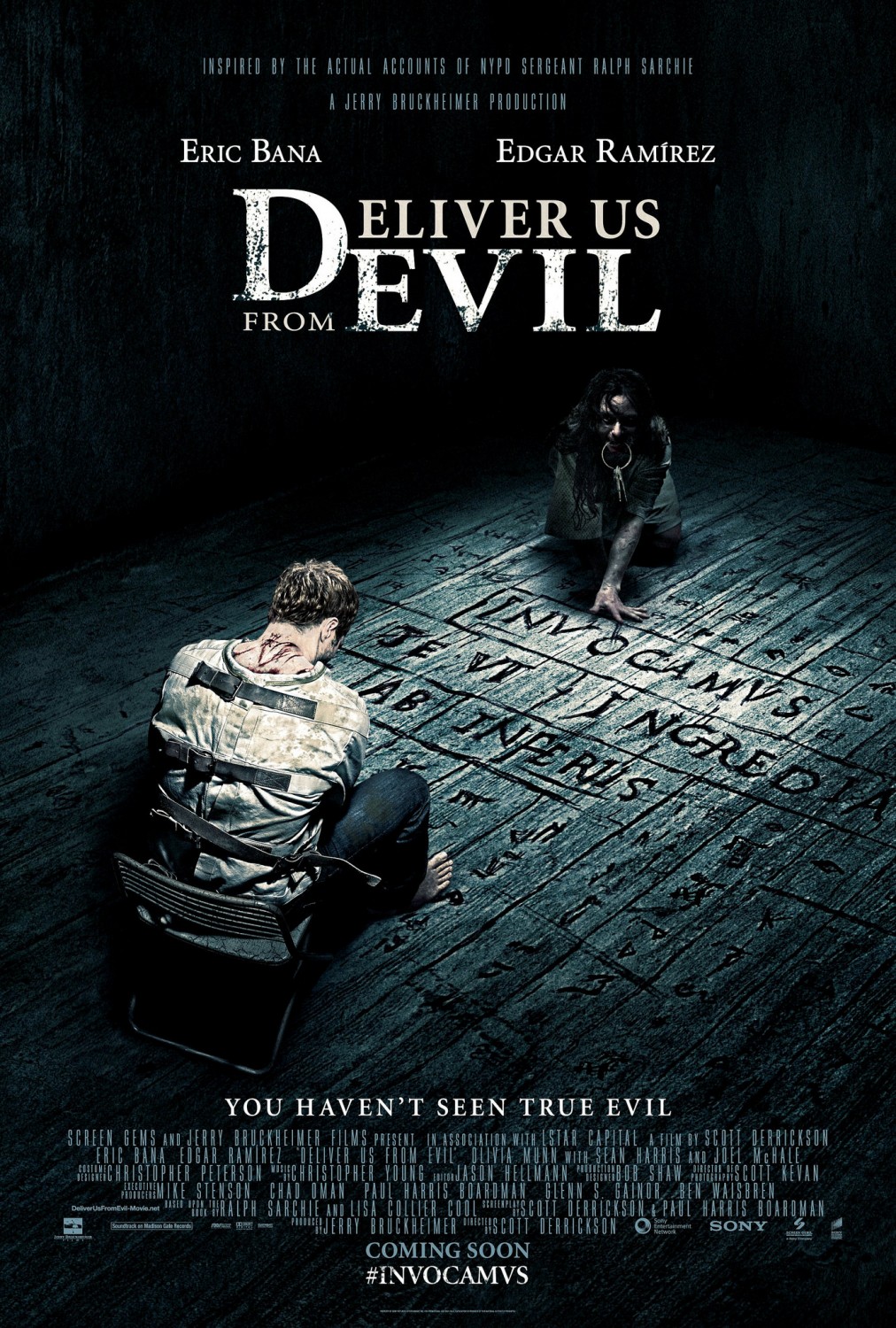
Deliver Us From Evil — which arrives on home video just in time for Halloween — is a police procedural driven by the obsessions of my favorite current scare-master, Scott Derrickson. Tricked out with wild special effects, Deliver Us follows a cop who, skeptical about Satan, teams up with a Catholic priest in order to track a serial killer: a villain whose methods defy rational explanations, and who may not even be human.
Let’s take a closer look at that one. I saw Deliver Us From Evil last July, and I’ve been thinking about ever since.
•
For Steven Spielberg, it’s the slow zoom in a dramatic moment. For Martin Scorsese, it’s the long-take dolly shot. What’s horror-master Scott Derrickson’s signature shot? It may well become that hold-your-breath moment, as a terrified seeker’s face is illuminated in the very light that he’s shining into the darkness. That image builds suspense by concealing the very things we are straining to discern in the darkness. But there’s a sneakier implication: That the light may indeed be revealing part of the problem — the seeker himself.
It’s oversimplifying matters to say that, in Derrickson’s film, “the real problem is within.” But that idea has come up in his work before: In The Exorcism of Emily Rose, Laura Linney plays a skeptic whose doubt becomes a torment when the evidence suggests supernatural events; and in Sinister, Ethan Hawke plays a novelist searching for understanding about horrific crimes, only to discover that his neglect of family is like bait for the monster. These aren’t simple stories of good guys hunting bad guys. They’re about people who won’t overcome evil unless they discover the insufficiency of their power, the weakness in their faith.
In Deliver Us From Evil, Derrickon’s most ambitious project, Eric Bana plays Officer Sarchie, a cop with a weakness and a strength. His righteous anger can get the better of him (Bana has plenty of experience “Hulking out”). But he also has a sixth sense for, well, sinister activity — think Peter Parker whose “spider-sense” tingles when criminals are up to something.
 On this particular manhunt, the killer seems capable of things that Sarchie’s worldview cannot explain. (Sarchie the character — loosely based on the film’s inspiration, a real cop-turned-exorcist who wrote Deliver Us From Evil as a memoir, not a novel — is a lapsed Catholic, determined to explain away things that go “bump” in the basements of the terrified callers who ask for his help. But as this case leads him down into creepy cellars, his confidence dissolves in the glow of his own flashlight. Something wicked this way comes — has already arrived.
Bana’s leading-man status is the first of several remarkable things about Deliver Us From Evil. It’s been nine years since Spielberg’s Munich, where Bana played the Israeli avenger who learns that responding to evil with violence can hollow out a heart. It’s been ten years since he was cast as the conscience-burdened Greek hero Hector, dueling Brad Pitt’s Achilles in Troy. But his full commitment to this performance proves here that he’s still a fine choice to play a movie’s Muscular Conscience.
Sarchie he comes equipped with the genre accessories: an amusing sidekick (Joel McHale, all smirk); a beautiful — and thus vulnerable — wife (Olivia Munn); and a cute-as-a-button daughter who may as well wear a shirt that says “Hey Evil Spirits, Please Come Haunt My Bedroom” on the front, and “Hey, Villains — Keep Me In Mind For This Movie’s Final Act” on the back. What sets good genre-film directors apart from bad ones? It isn’t their avoidance of convention, but whether or not they find a way to suspend our disbelief and surprise us even when we know the formula. Great genre-film directors find ways to do something truly imaginative within those routines, or alter them in some powerful way.
Here, Derrickson does both. He keeps us leaning forward in hopes of naming and catching the killer, but he’s also pulling a bait-and-switch. It’s a police procedural cake pan, but he’s filling it with horror-genre cake batter. So the result isn’t much like anything we’ve seen before.
Derrickson, his co-writer Paul Harris Boardman, cinematographer Scott Kevan, and a chillingly effective team of sound designers, mix up the ingredients; his actors — Bana, McHale, Munn, and the extraordinarily charismatic and confident Edgar Ramirez doing his first big genre pic — sell the results. They’re better than the genre requires. But Derrickson’s secret weapon here is one we rarely see in horror: This film is “Inspired by Actual Events.” That’s a claim likely to set film critics to scoffing. Come on, really? Demon possession? Crosses? Chants? Holy water, and all that?
But look into it, folks — Ralph Sarchie is for real, and his on-the-record stories are unsettling.
You may not believe in this stuff, but much of the world does, and it’d be tough to write off as mere fiction the testimonies of exorcism that defy rational explanation, and the cultural traditions around the world that accept the existence of demons. The Italian family whose haunted home is investigated by Sarchie — that’s not make believe. In an online discussion, Derrickson said, “I saw the video recordings that the real Ralph Sarchie made with the family members that the scene was based on. Those people weren’t lying, weren’t trying to get attention, and were absolutely terrified of their own house. Chilling to watch.”
I’m of the opinion that this stuff goes on scaring us because there is some truth to it. Whether we’re watching a B-movie like Paranormal Activity or an art film like No Country for Old Men, we are troubled because there is something about the suggestion that Other Powers are at work in the world… something that we sense to be true, even if it slips past the use of scientific instruments. And the fact that such testimonies persist — across generations, cultures, and geographic boundaries, while maintaining the same basic details — should give anybody pause before shrugging the spookiness off as “psychological disturbance” or coincidence. “There are more things in heaven and earth, Horatio, than are dreamt of in your philosophy,” Shakespeare’s Hamlet insists, and I believe that. But some religious traditions endure because they have given us a vocabulary about such things that rings true.
Sarchie — the character, not the real guy — wants to shrug off the suggestion of demonic powers, but the deeper he descends into some overlapping mysteries, the more he sees things that he wishes he could un-see. This isn’t an idiot-factor horror movie, in which stupid people get what’s coming to them, or a monster lurks just waiting for somebody to stumble into his clutches. Derrickson already fulfilled that formula with Sinister — masterfully, in my opinion. Here, he’s aiming higher. He wants to bring a stereotypical American hero — a muscular cop, a family man, and a pretty rational guy — face to face with the devil, or pretty close. He wants to show us that our heroes aren’t strong enough (or smart enough) to take on the real enemy, not without expanding their worldview and learning where the real power to overcome evil comes from. It’s Obi-Wan Kenobi arguing with Han Solo about the Force all over again. Sarchie insists that he’s seen “nothing that can’t be explained by human nature.” Mendoza replies, “Then you haven’t seen true evil.”
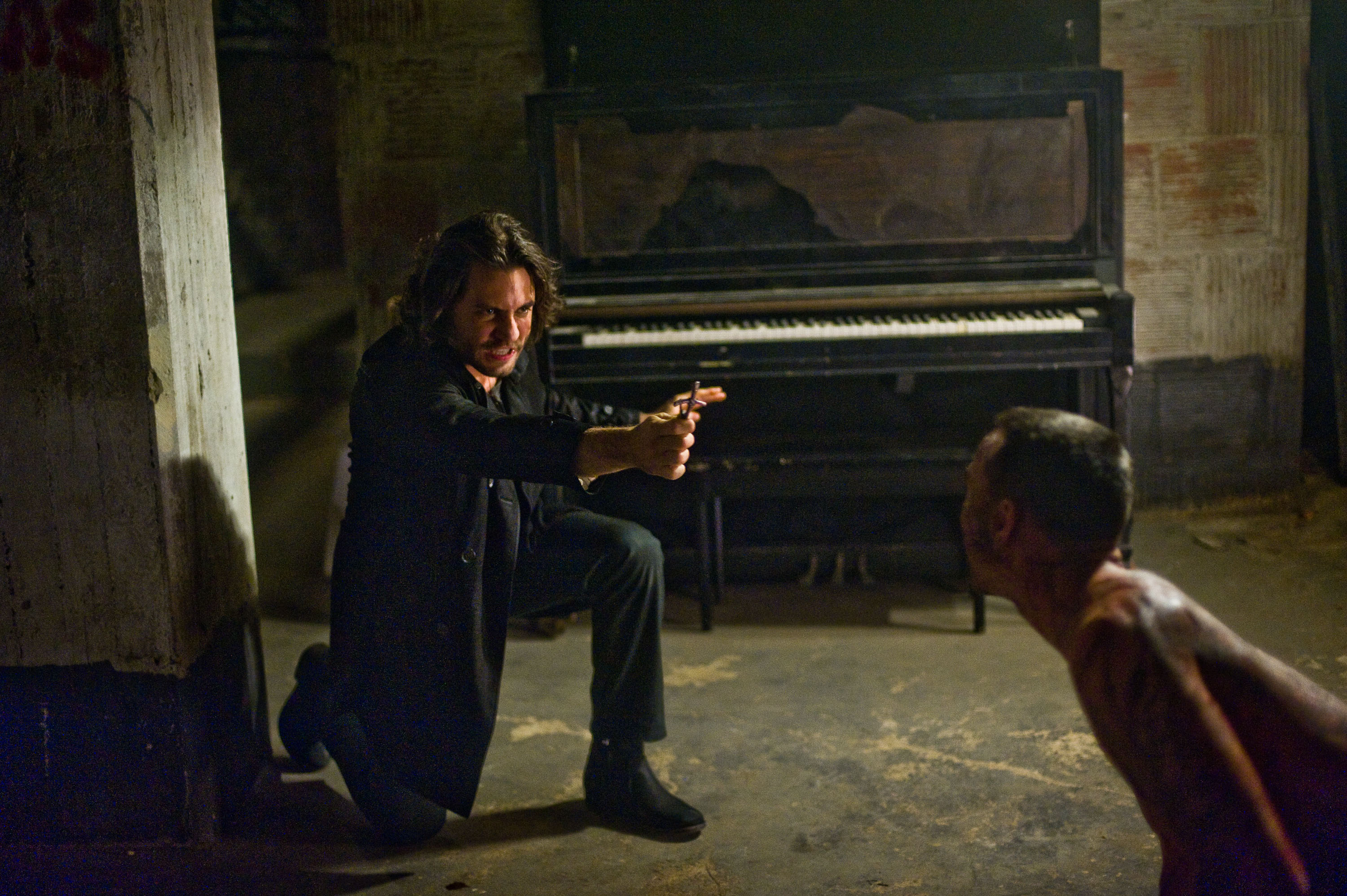 Thus, Sarchie’s a skeptical Scully to the enlightened Mulder of Father Mendoza, a “plainclothes priest” who specializes in demonology and exorcism. Mendoza believes. He’s seen enough to know, and his faith fills in the rest. Sarchie’s seen enough to know too, but he actively resists the faith that would complete the picture — he knows that he cannot embrace the truth without it costing him, without it changing his head, his heart, and his choices.
As Sheriff Bell said in No Country for Old Men: “The crime you see now, it’s hard to even take its measure. It’s not that I’m afraid of it. I always knew you had to be willing to die to even do this job. But, I don’t want to push my chips forward and go out and meet something I don’t understand. A man would have to put his soul at hazard.”
Just as Mendoza is, for this moviegoer, the film’s strongest character, so Édgar Ramirez is the actor who steals the show. He’s quiet, simmering, and introverted, which makes audiences lean forward. And he’s given a rich backstory — in part because Ramirez thought the character in the original screenplay needed work, so he inspired a rewrite by doing his own research on a Jesuit priest from Latin America.
As Sarchie, Bana is earnest and aggressive, seemingly the kind of cop hero that audiences love — which makes it all the more interesting that he never really takes control of the narrative, but remains a cipher, a guide whose doubts most people will understand.
That’s Derrickson’s twist: As in Raiders of the Lost Ark, the hero’s job is to realize that he’s not going to be the hero this time around. He cannot win this battle. His job is to (forgive me) “let go and let God.” Prayers are not magic spells but appeals for someone else to engage, to fight in our place. Best to invite the Almighty into the confrontation.
And how does God fight? By presenting himself as love, willing to suffer any evil we throw at him, willing to die for us. He shows us that true deliverance lies not in returning evil for evil, violence with violence, cruelty with cruelty, but in overcoming evil with good (see footnote*).
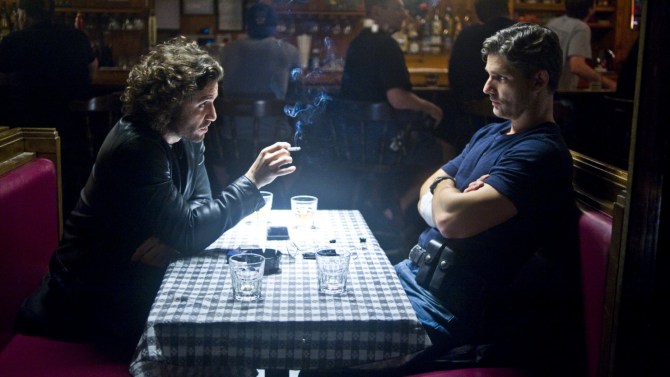 Thus, when these two — the man of faith and the man of skepticism — sit down like Pacino and De Niro in Michael Mann’s Heat, we feel that we’ve finally arrived at the film’s reason for being. It’s too bad, then, that this scene flies by, and that their conversation barely scratches the surface of their subject.
Similarly, while Bana and Munn make a good-looking couple, the scenes between them were too slight to make me really feel the tension when the inevitable tests come.
Still, as Sarchie and Mendoza close in on the responsible party, Derrickson keeps things strange by keeping them true — drawing on the details of eyewitness accounts and recordings of exorcisms. Yeah, the big showdown with demons will come, which makes for sensational big screen spectacle; but Derrickson makes sure that nobody leaves the theatre feeling completely satisfied. Demons don’t get locked away like crooks, and you can’t shoot them. The movie provides steps forward for its characters, and this particular demon hunt reaches a blistering, explosive conclusion. But moviegoers will feel that they’ve just seen an origin story — an episode in which a cop finds new vision and confidence, and a partnership worth following is formed.
Would it be too much to ask for a sequel? The devils, they’re still out there. And Mendoza has so much more to teach Sarchie.
Did you “like” the movie? Your answer will have a lot to do with what you believe. If you believe that “possession” is something different than a psychological disorder, this film may have the ring of truth. But if you think science can explain every mystery we encounter, and that spiritual warfare is just some dark-age delusion, this won’t feel like much more than a trip through a hokey house of horrors.
Me, I don’t think questions about spiritual forces get enough airtime at the movies. As someone who has come a little too close for comfort to a couple of circumstances like this, and who has close friends who express regret that they ever encountered such stuff first-hand, I don’t attend to stories like this the way I attend to, say, superhero movies. What Derrickson’s spotlighting is not just a bunch of “genre cliches.” Most of the time, entertainers treat demons as merely mythological, exploiting them for cheap thrills. Derrickson has enough respect for common, consistent testimonies — and enough faith in humankind’s ongoing experience of mystery — to take things much more seriously. By adhering to the details of actual testimonies, he provokes audiences to wrestle with the implications of those testimonies… that certain horrors cannot be just labeled and shelved as mental conditions or temporary psychosis.
This is, in some senses, a genre film, and thus certain familiar tropes are in play. But it’s a formula movie well-played, and one that layers formula upon formula into an intriguing hybrid. It’s built to entertain. But this is also a Scott Derrickson film. It’s going to give you more than you bargained for. It might keep you up at night with troubling questions about evil committed by humankind and, yes, evils done by something else. Derrickson shouldn’t have been able to “deliver” something that works both as a late-Friday-night popcorn scare fest and as a provocation to ask ourselves what we make of the prevalence of testimonies — across generations and cultures — regarding spiritual warfare of this nature. But that’s what he did.
No, not everything works. Olivia Munn should’ve been given something more than the usual concerned-mom/”What about us?” cop’s wife, because she made an impression with what little she had to do. I didn’t get enough from McHale’s character for his big scene to pack the necessary punch. And the end-credits montage, going to extremes to disturb and distress, ends up merely trying our patience. This material called for something a little more subtle and, dare I say it? Sacred.
But the cast is strong, the sound design is fantastic, and everything looks great. As the craft of horror goes, it’s a scream; and as a game of “Catch the Homage” or Use Your Allusions,” it’s a hoot and a half. (Blade Runner fans — watch for the clever Roy Batty reference at the end.)
And for the record, Mr. Derrickson, sir, if you’re listening: I would follow a whole franchise of Édgar Ramírez as The Specialist.
•
* This is a bit of a tangent, but it’s one I find compelling, so bear with me. The climactic confrontation in Deliver Us From Evil is profoundly Christian because it becomes a clash not of one violent force against another, but a meeting of the enemy’s violence with God’s willingness to suffer for the sake of love.
Many Christians get very excited about the idea of “The Battle of Armageddon,” a sort of epic-fantasy battle in which the armies of God and the armies of Satan clash at the end of the world. But what’s remarkable about the Scriptures upon which such fantasies are based is this: Revelation describes the enemies of God gathering at a place called Megiddo. But the battle never actually occurs. All that happens is this: God says from heaven, “It is done,” an echo of what Jesus said on the cross when he overcame by entering into death and overcoming its power. When those words are spoken, that is that. All resistance to God implodes, for the Great Liars have their strongest weapon — death — proven to be powerless against God’s immeasurable love. Thus, apocalyptic stories that show the Powers of Good overcoming Evil with a sort of coercive violence miss the whole point. It is God’s willingness to accept ultimate the ultimate suffering of our hatred, rejection, and violence — as an expression of his immeasurable love for us — that is (and has always been) the invincible, overcoming force in the universe. It is finished, indeed.
•
BONUS: Here’s Scott Derrickson giving nothing short of an epic interview to Steven Greydanus.
•
If you appreciate this post and enjoy Jeffrey’s work exploring the territory where art, faith, and culture intersect, you’re invited to “Put Your Name in the Credits.” Cast your vote for “Keep Looking Closer Alive.” Make a donation. Offer whatever you feel moved to contribute. All donations will be applied directly to that materials, events, and experiences that make the blog happen. That’s a Looking Closer promise.

Next Post

October 25, 2014 Ragamuffin (2014) - A Guest Review by Martin Stillion
Browse Our Archives
Select a Category Blog Bloggers on "Through a Screen Darkly" Browser Coming Soon Endorsements Fiction Books Film Forum Film Reviews Inspirations Interviews Journal Kindlings Muse Movie buzz Music Reviews Non-Fiction Books radio Reviewers on "Through a Screen Darkly" The Auralia Thread Through a Screen Darkly Through a Screen Darkly - Bonus Materials Top 10 (or 20 or 100) lists Uncategorized
Select a Month June 2015 May 2015 April 2015 March 2015 February 2015 January 2015 December 2014 November 2014 October 2014 September 2014 August 2014 July 2014 June 2014 May 2014 April 2014 March 2014 February 2014 January 2014 December 2013 November 2013 October 2013 September 2013 August 2013 July 2013 June 2013 May 2013 April 2013 March 2013 February 2013 January 2013 December 2012 November 2012 October 2012 September 2012 August 2012 July 2012 June 2012 May 2012 April 2012 March 2012 February 2012 January 2012 December 2011 November 2011 October 2011 September 2011 August 2011 July 2011 June 2011 May 2011 April 2011 March 2011 February 2011 January 2011 December 2010 November 2010 October 2010 September 2010 August 2010 July 2010 June 2010 May 2010 April 2010 March 2010 February 2010 January 2010 December 2009 November 2009 October 2009 September 2009 August 2009 July 2009 June 2009 May 2009 April 2009 March 2009 February 2009 January 2009 December 2008 November 2008 October 2008 September 2008 August 2008 July 2008 June 2008 May 2008 April 2008 March 2008 February 2008 January 2008 December 2007 November 2007 October 2007 September 2007 August 2007 July 2007 June 2007 May 2007 April 2007 March 2007 February 2007 January 2007 December 2006 November 2006 October 2006 September 2006 August 2006 July 2006 June 2006 May 2006 April 2006 March 2006 February 2006 January 2006 December 2005 November 2005 October 2005 September 2005 August 2005 July 2005 June 2005 May 2005 April 2005 March 2005 February 2005 January 2005 December 2004 November 2004 October 2004 September 2004 August 2004 July 2004 June 2004 May 2004 April 2004 July 2003 May 2003 March 2003 September 1999
Follow Us!
TAKE THE
Religious Wisdom Quiz
In 1 Peter 1, what does Peter say is more valuable than gold?
Select your answer to see how you score.
Righteousness Charity Wisdom Faith
Related posts from Looking Closer

This Is Not Goodbye. But It is... See...


What Specialists Are Saying About Jurassic World

Torres and the Influence of David Bazan and...
TRENDING AT PATHEOS Religious Music & Entertainment

"Les Diabolique" and Transgression
Alongside something like Arrival, Vertigo, or Charade, Les Diaboliques is a...

"The Plague Dogs" and Mortality
So, flashback to the late 70s, early 80s. Walt Disney Studios is...

With the recent and highly successful release of Christopher Nolan’s epic film,...

"L'avventura" and Human Weakness
Today's piece is going to be a little different for a few...

I first want to apologize for not posting or writing anything. I'm...

I've engaged in the multi-year project of reading through the Church Fathers,...
view all Religious Music & Entertainment blogs
Ad-Free & Subscriber Log-In Subscription Support
- About Us
- 2026 Calendar
- Videos
- Podcasts
- Library of World Religions
- Faith In Media Tracker
- Advertise With Us
- Write for Us
- Privacy Policy
- Terms of Service
- Do Not Sell My Data
- Contact Us
- Radiant Digital
- Manage Newsletter Subscriptions
- Unsubscribe From Notifications
- Sitemap
Copyright 2008-2026, Patheos. All rights reserved.
Subscription Support Ad-Free & Subscriber Log-In
Follow Patheos