
BuddhistCatholicContemplativeEvangelicalGeneral ChristianHinduJewishLatter-day SaintMuslimNew VisionsProgressive Christian
Beliefs
- Buddhist
- Catholic
- Contemplative
- Evangelical
- General Christian
- Hindu
- Jewish
- Latter-day Saint
- More Voices
- Muslim
- New Visions
- Pagan
- Progressive Christian
Topics
- Religion News
- Food and Religion
- Sports and Religion
- Religious Art
- Religious Music and Entertainment
- Religious Events
- History and Religion
- Style and Religion
- Politics and Religion
- Women in Religion
- Recreation Outdoors and Religion
- Business Finance and Religion
- Careers Workplace and Religion
- Education and Religion
- Family Parenting and Religion
- Health Fitness and Religion
- Home and Religion
- Relationships and Religion
- Technology and Religion
- Travel and Religion
Columnists
- Buddhist Columnists
- Business Finance and Religion Columnists
- Careers Workplace and Religion Columnists
- Catholic Columnists
- Contemplative Columnists
- Education and Religion Columnists
- Evangelists Columnists
- Family Parenting and Religion Columnists
- General Christian Columnists
- Health Fitness and Religion Columnists
- Hindu Columnists
- History and Religion Columnists
- Home and Religion Columnists
- Jewish Columnists
- More Voices Columnists
- Latter Day Columnists
- Muslim Columnists
- New Visions Columnists
- Nonreligious Columnists
- Pagan Columnists
- Politics and Religion Columnists
- Progressive Columnists
- Recreation Outdoors and Religion Columnists
- Relationships and Religion Columnists
- Religion News Columnists
- Religious Art Columnists
- Religious Events Columnists
- Religious Music and Entertainment Columnists
- Sports and Religion Columnists
- Style and Religion Columnists
- Technology and Religion Columnists
- Travel and Religion Columnists
- Women in Religion Columnists
Resource Library
- 2026 Calendar
- Library of World Religions
- The 100 Most Holy Places on Earth
- Patheos Answers
- Podcasts
- Videos
- Faith Leaders Database
- Anglican Episcopalian
- Bahai
- Baptist
- Buddhism
- Christianity
- Confucianism
- Eastern Orthodoxy
- Hinduism
- Holiness and Pentecostal
- ISKCON
- Islam
- Judaism
- Lutheran
- Methodist
- The Church of Jesus Christ of Latter-day Saints
- New Age
- Paganism
- Presbytarian and Reformed
- Protestantism
- Religion Behind the Scenes
- Roman Catholic
- Scientology
- Shia Islam
- Sikhism
- Sufism
- Sunni Islam
- Taoism
- Zen
- See all religions
Research Tools
 Ad-Free & Subscriber Log-In Subscription Support
Ad-Free & Subscriber Log-In Subscription Support
Follow Patheos 

- Trending:
- Forgiveness
- |
- Marriage
- |
- Consciousness
- |
- Death Penalty
- |
- Election
- |
- Halloween
 Looking Closer
- Home
- Religious Music & Entertainment
- Critics Vs. Audiences: Whom Shall We Trust?
Critics Vs. Audiences: Whom Shall We Trust?
Last updated on: August 27, 2014 at 2:10 pm by Jeffrey Overstreet
Critics Vs. Audiences: Whom Shall We Trust? 2014-08-27T14:10:14-06:00 Jeffrey Overstreet
Patheos Explore the world's faith through different perspectives on religion and spirituality! Patheos has the views of the prevalent religions and spiritualities of the world.
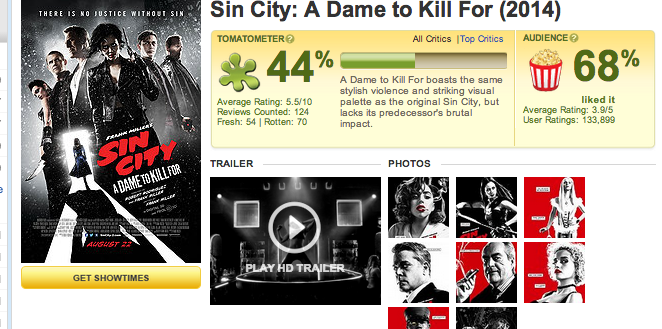
Who should you trust? The critics’ score? Or the audience score? Which is more reliable? Tricky question.
When I shared some reviews that question the quality of a faith-based film, I received a scornful comment.
So far, I’ve only received one. I anticipate more, based on experience. But if I only get one, I’ll be just fine with that.
The commenter — “M Didaskalos” — read my previous post: “Looking Closer at When the Game Stands Tall.”
And here’s his response, which I will answer point by point:
Didaskalos:
Gotta love the haughty disdain that pervades so many critics’ reviews of When The Game Stands Tall.
Overstreet:
It looks to me like the critics were doing their job: critiquing artistry with skill and professionalism. They pointed out strengths, and they pointed out weaknesses.
If they have some “disdain” for poor artistry, well, isn’t that their job?
Our call as reviewers… as audiences… is to push back against sentimentality and mediocrity and propaganda, for the sake of excellence in art — just as doctors are charged with pushing back against cancer for the sake of a healthy human being.
As the sometimes-snarky Flannery O’Connor wrote:
“The fact is that if the writer’s attention is on producing a work of art, a work that is good in itself, he is going to take great pains to control every excess, everything that does not contribute to this central meaning and design. He cannot indulge in sentimentality, in propagandizing, or in pornography and create a work of art, for all these things are excesses. They call attention to themselves and distract from the work as a whole.”
As reviewers, then, it is our job to expose anything that weakens the work, and praise anything that strengthens it.
But do go on.
Didaskalos:
On the exalted-arbiter-of-movies website, RottenTomatoes, a scant 18 percent of critics nod approval to [When the Game Stands Tall]. Seventy-seven percent of audience reviews (almost 10,000 vs. the 56 critics’ reviews) are approving. http://www.rottentomatoes.com/…
Overstreet:
I may be wrong, but your tone here sounds a little “haughty” and “disdaining.” I suppose I could be misreading it.
I’m curious: Do you think that the difference between the critics’ rating and the audience rating automatically means the audience is the side that shows integrity?
Food critics tend to have problems with fast-food fare like McDonald’s hamburgers. But people love those hamburgers and consume them in mass quantities! To whom should we give the benefit of the doubt? Who is more likely to help us understand whether that meal is good for us?
By the way, a “scant” 20% of critics “nod approval” to Teenage Mutant Ninja Turtles on Rotten Tomatoes. But 60% of audience reviews (more than 93,000 vs. the 99 critics reviews) are approving. Should I thus assume that the critics are wrong, and that Teenage Mutant Ninja Turtles is an admirable work of art?
The comedy Let’s Be Cops has an even lower critical rating: 16% positive. Audiences are 64% positive. Again, are the critics clearly off base?
Let’s see what happens when the big-screen adaptation of the famously trashy sex thriller 50 Shades of Gray arrives. Rotten Tomatoes will show you that no critics have reviewed yet… but the film has a 96% enthusiasm rating (“Can’t wait to see it!”) from audiences. Are you ready to tell me that “audiences” will be more reliable than critics when it comes to that one?
I’m not saying that a critical majority is always right, but it’s certainly not as simple as saying, “Well, yeah, but normal moviegoers love it!”
What are critics, by the way?
In my experience, they are the “audience” that is so devoted to the art of cinema that they study it, write about it, and hold artists to a high standard. Their opinions may differ, but they aren’t a different species than “audiences.” They are just more inclined to distrust a simple, immediate, emotional response. They look closer.
If you’re going to go in for surgery, would you entrust yourself to the general public that has some familiarity with the human body, but not a lot of experience in studying and working with the body? Or would you rather entrust yourself to a trained surgeon: someone whose primary focus is the study of, and salvation of, the body?
Didaskalos:
When ordinary (especially Christian ordinary) people do noble things, mundane as their words and acts often are in real life, critics fairly elbow each other out of the way to dismiss another box-office success as “platitudinous,” “threadbare,” “cliched” or [fill in your own pejorative adjective here].
Overstreet:
I would love to see some examples of what you’re saying. I often see critics use those terms… but they’re not describing the subject itself. They’re describing the way in which the subject is portrayed. I can’t remember the last time I saw a critic slam a movie because a character was being noble. No, I see them commenting on the way that it’s portrayed. Big difference.
I’ve seen films about Jesus that deserve to be written off as “platitudinous,” “threadbare,” and “cliched” … but that’s not a criticism of Jesus. It’s a criticism of screenwriting that would earn a B- in a decent screenwriting class, or unimaginative camerawork, or scenes that oversimplify what the Scriptures portray.
Sophie Scholl was a movie about a Christian who stands up for faith and truth — and that film was praised to high heaven by critics. But because it was in a foreign language, and it wasn’t given the usual, flashy, entertaining treatment, audiences weren’t interested. My favorite film of 2013 — the highly acclaimed independent drama This is Martin Bonner — was about ordinary people wrestling with questions of faith and trying to behave decently toward one another. That, too, was celebrated by almost all reviewers who saw it, but because it didn’t look like a flashy Hollywood production, and it didn’t have a big-name movie star, it didn’t get distributed.
I could list other examples. The point is this: It’s not what the characters believe in or do that aggravates critics, usually. It’s the artfulness (or lack of it) with which they are portrayed that makes a difference to critics.
Didaskalos:
The real-life coaches whose lives are portrayed in the film seem to be not altogether displeased about WTGST.
[Didaskalos included a long excerpt from this article by Debbie Elias. If you follow the link, you can read the whole thing.]
Overstreet:
No surprise there. People tend to be pleased when the media portrays them in a positive light.
By the way, I looked at the other reviews written by Debbie Elias, who wrote that review of When the Game Stands Tall for The Examiner. I can’t say I’m impressed with her discernment about films. Look at her track record. She seems similarly enthusiastic about Sin City: A Dame to Kill For (she gets the title wrong) and The Expendables 3, and, well, almost everything she’s reviewed there. That Expendables review doesn’t appear to have any actual criticism in it. It sounds more like she asked the film studio, “What would you like me to say?”
Anyway, regarding how the coaches respond to the movie: If I’m looking for insight into the excellence of a portrait, I’m not going to ask the person who posed for it. If I want to understand why Picasso’s Blue Guitar is a masterpiece, I’m not going to ask guitarist Jimmy Page. I’m going to ask someone who is gifted in looking closely and interpreting how a work of art means.
I’m only mildly curious about whether people feel like they’ve been portrayed accurately onscreen. When a great portrait is made of a person, that portrait is just as likely (if not more so) to disturb the subject as please him. I’m suspicious of artists who are concerned about whether or not their subject likes the result.
There’s a great story about this told in the lyrics of Bob Dylan’s song “Highlands” … but that’s a story for another post.
Didaskalos:
Love, humility, self-effacement, altruism? Well, no wonder so many critics are harrumphing at the movie.
Overstreet:
So, now you’re saying that critics, in general, disapprove of virtue.
In my experience, love, humility, self-effacement, and altruism are often celebrated by critics. In fact, the reasons they have such high, demanding standards about artistry is that they believe such things deserve to be portrayed with surpassing excellence, not shoddy craftsmanship.
Critics are, in a way, like car mechanics who examine automobiles for the sake of ensuring excellence, integrity, and safety. That car may be used to transport relief to suffering populations. It might be used to chauffeur the President of the United States. It might belong to a saint or a drug dealer. That doesn’t matter. What matters, to the mechanic, is whether or not that car is in excellent working order.
Where the Game Stands Tall may be about fantastic people. All the more reason for critics to care passionately about the quality of the movie that celebrates them. A film that preaches, that sentimentalizes, that oversimplifies… those things deserve to be criticized, no matter the subject, because they harm a work of art.
I haven’t read any reviews that condemn the people who inspired the film. I’ve read reviews by critics who question the artistry of the movie that celebrates them.
You say “haughty disdain.” I call it discernment.
Previous Post

August 23, 2014
Looking Closer at When the Game Stands Tall
Next Post
August 28, 2014 From the Director of "Metropolitan" and "The Last Days of Disco"
Browse Our Archives
Select a Category Blog Bloggers on "Through a Screen Darkly" Browser Coming Soon Endorsements Fiction Books Film Forum Film Reviews Inspirations Interviews Journal Kindlings Muse Movie buzz Music Reviews Non-Fiction Books radio Reviewers on "Through a Screen Darkly" The Auralia Thread Through a Screen Darkly Through a Screen Darkly - Bonus Materials Top 10 (or 20 or 100) lists Uncategorized
Select a Month June 2015 May 2015 April 2015 March 2015 February 2015 January 2015 December 2014 November 2014 October 2014 September 2014 August 2014 July 2014 June 2014 May 2014 April 2014 March 2014 February 2014 January 2014 December 2013 November 2013 October 2013 September 2013 August 2013 July 2013 June 2013 May 2013 April 2013 March 2013 February 2013 January 2013 December 2012 November 2012 October 2012 September 2012 August 2012 July 2012 June 2012 May 2012 April 2012 March 2012 February 2012 January 2012 December 2011 November 2011 October 2011 September 2011 August 2011 July 2011 June 2011 May 2011 April 2011 March 2011 February 2011 January 2011 December 2010 November 2010 October 2010 September 2010 August 2010 July 2010 June 2010 May 2010 April 2010 March 2010 February 2010 January 2010 December 2009 November 2009 October 2009 September 2009 August 2009 July 2009 June 2009 May 2009 April 2009 March 2009 February 2009 January 2009 December 2008 November 2008 October 2008 September 2008 August 2008 July 2008 June 2008 May 2008 April 2008 March 2008 February 2008 January 2008 December 2007 November 2007 October 2007 September 2007 August 2007 July 2007 June 2007 May 2007 April 2007 March 2007 February 2007 January 2007 December 2006 November 2006 October 2006 September 2006 August 2006 July 2006 June 2006 May 2006 April 2006 March 2006 February 2006 January 2006 December 2005 November 2005 October 2005 September 2005 August 2005 July 2005 June 2005 May 2005 April 2005 March 2005 February 2005 January 2005 December 2004 November 2004 October 2004 September 2004 August 2004 July 2004 June 2004 May 2004 April 2004 July 2003 May 2003 March 2003 September 1999
Follow Us!
TAKE THE
Religious Wisdom Quiz
Which Christian principle is highlighted in the parable of the Good Samaritan?
Select your answer to see how you score.
Only help friends Compassion for all Seek praise Ignore strangers
Related posts from Looking Closer

This Is Not Goodbye. But It is... See...



What Specialists Are Saying About Jurassic World
TRENDING AT PATHEOS Religious Music & Entertainment

"Les Diabolique" and Transgression
Alongside something like Arrival, Vertigo, or Charade, Les Diaboliques is a...

"The Plague Dogs" and Mortality
So, flashback to the late 70s, early 80s. Walt Disney Studios is...

With the recent and highly successful release of Christopher Nolan’s epic film,...

"L'avventura" and Human Weakness
Today's piece is going to be a little different for a few...

I first want to apologize for not posting or writing anything. I'm...

I've engaged in the multi-year project of reading through the Church Fathers,...
view all Religious Music & Entertainment blogs
Ad-Free & Subscriber Log-In Subscription Support
- About Us
- 2026 Calendar
- Videos
- Podcasts
- Library of World Religions
- Faith In Media Tracker
- Advertise With Us
- Write for Us
- Privacy Policy
- Terms of Service
- Do Not Sell My Data
- Contact Us
- Radiant Digital
- Manage Newsletter Subscriptions
- Unsubscribe From Notifications
- Sitemap
Copyright 2008-2026, Patheos. All rights reserved.
Subscription Support Ad-Free & Subscriber Log-In
Follow Patheos