
BuddhistCatholicContemplativeEvangelicalGeneral ChristianHinduJewishLatter-day SaintMuslimNew VisionsProgressive Christian
Beliefs
- Buddhist
- Catholic
- Contemplative
- Evangelical
- General Christian
- Hindu
- Jewish
- Latter-day Saint
- More Voices
- Muslim
- New Visions
- Pagan
- Progressive Christian
Topics
- Religion News
- Food and Religion
- Sports and Religion
- Religious Art
- Religious Music and Entertainment
- Religious Events
- History and Religion
- Style and Religion
- Politics and Religion
- Women in Religion
- Recreation Outdoors and Religion
- Business Finance and Religion
- Careers Workplace and Religion
- Education and Religion
- Family Parenting and Religion
- Health Fitness and Religion
- Home and Religion
- Relationships and Religion
- Technology and Religion
- Travel and Religion
Columnists
- Buddhist Columnists
- Business Finance and Religion Columnists
- Careers Workplace and Religion Columnists
- Catholic Columnists
- Contemplative Columnists
- Education and Religion Columnists
- Evangelists Columnists
- Family Parenting and Religion Columnists
- General Christian Columnists
- Health Fitness and Religion Columnists
- Hindu Columnists
- History and Religion Columnists
- Home and Religion Columnists
- Jewish Columnists
- More Voices Columnists
- Latter Day Columnists
- Muslim Columnists
- New Visions Columnists
- Nonreligious Columnists
- Pagan Columnists
- Politics and Religion Columnists
- Progressive Columnists
- Recreation Outdoors and Religion Columnists
- Relationships and Religion Columnists
- Religion News Columnists
- Religious Art Columnists
- Religious Events Columnists
- Religious Music and Entertainment Columnists
- Sports and Religion Columnists
- Style and Religion Columnists
- Technology and Religion Columnists
- Travel and Religion Columnists
- Women in Religion Columnists
Resource Library
- 2026 Calendar
- Library of World Religions
- The 100 Most Holy Places on Earth
- Patheos Answers
- Podcasts
- Videos
- Faith Leaders Database
- Anglican Episcopalian
- Bahai
- Baptist
- Buddhism
- Christianity
- Confucianism
- Eastern Orthodoxy
- Hinduism
- Holiness and Pentecostal
- ISKCON
- Islam
- Judaism
- Lutheran
- Methodist
- The Church of Jesus Christ of Latter-day Saints
- New Age
- Paganism
- Presbytarian and Reformed
- Protestantism
- Religion Behind the Scenes
- Roman Catholic
- Scientology
- Shia Islam
- Sikhism
- Sufism
- Sunni Islam
- Taoism
- Zen
- See all religions
Research Tools
 Ad-Free & Subscriber Log-In Subscription Support
Ad-Free & Subscriber Log-In Subscription Support
Follow Patheos 

- Trending:
- Forgiveness
- |
- Marriage
- |
- Consciousness
- |
- Death Penalty
- |
- Election
- |
- Halloween
 Looking Closer
- Home
- Religious Music & Entertainment
- Saving Mr. Banks (2013) … or Squandering Mr. Hanks
Saving Mr. Banks (2013) … or Squandering Mr. Hanks
Last updated on: May 19, 2014 at 3:00 pm by Jeffrey Overstreet
Saving Mr. Banks (2013) … or Squandering Mr. Hanks 2014-05-19T15:00:17-06:00 Jeffrey Overstreet
Patheos Explore the world's faith through different perspectives on religion and spirituality! Patheos has the views of the prevalent religions and spiritualities of the world.
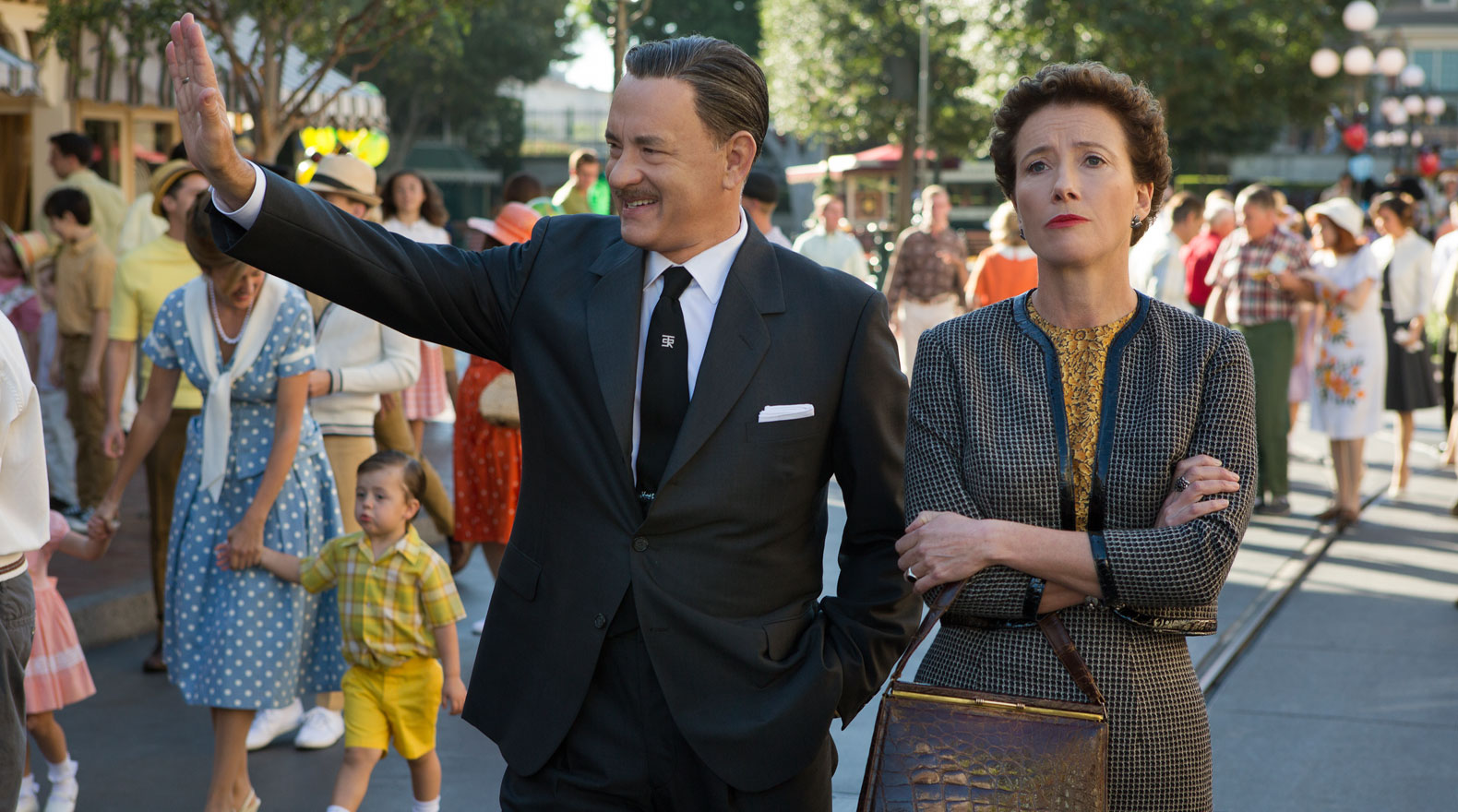
Travers is not amused.
Dear moviegoers who enjoyed Saving Mr. Banks, including those among my friends and family,
I’m glad you had a good time at the movies.
Seriously.
I would be nothing but a snob if I scorned anybody for enjoying a heart-warming work of fiction like this one.
I recognize that there are a lot of things moviegoers will enjoy here:
- Tom Hanks, being witty and skillful;
- Emma Thompson, being amusing and… British;
- nostalgic musical celebrations of Mary Poppins™;
- Paul Giamatti, in warm and lovably congenial mode;
- Colin Farrell and Ruth Wilson finding some humanity in a child’s tragic flashbacks.
You see, Disney baked this big, heavily frosted cake to make people happy, and that’s what they’ve done.
But if you want to hang on to that warm feeling, you may just want to stop reading — because “happiness” is about the opposite of how I felt when I finally sat down to watch Saving Mr. Banks.
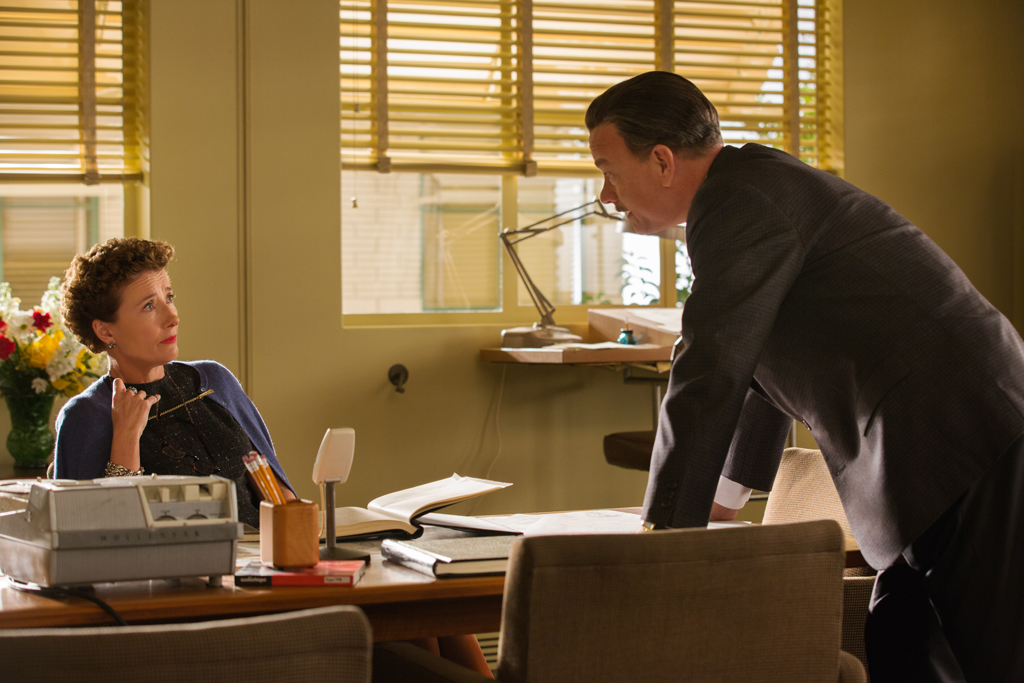
Travers is not amused.
I wanted to enjoy the movie the way you did. But I could not, and I’m going to explain why. You may think I’m just being impossible and unreasonable. You may roll your eyes just like Walt and the Sherman brothers—Richard and Robert—do in this movie whenever P. L. Travers voices her grievances about their plans to turn her beloved novel into a movie. Nobody likes a party-spoiler. Audiences are laughing at Travers’ obstinance because, well, most of us have had to deal with a stick-in-the-mud before. No wonder this movie is a crowdpleaser: It’s about joyful entertainers who find a way to bend a grouch to do what they want. To use the movie’s own words, it’s about “teaching the witch to be happy” — even though you can hear them thinking of a word that rhymes with “witch.”
I just want to ask two questions:
1) Do the ends justify the means?
That is to say: If an artist means to give audience a good time, does he have license to rewrite recent history so that the climax of the story is completely false, misrepresenting the character of the film’s central historical figure?
Many made a fuss when Spielberg’s Lincoln arrived because it testified that one congressman voted for slavery when, in fact, the record shows that he voted to abolish it. In Saving Mr. Banks, we have a far more egregious departure from the eyewitness testimonies.
But we’ll get back to the question of historical accuracy later. Most films that are ‘based on a true story” are revising that history in one way or another. Before we talk about how much revision is appropriate, let’s pretend that this movie gives us a “true story” … and get to my second question… the one that burns me like heartburn as I watch this film.
2) The movie concludes with all of the fanfare of a Disney happy ending. But is this really a happy ending? Or is it a tragedy?
Seriously, how is this a happy ending?
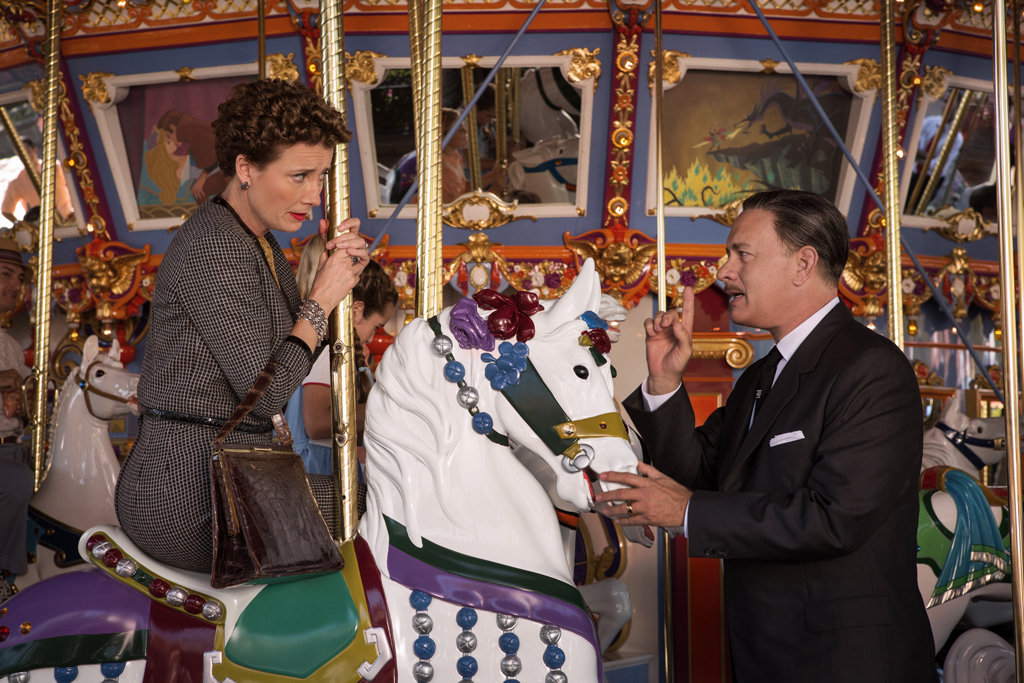
Travers is still not amused.
Saving Mr. Banks tells us a story in which two misguided characters clash over a collaboration. One of them has a warm, welcoming personality, and he just so happens to be a beloved figure in entertainment history. The other is relatively unknown by audiences, and she’s shown to be unpleasant, bitter, and exasperating. We’re talking about personalities here. But personalities and convictions are two different things. To the audience’s delight, Mr. Nice Guy prevails over Mrs. Madness. But what really happened here? Was Mr. Nice Guy really “the Good Guy” who should have prevailed?
I’ll tell you what happens in this movie: A businessman takes away an artist’s personal vision and refashions it to what will please the majority rather than what will convey what the artist meant to express in the first place. He has done so by putting her under tremendous pressure, driving her into a decision she doesn’t want to make. And this is tragic because, all along the way, his own ideas were good enough that he could have built his own original story without stealing a storyteller’s property and causing her great distress.
I have a personal aversion to Christian pop music that copies the sound and style of mainstream artists and rewrites the words into pandering praise lyrics. In the same way, I’m allergic to the way that Walt Disney Sudios has plundered the treasure chest of children’s stories, legends, fables, and fairy tale — ripping the big, beating hearts from those stories’ chests and replacing them with mechanical Disney cliches. Disney often tells us what we want to hear rather than what we need to hear. Until recent years, when some admirable exceptions have arrived (thanks to the influence of storytellers like Andrew Stanton, Brad Bird, and John Lasseter), almost every family film that Disney has produced has been a cliché-heavy story of “follow your heart” or “find your Prince Charming.”
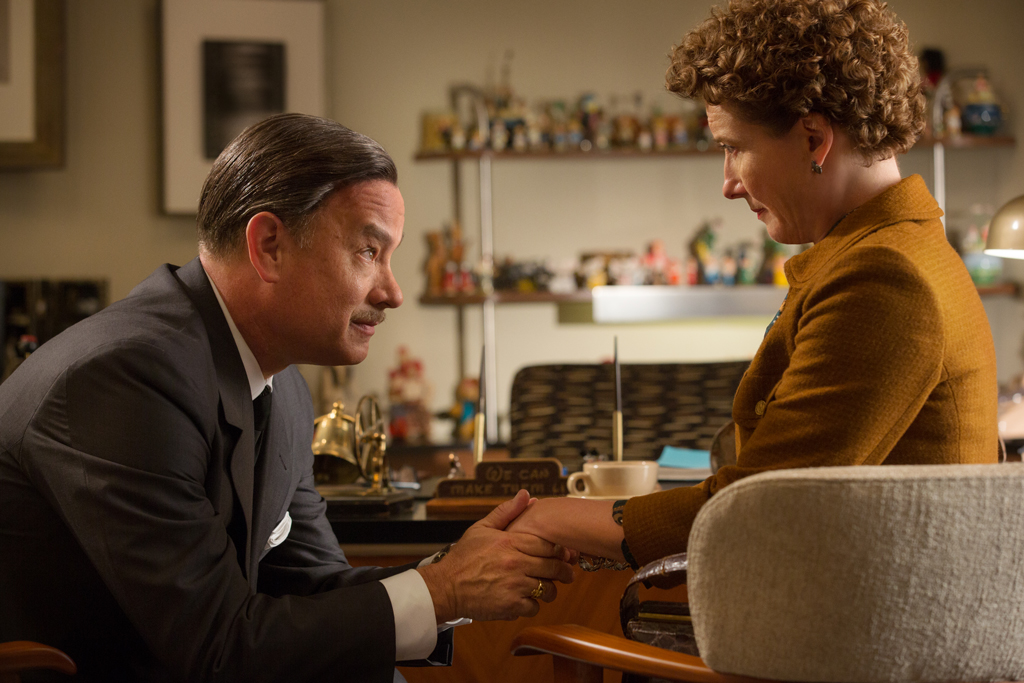
Is she amused? No. Travers is not amused.
In Saving Mr. Banks, we see Disney as the Evangelist of Crowdpleasing determining to exploit the work of Travers as the “unbeliever.” It ends by providing a Happy Ending that celebrates Disney’s own legacy, and that forces the character of Travers to end up weeping in the realization that Disney’s vision is superior…
… which (and now we’re back to Question 1) isn’t what happened.
In taking on the story of Walt Disney and P.L. Travers, director John Lee Hancock and his collaborators had a chance to tell what is, in truth, a story rich with provocative questions about telling the truth, about collaboration, about art, about entertainment, and about how artists can give the world tremendous gifts that have been made from the wounds they’ve suffered. Instead, they’ve made a film that Disney is right from the beginning, and that the only proper way to end the movie is to revise history and force Travers to bow to his superior wisdom.
You can see from the very beginning that this isn’t a movie about art… it’s a movie about breaking the stick-in-the-mud.
“The creator of our beloved Mary!” shouts Don DaGradi (Bradley Whitford).
“Poppins,” says Travers. “Never, ever just ‘Mary.'”
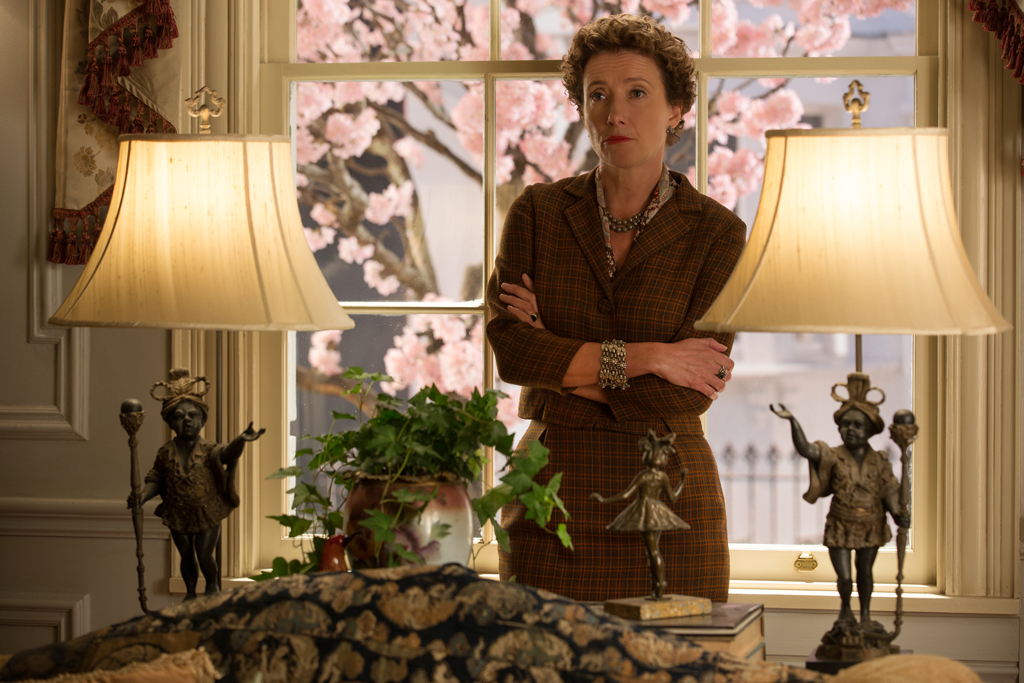
Given a moment to reflect, Travers is not amused.
Immediately Travers is portrayed as impossible. But doesn’t she have the right to ask people to respect her work, whatever her personality? The name “Mary Poppins” does, indeed, give us a different impression than just Mary. Surely she has the right to impress that upon the storytellers. It sounds wise to me. But the moment is staged to make us laugh at her ridiculousness, and to sympathize immediately with the Disney storytellers who see Mary Poppins as theirs… already!
Disney is portrayed as a longsuffering saint, bent on blessing the world by prying treasure free of the greedy hands of the person who found it, who owns it. Or, as I saw it, he plays a corporate CEO who is so used to getting his way that he’s insulted when a mother won’t easily hand over her dearest child to be despoiled of her lessons and brought up all over again from the beginning to suit his fancy.
I don’t for five minutes believe that this film’s “What Really Happened” story is much like what really happened at all. It’s all too Holly-wood-ified and all-star-cast-ified.
Thompson understands that she’s supposed to play Travers as stubborn and demanding. But when we finally hear Travers’ real voice during the film’s closing credits, we learn just how exaggerated Thompson’s performance has been. She’s played a sort of Saturday-Night-Live caricature. I’m guessing that the filmmakers asked Thompson to watch Downtown Abbey and play Travers the way that Dame Maggie Smith would have played her—furrow-browed, scornful, aloof, stubborn, nose turned up.

NOT. AMUSED.
The whole time, I was left wondering one simple question: If Disney wanted to tell his own version of the story so badly, why not just change the names and tell the story he felt was best? Why must there only be one story about a nanny who comes to help children struggling in a dark and money-corrupted world? People write derivative stories all the time? Why did the film have to have the title, the names, and the direct association with Travers?
One reason: Money. The book was so beloved — so beloved for what it was — that Disney new he’d draw a huge audience if he could exploit that popularity. For all that he’s saying about taking this character that his daughter loves and putting her on the screen, well… he’s not bringing that character or that story to the screen. He’s bringing something quite different altogether.
“You don’t know what she means to me,” Travers tells Disney. And the movie, trying to salvage Disney’s character, gives him intimate moments where he reveals to her that he understands better than she does.
And before the movie is over, we’ll see her weeping in ecstasy as the movie breaks her heart with its beauty.
That is not what happened, apparently.
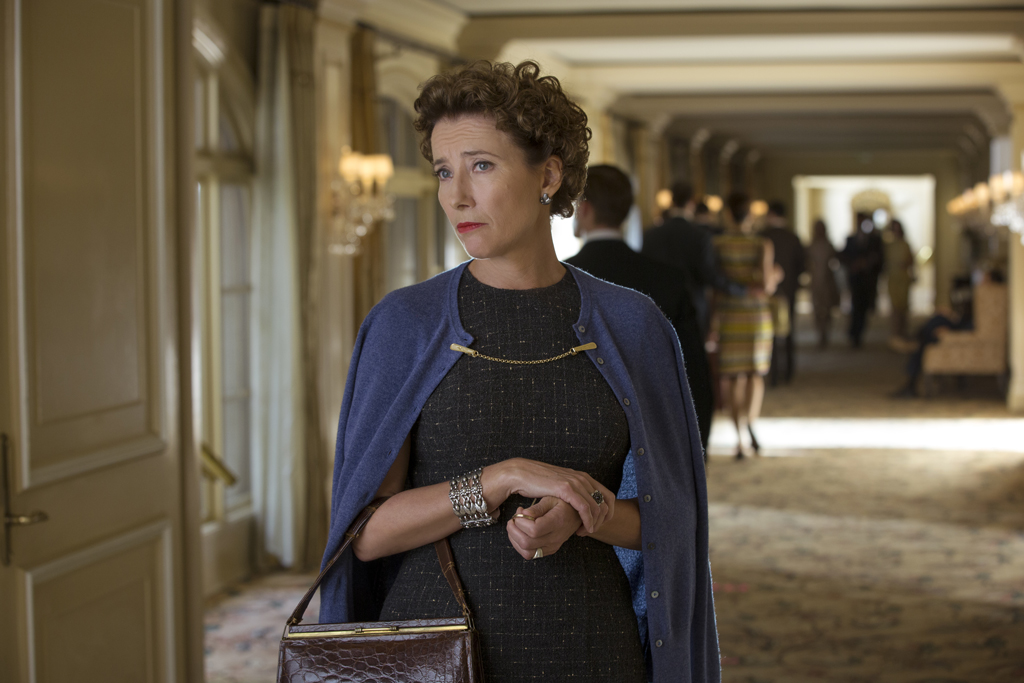
Travers the Unamused.
I’m all for artistic license, but not when the studio rewrites history to glorify its namesake at the expense of someone else. Here is a Disney movie telling us that the wrong-headed artist finally caved in and bowed down to him, when Travers reportedly wept through the movie because she was so upset about having her child ripped from her hands and brought up to be something quite contrary to her wishes.
Steven Greydanus is far more forgiving in his attitude toward this film than I can be, but he does say,
Saving Mr. Banks is history written by the winner: a Disney movie that regales us with just how ridiculously hard a prickly, capricious British authoress made it for our Uncle Walt to bring us Julie Andrews and Dick Van Dyke in one of the most beloved family films of all time.
Walt won that war of wills and Disneyfied Mary Poppins; now, adding insult to injury, he’s Disneyfied her creator, playing her abrasive personality for laughs as well as making her more conventional than she seems to have been. Travers has become a ridiculous creature of fun, just as she feared Mary Poppins would be. The closer Saving Mr. Banks is to history, which I suspect is not very, the more deeply it would doubtless have enraged Travers.
Perhaps if you love Disney’s Mary Poppins, you can shake your head indulgently at Travers’ misguided efforts to thwart the cinematic apotheosis of her magical nanny: Some people just don’t know what’s good for them. I confess I’ve never fallen under Mary Poppins’ spell, either on the screen or on the page, but for what it’s worth, my sympathies are rather more with Travers than with Disney.
Read more: http://www.ncregister.com/daily-news/sdg-reviews-saving-mr-banks#ixzz30aqyy3lV
And I find myself nodding along with Amy Nicholson as she writes:
Why does it matter that Saving Mr. Banks sabotages its supposed heroine? Because in a Hollywood where men still pen 85 percent of all films, there’s something sour in a movie that roots against a woman who asserted her artistic control by asking to be a co-screenwriter. (Another battle she lost — Mary Poppins‘ opening credits list Travers as merely a “consultant.”) Just as slimy is the sense that this film, made by a studio conglomerate in a Hollywood dominated by studio conglomerates, is tricking us into cheering for the corporation over the creator. We take sides because we can’t imagine living in a world without the songs the Sherman brothers wrote for the film: “Let’s Go Fly a Kite,” “Feed the Birds,” “Chim Chim Cher-ee.” We wouldn’t have had to either way; if Mary Poppins had collapsed, Walt planned to package up the songs wholesale for Bedknobs and Broomsticks.
Saving Mr. Banks would have been a meaningful contribution to the Disney legacy if it had actually portrayed P.L. Travers. But Richard Brody concludes:
Travers’s life left plenty of fascinating backstory for Hancock and his screenwriters to explore. But by narrowing it to her childhood in Australia, they elide the underlying cultural conflict between her and Disney—the age-old confrontation between art and commerce, between uninhibited personal expression and commercial bowdlerization—and reduced it to a story of two adults who still have issues with their fathers.
Travers would have been right to suspect that Hollywood—and, especially, Disney—could never show anything like intimate life as she knew it to be. Had “Saving Mr. Banks” shown Travers in all her complexity, it would have redeemed the studio’s honor—would have proven that a family-friendly movie could expand its definition of family to embrace those which, formerly, were beyond the studios’ purview. It would have been a vision of progress—or, dare I say, of hope. Instead, perversely, the movie of 2013 reënacts the willful omissions, the moralistic elisions from a movieland more than half a century old.
It would be very easy to create a Cape Fear-like “Fake Trailer” for this film in which Travers is a wounded, panic-stricken artist struggling to escape Disney the Stalker Businessman. That’s the movie I’d rather see, actually. It would be far more interesting. It would also be, unlike Saving Mr. Banks, based on true story.
Instead, what we get is It’s supercalifragilisticexpiali-shameless. A spoonful can help the medicine go down, but it can also trick audiences into swallowing a lie.
The biggest shame of all is that this is how Disney squandered our opportunity to see Tom Hanks play Walt Disney. He’s perfect for the part. And with the right script, they could have made an extraordinary film about one of history’s most influential imaginations.
Previous Post

May 9, 2014
Forget Twilight: These Are My Favorite Vampires
Next Post

May 11, 2014 Ten Years Ago Today...
Browse Our Archives
Select a Category Blog Bloggers on "Through a Screen Darkly" Browser Coming Soon Endorsements Fiction Books Film Forum Film Reviews Inspirations Interviews Journal Kindlings Muse Movie buzz Music Reviews Non-Fiction Books radio Reviewers on "Through a Screen Darkly" The Auralia Thread Through a Screen Darkly Through a Screen Darkly - Bonus Materials Top 10 (or 20 or 100) lists Uncategorized
Select a Month June 2015 May 2015 April 2015 March 2015 February 2015 January 2015 December 2014 November 2014 October 2014 September 2014 August 2014 July 2014 June 2014 May 2014 April 2014 March 2014 February 2014 January 2014 December 2013 November 2013 October 2013 September 2013 August 2013 July 2013 June 2013 May 2013 April 2013 March 2013 February 2013 January 2013 December 2012 November 2012 October 2012 September 2012 August 2012 July 2012 June 2012 May 2012 April 2012 March 2012 February 2012 January 2012 December 2011 November 2011 October 2011 September 2011 August 2011 July 2011 June 2011 May 2011 April 2011 March 2011 February 2011 January 2011 December 2010 November 2010 October 2010 September 2010 August 2010 July 2010 June 2010 May 2010 April 2010 March 2010 February 2010 January 2010 December 2009 November 2009 October 2009 September 2009 August 2009 July 2009 June 2009 May 2009 April 2009 March 2009 February 2009 January 2009 December 2008 November 2008 October 2008 September 2008 August 2008 July 2008 June 2008 May 2008 April 2008 March 2008 February 2008 January 2008 December 2007 November 2007 October 2007 September 2007 August 2007 July 2007 June 2007 May 2007 April 2007 March 2007 February 2007 January 2007 December 2006 November 2006 October 2006 September 2006 August 2006 July 2006 June 2006 May 2006 April 2006 March 2006 February 2006 January 2006 December 2005 November 2005 October 2005 September 2005 August 2005 July 2005 June 2005 May 2005 April 2005 March 2005 February 2005 January 2005 December 2004 November 2004 October 2004 September 2004 August 2004 July 2004 June 2004 May 2004 April 2004 July 2003 May 2003 March 2003 September 1999
Follow Us!
TAKE THE
Religious Wisdom Quiz
What Roman road was Paul traveling when he encountered Jesus?
Select your answer to see how you score.
Jericho Road Corinthian Way Roman Forum Road Damascus Road
Related posts from Looking Closer

This Is Not Goodbye. But It is... See...



What Specialists Are Saying About Jurassic World
TRENDING AT PATHEOS Religious Music & Entertainment

"Les Diabolique" and Transgression
Alongside something like Arrival, Vertigo, or Charade, Les Diaboliques is a...

"The Plague Dogs" and Mortality
So, flashback to the late 70s, early 80s. Walt Disney Studios is...

With the recent and highly successful release of Christopher Nolan’s epic film,...

"L'avventura" and Human Weakness
Today's piece is going to be a little different for a few...

I first want to apologize for not posting or writing anything. I'm...

I've engaged in the multi-year project of reading through the Church Fathers,...
view all Religious Music & Entertainment blogs
Ad-Free & Subscriber Log-In Subscription Support
- About Us
- 2026 Calendar
- Videos
- Podcasts
- Library of World Religions
- Faith In Media Tracker
- Advertise With Us
- Write for Us
- Privacy Policy
- Terms of Service
- Do Not Sell My Data
- Contact Us
- Radiant Digital
- Manage Newsletter Subscriptions
- Unsubscribe From Notifications
- Sitemap
Copyright 2008-2026, Patheos. All rights reserved.
Subscription Support Ad-Free & Subscriber Log-In
Follow Patheos