
BuddhistCatholicContemplativeEvangelicalGeneral ChristianHinduJewishLatter-day SaintMuslimNew VisionsProgressive Christian
Beliefs
- Buddhist
- Catholic
- Contemplative
- Evangelical
- General Christian
- Hindu
- Jewish
- Latter-day Saint
- More Voices
- Muslim
- New Visions
- Pagan
- Progressive Christian
Topics
- Religion News
- Food and Religion
- Sports and Religion
- Religious Art
- Religious Music and Entertainment
- Religious Events
- History and Religion
- Style and Religion
- Politics and Religion
- Women in Religion
- Recreation Outdoors and Religion
- Business Finance and Religion
- Careers Workplace and Religion
- Education and Religion
- Family Parenting and Religion
- Health Fitness and Religion
- Home and Religion
- Relationships and Religion
- Technology and Religion
- Travel and Religion
Columnists
- Buddhist Columnists
- Business Finance and Religion Columnists
- Careers Workplace and Religion Columnists
- Catholic Columnists
- Contemplative Columnists
- Education and Religion Columnists
- Evangelists Columnists
- Family Parenting and Religion Columnists
- General Christian Columnists
- Health Fitness and Religion Columnists
- Hindu Columnists
- History and Religion Columnists
- Home and Religion Columnists
- Jewish Columnists
- More Voices Columnists
- Latter Day Columnists
- Muslim Columnists
- New Visions Columnists
- Nonreligious Columnists
- Pagan Columnists
- Politics and Religion Columnists
- Progressive Columnists
- Recreation Outdoors and Religion Columnists
- Relationships and Religion Columnists
- Religion News Columnists
- Religious Art Columnists
- Religious Events Columnists
- Religious Music and Entertainment Columnists
- Sports and Religion Columnists
- Style and Religion Columnists
- Technology and Religion Columnists
- Travel and Religion Columnists
- Women in Religion Columnists
Resource Library
- 2026 Calendar
- Library of World Religions
- The 100 Most Holy Places on Earth
- Patheos Answers
- Podcasts
- Videos
- Faith Leaders Database
- Anglican Episcopalian
- Bahai
- Baptist
- Buddhism
- Christianity
- Confucianism
- Eastern Orthodoxy
- Hinduism
- Holiness and Pentecostal
- ISKCON
- Islam
- Judaism
- Lutheran
- Methodist
- The Church of Jesus Christ of Latter-day Saints
- New Age
- Paganism
- Presbytarian and Reformed
- Protestantism
- Religion Behind the Scenes
- Roman Catholic
- Scientology
- Shia Islam
- Sikhism
- Sufism
- Sunni Islam
- Taoism
- Zen
- See all religions
Research Tools
 Ad-Free & Subscriber Log-In Subscription Support
Ad-Free & Subscriber Log-In Subscription Support
Follow Patheos 

- Trending:
- Forgiveness
- |
- Marriage
- |
- Consciousness
- |
- Death Penalty
- |
- Election
- |
- Halloween
 Looking Closer
- Home
- Religious Music & Entertainment
- Inside Llewyn Davis (2013)
Inside Llewyn Davis (2013)
Last updated on: December 21, 2013 at 12:28 pm by Jeffrey Overstreet
Inside Llewyn Davis (2013) 2013-12-21T12:28:07-07:00 Jeffrey Overstreet
Patheos Explore the world's faith through different perspectives on religion and spirituality! Patheos has the views of the prevalent religions and spiritualities of the world.
 He stares into the camera, so shaken by the beauty of the music he’s just discovered that he appears to be in anguish. This music, he says, was “filled with such longing, such unfulfillable longing, it had me trembling.”
His name is Salieri, and in Milos Forman’s beloved film Amadeus, he is played by F. Murray Abraham.
Why am I talking about Amadeus when this is supposed to be a review of Inside Llewyn Davis? Stay with me. It’s important.
I first saw Amadeus when I was fourteen, and it really rattled my teenage mind. For the first time, a movie made me ponder how the most sublime art can burst like fireworks from the minds of criminals, losers, and fools — while those who hold the power, the keys to fame and fortune, have a tendency to either corrupt, exploit, or fail to recognize genius. Wolfgang Amadeus’s glorious art brought out the worst in Salieri, who had dedicated his life to music. He despised this intolerable party animal who was, in his opinion, unfairly blessed. He jealously sought to ruin him. In the end, Salieri became a champion of mediocrities around the world.
Critics around the globe are heralding the new film by the Coen brothers as a masterpiece — and some are even calling it the best picture of 2013. But I wonder what Salieri would have thought of it.
Would he have laughed, thinking of Wolfgang, as he watched Llewyn Davis, a talented folk musician, suffer one misfortune after another? Davis is a fine example, after all, of someone who shines in the spotlight, but lives a miserable life in the shadows beyond. Or would Salieri have sympathized, relating to Davis’s doomed attempts to break through and become a success?
For many months before it opened to raves at the Cannes Film Festival, film enthusiasts have been buzzing about how Joel and Ethan Coen were setting their new film in 1961, in Greenwich Village. The possibilities were intriguing, as that’s the time and place when folk music broke through the barriers of commercial pop music, led by Bob Dylan and other inspired voices, to become a powerful force in American culture. Rumor had it that the film would be loosely based on the life of a towering figure in that chapter of American music: Dave Von Ronk.
Although the Coens admit that Von Ronk did influence their thinking as they crafted this, their sixteenth film, no — despite all the buzz, this is not a celebration of legendary figures or a nostalgia trip. It’s something quite unexpected.
Sure, it’s full of fantastic music, masterfully produced by T-Bone Burnett and performed with effortless grace by a remarkable cast that includes Justin Timberlake, Carey Mulligan, and Adam Driver. And in the sharp contrasts between what was popular in 1961 and the gutsier, rough-edged style that was about to break through, we can see why America needed a musical revolution.
But ultimately, even though one important historical figure does make an appearance at the end of the movie, Inside Llewyn Davis is primarily a character study. In fact, of the Coens’ sixteen films, only The Man Who Wasn’t There is so focused on a single figure. The Coens have told many stories of losers and fools stumbling through hard times, but they rein in their wilder, wackier impulses here. Inside Llewyn Davis mopes its way through bogs of bitter irony and murky misfortune, its melancholy enhanced by the muted colors of Bruno Delbonnel’s exquisite cinematography.
In fact, for a film that almost qualifies as a musical, this is the quietest Coen brothers movie. Rather than making a stylistic sequel to O Brother Where Art Thou?, they’ve dialed down their famously quick and idiosyncratic dialogue so much that this film feels strangely heavy, smoky, and spacious.
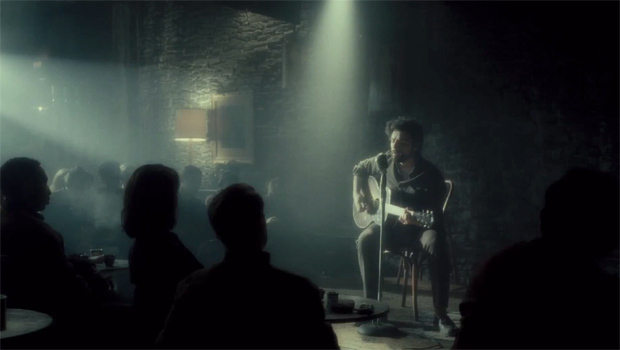
 Most of the heavy silences reflect the deepening despair of Llewyn himself. Llewyn, played by Oscar Isaac in a tremendous performance, often looks like the iconic American folk musician, striding through album-cover-art environments with his guitar — his weapon, his talisman, his reason for living — in one hand, and an orange tabby cat in the other.
Llewyn places his hopes in that guitar. It seems to be the only thing he has to offer the world: skillful, poignant music and soulful songs about loss and death. It’s also the only meaningful way he knows to earn his keep, or at least to try and pay his debts. The only other option available to him, it seems, is to join the merchant marines.
But the cat is just as important. The cat is a burden that Davis carries with him — an accident, a mistake, a loose end that he just can’t seem to tie up. And we learn that there are plenty of those in his life. As half of a promising duo, Llewyn enjoyed some fleeting attention; but that magical musical partnership ended tragically, and the loss has become the core of the black hole in Llewyn’s heart. Now he works for an agent who doesn’t do him any good. Given a chance to sign on for future royalties on a session recording, and he chooses to take quick cash instead… a choice he’ll come to regret.
And the worst of his problems are related to women.
Especially one woman: Jean (Carey Mulligan in a fierce performance). Jean, the wife of Llewyn’s friend Jim, is pregnant, and she thinks Llewyn is the father. Hell hath no fury like the wrath of an ambitious folk-singer woman who finds herself “in trouble,” and Llewyn, being a bastard on almost every level, is quick to recommend an abortion… something he’s clearly done before.
When Llewyn sings, we want to see him succeed. When he does just about anything else, we want to punch him in the face. (Don’t worry. Someone does.)
As usual, the Coens are not interested in telling fairy tales. They’re interested in losers. They’re interested in busting up American myths. In other films, they’ve demonstrated that they believe in love and they believe in grace. But they also believe in the wages of sin, and Llewyn seems incapable of decisions that would steer him onto a better path.
Reflecting on the movie, I recalled the words of Orson Welles: “I think the ‘self’ is a kind of enemy. My work is what enables me to come out of myself. I like what I do, not what I am. … Do you know the best service anyone could render to art? Destroy all biographies. Only art can explain the life of a man — and not the contrary.”
I think Llewyn would agree. You can see it in his face as he runs from his responsibilities; as he borrows money from people he’s quick to hurt; as he listens to a heroin-poisoned jazz man (John Goodman playing his ugliest character yet) mock the music he lives by. Llewyn’s life is not worth living… not unless he can sing. And when he sings, he’s carried up outside of himself, elevated by the beauty.
Will he ever get to do for a living that thing he believes is his purpose? Will he ever be appreciated the way he was when his partner was around?
As he trudges in snow-soaked shoes into Chicago, he pins his hopes on a meeting with an influential club owner — a gatekeeper named Grossman.
Grossman. This is the moment toward which the whole film has been moving. Llewyn has played unrewarding gigs. He’s been a session guitarist for painfully cheesy pop tunes. But now he gets to pour out his heart and soul for an industry gatekeeper.
Grossman.
Grossman… played by F. Murray Abraham.
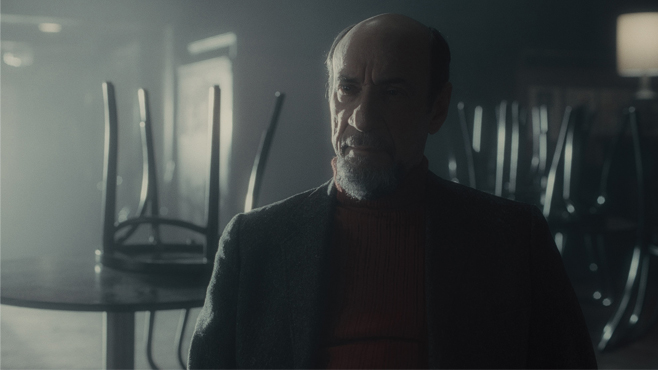 You can’t tell me that the Coens weren’t smiling when they cast Abraham in the role. There he is — Salieri — alive in 1961 like some kind of demon! Does he reach out to this suffering singer? Does he jealously complicate his progress? Or is he dedicated to a system that exalts mediocrity and kicks beauty in the gut?
I’ll let you find out what happens.
Grossman’s response rings out like an explosion. But don’t overlook the performance that provokes it. Llewyn sings like his life depends on it. His voice may not be a marvel, but it can be as melancholy as dusk and as bright and clear as a February morning. He may be a fool. He may be a disaster. But he can turn pain into glory.
Idolizing artists seems as American as pledging allegiance to the flag. But it’s a distraction. The music is what matters. Inside Llewyn Davis reminds us of that. It also reminds us that such vivid expressions of longing catch our attention because they sometimes come from those who are carrying the most pain, the most desperation for salvation… from the dead ends of the world and the folly of their own hearts.
In the end, the artist is — to steal from the big-deal song of the season — “just a reflector.”
Or, as Annie Dillard wrote in Holy the Firm, “There is no such thing as an artist: there is only the world, lit or unlit as the light allows. When the candle is burning, who looks at the wick? When the candle is out, who needs it? But the world without light is wasteland and chaos, and a life without sacrifice is abomination.”
If there is any hope for Llewyn Davis, it’s that his art will bring him some illumination. Or at least a paying gig.
Previous Post

December 19, 2013
Looking Closer's Last-Minute Christmas Gift Recommendations
Next Post

December 25, 2013 Her (2013): An All-Thumbs Review
Browse Our Archives
Select a Category Blog Bloggers on "Through a Screen Darkly" Browser Coming Soon Endorsements Fiction Books Film Forum Film Reviews Inspirations Interviews Journal Kindlings Muse Movie buzz Music Reviews Non-Fiction Books radio Reviewers on "Through a Screen Darkly" The Auralia Thread Through a Screen Darkly Through a Screen Darkly - Bonus Materials Top 10 (or 20 or 100) lists Uncategorized
Select a Month June 2015 May 2015 April 2015 March 2015 February 2015 January 2015 December 2014 November 2014 October 2014 September 2014 August 2014 July 2014 June 2014 May 2014 April 2014 March 2014 February 2014 January 2014 December 2013 November 2013 October 2013 September 2013 August 2013 July 2013 June 2013 May 2013 April 2013 March 2013 February 2013 January 2013 December 2012 November 2012 October 2012 September 2012 August 2012 July 2012 June 2012 May 2012 April 2012 March 2012 February 2012 January 2012 December 2011 November 2011 October 2011 September 2011 August 2011 July 2011 June 2011 May 2011 April 2011 March 2011 February 2011 January 2011 December 2010 November 2010 October 2010 September 2010 August 2010 July 2010 June 2010 May 2010 April 2010 March 2010 February 2010 January 2010 December 2009 November 2009 October 2009 September 2009 August 2009 July 2009 June 2009 May 2009 April 2009 March 2009 February 2009 January 2009 December 2008 November 2008 October 2008 September 2008 August 2008 July 2008 June 2008 May 2008 April 2008 March 2008 February 2008 January 2008 December 2007 November 2007 October 2007 September 2007 August 2007 July 2007 June 2007 May 2007 April 2007 March 2007 February 2007 January 2007 December 2006 November 2006 October 2006 September 2006 August 2006 July 2006 June 2006 May 2006 April 2006 March 2006 February 2006 January 2006 December 2005 November 2005 October 2005 September 2005 August 2005 July 2005 June 2005 May 2005 April 2005 March 2005 February 2005 January 2005 December 2004 November 2004 October 2004 September 2004 August 2004 July 2004 June 2004 May 2004 April 2004 July 2003 May 2003 March 2003 September 1999
Follow Us!
TAKE THE
Religious Wisdom Quiz
Who killed Goliath the giant?
Select your answer to see how you score.
Adam David Moses Joseph
Related posts from Looking Closer

This Is Not Goodbye. But It is... See...


What Specialists Are Saying About Jurassic World

Torres and the Influence of David Bazan and...
TRENDING AT PATHEOS Religious Music & Entertainment

"Les Diabolique" and Transgression
Alongside something like Arrival, Vertigo, or Charade, Les Diaboliques is a...

"The Plague Dogs" and Mortality
So, flashback to the late 70s, early 80s. Walt Disney Studios is...

With the recent and highly successful release of Christopher Nolan’s epic film,...

"L'avventura" and Human Weakness
Today's piece is going to be a little different for a few...

I first want to apologize for not posting or writing anything. I'm...

I've engaged in the multi-year project of reading through the Church Fathers,...
view all Religious Music & Entertainment blogs
Ad-Free & Subscriber Log-In Subscription Support
- About Us
- 2026 Calendar
- Videos
- Podcasts
- Library of World Religions
- Faith In Media Tracker
- Advertise With Us
- Write for Us
- Privacy Policy
- Terms of Service
- Do Not Sell My Data
- Contact Us
- Radiant Digital
- Manage Newsletter Subscriptions
- Unsubscribe From Notifications
- Sitemap
Copyright 2008-2026, Patheos. All rights reserved.
Subscription Support Ad-Free & Subscriber Log-In
Follow Patheos