
BuddhistCatholicContemplativeEvangelicalGeneral ChristianHinduJewishLatter-day SaintMuslimNew VisionsProgressive Christian
Beliefs
- Buddhist
- Catholic
- Contemplative
- Evangelical
- General Christian
- Hindu
- Jewish
- Latter-day Saint
- More Voices
- Muslim
- New Visions
- Pagan
- Progressive Christian
Topics
- Religion News
- Food and Religion
- Sports and Religion
- Religious Art
- Religious Music and Entertainment
- Religious Events
- History and Religion
- Style and Religion
- Politics and Religion
- Women in Religion
- Recreation Outdoors and Religion
- Business Finance and Religion
- Careers Workplace and Religion
- Education and Religion
- Family Parenting and Religion
- Health Fitness and Religion
- Home and Religion
- Relationships and Religion
- Technology and Religion
- Travel and Religion
Columnists
- Buddhist Columnists
- Business Finance and Religion Columnists
- Careers Workplace and Religion Columnists
- Catholic Columnists
- Contemplative Columnists
- Education and Religion Columnists
- Evangelists Columnists
- Family Parenting and Religion Columnists
- General Christian Columnists
- Health Fitness and Religion Columnists
- Hindu Columnists
- History and Religion Columnists
- Home and Religion Columnists
- Jewish Columnists
- More Voices Columnists
- Latter Day Columnists
- Muslim Columnists
- New Visions Columnists
- Nonreligious Columnists
- Pagan Columnists
- Politics and Religion Columnists
- Progressive Columnists
- Recreation Outdoors and Religion Columnists
- Relationships and Religion Columnists
- Religion News Columnists
- Religious Art Columnists
- Religious Events Columnists
- Religious Music and Entertainment Columnists
- Sports and Religion Columnists
- Style and Religion Columnists
- Technology and Religion Columnists
- Travel and Religion Columnists
- Women in Religion Columnists
Resource Library
- 2026 Calendar
- Library of World Religions
- The 100 Most Holy Places on Earth
- Patheos Answers
- Podcasts
- Videos
- Faith Leaders Database
- Anglican Episcopalian
- Bahai
- Baptist
- Buddhism
- Christianity
- Confucianism
- Eastern Orthodoxy
- Hinduism
- Holiness and Pentecostal
- ISKCON
- Islam
- Judaism
- Lutheran
- Methodist
- The Church of Jesus Christ of Latter-day Saints
- New Age
- Paganism
- Presbytarian and Reformed
- Protestantism
- Religion Behind the Scenes
- Roman Catholic
- Scientology
- Shia Islam
- Sikhism
- Sufism
- Sunni Islam
- Taoism
- Zen
- See all religions
Research Tools
 Ad-Free & Subscriber Log-In Subscription Support
Ad-Free & Subscriber Log-In Subscription Support
Follow Patheos 

- Trending:
- Forgiveness
- |
- Marriage
- |
- Consciousness
- |
- Death Penalty
- |
- Election
- |
- Halloween
 Looking Closer
- Home
- Religious Music & Entertainment
- What’s “The Most Cinematic Movie” Ever Made?
What’s “The Most Cinematic Movie” Ever Made?
Last updated on: October 31, 2013 at 3:45 pm by Jeffrey Overstreet
What’s “The Most Cinematic Movie” Ever Made? 2013-10-31T15:45:29-06:00 Jeffrey Overstreet
Patheos Explore the world's faith through different perspectives on religion and spirituality! Patheos has the views of the prevalent religions and spiritualities of the world.
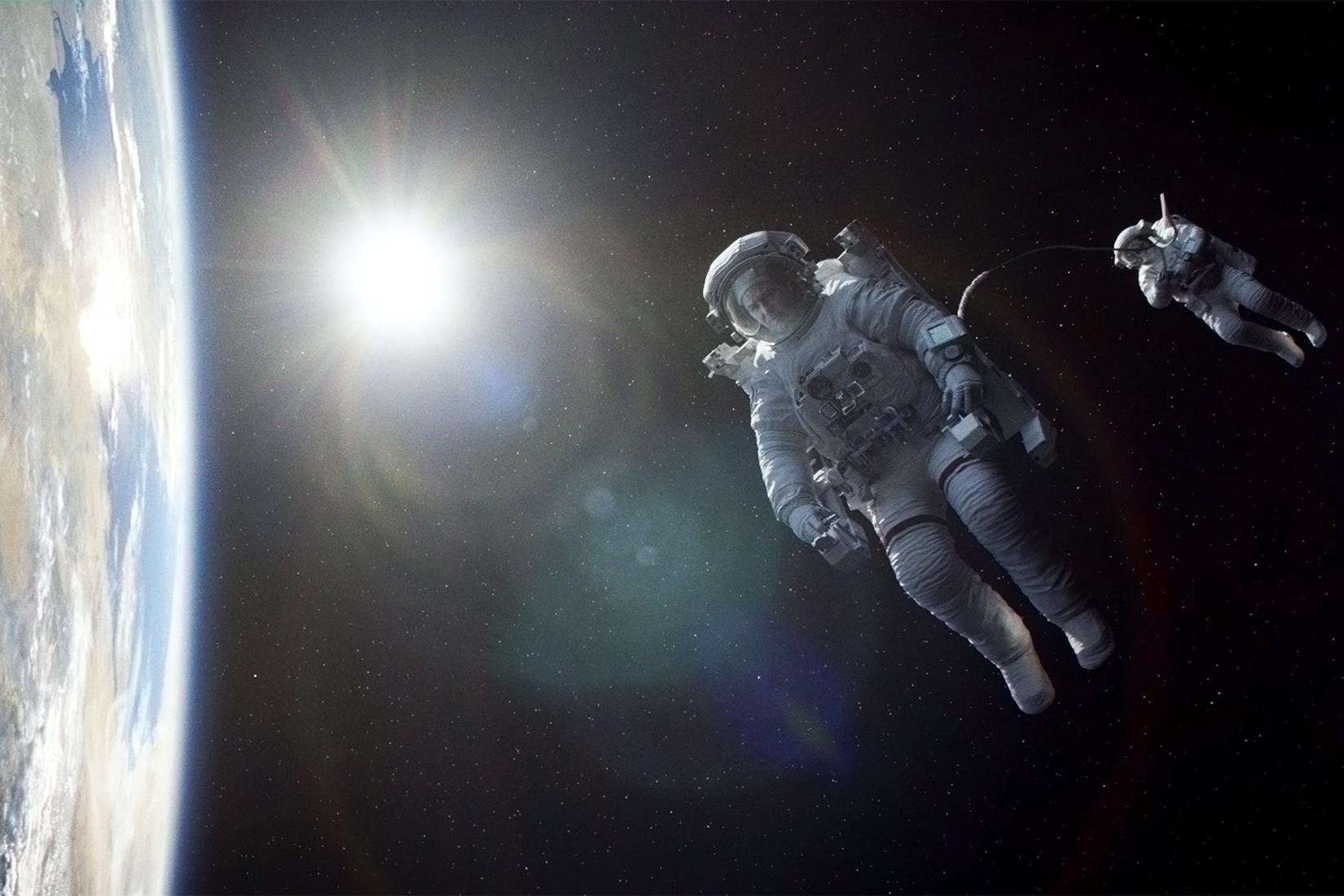 A popular voice in Christian media recently described Alfonso Cuarón’s movie Gravity by saying “If only because it is the most purely cinematic non-animated movie ever made, Gravity deserves to go down in history.”
I’m not quite sure what to make of that statement. I suspect that the moviegoer was expressing a sense that Gravity offers something only cinema can accomplish — an experience possible only through immersive imagery — and I can agree with that.
But the most purely cinematic movie ever made?
Can such a claim be persuasively made? By anybody?
I doubt it. It’s difficult to make absolute statements about something as mysterious and subjective as a work of art. We’d have to agree on the definition of “cinematic.” Further, we’d have to determine our frame of reference, with a capacity for sifting through all of international cinema history. To make such a statement, one would have to be extremely familiar with film history, and with the wild array of cinematic offerings from around the world year by year.
This year alone, I can think of other films that feel every bit as “cinematic” as Gravity… perhaps even more so. But again, I’m not in the position to make that call.
What would you nominate as “the most purely cinematic movie ever”? You’re invited to share your favorites in the Comments below. (Remember this blog’s Comments Policy.)
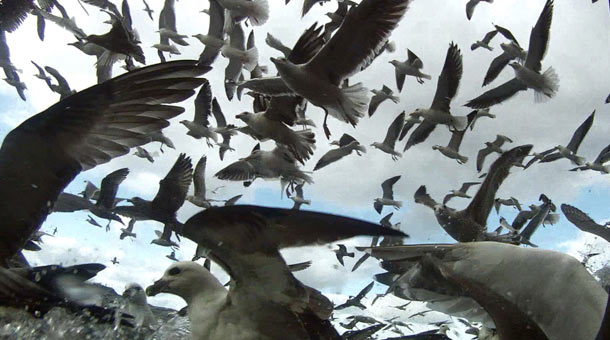 I suspect that those with the patience and the willingness to endure and explore Leviathan may find it to be just as immersive at Gravity, just as intense, just as pregnant with implications and questions and challenges and ideas… if not more so. (Personally, I found it far more interesting, more enthralling, and much stranger than Gravity. It didn’t just take me into environments quite foreign to me, where the laws of physics test the capacity for human beings to adjust and survive. It took me there through perspectives foreign to a human being’s point of view. It expanded the stock of vicarious experience available to the audience in ways no other experience could. Moreover, Leviathan is an experience that operates untethered from a narrative, whereas Gravity, for all of its overwhelming imagery, is pretty much a formulaic “This Happened, and Then This Happened” survival story.
I would also argue that two more 2013 releases — Shane Carruth’s Upstream Color and Terrence Malick’s To the Wonder — are just as “cinematic” as Gravity, because they make meaning by asking us to attend to the composition of images and to the poetic implications established by editing. Their questions and implications can only be perceived by a studious attention to how the images are made.
 Nevertheless, I wouldn’t call Leviathan, Upstream Color, or To the Wonder “the most cinematic movie ever made.” What could such a statement possibly mean? How would we verify it? What does “cinematic” really mean?
Cinema is, by the definitions that make sense to me, not fundamentally about narrative. It is about imagery — about the composition and sequencing of images (moving images or otherwise) — that encourages us to consider associations, tensions, juxtapositions, and correlations between them.
You can take away a traditional narrative and still have a movie.
You can take away sound and still have a movie.
But if you take away a juxtaposition of images, you can’t have a movie.
Cinema can be plot-driven or poetic. It can be didactic or abstract. It can be feature-length or fleeting. It can be silent or a “talkie.” But it must engage the eyes with images — no exceptions.
(To this end, Matt Zoller Seitz has provocatively argued that an animated GIF is, actually, cinema.)
In view of these distinctions, Stanley Kubrick’s 2001: A Space Odyssey — a movie to which many film critics are comparing Gravity — strikes me as even more “cinematic.” In that film, much is suggested by the alignment of contrasting and correlating imagery.

When it comes to movies about space travel and loss*,* Andrei Tarkovsky’s 1972 science fiction film Solaris is probably going to rate higher on the “cinematic” scale with most film scholars than Gravity.
The groundbreaking 1929 film Man With a Movie Camera seems to me to be an important landmark in the history of cinema, in that it’s one of the earliest films I’ve encountered that giddily explores, discovers, demonstrates, and celebrates what is possible in a “musical” assemblage of images. By “musical” I’m not referring to its soundtrack, but to the rhythms and rushes of its myriad images.
And, along the same lines, the slideshow qualities of Chris Marker’s 1962 short called La Jetée seem to me more “cinematic” than Terry Gilliam’s thoroughly enjoyable (and far more accessible) version of the same story — 12 Monkeys. The meaning of La Jetée is conveyed by its unique form… in how the succession of still pictures specifically challenge our understanding of lived experience and memory, and in how they set us up for a moment in which one image is fundamentally different in form from the rest. By contrast, the imagery in 12 Monkeys enhances its narrative, but the narrative is the film’s raison d’être and foundation.
 To this end, the great director Raul Ruiz, who made Mysteries of Lisbon and Night Across the Street, wrote this in his second volume in his Poetics of Cinema:
What we have seen is something new, something the art of memory could not have foreseen: images striving for their independence. They aim to make themselves noticeable, to have greater worth than that of being a mere sign. As they say in my country: ‘They are telling themselves their own story.’ Well, that and not much else is what happens in a film, when we shift our attention from the course that the narration proposes, and allow ourselves to be carried away by the involuntary associations that proliferate among images.
(Thanks to Ryan Holt for sharing this quote on Facebook.)
Along the same lines, director Peter Greenaway has said,
I suppose, my general sense of anxiety and disquiet about the cinema we’ve got after 100 years — a cinema which is predicated on text. So whether your name is Spielberg or Scorsese or Godard, there’s always a necessity to start with text and finish with image. I don’t think that’s particularly where we should organize an autonomous art form. That’s why I think that, in a way, we haven’t seen the cinema yet, all we’ve seen is 100 years of illustrated text.
This resonates with what I have begun to suspect about most of the movies I have seen in my life: They have entertained me, dazzled me, distracted me, and occasionally caused me to feel something or think about something. But rarely have they startled me into an aggressive and involving participation. Rarely have they made me think about what I am seeing.
And that is something that cinema can do. Uniquely.
This line of thinking has helped me understand my diminishing interest in so much commercial filmmaking. In American big-screen entertainment, the big screen is used primarily as a space to fill with pictures that merely illustrate what is happening in the storytelling. The pictures themselves are there to entertain the senses rather than to intrigue us. We’re not often invited to think about why an image looks the way it does, or why the director set one kind of image in sequence with another kind of image. We’re not inspired to consider the possibility that there is something more to realize than what the characters are talking about, or than what the script suggests will happen next in the story.
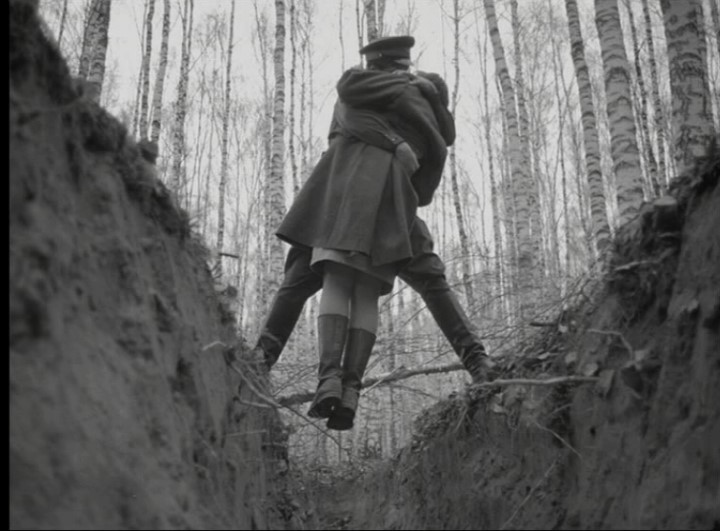 By contrast, I am falling in love with films that are teaching me to look closer, to discover a foreign language that can convey truths, create experiences, and evoke emotions that the derivative, shallow, unimaginative, and (yes) abusive imagery of so much American media cannot begin to accomplish.
I like what director Wim Wenders has said:
… I think of films the same way I looked at stories in books, when I was little. I realized very early on that the story was not in the written words, but in the space between the lines. That’s where the real reading took place: In my imagination, and that happened in all the white between the letters and the lines. And when I started to see films, I approached them the same way. In fact those films allowed me to perceive them like that, they were asking me to dream myself into them. The classic American cinema has that same specific quality, and this is also the great tradition of European Cinema. I did not invent that “method”. It is an endangered process, though, these days. More and more films come as “wall to wall” entertainment. What you see (and hear!) is what you get. No more space between the frames, so to speak. No chance to sneak in with your imagination, to dream on and to project your innermost hopes or fears or desires into what you see and thereby pushing it further. You come out of the theatre and feel strangely empty. For two hours you were prevented from participating. You were obliged to “witness” instead.
Now, don’t get me wrong — I love storytelling as much as the next moviegoer. There’s nothing wrong with a well-illustrated text.
I’ve just seen director Steve McQueen’s new film 12 Years a Slave, and it uses imagery and dialogue to powerfully illustrate a narrative in a very prose-y fashion (although there are moments in which the imagery draws attention to itself — or rather, into itself — in a way that can only be described as “poetic”). This story has been told in writing for many years, but the big screen adaptation is very impressive.
But I think that the hyperventilation I’m witnessing among so many moviegoers who have just seen Gravity is evidence of the fact that moviegoers have become conditioned to accept a very tepid form of filmmaking. I’m not saying Gravity is “tepid,” but the superlatives used to describe it suggest that moviegoers just haven’t seen much evidence of what cinema can be and do. When they see something that is “cinematic” — and yes, as American blockbusters go, Gravity is quite cinematic — they feel things they haven’t ever felt before, and they sense that they’ve experienced something unique.
This is promising.
Perhaps it means that moviegoers will begin to realize what is uniquely possible in cinema. And they’ll start to notice that a lot of filmmakers, around the world and throughout history, have been making a kind of art that goes generally misunderstood, misinterpreted, and unappreciated.
They’ll make a leap equivalent to the radio listener who discovers that music is actually a much larger and more powerful world than just Top 40 songs. They may even come to see that Top 40 pop songs are actually a rather limited, even feeble, demonstration of what music is capable of achieving.
Or, put it this way: Having tasted an “Spicy Thai Salad” at a diner like Denny’s, they may learn that while they enjoyed this unconventional meal, they should not immediately conclude that this was the best representation of Thai food. They might actually become curious enough, and courageous enough, to venture into Thai restaurants and enjoy new worlds of cuisine that others have been attentively enjoying for ages.
American cineplexes usually invite us to wading pools. Those who broaden their horizons will find much larger bodies of water waiting for them. Those lakes, those seas, those oceans go by exotic names — like Denis, and Malick, and Hou, and Kiarostami, and Kieslowski, and Godard, and Tarkovsky, and Bresson, and Ozu, and Dreyer. And oceans are not a new innovation. Some of them have been out there, welcoming explorers, for a long, long time.
In view of this, what strikes you as the “most cinematic” movies you have seen?
Previous Post

October 28, 2013
Did You Name Your Pet After a Movie Character?
Next Post

November 2, 2013 12 Years a Slave (2013)
Browse Our Archives
Select a Category Blog Bloggers on "Through a Screen Darkly" Browser Coming Soon Endorsements Fiction Books Film Forum Film Reviews Inspirations Interviews Journal Kindlings Muse Movie buzz Music Reviews Non-Fiction Books radio Reviewers on "Through a Screen Darkly" The Auralia Thread Through a Screen Darkly Through a Screen Darkly - Bonus Materials Top 10 (or 20 or 100) lists Uncategorized
Select a Month June 2015 May 2015 April 2015 March 2015 February 2015 January 2015 December 2014 November 2014 October 2014 September 2014 August 2014 July 2014 June 2014 May 2014 April 2014 March 2014 February 2014 January 2014 December 2013 November 2013 October 2013 September 2013 August 2013 July 2013 June 2013 May 2013 April 2013 March 2013 February 2013 January 2013 December 2012 November 2012 October 2012 September 2012 August 2012 July 2012 June 2012 May 2012 April 2012 March 2012 February 2012 January 2012 December 2011 November 2011 October 2011 September 2011 August 2011 July 2011 June 2011 May 2011 April 2011 March 2011 February 2011 January 2011 December 2010 November 2010 October 2010 September 2010 August 2010 July 2010 June 2010 May 2010 April 2010 March 2010 February 2010 January 2010 December 2009 November 2009 October 2009 September 2009 August 2009 July 2009 June 2009 May 2009 April 2009 March 2009 February 2009 January 2009 December 2008 November 2008 October 2008 September 2008 August 2008 July 2008 June 2008 May 2008 April 2008 March 2008 February 2008 January 2008 December 2007 November 2007 October 2007 September 2007 August 2007 July 2007 June 2007 May 2007 April 2007 March 2007 February 2007 January 2007 December 2006 November 2006 October 2006 September 2006 August 2006 July 2006 June 2006 May 2006 April 2006 March 2006 February 2006 January 2006 December 2005 November 2005 October 2005 September 2005 August 2005 July 2005 June 2005 May 2005 April 2005 March 2005 February 2005 January 2005 December 2004 November 2004 October 2004 September 2004 August 2004 July 2004 June 2004 May 2004 April 2004 July 2003 May 2003 March 2003 September 1999
Follow Us!
TAKE THE
Religious Wisdom Quiz
What does "Naphtali" mean in Hebrew?
Select your answer to see how you score.
God is my rock The Lord is my strength My struggle Chosen One
Related posts from Looking Closer

This Is Not Goodbye. But It is... See...


What Specialists Are Saying About Jurassic World

Torres and the Influence of David Bazan and...
TRENDING AT PATHEOS Religious Music & Entertainment

"Les Diabolique" and Transgression
Alongside something like Arrival, Vertigo, or Charade, Les Diaboliques is a...

"The Plague Dogs" and Mortality
So, flashback to the late 70s, early 80s. Walt Disney Studios is...

With the recent and highly successful release of Christopher Nolan’s epic film,...

"L'avventura" and Human Weakness
Today's piece is going to be a little different for a few...

I first want to apologize for not posting or writing anything. I'm...

I've engaged in the multi-year project of reading through the Church Fathers,...
view all Religious Music & Entertainment blogs
Ad-Free & Subscriber Log-In Subscription Support
- About Us
- 2026 Calendar
- Videos
- Podcasts
- Library of World Religions
- Faith In Media Tracker
- Advertise With Us
- Write for Us
- Privacy Policy
- Terms of Service
- Do Not Sell My Data
- Contact Us
- Radiant Digital
- Manage Newsletter Subscriptions
- Unsubscribe From Notifications
- Sitemap
Copyright 2008-2026, Patheos. All rights reserved.
Subscription Support Ad-Free & Subscriber Log-In
Follow Patheos