
BuddhistCatholicContemplativeEvangelicalGeneral ChristianHinduJewishLatter-day SaintMuslimNew VisionsProgressive Christian
Beliefs
- Buddhist
- Catholic
- Contemplative
- Evangelical
- General Christian
- Hindu
- Jewish
- Latter-day Saint
- More Voices
- Muslim
- New Visions
- Pagan
- Progressive Christian
Topics
- Religion News
- Food and Religion
- Sports and Religion
- Religious Art
- Religious Music and Entertainment
- Religious Events
- History and Religion
- Style and Religion
- Politics and Religion
- Women in Religion
- Recreation Outdoors and Religion
- Business Finance and Religion
- Careers Workplace and Religion
- Education and Religion
- Family Parenting and Religion
- Health Fitness and Religion
- Home and Religion
- Relationships and Religion
- Technology and Religion
- Travel and Religion
Columnists
- Buddhist Columnists
- Business Finance and Religion Columnists
- Careers Workplace and Religion Columnists
- Catholic Columnists
- Contemplative Columnists
- Education and Religion Columnists
- Evangelists Columnists
- Family Parenting and Religion Columnists
- General Christian Columnists
- Health Fitness and Religion Columnists
- Hindu Columnists
- History and Religion Columnists
- Home and Religion Columnists
- Jewish Columnists
- More Voices Columnists
- Latter Day Columnists
- Muslim Columnists
- New Visions Columnists
- Nonreligious Columnists
- Pagan Columnists
- Politics and Religion Columnists
- Progressive Columnists
- Recreation Outdoors and Religion Columnists
- Relationships and Religion Columnists
- Religion News Columnists
- Religious Art Columnists
- Religious Events Columnists
- Religious Music and Entertainment Columnists
- Sports and Religion Columnists
- Style and Religion Columnists
- Technology and Religion Columnists
- Travel and Religion Columnists
- Women in Religion Columnists
Resource Library
- 2026 Calendar
- Library of World Religions
- The 100 Most Holy Places on Earth
- Patheos Answers
- Podcasts
- Videos
- Faith Leaders Database
- Anglican Episcopalian
- Bahai
- Baptist
- Buddhism
- Christianity
- Confucianism
- Eastern Orthodoxy
- Hinduism
- Holiness and Pentecostal
- ISKCON
- Islam
- Judaism
- Lutheran
- Methodist
- The Church of Jesus Christ of Latter-day Saints
- New Age
- Paganism
- Presbytarian and Reformed
- Protestantism
- Religion Behind the Scenes
- Roman Catholic
- Scientology
- Shia Islam
- Sikhism
- Sufism
- Sunni Islam
- Taoism
- Zen
- See all religions
Research Tools
 Ad-Free & Subscriber Log-In Subscription Support
Follow Patheos 

- Trending:
- Advent
- |
- Forgiveness
- |
- Thanksgiving
- |
- Election
- |
- Seasonal Holidays
- |
- Marriage
 Looking Closer
- Home
- Religious Music & Entertainment
- The Counselor (2013)
The Counselor (2013)
Last updated on: October 26, 2013 at 7:34 pm by Jeffrey Overstreet
The Counselor (2013) 2013-10-26T19:34:10-06:00 Jeffrey Overstreet
Patheos Explore the world's faith through different perspectives on religion and spirituality! Patheos has the views of the prevalent religions and spiritualities of the world.
 Did your plans go wrong? Did a deal go bad?
No matter. You can outwit the devil. You can get away clean. You just need the right stuff. Cleverness. Strength. Resourceful friends. Enough money. Slick gadgetry. A holster at your hip. Courage and charm. Oh — and an escape route, in case you need to disappear. Don’t worry… you can untangle yourself, learn from your mistakes, and start fresh.
This is America, after all. For those who get wise and pull themselves up by their bootstraps, this is the land of second chances.
That’s what the movies tell us. Over and over again. The best way to manage in a world of bad men with guns is to become a good man with a gun. Doesn’t the Bible tell us we can overcome evil with good — or at least with good intentions?
And if you’re really good, you can look cool doing it.
Cormac McCarthy does not believe that.
McCarthy’s human beings may be catch occasional glimpses of grace — but it’s always in the distance, unreachable on the darkling plain between birth and death. His stories are not about decent men falling into trouble and then extracting themselves in the nick of time… because he doesn’t believe that there are any good men to begin with. (And more power to him!) His spectrum of humanity ranges from the dangerously naive, who live in denial of the darkness around and within them, to the wholeheartedly barbaric. We’re either bloodthirsty predator or panic-stricken prey.
If we dare to place our hopes in something beyond the frame of human influence, a dream of benevolence waiting for us out there in the dark, then we might find some strength to serve a higher cause… but don’t expect to see that make much of a difference in the here and now.
As he has made clear in stories like No Country for Old Men and The Road, he sees a world being perpetually sucked into a black hole of evil. Any belief that we can do something to stop it… “That’s vanity.” In No Country, he troubled moviegoers by suggesting that a central character — an opportunist who took money from a crime scene — was as expendable as any nameless bad-guy henchman in a shootout. There are no heroes, McCarthy suggested. There are only antiheroes. And no matter how sympathetic they might be, no matter how well-intentioned or guilty by association, they’re likely to end up as roadkill on evil’s merciless highway.
Innocents? There aren’t any. But even those who believe in love will die miserably in the hands of villains so cruel that they are capable of doing anything. You don’t want to know what human beings will do to one another, he says. You really don’t. And then he shows us anyway. And we, the despairing audience, are left fumbling about in the dark
As my colleague Dr. Jeff Keuss observed in a recent lecture, the men of Cormac McCarthy stories almost always end up on their knees, weeping, grasping at the earth as if trying to return to the dust they came from. (And Keuss hasn’t even seen The Counselor yet!)
McCarthy’s skepticism — no, his cynicism — about humankind runs so deep that the titular character in his new screenplay, The Counselor — which has been swiftly realized for the big screen by the legendary director Ridley Scott — seems to be anything but a “counselor.” He’s never actually named. Everyone calls him “Counselor.” And yet he seems to be receiving counsel from one questionable source after another almost every time he appears on screen.
As played by Michael Fassbender, this counselor is a lawyer who seems to have stepped right out of a Vanity Fair fashion ad. Scott Tobias at The Dissolve rightly describes him as “nameless and purposefully generic, like the world’s most handsome paper sack.” Playful in the sheets with Laura (Penelope Cruz, playing sexy and dumb), he emanates movie star charm and confidence. But after the title card fades, his sense of cool goes flat faster than cafeteria soda. He looks hollow and lost.
Hoping to find an engagement ring for Laura — one with a rock as impressive as his igorance — he consults a diamond expert (Bruno Ganz, scene-stealing as usual). The jeweler teaches him that diamonds are ultimately defined by their flaws. That sound you hear — it’s English majors reaching for their highlighters to underline this passage as important.

Diaz and Cruz — one’s a cheetah, one’s prey.
But how can the debt-burdened Counselor afford such a rock? Easy. A fellow like him, suave and connected and worldly wise, should be able to pull off a one-time drug trafficking deal with a Ciudad Juárez cartel.
But his collaboration with Reiner, a wealth-happy El Paso crime lord (Javier Bardem, hamming it up), brings him under the influence of Reiner’s malevolent girlfriend, Malkina (Cameron Diaz), who has her tentacles in all kinds of sordid affairs. Apparently the criminal underworld has a theme song: a sick and twisted version of “It’s a Small World.” And when the Counselor tries to help an incarcerated client (Rosie Perez in a sassy, long-overdue return to the screen), he learns just how small the world really is.
It’s almost funny, how stupefied the Counselor seems when he realizes that deals with the devil can, yes, go badly. But the laughs won by McCarthy’s script are painful. The wages of sin in this world are so severe, they’ll make you pity all victims, no matter how “clean” or “dirty” they might seem.
Watching The Counselor, the first story McCarthy has written directly for the screen, I felt a strange fascination watching movie stars who are well-known for their onscreen swagger, charisma, and cool, playing those familiar notes in a story that shows up the emptiness and futility of ego. “Cool” in McCarthy-land is only self-deception, ultimately absurd.
That the film is captured by one of cinema’s Masters of Cool speaks to the power of McCarthy’s script. No matter how atmospheric, textured, and scrumptious Ridley Scott’s images become — and they are often glorious in this film — McCarthy refuses to let us get carried away with aesthetic enjoyment. He wants to horrify us. He succeeds. This is one of only four films in Scott’s catalog of more than twenty in which I’ve felt that the script’s substance lives up to — even surpasses — the seductive qualities of its imagery. (The other three I admire, if you’re curious, are Matchstick Men, Blade Runner, and Alien.) For all of the aesthetically immersive flamboyance of last year’s sci-fi epic Prometheus, this McCarthy adaptation takes us to a far more frightening, and even alien, place — the America we don’t want to see.
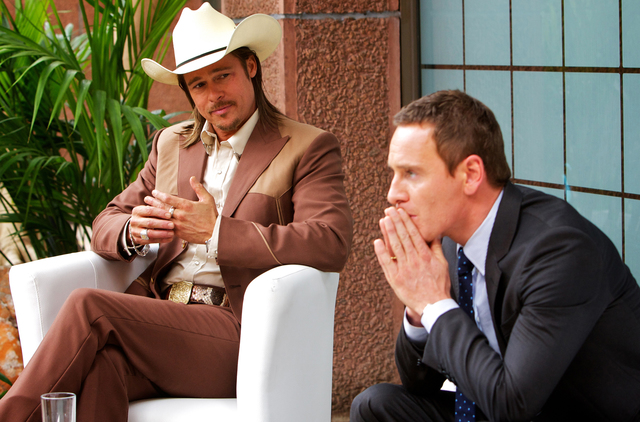
After all, here we have a self-proclaimed Counselor who needs an influx of cash to settle debts (like America) which will lead him to make “risky” deals (like America) that really aren’t so risky… because they’re certain to go badly. Even the coolest gambler in the business (played here by Brad Pitt with self-aware cool), who talks about the necessity of an escape plan, is a fool. Thus the Counselor (like America) plays into game that has no winners, losing his capital (like America), and falling from any moral high ground (like America). There’s nothing he can do but watch himself and his loved ones slowly sucked into evil’s insatiable appetite, a black hole personified by Malkina.
To some extent, he (like America) has himself to blame. But does it matter? Even innocents seem doomed to suffer violence in McCarthy’s world. And in ours.
In other stories, McCarthy has suggested the possibility of hope. But it’s beyond the frame of this valley of death. We can sense it in dreams, perhaps — a mysterious and transcendent source of grace. And that may be small comfort for those of us in trouble now.
We need movies like this. They show up all of those movies that have sought to inspire us with stories about men who, caught in a compromise, bravely seek to correct their wrongs and pry themselves free of the influence of villains.
This is what most impressed me about Steven Soderbergh’s thriller Side Effects, in which a Cary Grant-ish Jude Law played a fellow who, realizing the implications of his morally compromised state, sought to fight back, to shut down the villains, to regain his family, and to set himself free to enjoy the “happiness” of his upper class privilege again. But his methods were corrupt. And in the last act of the film, everything took on a strangely satirical edge — as if we could have a happy ending only if we acknowledged its artificiality. In The Counselor, there’s no such allowance for wishful thinking. Once you’ve logged on to evil’s network, even for a moment, to achieve an honorable end, you cannot wipe your hard drive, you cannot stop the viruses you’ve downloaded, and you will never be able to escape the devil’s program. And you would probably have been taken down anyway.
Thus, The Counselor is a truthful diagnosis about the wages of sin in this world. It’s unpleasant, humbling, even appalling. But it’s necessary.
There are a lot of “key moments” in this film, but one that stands out as most important to me: The scene in which Malkina asks the naive, lovesick Laura if she wants to know what her gaudy engagement ring diamond costs. Laura — strangely fearful — insists that she doesn’t want to know how much her dream is costing anybody. Of course, she doesn’t. Men as suave and rich and charming as the Counselor cannot be the Dream Husband — it’s a fantasy. On some level, Laura knows she’s been seduced by a man with devilry in his rakish grin. And his compromises have been expensive. She doesn’t want to know what this ring has already cost him. And she really, really doesn’t want to know what it will cost him.
Is the Counselor’s “love story” a glimpse of a better path? “Laura” means “light,” after all. Surely McCarthy knows that.
But as a vision of a higher, more rewarding path, this love story seems sentimental, superficial, and sex-obsessed. It’s primarily a physical intimacy achieved through poorly placed trust and flattery. Laura comes across as a pretty little fool, lacking the substantial virtues and beauty of heart that we saw in No Country for Old Men‘s tender-hearted Carla. Carla had the stuff to shake the even the devil’s confidence. By contrast, Laura’s just a gullible fool drowning in Denial (the murkiest river, as the joke goes).
The film’s biggest problem with The Counselor is that it belongs to the character of Malkina, and that part has been given to Cameron Diaz. Malkina’s the “Jaws” in a sea of sharks, lesser predators, bottom-feeders, and krill. Diaz is aging spectacularly, becoming a gargoyle of Hollywood beauty, her face spectacularly lined, her monstrous smile increasingly Grinch-ian in its writhing elasticity. No special effects wizard could have imagined her. In her already famous sex-with-a-car scene, she throws herself with wild abandon into a dance that demonstrates the inevitable end of consumerism — self-indulgence that terrifies even her witless boyfriend. Watching Reiner and Malkina sit back, sip martinis, and enjoy the sight of cheetahs hunting jackrabbits, we get the unnerving feeling that we’re watching the One Percent smugly watching FOX News reports about the bungled, the botched, and the poor.
And yet, while Diaz looks the part, she never convinces us that lines as literary as these could come from Malkina’s forked tongue. McCarthy’s dialogue takes on a certain ponderousness that asks us to accept McCarthy’s vision as something more than “realism.” Perhaps Angelina Jolie, the actress first sought after for this role, could have pulled it off. 20 years ago, Lena Olin would have been absolutely perfect. And I would have given anything to see Juliette Binoche add this character to her collection. I’m not sure, though… we might not have an actress right now who could achieve it. Marion Cotillard, perhaps?
Is there any glimmer of hope at all? Is there any offer of true friendship? If by “friendship” we mean “someone willing to die for us,” then… no. Not in this film’s cast of characters.
Do you believe there’s anyone out there willing to die for you? It’s a question that hangs over the movie. Perhaps the priest, played by Edgar Ramirez, could address that question. But no one asks him. Malkina, visiting a confessional for the first time, can’t think of anything to do but boast about how bad she’s been. To his credit, the priest gets up and walks away. He refuses to participate in such exhibitionism, such lurid and inappropriate sensationalism.
McCarthy seems to sympathize with the priest. He knows that if he’s not careful, stories of smooth-talking con artists and glamorous criminals will become seductive. Thus, having Ridley Scott at the helm, he poses the audience with a challenge. Will be be swept away by the way Scott aestheticizes greed, power, and violence? If we are, then we’re in Malkina’s court, savoring the sight of killers chasing down prey. Malkina’s made a heaven of hell. If we follow her example, we’re proving McCarthy’s worst speculations to be true.
No, this is not more of the trendy Tarantino revelry in nastiness and violence. This is a true horror film. Like David Fincher’s Se7en, one of this movie’s closest spiritual cousins, The Counselor ultimately delivers a diagnosis that tells the awful truth. And the Counselor doesn’t want to know it. He really, really doesn’t want to know.

Next Post

October 27, 2013 Farewell to Lou Reed
Browse Our Archives
Select a Category Blog Bloggers on "Through a Screen Darkly" Browser Coming Soon Endorsements Fiction Books Film Forum Film Reviews Inspirations Interviews Journal Kindlings Muse Movie buzz Music Reviews Non-Fiction Books radio Reviewers on "Through a Screen Darkly" The Auralia Thread Through a Screen Darkly Through a Screen Darkly - Bonus Materials Top 10 (or 20 or 100) lists Uncategorized
Select a Month June 2015 May 2015 April 2015 March 2015 February 2015 January 2015 December 2014 November 2014 October 2014 September 2014 August 2014 July 2014 June 2014 May 2014 April 2014 March 2014 February 2014 January 2014 December 2013 November 2013 October 2013 September 2013 August 2013 July 2013 June 2013 May 2013 April 2013 March 2013 February 2013 January 2013 December 2012 November 2012 October 2012 September 2012 August 2012 July 2012 June 2012 May 2012 April 2012 March 2012 February 2012 January 2012 December 2011 November 2011 October 2011 September 2011 August 2011 July 2011 June 2011 May 2011 April 2011 March 2011 February 2011 January 2011 December 2010 November 2010 October 2010 September 2010 August 2010 July 2010 June 2010 May 2010 April 2010 March 2010 February 2010 January 2010 December 2009 November 2009 October 2009 September 2009 August 2009 July 2009 June 2009 May 2009 April 2009 March 2009 February 2009 January 2009 December 2008 November 2008 October 2008 September 2008 August 2008 July 2008 June 2008 May 2008 April 2008 March 2008 February 2008 January 2008 December 2007 November 2007 October 2007 September 2007 August 2007 July 2007 June 2007 May 2007 April 2007 March 2007 February 2007 January 2007 December 2006 November 2006 October 2006 September 2006 August 2006 July 2006 June 2006 May 2006 April 2006 March 2006 February 2006 January 2006 December 2005 November 2005 October 2005 September 2005 August 2005 July 2005 June 2005 May 2005 April 2005 March 2005 February 2005 January 2005 December 2004 November 2004 October 2004 September 2004 August 2004 July 2004 June 2004 May 2004 April 2004 July 2003 May 2003 March 2003 September 1999
Follow Us!
TAKE THE
Religious Wisdom Quiz
My hair held my strength, but a woman's betrayal led to my capture and blindness. Who am I?
Select your answer to see how you score.
Absalom Samson Gideon Saul
Related posts from Looking Closer

This Is Not Goodbye. But It is... See...


What Specialists Are Saying About Jurassic World
TRENDING AT PATHEOS Religious Music & Entertainment

A Christian, a Narnia Fan, and a Filmmaker...
Watching The Narnia Trailer As A Fan And A Filmmaker Ever since...

Great Spiritual Horror Films of the 20th Century...
For the Christian, horror movies are often troubling—and many would say that...

"Les Diabolique" and Transgression
Alongside something like Arrival, Vertigo, or Charade, Les Diaboliques is a...

"The Plague Dogs" and Mortality
So, flashback to the late 70s, early 80s. Walt Disney Studios is...

With the recent and highly successful release of Christopher Nolan’s epic film,...

"L'avventura" and Human Weakness
Today's piece is going to be a little different for a few...
view all Religious Music & Entertainment blogs
Ad-Free & Subscriber Log-In Subscription Support
- About Us
- 2026 Calendar
- Videos
- Podcasts
- Library of World Religions
- Faith In Media Tracker
- Advertise With Us
- Write for Us
- Privacy Policy
- Terms of Service
- Do Not Sell My Data
- Contact Us
- Radiant Digital
- Manage Newsletter Subscriptions
- Unsubscribe From Notifications
- Sitemap
Copyright 2008-2026, Patheos, part of the Radiant Digital network of media brands. All rights reserved.
Subscription Support Ad-Free & Subscriber Log-In
Follow Patheos