
BuddhistCatholicContemplativeEvangelicalGeneral ChristianHinduJewishLatter-day SaintMuslimNew VisionsProgressive Christian
Beliefs
- Buddhist
- Catholic
- Contemplative
- Evangelical
- General Christian
- Hindu
- Jewish
- Latter-day Saint
- More Voices
- Muslim
- New Visions
- Pagan
- Progressive Christian
Topics
- Religion News
- Food and Religion
- Sports and Religion
- Religious Art
- Religious Music and Entertainment
- Religious Events
- History and Religion
- Style and Religion
- Politics and Religion
- Women in Religion
- Recreation Outdoors and Religion
- Business Finance and Religion
- Careers Workplace and Religion
- Education and Religion
- Family Parenting and Religion
- Health Fitness and Religion
- Home and Religion
- Relationships and Religion
- Technology and Religion
- Travel and Religion
Columnists
- Buddhist Columnists
- Business Finance and Religion Columnists
- Careers Workplace and Religion Columnists
- Catholic Columnists
- Contemplative Columnists
- Education and Religion Columnists
- Evangelists Columnists
- Family Parenting and Religion Columnists
- General Christian Columnists
- Health Fitness and Religion Columnists
- Hindu Columnists
- History and Religion Columnists
- Home and Religion Columnists
- Jewish Columnists
- More Voices Columnists
- Latter Day Columnists
- Muslim Columnists
- New Visions Columnists
- Nonreligious Columnists
- Pagan Columnists
- Politics and Religion Columnists
- Progressive Columnists
- Recreation Outdoors and Religion Columnists
- Relationships and Religion Columnists
- Religion News Columnists
- Religious Art Columnists
- Religious Events Columnists
- Religious Music and Entertainment Columnists
- Sports and Religion Columnists
- Style and Religion Columnists
- Technology and Religion Columnists
- Travel and Religion Columnists
- Women in Religion Columnists
Resource Library
- 2026 Calendar
- Library of World Religions
- The 100 Most Holy Places on Earth
- Patheos Answers
- Podcasts
- Videos
- Faith Leaders Database
- Anglican Episcopalian
- Bahai
- Baptist
- Buddhism
- Christianity
- Confucianism
- Eastern Orthodoxy
- Hinduism
- Holiness and Pentecostal
- ISKCON
- Islam
- Judaism
- Lutheran
- Methodist
- The Church of Jesus Christ of Latter-day Saints
- New Age
- Paganism
- Presbytarian and Reformed
- Protestantism
- Religion Behind the Scenes
- Roman Catholic
- Scientology
- Shia Islam
- Sikhism
- Sufism
- Sunni Islam
- Taoism
- Zen
- See all religions
Research Tools
 Ad-Free & Subscriber Log-In Subscription Support
Ad-Free & Subscriber Log-In Subscription Support
Follow Patheos 

- Trending:
- Forgiveness
- |
- Marriage
- |
- Consciousness
- |
- Death Penalty
- |
- Election
- |
- Halloween
 Looking Closer
- Home
- Religious Music & Entertainment
- Constantine (2005): Remembering a Movie I’d Rather Forget
Constantine (2005): Remembering a Movie I’d Rather Forget
Last updated on: September 28, 2013 at 12:13 pm by Jeffrey Overstreet
Constantine (2005): Remembering a Movie I’d Rather Forget 2013-09-28T12:13:00-06:00 Jeffrey Overstreet
Patheos Explore the world's faith through different perspectives on religion and spirituality! Patheos has the views of the prevalent religions and spiritualities of the world.
 2013 UPDATE: This just in — the DC comic book character Constantine is about to make a comeback.
Warner Bros. TV and DC Comics are on a roll this development season with a third high-profile project.Constantine, a drama based on the characters in DC Comics’ John Constantine stories, has sold to NBC with penalty. It is written/executive produced by The Mentalist executive producer Daniel Cerone and David S. Goyer, the go-to writer for Warner Bros.’ feature DC adaptations. Constantine centers on John Constantine, an enigmatic and irreverent con man-turned-reluctant supernatural detective who is thrust into the role of defending us against dark forces from beyond.
Reason to rejoice? Hardly.
My experience with the Constantine phenomenon was a bitter one. Some of you who were already reading my reviews back in 2005 may remember it.
Somehow, studios convinced a Christian media company to market the big-budget fantasy movie Constantine to Christian audiences as if it was going to be some kind of substantially theological event. Instead, the movie turned out to be an event that reveled in distortions of Christian theology, iconography, terminology, ideals, and traditions. Even as it made money of gullible Christian audiences (there were even discussion guides for churches), it was laughing all the way to the bank by mocking Christianity and demonstrating a total lack of understanding.
I was reluctant to give the film any attention at all. But somebody had to blow the whistle.
Here’s a souvenir of that experience… my original review of Constantine. It was published in the February 2005 print edition of Christianity Today and on their website. I also participated in interviews with the cast and the director. You can read excerpts from those conversations.
Consider this proof that no amount of sweet-talking, gifts from the studio, expensive accommodations, or attempts to “Christianize” an abomination will persuade me to give something a good review.
The Original CT Review of Constantine
You’d be hard-pressed to find an adventure film that uses as much Christian terminology and symbolism as Constantine. You’d have a tougher time finding one that’s makes a bigger mess of it.
Director Francis Lawrence’s stylish, adrenaline-fueled adaptation of the comic book Hellblazer will probably win some enthusiastic fans among Christian moviegoers keen on pop culture. After all, this hero seeks redemption, fights Satan, entertains angels, and blasts demons with weapons that bear the mark of the Cross (from the blessed brass knuckles to a golden crucifix-Tommy gun). But if you’re looking for profound spiritual exploration, this isn’t your movie. Nor is it a fun hodgepodge of magical fairy tales like Harry Potter. It’s an R-rated immersion in the vocabulary of demon possession and the occult. Compared with Constantine, The Exorcist seems like an after-school special.

John Constantine (Keanu Reeves) is a suit-and-tie exorcist and a chain smoker. He’s been to hell and back—literally. Committing suicide, he plunged himself into Satan’s clutches, only to be resuscitated back to the land of the living. Why suicide? John grew up with the “gift” of seeing spiritual warfare around him: screaming demons, angels with enormous wings, and “half-breeds” — agents clad in human flesh who act as influence peddlers serving to nudge people either heavenward or to the abyss. You’d think his taste of brimstone would have convinced him to repent. But no — John’s too proud, too resentful. Instead he’ll try to earn salvation as a volunteer demon hunter on the streets of Los Angeles.
It’s a bad time to be a soldier in the spirit wars. In a sequence that recalls The Return of the King‘s prologue, a talisman called the Spear of Destiny corrupts and transforms the man who discovers it. This menacing villain marches toward L.A., desolation in his wake, preparing to unleash a new devil that will upset “the balance” in the struggle of heaven versus hell.
When John discovers that demons are breaking the rules of engagement and coming through into the physical world, his colleagues don’t believe him: “We’re finger puppets to them, not doorways.” But John knows better. He sets out on a quest with three purposes: to help a police investigator (Rachel Weisz as Angela Dodson) unravel the mystery of her sister’s murder; to avert the coming apocalypse; and to stop the spread of his terminal lung cancer. (In The Matrix, Keanu knew kung fu. Here, he has coughing fits.)

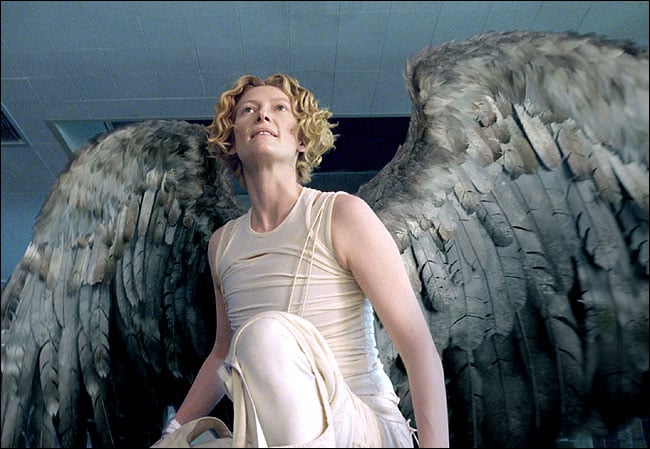
John gets help from a cocky apprentice named Chas (Shia LeBeouf from Holes) who wants to “get off the bench” and into the game of spiritual warfare; an alcoholic priest (Pruitt Taylor Vince) who scans spiritual wavelengths for psychic murmurings; and a relic collector (Max Baker) who lives in a bowling alley. But other colleagues confuse matters. A nightclub manager called Midnite (Djimon Hounsou) claims to be neutral, but he happily gives hell-spawn a place to party. Gabriel, an androgynous, “half-breed” angel (Tilda Swinton), is less than angelic.
And yet Gabriel alone has some grasp of the exorcist’s theological blind spots. He (she?) reminds John that salvation cannot be earned through good works. When John asks what God expects, Gabriel replies, “The usual. Self-sacrifice. Belief.” John knows the value of repentance; he lectures a demon (rock star Gavin Rossdale) on the subject. But his grudge against the Almighty is too strong. “God’s just a child with an anthill,” he declares. “He has no plan.”
Constantine touches on many things that Christians hold to be true: the battle between forces seeking to save or to ruin souls, the reality of demonic possession, the responsibility that comes with God-given gifts. Lawrence and his screenwriters Kevin Brodbin and Frank Cappello do not identify themselves as particularly religious (although Cappello says he has a Lutheran background). They score some points for trying. But they’d have avoided embarrassing errors if they’d consulted with some Bible readers.
First Corinthians has chapters, not “acts.”
Jesus died as a result of crucifixion, not because a Roman soldier thrust a spear into his side.
A Catholic could have told them that Roman Catholicism does not consign suicide victims to eternity in hell.
 But the film’s preoccupation with jarring violence and distortions of Christian symbolism are truly troubling.
A character undergoes a reverse baptism, awakening to horror. Demons try shoving their way through one woman’s throat and another woman’s womb. The Cross is everywhere, but the Savior who died on it goes unmentioned. Constantine‘s premise makes Jesus’ existence impossible — God and Satan have apparently made a bargain not to intervene on the plane of human existence, using only the power of suggestion instead.
If this movie wants to make claims about the power of the cross, well then… what was Christ, if not God’s most significant intervention into human history?
This question is easily forgotten in the onslaught of frenzied, CGI-generated apocalyptic imagery. Horror movie buffs will enthusiastically absorb the relentless shocks, the showdowns, and the expletive-laced ultimatums. Lawrence’s approach to holding our attention consists of frequent, hushed pauses, followed by explosive assaults to our senses. The camera is at the receiving end of gunfire, punches, blowtorch blasts, and falling bodies. Every few minutes, someone smashes through a mirror, a window, a wall, or a watery surface. One hero half-drowns another. Holy water acts like acid, burning human flesh off demons in disguise. The relentless violence is wearying. By the time Peter Stormare appears in the last act playing the part of Lucifer (Constantine calls him “Lu”), the story has become so convoluted and ridiculous that we can’t take the movie seriously anymore. (Judging from his campy, over-the-top performance, neither can Stormare.)

Fortunately, the storytellers know enough to recognize the need for a Christ figure, even if all they have available is an arrogant, resentful con man with the initials “J.C.” But the conclusion would have been more resonant if we’d learned not just the wages of sin, but the blessings of obedience. It’s a misleading idea that the film presents — good and evil in “balance.” Even so, we get gobs of hell and only a glimmer of heaven.
Constantine is likely to blockbust its way to some sequels. Christian moviegoers who see it might enrich post-viewing discussions by pointing out what Scripture actually says about spiritual warfare and the “full armor of God” (Ephesians 6:10-18). They might point to a God who is not remote, not indifferent, but aggressively benevolent. He never signed a cosmic détente with Satan. Instead, he defeated him by taking the sting from death through the sacrifice and resurrection of an obedient, willing hero.
What Other Critics Are Saying: Excerpts from Christianity Today’s Film Forum
Steven D. Greydanus (Decent Films) is troubled by Constantine‘s glorification of evil. “The contrast between the masculine demons and the androgynous Gabriel subtly reinforces the film’s overall depiction of the forces of darkness as more forceful and virile than the forces of light.” He describes the movie as “a relentless action movie with more ideas than both Matrix sequels put together.”
Christopher Lyon (Plugged In) calls it “a slick, tightly written, but grotesque and deceptive horror flick. What kind of God makes a wager with the devil for human souls? Certainly, a weaker, less caring God than the one presented in the Bible.”
“There’s been a lot of talk about this film representing good and evil,” says Annabelle Robertson (Crosswalk). “What I [saw] was a bizarre portrayal of demonic and the occult, with virtually no representation of God or anything good. Despite a massive marketing campaign to the Christian media … Constantine offers no spiritual or moral value. Unfortunately, it has little cinematic value, either. It’s convoluted, dark and disingenuous. It’s also extremely violent—gratuitously so. Moreover, by attempting to make evil so fascinating, it may tempt many to dabble in the occult.”
Greg Wright (Hollywood Jesus) says, “Constantine often plays like eschatology-as-theme-park-ride. And when it’s all said and done, you may find yourself tired of the—ahem—constantinanity.”
Previous Post

September 26, 2013
Hi 5: Autumn Arrives, Eric Crissman Moves On
Browse Our Archives
Select a Category Blog Bloggers on "Through a Screen Darkly" Browser Coming Soon Endorsements Fiction Books Film Forum Film Reviews Inspirations Interviews Journal Kindlings Muse Movie buzz Music Reviews Non-Fiction Books radio Reviewers on "Through a Screen Darkly" The Auralia Thread Through a Screen Darkly Through a Screen Darkly - Bonus Materials Top 10 (or 20 or 100) lists Uncategorized
Select a Month June 2015 May 2015 April 2015 March 2015 February 2015 January 2015 December 2014 November 2014 October 2014 September 2014 August 2014 July 2014 June 2014 May 2014 April 2014 March 2014 February 2014 January 2014 December 2013 November 2013 October 2013 September 2013 August 2013 July 2013 June 2013 May 2013 April 2013 March 2013 February 2013 January 2013 December 2012 November 2012 October 2012 September 2012 August 2012 July 2012 June 2012 May 2012 April 2012 March 2012 February 2012 January 2012 December 2011 November 2011 October 2011 September 2011 August 2011 July 2011 June 2011 May 2011 April 2011 March 2011 February 2011 January 2011 December 2010 November 2010 October 2010 September 2010 August 2010 July 2010 June 2010 May 2010 April 2010 March 2010 February 2010 January 2010 December 2009 November 2009 October 2009 September 2009 August 2009 July 2009 June 2009 May 2009 April 2009 March 2009 February 2009 January 2009 December 2008 November 2008 October 2008 September 2008 August 2008 July 2008 June 2008 May 2008 April 2008 March 2008 February 2008 January 2008 December 2007 November 2007 October 2007 September 2007 August 2007 July 2007 June 2007 May 2007 April 2007 March 2007 February 2007 January 2007 December 2006 November 2006 October 2006 September 2006 August 2006 July 2006 June 2006 May 2006 April 2006 March 2006 February 2006 January 2006 December 2005 November 2005 October 2005 September 2005 August 2005 July 2005 June 2005 May 2005 April 2005 March 2005 February 2005 January 2005 December 2004 November 2004 October 2004 September 2004 August 2004 July 2004 June 2004 May 2004 April 2004 July 2003 May 2003 March 2003 September 1999
Follow Us!
TAKE THE
Religious Wisdom Quiz
What does Proverbs 22:6 say about training a child?
Select your answer to see how you score.
Train up a child in the way he should go, and when he is old he will not depart from it. Teach a child discipline, and he will live in wisdom. Guide the young, and they will not stumble. Children should be seen and not heard.
Related posts from Looking Closer

This Is Not Goodbye. But It is... See...


What Specialists Are Saying About Jurassic World

Torres and the Influence of David Bazan and...
TRENDING AT PATHEOS Religious Music & Entertainment

"Les Diabolique" and Transgression
Alongside something like Arrival, Vertigo, or Charade, Les Diaboliques is a...

"The Plague Dogs" and Mortality
So, flashback to the late 70s, early 80s. Walt Disney Studios is...

With the recent and highly successful release of Christopher Nolan’s epic film,...

"L'avventura" and Human Weakness
Today's piece is going to be a little different for a few...

I first want to apologize for not posting or writing anything. I'm...

I've engaged in the multi-year project of reading through the Church Fathers,...
view all Religious Music & Entertainment blogs
Ad-Free & Subscriber Log-In Subscription Support
- About Us
- 2026 Calendar
- Videos
- Podcasts
- Library of World Religions
- Faith In Media Tracker
- Advertise With Us
- Write for Us
- Privacy Policy
- Terms of Service
- Do Not Sell My Data
- Contact Us
- Radiant Digital
- Manage Newsletter Subscriptions
- Unsubscribe From Notifications
- Sitemap
Copyright 2008-2026, Patheos. All rights reserved.
Subscription Support Ad-Free & Subscriber Log-In
Follow Patheos