
BuddhistCatholicContemplativeEvangelicalGeneral ChristianHinduJewishLatter-day SaintMuslimNew VisionsProgressive Christian
Beliefs
- Buddhist
- Catholic
- Contemplative
- Evangelical
- General Christian
- Hindu
- Jewish
- Latter-day Saint
- More Voices
- Muslim
- New Visions
- Pagan
- Progressive Christian
Topics
- Religion News
- Food and Religion
- Sports and Religion
- Religious Art
- Religious Music and Entertainment
- Religious Events
- History and Religion
- Style and Religion
- Politics and Religion
- Women in Religion
- Recreation Outdoors and Religion
- Business Finance and Religion
- Careers Workplace and Religion
- Education and Religion
- Family Parenting and Religion
- Health Fitness and Religion
- Home and Religion
- Relationships and Religion
- Technology and Religion
- Travel and Religion
Columnists
- Buddhist Columnists
- Business Finance and Religion Columnists
- Careers Workplace and Religion Columnists
- Catholic Columnists
- Contemplative Columnists
- Education and Religion Columnists
- Evangelists Columnists
- Family Parenting and Religion Columnists
- General Christian Columnists
- Health Fitness and Religion Columnists
- Hindu Columnists
- History and Religion Columnists
- Home and Religion Columnists
- Jewish Columnists
- More Voices Columnists
- Latter Day Columnists
- Muslim Columnists
- New Visions Columnists
- Nonreligious Columnists
- Pagan Columnists
- Politics and Religion Columnists
- Progressive Columnists
- Recreation Outdoors and Religion Columnists
- Relationships and Religion Columnists
- Religion News Columnists
- Religious Art Columnists
- Religious Events Columnists
- Religious Music and Entertainment Columnists
- Sports and Religion Columnists
- Style and Religion Columnists
- Technology and Religion Columnists
- Travel and Religion Columnists
- Women in Religion Columnists
Resource Library
- 2026 Calendar
- Library of World Religions
- The 100 Most Holy Places on Earth
- Patheos Answers
- Podcasts
- Videos
- Faith Leaders Database
- Anglican Episcopalian
- Bahai
- Baptist
- Buddhism
- Christianity
- Confucianism
- Eastern Orthodoxy
- Hinduism
- Holiness and Pentecostal
- ISKCON
- Islam
- Judaism
- Lutheran
- Methodist
- The Church of Jesus Christ of Latter-day Saints
- New Age
- Paganism
- Presbytarian and Reformed
- Protestantism
- Religion Behind the Scenes
- Roman Catholic
- Scientology
- Shia Islam
- Sikhism
- Sufism
- Sunni Islam
- Taoism
- Zen
- See all religions
Research Tools
 Ad-Free & Subscriber Log-In Subscription Support
Ad-Free & Subscriber Log-In Subscription Support
Follow Patheos 

- Trending:
- Forgiveness
- |
- Marriage
- |
- Consciousness
- |
- Death Penalty
- |
- Election
- |
- Halloween
 Looking Closer
- Home
- Religious Music & Entertainment
- The Way, Way Back (2013)
The Way, Way Back (2013)
Last updated on: July 12, 2013 at 12:22 pm by Jeffrey Overstreet
The Way, Way Back (2013) 2013-07-12T12:22:43-06:00 Jeffrey Overstreet
Patheos Explore the world's faith through different perspectives on religion and spirituality! Patheos has the views of the prevalent religions and spiritualities of the world.
 Poor Duncan.
He’s in the way, way back of the family station wagon, looking out the back window at his past… the happy times, when his family was a unit.
What happened to Duncan’s father?
Why is he on a road trip with his mother and her boyfriend?
And why is that volunteer stepfather throwing fuel on the fire of Duncan’s insecurities like some kind of pyromaniac?
Come to think of it, why is Duncan sitting in the back, facing the places he’s been? Maybe he hopes Trent, the middle-aged bully at the wheel, will forget that he exists. Or maybe Trent put him there to make him feel like nothing more than baggage.
And by the way, way: What in the world?! Who drives a station wagon like this anymore? Is this movie set in the late ’70s?
There’s a lot about The Way, Way Back that feels way, way old-fashioned and, thus, way, way predictable. There’s the after-school-special simplicity of its plot. There are the obvious lessons to be learned about coming of age, learning to stand up for yourself (and your mother), and learning to “go your own way.” (Queue the pop-song soundtrack.)
Even more predictable is what critics will say about it. Many will bring down the sledgehammer on its formulaic storytelling. Others, especially those in right-wing media who are more concerned with ethics than artistry, will praise it to high heaven: Finally, a movie that forces a lesson about the evils of divorce and irresponsible parenting!
They’re both right, to a degree. But I’m happy to argue that The Way, Way Back is worth seeing because its first rate cast takes a decent script and makes it way, way better. I’m also happy to affirm its truthful, even courageous insistence on the importance of fidelity and responsible parenting. Ladies and gentlemen, here’s a new flash: Parents who prioritize their own romantic fulfillment over their roles as guides and examples to their children are lighting fuses that will set off explosions that hurt everybody — the children most of all.
But I also cannot deny that, while the movie has some impressive moments, there isn’t a single great moment. While the story makes certain things plain, it’s devoid of visual poetry. It’s one of those movies that basically turns on a camera and documents people saying things.
Thus, it’s not likely to stick with you. It’s sweet, it’s good for you, it’s simplistic and unsurprising, and it vanishes. In other words, it’s one of those summer juice pops that’s designed to make your daily dose of Vitamin C appealing. No harm, no problem, and no big deal.
So… to the story: Trent, Duncan’s stepfather-in-the-running is driving Pam (Duncan’s mom), Duncan, and his own typically self-absorbed teenage daughter Stef to a Cape Cod beach for the summer. That’s where Trent plans to go on romancing Pam. That’s where Stef will sit around being snotty with the local Mean Girls. And that’s where Duncan will fumble around for a reason to exist.
Wow, this kid is so disconcertingly insecure that it’s hard to believe he appears in an American movie. When he isn’t being neglected by his mother, treated like a slave by Trent, or laughed at by other teens, Duncan’s in danger of disappearing into the black hole of his broken heart. His father is living with his new squeeze (a much younger woman than Pam, of course). And Duncan’s mother barely notices him. She’s too desperate to fill the void in her heart, so she’s idealizing the only charismatic man around and giving him all of her attention. (To everybody else, Trent is obviously a ticking time-bomb of vanity, superficiality, and hypocrisy.)
Children of divorce, neglect, abuse, or some combination of the three are more likely than most kids to seek out activities that will serve as anesthetics, escapes that will render them less capable of meeting life’s challenges. (And who can blame them, since their role models taught them to do whatever they want to do, no matter who gets hurt?)
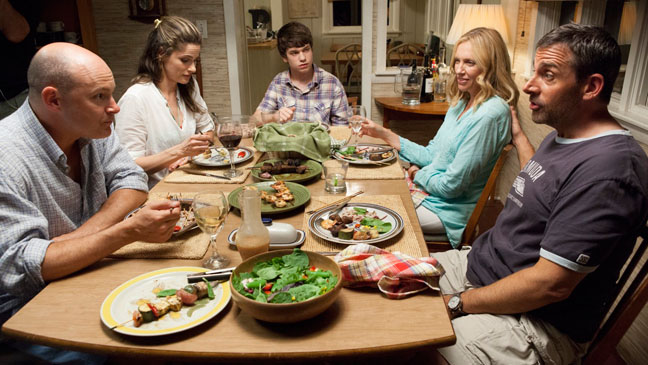
Fortunately for audiences, The Way, Way Back doesn’t follow Duncan into a downward spiral. Even better, it doesn’t follow him into a fairy tale happy ending. I wouldn’t call Duncan’s story “plausible,” but at least it leads him into unlikely relationships that give him reason for hope.
The first is literally the girl next door. Susanna, the attractive teen daughter of the flamboyant, tipsy beach house neighbor, seems to understand Duncan’s sadness. Instead of running away, Susanna moves toward him, reaches out, shows compassion. And the two find a bond of empathy and friendship… one that is almost too convenient.
Several things threaten to throw this film off-balance into wishful thinking, and Susanna’s affection for Duncan is at the top of that list. I was an awkward high-schooler, I’ve known a lot of awkward high-schoolers, and I never saw anything even remotely resembling this kind of heaven-sent crush reciprocation. Fortunately, both Duncan and Susanna are played with personality and persuasive sensitivity by newcomer Liam James and the frighteningly confident AnnaSophia Robb (Bridge to Terabithia, TV’s The Carrie Diaries).
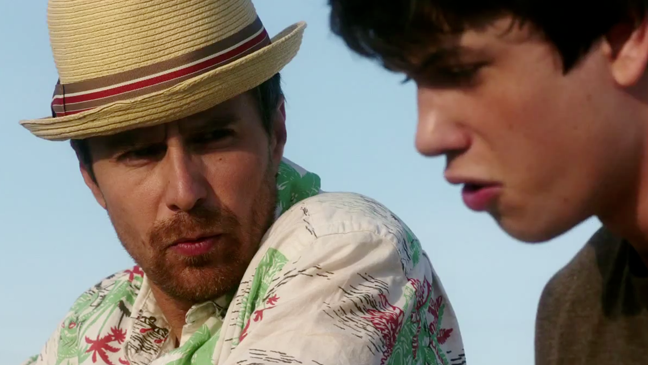
The second surprise friendship comes in the form of a middle-aged goofball named Owen. Owen’s greatest accomplishment is managing to hold down a job at the beachfront amusement park called Water Wizz. He’s lazy, quick-witted, immature, somewhat pessimistic, and yet surprisingly insightful when it comes to Duncan. He recognizes the hole in Duncan’s heart, and knows what to do. He steps in and gives him trustworthy, unconditional friendship. If Owen could overcome his own challenges instead of just worrying about Duncan’s, he might find a better future for himself. The park’s manager, played with tenderness by Maya Rudolph, is watching Owen closely, seeing potential in the man he might become.
For Duncan, Owen is a life-saver. But for the audience watching this movie, the actor who plays Owen makes this movie way, way worth the price of a ticket.
Sam Rockwell’s cocksure demeanor, his gonzo sense of timing, his devil-may-care grin (he really should play the Cheshire Cat someday), and his improvisational shtick have made him one of the most predictable big-screen presences in American movies. That’s not necessarily a bad thing. As with Robin Williams’ Tasmanian Devil hyperactivity, Charles Grodin’s sullen sarcasm, Jim Carrey’s Plastic-Man expressions, Will Ferrell’s man-child obliviousness, Jack Black’s brash madness, and Fred Willard’s wonderfully appalling impropriety, Rockwell’s comic personality is entirely his own. Inimitable. Hard to describe. Immediately recognizable.
Rockwell’s charisma is like the Colonel’s Secret Recipe — a mysterious chemistry that keeps people coming back, but also a brand that can get old fast if you have too much of it. Sometimes, when filmmakers throw talents like this into a mix as if they’ll automatically add value to the situation, the strategy backfires. Just as Rockwell’s personality can become a movie’s shining glory, it can also sink the picture if he doesn’t fit in. In Seven Psychopaths, I found Rockwell presence aggravating and his character poorly written. In Iron Man 2, his personality was just one of the film’s many gratuitous special effects. Let’s not talk about Cowboys and Aliens.
But when Rockwell goes to work on a well-written character, and is wisely directed, he can find real soul in even the most obnoxious character. In Galaxy Quest, he made so much out of so little, and it was a star-making turn. He did wonders with more substantial roles in Matchstick Men and The Assassination of Jesse James by the Coward Robert Ford. And he silenced his critics with a complex and brilliant performance in Moon, a film that he had to carry almost single-handedly.
But The Way, Way Back gives him what may be the character best-suited to his talents.
Owen is complicated. He’s a guy who could have easily soured with self-loathing over his failures, and turned bitter with disappointment at the dead-end of his life. But instead, he’s like the ideal class clown — he’s a likable joker without an ounce of bully in him. And, with humor and imagination, he makes the most of it, applying himself to improving life for everybody around him. He recognizes the need for others to take risks, get involved, and make something of themselves even in this unremarkable water park.
Owen is a great character. And I guess the highest compliment I can give Rockwell is that I believe in Owen so completely that I wouldn’t want to see anybody else in the role.
 It’s good that we meet him early in the movie. He very quickly provides a center for the film.
Don’t get me wrong — Liam James is just about perfect in the lead role. He makes Duncan convincingly sullen and insecure. We’ve all met some poor, disrespected adolescent who seems to have accepted the message from heartless adults that he’s good for nothing. Wisely, Paxon and Rash refrain from transforming Duncan from a depressed kid into a teen heartthrob. He’s the same awkward kid at the end that he was at the beginning, except for his posture, and for the spark of hope that has been lit inside of him. He started as a tangle of disappointment and self-doubt and anger, and under the influence of Owen’s surrogate fatherhood and Susanna’s almost inexplicable sweetness, he loosened up and straightened out. Duncan is one of the most believable teen characters I’ve seen in an American comedy.
But the fact that life has buried Duncan deep inside of himself means that somebody else has to bring the movie to life. Rockwell’s Owen works like magic.
And the rest of the cast ensure that every character is not only memorable, but human.
Steve Carell, in a role that expands our understanding of his powers, makes Trent almost insufferable — and yet, somehow, he ends up being more of a mess than a monster. That’s the work of a gifted actor.
Similarly, Allison Janney might have made Betty, Susanna’s perpetually intoxicated mother, intolerably zany. But Janney’s too good for that; she finds some wisdom within the flamboyance and escapism.
The film’s other prominent couple, Kip and Joan, played by Rob Corddry and Amanda Peet, could have been flat and forgettable. But you’ll believe in them, too, by the end.
The posters for The Way, Way Back boast that this film is “from the studio that brought you Little Miss Sunshine.” That may seem like a desperate bid for attention. But it’s not a bad reference, actually. Like Little Miss Sunshine, it shares countercultural insights about the pursuit of happiness, and its cast is like an accomplished gymnastics team, striking a perfect and complementary balance of drama and comedy that remains recognizably and gracefully human, never stumbling into mere sentimentality.
It doesn’t aim as high as Little Miss Sunshine did. (I’m still grateful for that movie’s hilarious conclusion, which exposed how America’s children are often exploited by self-centered parents and a celebrity-obsessed, sex-crazed culture.) But that’s okay. This film aims to tell a smaller story. I think it arrives at an impressively modest, understated, and encouraging conclusion.
Above all, it’s a blessing for those of us who would hope that 10-to-13-year-olds would have movies to see that focus on human beings instead of Transformers, superheroes, explosions, fart jokes, and spring breakers.
Buy tickets. Let’s make it the sleeper hit of the summer.
–
Writers and directors – Nat Faxon and Jim Rash; director of photography – John Bailey; editor – Tatiana S. Riegel; music – Rob Simonsen; production design – Mark Ricker; costumes – Ann Roth and Michelle Matland; producers – Kevin J. Walsh and Tom Rice. Starring – Steve Carell (Trent), Toni Collette (Pam), Allison Janney (Betty), AnnaSophia Robb (Susanna), Sam Rockwell (Owen), Maya Rudolph (Caitlin), Liam James (Duncan), Rob Corddry (Kip) and Amanda Peet (Joan). Fox Searchlight Pictures. 1 hour 43 minutes.
Previous Post

July 9, 2013
Five Must-See Movies of the Summer (Including "Stories We Tell")
Next Post

July 16, 2013 Why So Serious? Why, It's My Fifth Dark Knight-iversary!
Browse Our Archives
Select a Category Blog Bloggers on "Through a Screen Darkly" Browser Coming Soon Endorsements Fiction Books Film Forum Film Reviews Inspirations Interviews Journal Kindlings Muse Movie buzz Music Reviews Non-Fiction Books radio Reviewers on "Through a Screen Darkly" The Auralia Thread Through a Screen Darkly Through a Screen Darkly - Bonus Materials Top 10 (or 20 or 100) lists Uncategorized
Select a Month June 2015 May 2015 April 2015 March 2015 February 2015 January 2015 December 2014 November 2014 October 2014 September 2014 August 2014 July 2014 June 2014 May 2014 April 2014 March 2014 February 2014 January 2014 December 2013 November 2013 October 2013 September 2013 August 2013 July 2013 June 2013 May 2013 April 2013 March 2013 February 2013 January 2013 December 2012 November 2012 October 2012 September 2012 August 2012 July 2012 June 2012 May 2012 April 2012 March 2012 February 2012 January 2012 December 2011 November 2011 October 2011 September 2011 August 2011 July 2011 June 2011 May 2011 April 2011 March 2011 February 2011 January 2011 December 2010 November 2010 October 2010 September 2010 August 2010 July 2010 June 2010 May 2010 April 2010 March 2010 February 2010 January 2010 December 2009 November 2009 October 2009 September 2009 August 2009 July 2009 June 2009 May 2009 April 2009 March 2009 February 2009 January 2009 December 2008 November 2008 October 2008 September 2008 August 2008 July 2008 June 2008 May 2008 April 2008 March 2008 February 2008 January 2008 December 2007 November 2007 October 2007 September 2007 August 2007 July 2007 June 2007 May 2007 April 2007 March 2007 February 2007 January 2007 December 2006 November 2006 October 2006 September 2006 August 2006 July 2006 June 2006 May 2006 April 2006 March 2006 February 2006 January 2006 December 2005 November 2005 October 2005 September 2005 August 2005 July 2005 June 2005 May 2005 April 2005 March 2005 February 2005 January 2005 December 2004 November 2004 October 2004 September 2004 August 2004 July 2004 June 2004 May 2004 April 2004 July 2003 May 2003 March 2003 September 1999
Follow Us!
TAKE THE
Religious Wisdom Quiz
By questioning Moses' authority this person became leperous?
Select your answer to see how you score.
Ithamar Miriam Aaron Caleb
Related posts from Looking Closer

This Is Not Goodbye. But It is... See...



What Specialists Are Saying About Jurassic World
TRENDING AT PATHEOS Religious Music & Entertainment

"Les Diabolique" and Transgression
Alongside something like Arrival, Vertigo, or Charade, Les Diaboliques is a...

"The Plague Dogs" and Mortality
So, flashback to the late 70s, early 80s. Walt Disney Studios is...

With the recent and highly successful release of Christopher Nolan’s epic film,...

"L'avventura" and Human Weakness
Today's piece is going to be a little different for a few...

I first want to apologize for not posting or writing anything. I'm...

I've engaged in the multi-year project of reading through the Church Fathers,...
view all Religious Music & Entertainment blogs
Ad-Free & Subscriber Log-In Subscription Support
- About Us
- 2026 Calendar
- Videos
- Podcasts
- Library of World Religions
- Faith In Media Tracker
- Advertise With Us
- Write for Us
- Privacy Policy
- Terms of Service
- Do Not Sell My Data
- Contact Us
- Radiant Digital
- Manage Newsletter Subscriptions
- Unsubscribe From Notifications
- Sitemap
Copyright 2008-2026, Patheos. All rights reserved.
Subscription Support Ad-Free & Subscriber Log-In
Follow Patheos