
BuddhistCatholicContemplativeEvangelicalGeneral ChristianHinduJewishLatter-day SaintMuslimNew VisionsProgressive Christian
Beliefs
- Buddhist
- Catholic
- Contemplative
- Evangelical
- General Christian
- Hindu
- Jewish
- Latter-day Saint
- More Voices
- Muslim
- New Visions
- Pagan
- Progressive Christian
Topics
- Religion News
- Food and Religion
- Sports and Religion
- Religious Art
- Religious Music and Entertainment
- Religious Events
- History and Religion
- Style and Religion
- Politics and Religion
- Women in Religion
- Recreation Outdoors and Religion
- Business Finance and Religion
- Careers Workplace and Religion
- Education and Religion
- Family Parenting and Religion
- Health Fitness and Religion
- Home and Religion
- Relationships and Religion
- Technology and Religion
- Travel and Religion
Columnists
- Buddhist Columnists
- Business Finance and Religion Columnists
- Careers Workplace and Religion Columnists
- Catholic Columnists
- Contemplative Columnists
- Education and Religion Columnists
- Evangelists Columnists
- Family Parenting and Religion Columnists
- General Christian Columnists
- Health Fitness and Religion Columnists
- Hindu Columnists
- History and Religion Columnists
- Home and Religion Columnists
- Jewish Columnists
- More Voices Columnists
- Latter Day Columnists
- Muslim Columnists
- New Visions Columnists
- Nonreligious Columnists
- Pagan Columnists
- Politics and Religion Columnists
- Progressive Columnists
- Recreation Outdoors and Religion Columnists
- Relationships and Religion Columnists
- Religion News Columnists
- Religious Art Columnists
- Religious Events Columnists
- Religious Music and Entertainment Columnists
- Sports and Religion Columnists
- Style and Religion Columnists
- Technology and Religion Columnists
- Travel and Religion Columnists
- Women in Religion Columnists
Resource Library
- 2026 Calendar
- Library of World Religions
- The 100 Most Holy Places on Earth
- Patheos Answers
- Podcasts
- Videos
- Faith Leaders Database
- Anglican Episcopalian
- Bahai
- Baptist
- Buddhism
- Christianity
- Confucianism
- Eastern Orthodoxy
- Hinduism
- Holiness and Pentecostal
- ISKCON
- Islam
- Judaism
- Lutheran
- Methodist
- The Church of Jesus Christ of Latter-day Saints
- New Age
- Paganism
- Presbytarian and Reformed
- Protestantism
- Religion Behind the Scenes
- Roman Catholic
- Scientology
- Shia Islam
- Sikhism
- Sufism
- Sunni Islam
- Taoism
- Zen
- See all religions
Research Tools
 Ad-Free & Subscriber Log-In Subscription Support
Ad-Free & Subscriber Log-In Subscription Support
Follow Patheos 

- Trending:
- Forgiveness
- |
- Marriage
- |
- Consciousness
- |
- Death Penalty
- |
- Election
- |
- Halloween
 Looking Closer
- Home
- Religious Music & Entertainment
- What Do 2013’s Most Stylish Vampires Have in Common with Johnny Depp, Tom Waits, and Bill Murray?
What Do 2013’s Most Stylish Vampires Have in Common with Johnny Depp, Tom Waits, and Bill Murray?
Last updated on: June 2, 2013 at 9:21 pm by Jeffrey Overstreet
What Do 2013’s Most Stylish Vampires Have in Common with Johnny Depp, Tom Waits, and Bill Murray? 2013-06-02T21:21:46-06:00 Jeffrey Overstreet
Patheos Explore the world's faith through different perspectives on religion and spirituality! Patheos has the views of the prevalent religions and spiritualities of the world.
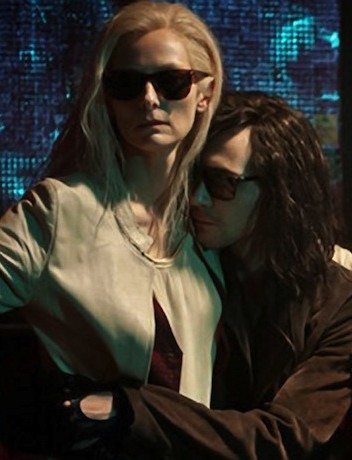 In a few months, vampires will prowl on the big screen again.
This may sound like unremarkable news. How many vampires have we seen on the big screen in recent years?
But these approaching vampires aren’t your ordinary bloodsuckers. Nor are they the sentimentalized, sparkle-chested fakes from Twilight land. Their names are Adam and Eve. They’re played by Tom Hiddleston (The Avengers, The Deep Blue Sea) and Tilda Swinton. They stirred up some rave reviews at the Cannes Film Festival in May. They rise from the imagination of one of my favorite filmmakers — Jim Jarmusch.
If you’re not familiar with Jarmusch, you can read my two-part study of his substance and style. Part One, “Jarmusch 101,” is here. Part Two, which is my review of The Limits of Control, is here.
You could also just dive in and watch his movies. I’d recommend that you start with my favorite — Down By Law — which stars John Lurie, Tom Waits, and Roberto Begnini as prisoners forced to share the same cell. The Criterion Collection edition is fantastic.
If you have Netflix Instant, you can also currently stream Ghost Dog: Way of the Samurai (with Forrest Whitaker), Coffee and Cigarettes (with Tom Waits, Jack White, Alfred Molina, Bill Murray, and Cate Blanchett), Dead Man (with Johnny Depp), and the bittersweet romantic comedy Broken Flowers (starring Bill Murray).
And here, for the first time on my own site, is my review of Broken Flowers. This review was originally published at Christianity Today back when the film opened in 2005.
–
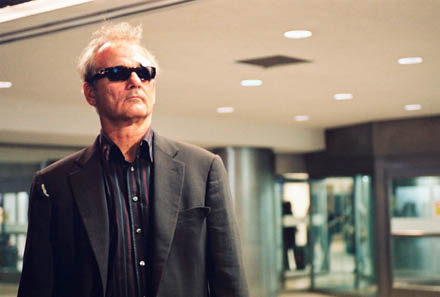
Bill Murray, under the direction of Jim Jarmusch, declares the beginning of the end of the summer season of blockbusters by delivering August’s first high-profile American art film: Broken Flowers.
It’s time, at last, to bring our focus back to films made for grownups … one that offers us three-dimensional human beings whose stories invite us to pay attention and think things through. Broken Flowers is a story about the deep sadness, regrets, and scars of a man who has neglected what some would call “family values.”
Don’t misunderstand — the movie is fun. Jarmusch will jolt you with big laughs, the sort that have earned him a loyal following through previous works like Stranger Than Paradise, Down by Law, and, most recently, Coffee and Cigarettes.
Don Johnston (Murray) made his money “in computers,” and yet money hasn’t bought him true love or joy. We’re given hints of his younger self — the nickname “Don Juan” follows him around more like a curse than an honor. His dalliances with various lovers ended in disappointment. When we meet him, his latest girlfriend Sherry (Julie Delpy) is, in fact, leaving. With Don’s face in profile filling the right side of the screen, we see Sherry standing with her suitcase in the entryway, as though inside a thought bubble — an echo of so many past departures. He’s left staring despondently past handsome furniture into oblivion, sullenly resigned to another failure.
Enter Winston (Jeffrey Wright), Don’s meddling neighbor. Winston’s a family man who has discovered “the Net” and is indulging his interest in detective work. Another director might have cast Luis Guzman in the role, and that would have worked. But Wright, a powerfully versatile actor who made strong impressions as a violent gangster in the re-make of Shaft and as the traumatized war veteran in the re-make of The Manchurian Candidate, plays Winston with note-perfect humor and an Ethiopian accent. Winston’s just dying for a mystery to solve, and Don unwittingly serves one up.
A pink envelope brings a shock to Don’s system: he’s apparently the father of an eighteen-year-old son. The letter isn’t signed. Don, being Don, responds by bravely digging another furrow across his brow. But Winston’s enthusiastic — near-hysterical — response involves a different kind of digging. Before Don can effectively protest, Winston gathers the tools necessary to solve the mystery.
Here, you’re likely to share Jarmusch’s tangible reluctance to tear Don away from Winston. Their casual chemistry is the film’s richest resource of humor and nerves. But the show must go on, and so we’re off on the Odyssey of Don: a trip down memory lane, the major points on the map being the current locations of his lost loves. Those failures are played by Sharon Stone, Frances Conroy, Jessica Lange, and Tilda Swinton.
Stone, making up for her embarrassing turn in Catwoman, is at once funny and painfully sad as Laura, a shallow but free-spirited widow and the mother of a dangerously ditzy teen. Appropriately named Lolita (Alexis Dziena), the daughter’s eagerness to full-frontally flaunt her adolescent comeliness for Don is the primary reason for the film’s rating.
Dora (Conroy) has entombed her regrets in a pile of stylish throw pillows and pristine home furnishings, her ’60s ideals lost in a superficial marriage and a career as a pre-fab home seller.
Exquisitely strange, Carmen (Lange), guarded by a venomous and psychotically overprotective secretary (Chloe Sevigny, of course), has the most unusual occupation — that’s best kept as a surprise.
And as a monster spewing bile and bitterness, Tilda Swinton is so scary, it’s hard to imagine she’ll be any more dangerous when she plays Narnia’s White Witch.
Each encounter reveals more of the history behind Don’s defeated demeanor. And, during another visit, in a scene of rain, bruises, and defeat, Murray breaks our heart with an expression that may be the most affecting moment of his career.
Broken Flowers is the reverse of Murray’s zany classic Groundhog Day. In Harold Ramis’s comedy, Murray got to relive the same day over and over, behaving differently while circumstances and surroundings stayed put. Here, his surroundings keep changing, but he maintains the same reluctance and stoicism throughout, so beleaguered by his mistakes that he can’t muster the energy to pursue a thing.
To regular moviegoers, it will feel like an art film; to art house patrons, it will feel mainstream. They’ll both be right. It’s a film that follows a simple storyline, and yet seizes every opportunity to turn a cliché into something slightly dissatisfying, slightly sour, with deep emotions and complicated thoughts running in barely perceptible currents under the sparse dialogue. With the help of Frederick Elmes’ graceful cinematography, Jarmusch is a true artist who never steers matters toward an obvious lesson, inviting us to arrive at our own interpretations.
But it is interesting that the only glimmers of real joy in the film can be found in Winston’s thriving family. During Don’s four-city tour, he finds former flames in various phases of dissatisfaction or delusion. Glamour? It fades and reveals the emptiness beneath it. Success? It’s no substitute for contentment. New Age hocus-pocus? Yikes. The continual misapprehensions of Don’s real name (“Don Johnson?”) bring to mind a popular ideal of the stylish, confident American male. This, we might conclude, is where the path of the macho seducer ultimately leads — to ruin, regret, and rumination on what might have been. Don’s journey peels back the surface of so many American dreams to find them wanting, while Winston, dodging his kids and doting on his “perfect” wife, seems as rich as a king.
Broken Flowers has only one thing working against it: Murray’s been playing sullen, withdrawn characters a bit too often. The fact that we’ve recently seen him sulk through Rushmore, The Royal Tenenbaums, Lost in Translation (still his finest performance), and The Life Aquatic with Steve Zissou (another film about a man discovering fatherhood too late), blunts the impact of this, another brilliant performance.
Nevertheless, Broken Flowers‘ conclusion will send audiences out talking about what it means. But take note: Only the watchful will perceive the subtle significance of that final shot. It finally resolves the central tension of the story. Some critics are missing it, concluding that Don is doomed to the doldrums of disillusionment. But there is a crucial difference in the “hero” during our final, poignant glimpse of him. To say more would be telling, but it could be the key to his redemption.
So, do the film’s fleeting moments of explicit content make it entirely unacceptable? That’s for each viewer and their conscience to decide. Mature viewers who give Broken Flowers a chance may find themselves refreshed by a movie that invites them to ponder their own regrets and to contemplate the possibility of redemption and grace. That’s a nice change from films that treat us like thrill-seeking children (Michael Bay’s Island, anyone?). Where Hitchcock insisted his films were not slices of life, but slices of cake, Jarmusch’s are savory servings of life, and they deserve to be treated as delicacies.
Previous Post

May 28, 2013
Indiana Jones and the Kingdom of the Crystal Skull (2008)
Next Post
June 1, 2013 Want to Go to Jerusalem with Benedict Cumberbatch?
Browse Our Archives
Select a Category Blog Bloggers on "Through a Screen Darkly" Browser Coming Soon Endorsements Fiction Books Film Forum Film Reviews Inspirations Interviews Journal Kindlings Muse Movie buzz Music Reviews Non-Fiction Books radio Reviewers on "Through a Screen Darkly" The Auralia Thread Through a Screen Darkly Through a Screen Darkly - Bonus Materials Top 10 (or 20 or 100) lists Uncategorized
Select a Month June 2015 May 2015 April 2015 March 2015 February 2015 January 2015 December 2014 November 2014 October 2014 September 2014 August 2014 July 2014 June 2014 May 2014 April 2014 March 2014 February 2014 January 2014 December 2013 November 2013 October 2013 September 2013 August 2013 July 2013 June 2013 May 2013 April 2013 March 2013 February 2013 January 2013 December 2012 November 2012 October 2012 September 2012 August 2012 July 2012 June 2012 May 2012 April 2012 March 2012 February 2012 January 2012 December 2011 November 2011 October 2011 September 2011 August 2011 July 2011 June 2011 May 2011 April 2011 March 2011 February 2011 January 2011 December 2010 November 2010 October 2010 September 2010 August 2010 July 2010 June 2010 May 2010 April 2010 March 2010 February 2010 January 2010 December 2009 November 2009 October 2009 September 2009 August 2009 July 2009 June 2009 May 2009 April 2009 March 2009 February 2009 January 2009 December 2008 November 2008 October 2008 September 2008 August 2008 July 2008 June 2008 May 2008 April 2008 March 2008 February 2008 January 2008 December 2007 November 2007 October 2007 September 2007 August 2007 July 2007 June 2007 May 2007 April 2007 March 2007 February 2007 January 2007 December 2006 November 2006 October 2006 September 2006 August 2006 July 2006 June 2006 May 2006 April 2006 March 2006 February 2006 January 2006 December 2005 November 2005 October 2005 September 2005 August 2005 July 2005 June 2005 May 2005 April 2005 March 2005 February 2005 January 2005 December 2004 November 2004 October 2004 September 2004 August 2004 July 2004 June 2004 May 2004 April 2004 July 2003 May 2003 March 2003 September 1999
Follow Us!
TAKE THE
Religious Wisdom Quiz
What structure did humans try to build to reach the heavens, leading God to scatter them?
Select your answer to see how you score.
Great Pyramid Golden Calf Temple of Solomon Tower of Babel
Related posts from Looking Closer

This Is Not Goodbye. But It is... See...


What Specialists Are Saying About Jurassic World

Torres and the Influence of David Bazan and...
TRENDING AT PATHEOS Religious Music & Entertainment

"Les Diabolique" and Transgression
Alongside something like Arrival, Vertigo, or Charade, Les Diaboliques is a...

"The Plague Dogs" and Mortality
So, flashback to the late 70s, early 80s. Walt Disney Studios is...

With the recent and highly successful release of Christopher Nolan’s epic film,...

"L'avventura" and Human Weakness
Today's piece is going to be a little different for a few...

I first want to apologize for not posting or writing anything. I'm...

I've engaged in the multi-year project of reading through the Church Fathers,...
view all Religious Music & Entertainment blogs
Ad-Free & Subscriber Log-In Subscription Support
- About Us
- 2026 Calendar
- Videos
- Podcasts
- Library of World Religions
- Faith In Media Tracker
- Advertise With Us
- Write for Us
- Privacy Policy
- Terms of Service
- Do Not Sell My Data
- Contact Us
- Radiant Digital
- Manage Newsletter Subscriptions
- Unsubscribe From Notifications
- Sitemap
Copyright 2008-2026, Patheos. All rights reserved.
Subscription Support Ad-Free & Subscriber Log-In
Follow Patheos