
BuddhistCatholicContemplativeEvangelicalGeneral ChristianHinduJewishLatter-day SaintMuslimNew VisionsProgressive Christian
Beliefs
- Buddhist
- Catholic
- Contemplative
- Evangelical
- General Christian
- Hindu
- Jewish
- Latter-day Saint
- More Voices
- Muslim
- New Visions
- Pagan
- Progressive Christian
Topics
- Religion News
- Food and Religion
- Sports and Religion
- Religious Art
- Religious Music and Entertainment
- Religious Events
- History and Religion
- Style and Religion
- Politics and Religion
- Women in Religion
- Recreation Outdoors and Religion
- Business Finance and Religion
- Careers Workplace and Religion
- Education and Religion
- Family Parenting and Religion
- Health Fitness and Religion
- Home and Religion
- Relationships and Religion
- Technology and Religion
- Travel and Religion
Columnists
- Buddhist Columnists
- Business Finance and Religion Columnists
- Careers Workplace and Religion Columnists
- Catholic Columnists
- Contemplative Columnists
- Education and Religion Columnists
- Evangelists Columnists
- Family Parenting and Religion Columnists
- General Christian Columnists
- Health Fitness and Religion Columnists
- Hindu Columnists
- History and Religion Columnists
- Home and Religion Columnists
- Jewish Columnists
- More Voices Columnists
- Latter Day Columnists
- Muslim Columnists
- New Visions Columnists
- Nonreligious Columnists
- Pagan Columnists
- Politics and Religion Columnists
- Progressive Columnists
- Recreation Outdoors and Religion Columnists
- Relationships and Religion Columnists
- Religion News Columnists
- Religious Art Columnists
- Religious Events Columnists
- Religious Music and Entertainment Columnists
- Sports and Religion Columnists
- Style and Religion Columnists
- Technology and Religion Columnists
- Travel and Religion Columnists
- Women in Religion Columnists
Resource Library
- 2026 Calendar
- Library of World Religions
- The 100 Most Holy Places on Earth
- Patheos Answers
- Podcasts
- Videos
- Faith Leaders Database
- Anglican Episcopalian
- Bahai
- Baptist
- Buddhism
- Christianity
- Confucianism
- Eastern Orthodoxy
- Hinduism
- Holiness and Pentecostal
- ISKCON
- Islam
- Judaism
- Lutheran
- Methodist
- The Church of Jesus Christ of Latter-day Saints
- New Age
- Paganism
- Presbytarian and Reformed
- Protestantism
- Religion Behind the Scenes
- Roman Catholic
- Scientology
- Shia Islam
- Sikhism
- Sufism
- Sunni Islam
- Taoism
- Zen
- See all religions
Research Tools
 Ad-Free & Subscriber Log-In Subscription Support
Follow Patheos 

- Trending:
- Advent
- |
- Forgiveness
- |
- Thanksgiving
- |
- Election
- |
- Seasonal Holidays
- |
- Marriage
 Looking Closer
- Home
- Religious Music & Entertainment
- Monsters University: Bonus Question – Are These Monsters Dangerous?
Monsters University: Bonus Question – Are These Monsters Dangerous?
Last updated on: June 26, 2013 at 8:48 pm by Jeffrey Overstreet
Monsters University: Bonus Question – Are These Monsters Dangerous? 2013-06-26T20:48:05-06:00 Jeffrey Overstreet
Patheos Explore the world's faith through different perspectives on religion and spirituality! Patheos has the views of the prevalent religions and spiritualities of the world.
 If you read my review of Monsters University, you know that I liked it.
But I hope that wasn’t enough for you. I hope you don’t stop there. I didn’t.
I went on to read reviews by Matt Zoller Seitz and Steven Greydanus. One increased my appreciation of the movie, and the other helped me see its strengths and weaknesses more clearly.
And then another review aggravated this lifelong lover of monsters.
Matt Zoller Seitz, who has stepped into Roger Ebert’s enormous shoes at RogerEbert.com, strikes back at cynics with a powerful appreciation of the movie:
Sully and Mike are such richly-drawn individuals, so fully imagined in terms of psychology, body language and vocal performance, that they feel more “real” than the live-action heroes in almost any current summer blockbuster you can name. This is a specific Pixar talent, and for all the goodwill that the company has generated over the years, they still don’t get enough credit for it.
…
“Monsters University” is the sort of film that’s easy to undervalue. It’s not deep, nor is it trying to be, but its goals are numerous and varied, and it achieves every of them with grace. …
The script is filled with lines that are quotable not just because they’re funny (though many are) but because they’re wise…. My former colleague Manohla Dargis was right to object to Pixar’s decision to tell yet another guy-centric story after releasing the quietly revolutionary “Brave” — but considering the warmth and intelligence radiating from every frame of this film, it’s far from a dealbreaker. There’s a decency and lightness of spirit to “Monsters University” which, in a time of tediously “dark” and “gritty” entertainment, is as bracing as a cannonball-dive into a pool on a hot summer’s day.
And then Steven Greydnaus writes,
There are clever touches throughout and at least one solid, subversive idea that is vintage Pixar.
That one idea flies in the face of countless Hollywood films, both animated and otherwise. Hollywood is always telling us that if you want anything badly enough, you can achieve it; just believe in yourself, and you can accomplish anything you set your mind to.
In a way, Pixar has been pouring cold water on this idea ever since Buzz Lightyear came crashing to Earth despite his deep need to believe that he could fly. Perhaps everyone is special, and anyone can cook — but real superpowers, or the makings of a great chef, are a gift that not everyone has. On this theme, Pixar remains true to its school.
Well, kind of. Monsters University acknowledges that not every monster is cut out for scaring — but this hard truth isn’t consistently applied to a number of cuddly, obviously unscary monsters who wind up making the grade against all odds.
But another review prompted me to add a “Bonus Question” to my own Monsters University Test Questions.
I meant to include the Bonus Question in my review, but then I decided that the Bonus Question was rather tangential, leading us into questions that are much bigger than the central subjects of Pixar’s whimsical movie.
So I’m giving this question its own post.
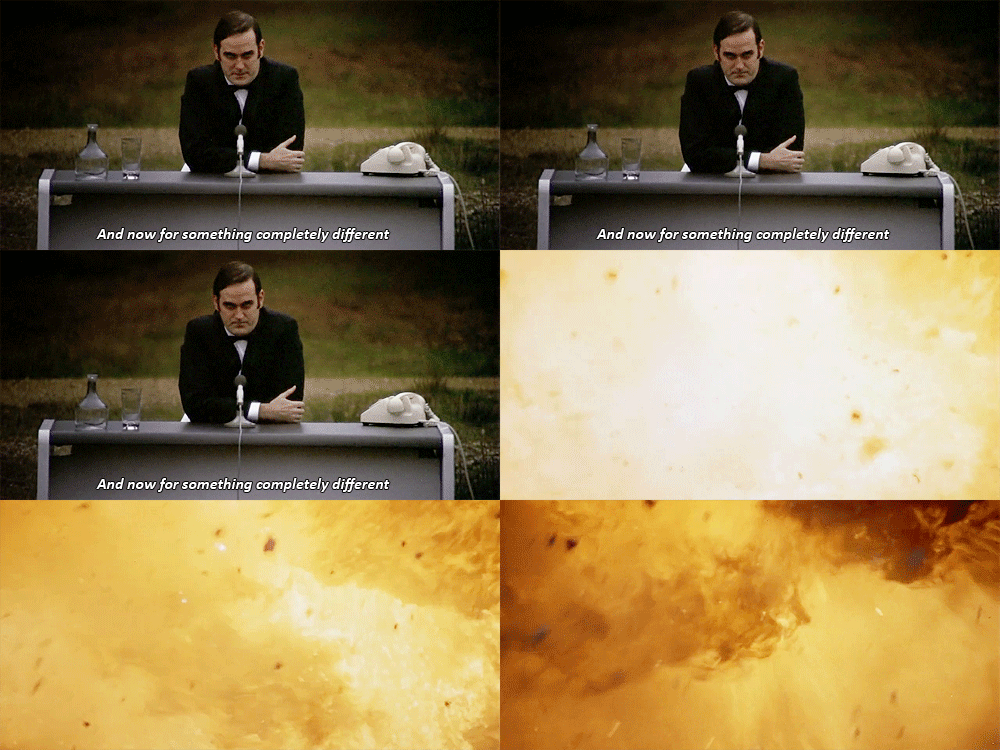
BONUS QUESTION:
Packed with monsters of all sizes and shapes, Monsters University is
A. too scary for children.
B. dangerous for children, because monsters should be portrayed as evil, not endearing.
C. good, because it encourages kids to start saving now for paying off their student loans.
D. meaningful, because it encourages young people to pursue their dreams, and to do so with humility, with hard work, with integrity, and with an uncompromising commitment to honesty.
ANSWER: D.
EXPLAIN:
I’m compelled to write about this in response to another reviewer, who argued something very close to “B.”
Timothy Wainwright at Christianity Today writes:
The Monsters films, while funny and cute, aren’t fairy tales. There is no hero, and no villain, in Monsters University. In fact, the villains of fairy tales become the heroes of this film. Thus it teaches kids not that the night is dark and full of terrors, but that it is dark and full of adorable fuzzy things.
By making monsters adorable, Monsters University destroys the meaning of the word monster. And the wisdom of tradition and faith, which remind us that bad things are very real, tells us that children must know the meaning of that word.
For the adults who wrote the film and the parents who will go to see it—grown-ups who have enough perspective to recognize the value of internal struggles and tragic flaws—the “monsters” theme is a clever device. But the question remains: is it the best thing for the moral formation of a child?
When you go see Monsters University, you might want to leave the kids at home.
While I appreciate Wainwright’s desire to look out for the children, I can’t agree with his conclusions.
Here are four reasons why.
1.
First of all… regarding Wainwright’s claim that “There is no hero, and no villain, in Monsters University. In fact, the villains of fairy tales become the heroes of this film.”
That’s a contradiction. If there are no heroes or villains, how can the ‘villains of fairy tales’ become ‘the heroes of this film’?
Whatever the case, who cares? Does a children’s story need a villain? Does it need a hero?
I didn’t see “heroes and villains” in this film. I saw monsters who represent the kinds of people students may encounter in college. Some are bullies, some are cowards, some are brainiacs, some are prodigies, some are leaders, some are followers. And that’s fine.
Villains can be an important part of storytelling, but some of the most meaningful stories of my childhood had no villains at all. In fact, some of the most important were stories that took my expectation of a villain and turned that upside, making me learn not to see the world as divided into “good guys” and “bad guys.”
And my commitment to following Jesus Christ compels me to realize that all human beings are “bad guys” to one degree or another, and when we start dividing ourselves into “the good guys” (us) and “the bad guys” (others), we are on the road to becoming monsters ourselves.
2.
Second, sure — Monsters University does not teach children that the night is dark and full of terrors.
What kind of movie teaches children to be afraid of the dark?
A meaningful children’s story will teach them that, yes, there are some scary and dangerous monsters out there, and we should live with discernment and wisdom. But no, we shouldn’t live in fear.
Sometimes, whether we stumble into the shadows or venture there with good intentions, we find good things there.
And, as Jesus taught, and as The Lord of the Rings echoed him, we should approach even the most monstrous among us with compassion, or else… again… we become monstrous ourselves.
3.
Furthermore — stories that teach children to recognize bad monsters by making snap judgments based on appearance and personality are preparing kids for a lifetime of hasty judgments based on first impressions.
Even in the Scriptures, we find symbols of the satanic and the dangerous turned upside down to represent the good and the redemptive. Consider the lion. The devil is a lion, right? He’s out there prowling… seeking whom he may devoir. But the lion is also a sign of God himself, and specifically, a sign of Jesus. The lion of Judah.
Were the prophets and poets of scripture irresponsible to suggest that a lion is anything more than a dangerous, man-eating predator? I don’t think so.
And who, in the scriptures, seems more monstrous than Saul, the mass-murderer of Christians? Still, we revere the Apostle Paul because God used even a monster like him, redeeming him and transforming him. Paul would always confess that he was the chiefest among sinners, but this was an occasion for God to show that the world is not divided into black-and-white camps.
4.
It is true that, in mythology, monsters are, essentially, representative of disorder, of brokenness, and, sometimes, of evil. The concept of monsters is important in child development for helping children give shape to their fears, learn to have courage when facing them, learn to overcome them, and most importantly, learn to avoid becoming one.
But it is also important to recognize that monsters are useful for other purposes as well. Kids tend to love monsters and even become attached to some of them because they know, on some level, that we are all a little monstrous, and we need to be honest about it and show come compassion and patience toward one another.
That’s why kids love Grover and Cookie Monster on Sesame Street and the Great Gonzo and Animal on The Muppet Show. That’s why children who are lucky enough to discover Hayao Miyazaki’s My Neighbor Totoro and Spirited Away fall in love with some of the monsters there.
Moreover, some of the wisest stories are about learning that characters who seem monstrous at first glance might be more than meets the eye. Frankenstein, for example. .
Some even wiser stories encourage us to consider the possibility that a monster might not be doomed to behaving like one, but might even been transformed. Consider various renditions of “Beauty and the Beast,” in which the monster is shown grace and love, and is transformed. Consider “The Selfish Giant.” Consider “How the Grinch Stole Christmas,” in which the mysterious grace of Christmas redeems an ugly devil… even though the transformation is internal, not external.
Finally…
I’ll leave you with this exchange, which took place in my Facebook correspondence last week:
QUESTION:
I finally watched Beauty and the Beast from 1946, and while I was absolutely enchanted by most of it, [SPOILER ALERT] the ending just hasn’t been able to connect with me.Frankly, I was more than a little disappointed, and it seemed like Belle’s character was as well.. yet the film still went with a Happily Ever After vibe despite the disappointment.
Am I missing something? Was I expecting something that I shouldn’t have been, thus leading to crushed expectations?
MY REPLY:
I think that the ending of “Beauty and the Beast” is almost always disappointing… whether it’s Jean Cocteau or Disney or something more recent like “Warm Bodies.”I think it’s because we relate to, sympathize with, and care about the Beast. We love him: his rough textures, his pathetic ego, his potential to do damage, the way he is enchanted by beauty. When the beast is redeemed, there is some measure of relief, but at the same time, no storyteller, no story can persuasively portray a fully redeemed character in a way that we can understand.
When this movie first played in 1946, it is said (this story may not actually be true, but it “rings true”) that one of the special guests in the audience — it may have been Marlene Dietrich or Greta Garbo — cried out in the closing scene, “What have you done with my Beast?” On some level, we broken human beings are so well-acquainted with being monsters that the vision of a “restored human being” just doesn’t connect with us. How do you show an internal redemption? Unless you go about showing us a remarkable change in behavior, you can’t. And the movie doesn’t even try.
What does this have to do with Monsters University?
Pixar’s Monsters world is, like the world of The Muppets, Sesame Street, the films of Hayao Miyzaki, and Norton Juster’s The Phantom Tollbooth, a world in which characters take on all kinds of appearances that often tell us things about their personalities, their challenges, and their true nature. Some of them turn out to be truly “monstrous” in character as well as appearance. And yet, we connect with them because, in their myriad variations, they remind us of how all of us are weird and strange and funny and surprising and broken.
And it feels right when some of them end up proving themselves to be just as disordered as they appear to be.
It also feels right when some of them prove to be better than that, or worth loving even if they’re disordered, broken, dangerous, and yes… scary.
Previous Post

June 22, 2013
Star Trek Into Heartlessness
Next Post

June 28, 2013 Happy 5th Birthday, WALL•E!
Browse Our Archives
Select a Category Blog Bloggers on "Through a Screen Darkly" Browser Coming Soon Endorsements Fiction Books Film Forum Film Reviews Inspirations Interviews Journal Kindlings Muse Movie buzz Music Reviews Non-Fiction Books radio Reviewers on "Through a Screen Darkly" The Auralia Thread Through a Screen Darkly Through a Screen Darkly - Bonus Materials Top 10 (or 20 or 100) lists Uncategorized
Select a Month June 2015 May 2015 April 2015 March 2015 February 2015 January 2015 December 2014 November 2014 October 2014 September 2014 August 2014 July 2014 June 2014 May 2014 April 2014 March 2014 February 2014 January 2014 December 2013 November 2013 October 2013 September 2013 August 2013 July 2013 June 2013 May 2013 April 2013 March 2013 February 2013 January 2013 December 2012 November 2012 October 2012 September 2012 August 2012 July 2012 June 2012 May 2012 April 2012 March 2012 February 2012 January 2012 December 2011 November 2011 October 2011 September 2011 August 2011 July 2011 June 2011 May 2011 April 2011 March 2011 February 2011 January 2011 December 2010 November 2010 October 2010 September 2010 August 2010 July 2010 June 2010 May 2010 April 2010 March 2010 February 2010 January 2010 December 2009 November 2009 October 2009 September 2009 August 2009 July 2009 June 2009 May 2009 April 2009 March 2009 February 2009 January 2009 December 2008 November 2008 October 2008 September 2008 August 2008 July 2008 June 2008 May 2008 April 2008 March 2008 February 2008 January 2008 December 2007 November 2007 October 2007 September 2007 August 2007 July 2007 June 2007 May 2007 April 2007 March 2007 February 2007 January 2007 December 2006 November 2006 October 2006 September 2006 August 2006 July 2006 June 2006 May 2006 April 2006 March 2006 February 2006 January 2006 December 2005 November 2005 October 2005 September 2005 August 2005 July 2005 June 2005 May 2005 April 2005 March 2005 February 2005 January 2005 December 2004 November 2004 October 2004 September 2004 August 2004 July 2004 June 2004 May 2004 April 2004 July 2003 May 2003 March 2003 September 1999
Follow Us!
TAKE THE
Religious Wisdom Quiz
What Christian group believes in "baptism by immersion only"?
Select your answer to see how you score.
Presbyterians Catholics Lutherans Baptists
Related posts from Looking Closer

This Is Not Goodbye. But It is... See...

What Specialists Are Saying About Jurassic World
TRENDING AT PATHEOS Religious Music & Entertainment

A Christian, a Narnia Fan, and a Filmmaker...
Watching The Narnia Trailer As A Fan And A Filmmaker Ever since...

Great Spiritual Horror Films of the 20th Century...
For the Christian, horror movies are often troubling—and many would say that...

"Les Diabolique" and Transgression
Alongside something like Arrival, Vertigo, or Charade, Les Diaboliques is a...

"The Plague Dogs" and Mortality
So, flashback to the late 70s, early 80s. Walt Disney Studios is...

With the recent and highly successful release of Christopher Nolan’s epic film,...

"L'avventura" and Human Weakness
Today's piece is going to be a little different for a few...
view all Religious Music & Entertainment blogs
Ad-Free & Subscriber Log-In Subscription Support
- About Us
- 2026 Calendar
- Videos
- Podcasts
- Library of World Religions
- Faith In Media Tracker
- Advertise With Us
- Write for Us
- Privacy Policy
- Terms of Service
- Do Not Sell My Data
- Contact Us
- Radiant Digital
- Manage Newsletter Subscriptions
- Unsubscribe From Notifications
- Sitemap
Copyright 2008-2026, Patheos, part of the Radiant Digital network of media brands. All rights reserved.
Subscription Support Ad-Free & Subscriber Log-In
Follow Patheos